
FUEL ONLINE / Bankruptcy Law Firms / SEO
Bankruptcy lawyer SEO: Search Strategy

Bankruptcy firms need local matters that fit their chapter, jurisdiction, and case threshold, not calculators, creditor requests, or unrelated legal questions. Fuel maps searches such as 'Chapter 7 attorney in Worcester' to focused service, location, process, proof, and comparison pages, while treating 'bankruptcy calculator spreadsheet' as different intent. The bankruptcy lawyer SEO work also fixes indexation and internal-link gaps and produces evidence-backed briefs. Reporting connects search visibility with accepted bankruptcy consultations, not traffic or rankings in isolation.
Jurisdiction and accepted matter type; Consumer versus business representation; Consultation availability and process; Conflict screening and firm acceptance criteria
Compare bankruptcy lawyer SEO through educational and practice resources
Choose a bankruptcy lawyer SEO agency by comparing the customer questions its proposed resources will answer. A useful organic-search plan distinguishes education, offered practice information, professional identity and administrative contact. Each resource should have a clear role and an understandable relationship with the others. The practical agency comparison is whether the plan improves those answers and the paths between them, rather than simply increasing the page count or repeating a practice phrase across multiple destinations.
Assign a question to each resource
Start with an inventory of the actual site. For each important resource, record its principal reader question, the firm information supporting the answer and the next relevant destination. Ask the agency to identify which answers already have a suitable home and which useful gaps remain. This makes a revision proposal comparable with an expansion proposal. Both can be appropriate, but each should describe a distinct improvement to the reader's understanding rather than treating every new query variation as a reason for another page.
Practice pages describe the firm's offered services using information the firm supplies. Educational resources explain topics using the professional material selected for publication. A biography establishes a person's published role, and a contact destination explains an administrative route. Ask the agency to show how those meanings stay separate while supporting a coherent reading path. A reader should not have to infer the firm's service scope from a general article or search several disconnected pages to find the relevant contact explanation.
A query-to-resource map is useful when it records the question behind the wording. Several phrases may express the same need, while similar phrases can lead to different tasks. Ask the agency to demonstrate this distinction with a sample practice question and an educational question. The deliverable should explain which resource answers each and what information it needs. That gives the firm a meaningful editorial decision rather than a spreadsheet that assigns every phrase to a new destination without examining the actual reader task.
| Resource decision | Evidence required | Useful acceptance point |
|---|---|---|
| Practice resource | A distinct firm-supplied service explanation and its relationship with existing descriptions. | A separate page answers a real reader question rather than duplicating the same scope. |
| Educational resource | The professional material, references and illustrative context supporting the explanation. | A summary and its linked full resource retain the same meaning and scope. |
| Location resource | The actual office or geographic information that justifies the destination. | The page provides meaningful context without implying an unsupported office or service relationship. |
| Professional context | A maintained biography and the resources that depend on its published role information. | Another editor can identify which descriptions need review when that central fact changes. |
Earn separate practice and location pages
Separate practice resources need distinct scope. If the agency proposes an additional page, ask what firm-supplied information makes it useful beside the existing description. The answer should identify a real difference the reader needs to understand, not merely a different heading. The firm's professional team can decide which distinctions accurately describe its published offering. The agency can organize that information and connect the resources without inventing legal rules or presenting a general explanation as advice for an individual situation.
Location resources need an equally clear reason to exist. Ask which actual office or geographic practice information supports the proposed page and how it relates to the central firm description. A location name should not create an impression of a new office or a universal service arrangement. A useful proposal explains what the firm can say about that place, what the reader gains from a separate resource and how the resource will remain connected with current professional and contact information.
Compare two possible plans for local expansion. One produces multiple versions of the same paragraph with different place names. Another first identifies the actual location facts, the questions the firm can answer and the resources already covering those questions. The second gives the buyer clearer acceptance decisions even if it recommends fewer pages. The point is not a universal preference for consolidation. It is whether each proposed destination has a specific information role that the firm can supply and maintain accurately.
Educational content should retain its original scope as it enters the organic resource map. Ask the agency how references, illustrative context and professional review relationships remain visible after a rewrite or navigation change. A short summary can lead to the full explanation, but it should not silently change what the original material means. The firm should be able to inspect the relationship between the introductory passage and the supporting resource rather than having to judge the new page as an isolated block of promotional text.
Connect educational context with firm information
Professional biographies should be connected where they genuinely help the reader understand the published resource or practice. Ask which biography provides the current role information and how a changed title or association would reach dependent descriptions. The agency's map should identify these relationships. A biography link placed indiscriminately on every page is less useful than a clear explanation of why that professional context belongs to the reader's task and which source maintains the underlying fact.
Internal navigation can be accepted through a reading exercise. Begin with an educational question, follow the relevant resource to the offered practice description and then find the firm's established contact route. Repeat the exercise starting from a professional biography. Ask someone unfamiliar with the site to explain what each page contributes. The exercise tests whether the organic information structure works for a person, rather than checking only whether a set of internal links exists in the source.
The technical scope should connect implementation tasks with the resource being improved. Ask the agency to show a sample issue, the affected destination, the responsible supplier and the completed check. The example should explain what changed for access or navigation without implying that one technical adjustment guarantees a search position. This makes implementation work easier to compare and keeps it connected with the actual website rather than leaving the buyer with a generic checklist unrelated to the resources under review.
A content dependency register helps preserve coherence after release. A revised practice description, changed biography or updated contact destination can affect several pages. Ask the agency to identify which resources depend on those facts and who maintains the central source. The register should be usable by another editor. Its practical value is the ability to find affected resources during an ordinary future change, not merely the existence of a document described as a governance deliverable in the proposal.
Make the resource map maintainable
Reporting should identify completed work in the same resource terms. Which page changed, which reader question is clearer and what observation helped choose the next task? Ask for a worked example that separates a measured discovery observation from the editorial or technical action delivered. This makes an ongoing roadmap easier to review without requiring a guaranteed traffic forecast. The firm can decide whether the next task addresses a real information gap or repeats an answer that already has a suitable home.
For the first release, choose a bounded group of related resources rather than an unqualified volume target. The scope might connect a practice explanation, a selected educational resource, a biography and the current contact route. Specify the supplied information and the reading tests used to accept the work. The next release can then follow from an identified gap in the map. This creates a practical sequence for building useful organic coverage around the firm's actual published information.
At the final comparison, ask every agency to walk through the same question and show the resources it would improve. The more useful scope explains why each destination exists, what supports its content and how it connects with the next reader task. A bankruptcy SEO engagement can then be assessed through concrete information improvements and maintained relationships, while educational material, firm identity and individual professional conversations retain their separate purposes throughout the website.
For a concrete resource comparison, ask each agency to take one educational question and one practice-selection question through its proposed map. The exercise should identify the principal answer, the supporting professional context and the appropriate next destination. If both questions are assigned to the same resource, ask how the page maintains their distinct meanings. If they receive separate resources, ask what information makes each one useful. This reveals the editorial reasoning behind the proposed architecture without assuming that expansion or consolidation is inherently the better choice for every part of the site.
Then review a proposed location resource using only facts supplied by the firm. Ask which paragraph explains a real geographic relationship, which existing resource supports it and what the reader gains from a separate destination. If the useful information is already covered clearly elsewhere, the agency can explain why a navigation improvement may serve the reader better than another page. If distinct information exists, it can show how the new resource will be maintained. The buyer can compare these alternatives through actual information value rather than a promised number of local pages.
A future-edit exercise makes the resource map testable. Change a professional role in a biography and ask another editor to identify dependent practice introductions, educational references and related navigation. Some resources may need a revised statement while others only need their link checked. The agency should explain that difference. This tests whether the map records the actual relationship between sources, not merely that two pages are connected. It also gives the firm practical maintenance knowledge that remains useful after the initial organic-search release has been delivered.
For the ongoing roadmap, ask for a sample task written as a reader problem and a specific resource improvement. An educational introduction may need clearer context, a practice page may need an accurate connection to professional information or a contact link may need a more descriptive label. Each task should identify its source material and acceptance exercise. This leaves the firm with a way to compare proposed work against the information already on the site. It also prevents a recurring schedule from becoming a list of new page titles whose distinct purpose has never been established.
For the related firm-wide scope, explore bankruptcy law marketing.
AGGRESSIVE FROM THE START
One month. The work many agencies stretch across three.
Our mandate: move faster, go deeper and put experienced specialists to work immediately.
Fuel attacks the work in parallel: site audits, technical errors, new content, internal links, backlink outreach and conversion improvements. Your agreed scope determines the channels; urgent fixes do not wait behind a drawn-out planning phase.
The bankruptcy lawyer SEO brief identifies visibility and lead barriers. Actionable fixes move into production while deeper analysis continues.
Your bankruptcy law search engine optimization work runs alongside industry-specific content, relevant links and earned-authority outreach, based on your agreed scope.
The SEO services for bankruptcy law firms review shows completed work, lead quality and the next opportunities. You see who owns each action.
Fast execution is the operating standard. Access, approvals and scope shape delivery; search and revenue results have their own timelines.
What bankruptcy lawyer SEO changes for bankruptcy law demand
Search strategy begins with the buying decision, not a list of high-volume phrases. Fuel separates research, comparison, local, and action intent for bankruptcy firms seeking matters that fit their jurisdiction, representation model, and case threshold. One primary page owns each meaningful decision so several thin pages do not compete with one another.
The technical review covers crawl access, indexation, canonicals, redirects, rendering, and internal links. Content briefs then turn attorney-reviewed information, accurate jurisdiction and representation statements, named authorship, and permissioned client evidence into useful chapter, eligibility, process, attorney, jurisdiction, and consultation-preparation pages with a clear audience, limits, and next step.
A practical bankruptcy law SEO diagnostic
Use this diagnostic when search visibility improves but the receiving team does not see a comparable change in accepted bankruptcy consultations. The diagnostic for bankruptcy lawyer SEO starts with the observable symptom, checks the page, source, campaign, or handoff responsible for it, and ends with one reviewed action, owner, and validation method.
Observable symptom
Search visibility grows around 'bankruptcy calculator spreadsheet' while the business needs discovery closer to 'Chapter 7 attorney in Worcester'.
What to inspect in bankruptcy law search engine optimization
Review query-to-page fit, indexation, competing pages, internal links, proof, and the next step shown on the landing page.
Decision criteria for SEO services for bankruptcy law firms
Consolidate, repair, expand, or retire the page before adding another URL for the same decision.
Inspectable output
A query-to-page decision and validated release ticket tied to inquiry fit and accepted bankruptcy consultations, not rankings alone.
SEO services for bankruptcy law firms deliverables you can inspect
The team receives query-to-page decisions, a technical priority register, briefs, internal-link actions, and release validation tied to inquiry fit.
- Query-to-page map and overlap decisions, used to define the bankruptcy lawyer SEO scope.
- Technical priority register and validation method, used to govern the bankruptcy law search engine optimization release.
- Internal-link plan, used to evaluate the SEO services for bankruptcy law firms decision.
- Evidence-backed page briefs
- Release log tied to accepted inquiry quality
Illustrative bankruptcy law example
Illustrative example, not a client result: Fuel would map the search need represented by a local consumer or business prospect seeking a chapter and matter type the firm handles to one authoritative decision page and keep calculators, creditor requests, out-of-jurisdiction matters, and unrelated legal questions out of that conversion path. The review would resolve competing URLs, missing proof, internal links, and indexation before another page is commissioned.
The bankruptcy law search engine optimization review would end with a query-to-page decision, an implementation ticket, and a validation check. Search visibility is diagnostic; continued work depends on whether the released page contributes to accepted bankruptcy consultations.
Within SEO services for bankruptcy law firms, the buyer team can inspect the artifact, approval, and next investment decision.
How commercial progress is judged
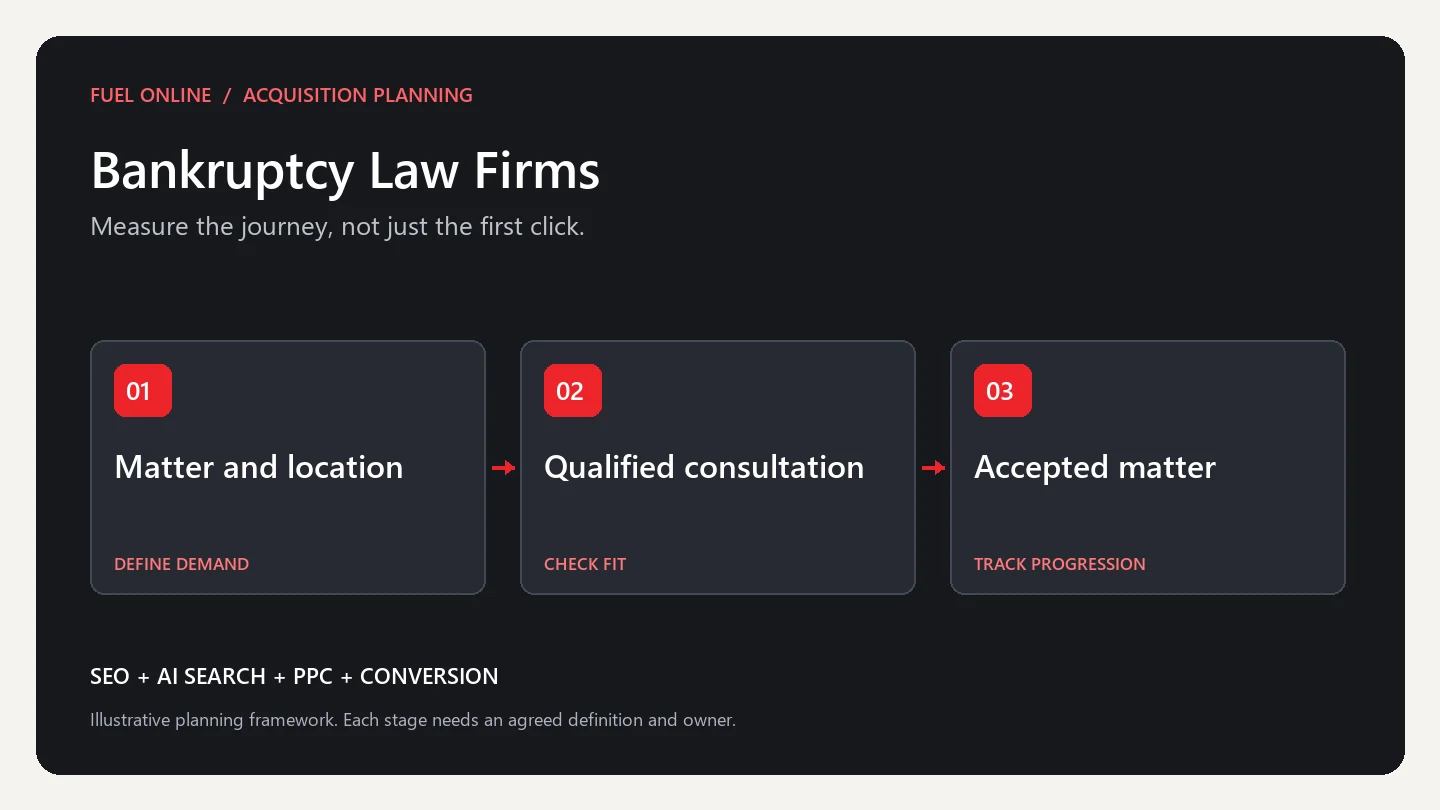
Fuel connects page, query, campaign, or source context with acceptance, rejection reasons, response, capacity, and qualified consultations, attendance, accepted matters, and inquiry fit by jurisdiction. Diagnostic measures explain where the journey breaks; they do not replace the business outcome.
The decision record for bankruptcy lawyer SEO states what changed, why it changed, who approved it, and whether the next action is to expand, revise, consolidate, or stop.
Reporting for SEO services for bankruptcy law firms must connect the service-specific diagnostic to accepted bankruptcy consultations, explain data limits, and name the next decision rather than treating activity as proof of value.
Questions to ask a bankruptcy law agency
Ask for a sample query-to-page map, technical ticket, content brief, and release validation. Confirm who can implement site changes and how accepted inquiries affect the search roadmap.
When reviewing bankruptcy lawyer SEO, require a named practitioner, implementation owner, approval path, and sample artifact. Reject unsupported promises of rankings, citations, lead volume, cost, or revenue.
How we measure bankruptcy law search engine optimization
- qualified consultations
- attendance
- accepted matters
- inquiry fit by jurisdiction
Connect organic discovery to inquiry quality
Organic inquiry qualification rate = suitable organic inquiries ÷ organic inquiries reviewed.
Illustrative arithmetic: 12 suitable inquiries out of 20 reviewed organic inquiries is a 60% qualification rate. This measures inquiry fit, not search market share, and requires a recorded source and an agreed definition of suitable.
Agree on the baseline, data source and qualification criteria before comparing results. Separate visibility from inquiries and accepted business opportunities.
CONNECTED SERVICES
Choose the right next step for your business
Explore Fuel’s SEO capabilities, published campaign work and team to evaluate how we would support your organization.
BEFORE YOU CHOOSE AN AGENCY
Questions about bankruptcy law search engine optimization
What does the first SEO month produce?
During the first month, the bankruptcy lawyer SEO scope produces a query-to-page map, technical priorities, overlap decisions, and the first brief or consolidation ticket. Fuel also records the client inputs and approval needed for the first release.
What does Fuel need from our bankruptcy law team?
Effective bankruptcy law search engine optimization work requires site and search-data access, an implementation owner, subject-matter reviewers, approved proof, and accepted or rejected inquiry feedback. Fuel identifies missing access or ownership before work is scheduled around it.
How will we know the work is commercially useful?
Under SEO services for bankruptcy law firms, commercial usefulness depends on whether the diagnostic connects to accepted bankruptcy consultations, the data limits are stated, and the evidence supports a clear keep, revise, or stop decision.
Should SEO and paid search work together?
Yes, when they share query evidence, landing-page learning, and qualification feedback while retaining separate attribution and budget decisions. In bankruptcy lawyer SEO, paid search can test active demand as SEO develops durable decision pages.
What does a credible bankruptcy law search engine optimization scope include?
A credible bankruptcy law search engine optimization scope includes query ownership, technical priorities, evidence-backed briefs, implementation responsibilities, release validation, and inquiry-quality review. It also names the client dependencies, practitioner, deliverable, and approval path.
How should SEO services for bankruptcy law firms report commercial progress?
Reporting under SEO services for bankruptcy law firms should connect the service-specific diagnostic to accepted bankruptcy consultations, show what changed and why, state data limits, and name the next decision.
Make your next agency conversation specific.
Bring one important search such as 'Chapter 7 attorney in Worcester', the page meant to answer it, and examples of unsuitable inquiries. The first working session on bankruptcy law search engine optimization will identify the priority artifact, evidence, owner, and approval decision for accepted bankruptcy consultations.
Talk with a Fuel strategist →