
FUEL ONLINE / Bankruptcy Law Firms / PPC & Google Ads
Bankruptcy lawyer PPC management: Google Ads

Bankruptcy firms need local matters that fit their chapter, jurisdiction, and case threshold, not calculators, creditor requests, or unrelated legal questions. Fuel separates paid searches such as 'Chapter 7 attorney in Worcester' from low-fit intent such as 'bankruptcy calculator spreadsheet', then aligns ads, geography, landing pages, and contact actions with consumer or business need, potential chapter, jurisdiction, urgency, and consultation fit. Search-term reviews and intake team feedback move budget toward accepted bankruptcy consultations, not the cheapest clicks or form fills.
Jurisdiction and accepted matter type; Consumer versus business representation; Consultation availability and process; Conflict screening and firm acceptance criteria
Compare bankruptcy lawyer PPC through search purpose and contact events
Choose a bankruptcy lawyer PPC management agency by comparing its treatment of search purpose, destination meaning and measurable contact events. A useful proposal distinguishes someone seeking general legal information from someone looking for a specific firm or its contact route. It then shows why a particular campaign and destination serve the selected task. The buyer should be able to inspect these choices before comparing budgets or activity totals, because different search purposes can produce interactions with very different administrative meanings.
Classify searches by the intended conversation
Begin with sample searches selected for a planning exercise. Include a firm-name search, a general educational question, a search for an offered practice and a returning contact looking for the business. Ask the agency to explain which examples belong in the proposed paid scope and which do not. The purpose is to make its reasoning visible. A keyword list alone does not show whether the campaign is designed to introduce the firm, distribute information or support an identifiable new-prospect contact journey.
The firm's own scope should guide campaign boundaries. Have the firm supply its offered practice descriptions, published location information and established contact process. Ask the agency to map those facts to campaign groups and destinations. This prevents a planning exercise from quietly expanding the advertised scope beyond the business information the firm actually maintains. The agency can propose a structure and explain the tradeoffs without deciding legal questions or inferring the suitability of the practice for an individual reader.
A branded search deserves separate attention in the buying comparison. A person seeking a known firm might be a new prospect, an existing contact or someone looking for an administrative detail. Ask how the agency will organize and explain that activity rather than treating every branded interaction as equivalent new acquisition. The available records may not identify every person's purpose. A useful report keeps that uncertainty visible while describing the actual campaign decisions and evidence behind them.
| Paid-search decision | Evidence requested | Comparison benefit |
|---|---|---|
| Conversation served | A sample search classified by task and linked with its proposed campaign and destination. | The buyer can distinguish practice introduction, education and known-firm contact purposes. |
| Destination scope | The maintained firm information supporting the message and the supplier responsible for changes. | A campaign resource remains connected with the actual service and professional descriptions. |
| Cost denominator | A record example defining the event counted and the treatment of repeated interactions. | Reported costs can be compared on equivalent meanings instead of incompatible conversion labels. |
| Account continuity | The campaign map, selected decisions and ownership of destinations and measurement definitions. | Another team can understand and maintain the account without reconstructing undocumented assumptions. |
Keep the message and destination consistent
Compare each message with its destination. An advertisement introducing the practice should lead to a resource that supports its description and provides the relevant contact route. An educational message should not arrive at a page that silently changes the conversation into an unsupported personal conclusion. Ask for a worked query-to-message-to-page example. The exercise should show why the destination is relevant and which firm-supplied information establishes its meaning, rather than relying on a claim that one landing-page format always wins.
Destination ownership affects the commercial scope. Ask whether the agency will revise an existing firm page, build a separate resource or depend on another supplier to implement changes. Each approach should include a clear relationship with the maintained practice and professional information. A standalone campaign page can become disconnected if no one knows which central description it depends on. The proposal should make that dependency visible so that later changes to the firm's published information reach the paid destination as well.
Local targeting should match the firm's supplied geographic context. Ask the agency to show the relationship between the targeting decision, the location wording in the message and the destination's explanation. A location named in a campaign is not by itself evidence of an office or an unlimited practice relationship. The buying exercise should use the firm's actual published facts. A useful account map lets another team understand why a particular area is included and which resource supplies the customer-facing explanation.
The contact event should be defined before a cost metric is selected. A button click, an observed call, an identifiable inquiry and a later administrative disposition require different evidence. Ask the agency which events it will configure and which records the firm can inspect. A lower cost per interaction may reflect a different event definition rather than a better commercial outcome. A proposal becomes easier to compare when its denominator can be explained through one ordinary record rather than a label in a dashboard.
Compare event costs on an equivalent basis
Use a hypothetical reporting exercise containing a repeated call, a form submission and a returning-contact interaction. Ask how each contributes to the proposed totals and which relationships can actually be established. The agency should explain whether it is reporting interaction counts or linked incoming conversations. This demonstrates its reconciliation approach without requiring a fictional conversion benchmark. It also gives the firm's receiving team a common vocabulary for discussing records that may appear differently in campaign tools and its own administrative system.
Search-term review should leave an understandable record of decisions. Ask for an example that identifies the observed wording, the task it appears to represent, the resulting account change and the destination affected. The example can be a planning demonstration rather than a claimed performance result. Its value is the reasoning another person can follow. The firm should be able to see how a specific observation produces a campaign decision instead of receiving an unexplained list of changed exclusions and bids.
Separate the components of the paid program when comparing agency scope. Account management, message development, destination implementation, measurement configuration and media spend are different items. Ask which are included and what each leaves behind. The firm should also know who owns the account, destination files and event definitions at handover. This supports a fair comparison without inventing published prices or assuming that two suppliers' similarly named management services include the same implementation responsibilities.
Before launch, test an included prospect search, a firm-name path and an existing-contact route. Follow the message and destination through the contact action to the resulting record. The firm can then review whether the public wording and administrative event have the same meaning. This is more useful than checking only whether a form fires a tag. The complete exercise tests the relationship between the campaign purpose and the real information the receiving team will use.
Retain an account another team can understand
At handover, retain the account map, destination dependencies, event definitions and selected search-term decisions. Another team should be able to explain which conversation each campaign serves and why its principal costs are calculated as shown. It should also be able to identify what must change when the firm revises its own practice information. These artifacts make the ongoing service more inspectable and reduce reliance on undocumented assumptions held by the original campaign manager.
A bounded first release can focus on one offered practice and its relevant contact journey. Specify the firm facts required, the destination work, the measurement setup and the records used to assess the release. The next account decision can then build on a defined event rather than an unexplained increase or decrease in traffic. This gives the buyer a practical basis for prioritizing work while leaving legal services and individual professional decisions with the firm.
The final comparison should ask each PPC agency to demonstrate the same search purpose and the same contact event. Look for a clear relationship between the advertisement, maintained firm information and the administrative record. A useful bankruptcy paid-search program is understandable at each of those steps. The buyer can review what the agency actually configures and maintains without relying on promised cost levels, lead volumes or future matter outcomes to make the proposal appear complete.
For a worked account comparison, ask each agency to choose a search representing an offered practice and show its proposed message, destination passage and counted contact event. Then compare that example with a person searching for the firm's name. The two paths may use related resources, but the agency should explain whether their campaign purposes and reported totals differ. This exercise reveals the logic of the proposed account structure without asking for invented cost estimates. It also gives the firm a concrete way to challenge a structure that treats every search as identical acquisition demand.
A destination change provides another useful test. Revise a practice description in the review copy and ask which paid pages or messages depend on the earlier wording. The agency should identify the relevant assets and the person able to change each one. A campaign destination managed outside the main website still needs a maintained relationship with the firm's central information. The exercise makes that implementation dependency visible in the commercial scope and helps the firm understand what another supplier must contribute before the released message and destination can remain consistent.
For a reporting exercise, use a hypothetical set of records containing a click to call, an observed call and a related form. Ask how the proposed report counts these events and which cost denominator uses each total. The agency should explain what can be linked with the receiving records and what remains an interaction-only observation. A useful answer allows another person to reproduce the meaning of the numbers. It does not turn a tracking event into an accepted matter or require a fabricated forecast to demonstrate that the reporting design is understandable.
Retain a sample account-change explanation with the handover. It should name the search purpose observed, the relevant destination and the reason for a resulting campaign adjustment. A future manager can then distinguish an intentional decision from an unexplained historical setting. This is particularly useful when a firm revises its public practice information or changes who maintains its destination pages. The delivered account should remain interpretable as a set of customer-task decisions, rather than becoming a collection of settings whose relationship with the firm's current information is known only to its original manager.
For the related firm-wide scope, explore bankruptcy law marketing.
AGGRESSIVE FROM THE START
One month. The work many agencies stretch across three.
Our mandate: move faster, go deeper and put experienced specialists to work immediately.
Fuel attacks the work in parallel: site audits, technical errors, new content, internal links, backlink outreach and conversion improvements. Your agreed scope determines the channels; urgent fixes do not wait behind a drawn-out planning phase.
The bankruptcy lawyer PPC management brief identifies visibility and lead barriers. Actionable fixes move into production while deeper analysis continues.
Your bankruptcy law Google Ads work runs alongside industry-specific content, relevant links and earned-authority outreach, based on your agreed scope.
The PPC management for bankruptcy law firms review shows completed work, lead quality and the next opportunities. You see who owns each action.
Fast execution is the operating standard. Access, approvals and scope shape delivery; search and revenue results have their own timelines.
What bankruptcy lawyer PPC management changes for bankruptcy law demand
Paid acquisition becomes useful when the account mirrors the business. Fuel separates campaigns when geography, service, economics, qualification, or next step differs. The distinction between 'Chapter 7 attorney in Worcester' and 'bankruptcy calculator spreadsheet' becomes visible in queries, exclusions, ads, pages, and reporting.
Each ad group has a defined buyer, promise, evidence need, destination, and contact action. The landing page uses attorney-reviewed information, accurate jurisdiction and representation statements, named authorship, and permissioned client evidence and gives the intake team case type, jurisdiction, urgency, safe contact details, approved intake facts, and conflict-screening status.
A practical bankruptcy law PPC diagnostic
Use this diagnostic when paid conversion volume improves but the receiving team does not see a comparable change in accepted bankruptcy consultations. The diagnostic for bankruptcy lawyer PPC management starts with the observable symptom, checks the page, source, campaign, or handoff responsible for it, and ends with one reviewed action, owner, and validation method.
Observable symptom in bankruptcy lawyer PPC management performance
Reported conversions increase, but search terms and landing pages still send 'bankruptcy calculator spreadsheet' demand instead of opportunities closer to 'Chapter 7 attorney in Worcester'.
What to inspect in bankruptcy law Google Ads
Review actual search terms, geography, ad promise, landing-page fit, contact action, and the sales, intake, or scheduling decision.
Decision criteria for PPC management for bankruptcy law firms
Add or remove a reviewed exclusion, separate the campaign, revise the landing page, or hold budget until the handoff works.
Inspectable output
A search-term and landing-page decision log showing what changed, why budget moved, and whether accepted bankruptcy consultations improved.
PPC management for bankruptcy law firms deliverables you can inspect
The team receives a campaign and budget matrix, reviewed query decisions, exclusions, landing-page message map, conversion tracking, and a weekly budget log.
- Campaign, geography, and budget matrix, used to define the bankruptcy lawyer PPC management scope.
- Reviewed query and exclusion set, used to govern the bankruptcy law Google Ads release.
- Ad and landing-page message map, used to evaluate the PPC management for bankruptcy law firms decision.
- Conversion and offline-disposition tracking
- Weekly search-term and budget decision log
Illustrative bankruptcy law example
Illustrative example, not a client result: Fuel would separate paid-search demand from a local consumer or business prospect seeking a chapter and matter type the firm handles and calculators, creditor requests, out-of-jurisdiction matters, and unrelated legal questions in the account, then review the actual query, geography, promise, landing page, contact action, and final disposition before changing budget.
The bankruptcy law Google Ads decision log would show the exclusion, campaign split, landing-page revision, or budget hold and its owner. Spend expands only after reviewed evidence shows a stronger path to accepted bankruptcy consultations.
Within PPC management for bankruptcy law firms, the buyer team can inspect the artifact, approval, and next investment decision.
How commercial progress is judged
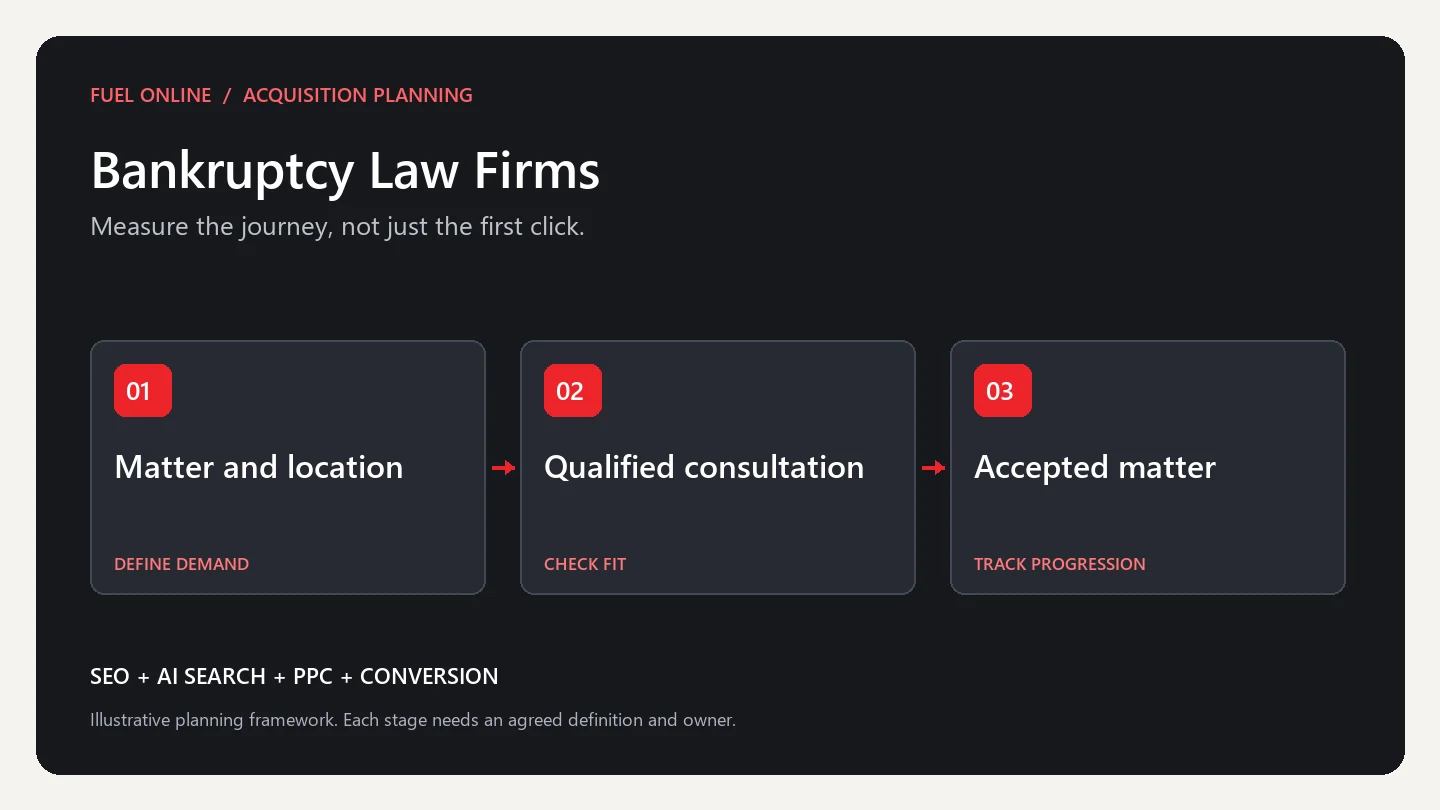
Fuel connects page, query, campaign, or source context with acceptance, rejection reasons, response, capacity, and qualified consultations, attendance, accepted matters, and inquiry fit by jurisdiction. Diagnostic measures explain where the journey breaks; they do not replace the business outcome.
The decision record for bankruptcy lawyer PPC management states what changed, why it changed, who approved it, and whether the next action is to expand, revise, consolidate, or stop.
Reporting for PPC management for bankruptcy law firms must connect the service-specific diagnostic to accepted bankruptcy consultations, explain data limits, and name the next decision rather than treating activity as proof of value.
Questions to ask a bankruptcy law agency
Ask for a search-term decision log, landing-page map, conversion definition, and budget-change record. Confirm who approves exclusions, creative, tracking, and offline disposition imports.
When reviewing bankruptcy lawyer PPC management, require a named practitioner, implementation owner, approval path, and sample artifact. Reject unsupported promises of rankings, citations, lead volume, cost, or revenue.
How we measure bankruptcy law Google Ads
- qualified consultations
- attendance
- accepted matters
- inquiry fit by jurisdiction
Use a cost metric that reflects qualified demand
Cost per qualified inquiry = campaign spend ÷ inquiries meeting the agreed criteria.
Define the included spend, reporting window and qualification rules before comparing campaigns. Track raw leads separately so cheaper but unsuitable inquiries do not make performance look better.
Agree on the baseline, data source and qualification criteria before comparing results. Separate visibility from inquiries and accepted business opportunities.
CONNECTED SERVICES
Choose the right next step for your business
Explore Fuel’s PPC & Google Ads capabilities, published campaign work and team to evaluate how we would support your organization.
BEFORE YOU CHOOSE AN AGENCY
Questions about bankruptcy law Google Ads
What happens before Fuel increases paid spend?
During the first month, the bankruptcy lawyer PPC management scope produces a search-term review, campaign and geography matrix, conversion definition, and the first budget decision. Fuel also records the client inputs and approval needed for the first release.
What does Fuel need from our bankruptcy law team?
Effective bankruptcy law Google Ads work requires ad-account, analytics, landing-page, call, and disposition access plus budget constraints, approved claims, and timely query review. Fuel identifies missing access or ownership before work is scheduled around it.
How will we know the work is commercially useful?
Under PPC management for bankruptcy law firms, commercial usefulness depends on whether the diagnostic connects to accepted bankruptcy consultations, the data limits are stated, and the evidence supports a clear keep, revise, or stop decision.
What should the first bankruptcy lawyer PPC management priority be?
Start with the query, geography, ad promise, landing page, contact action, and receiving path closest to accepted bankruptcy consultations. The bankruptcy lawyer PPC management plan should hold expansion when a landing-page or handoff defect would turn more spend into unusable conversions.
What does a credible bankruptcy law Google Ads scope include?
A credible bankruptcy law Google Ads scope includes query and exclusion review, geography and budget rules, landing-page alignment, conversion definitions, disposition feedback, and documented budget decisions. It also names the client dependencies, practitioner, deliverable, and approval path.
How should PPC management for bankruptcy law firms report commercial progress?
Reporting under PPC management for bankruptcy law firms should connect the service-specific diagnostic to accepted bankruptcy consultations, show what changed and why, state data limits, and name the next decision.
Make your next agency conversation specific.
Bring recent search terms, landing pages, and accepted or rejected contacts so we can identify the first paid-media decision. The first working session on bankruptcy law Google Ads will identify the priority artifact, evidence, owner, and approval decision for accepted bankruptcy consultations.
Talk with a Fuel strategist →