
AI SEO – AEO Course 20
Build a 90-Day AEO Implementation Plan Around the Buyer Task
Build a 90-day AEO implementation plan around the business decision you want to improve, the stage currently limiting progress and the resources you can actually commit. Establish facts and a baseline, complete a bounded pilot, then expand work that meets explicit acceptance criteria. Budget verification and repair alongside production. Separate completed deliverables from later AI-search visibility, referrals and revenue observations.
Begin with a narrow mandate. A software company might want buyers to receive accurate integration and pricing answers during evaluation. A service business might need local recommendations to respect geography and availability. Those goals require different evidence and operating owners. A broad instruction to improve AI presence does not tell the team which buyer problem deserves the first week.
State what the AEO implementation plan can deliver within ninety days. Examples include corrected commercial facts, a stable observation panel, several useful decision pages, a verified delivery path and an acquisition-evidence handoff. These are work products with inspectable acceptance conditions. A guaranteed citation rate or revenue increase is a different claim and is not established by completing the work.
Define the limiting stage. Public content may be inaccessible, accurate information may be missing, existing answers may be hard to interpret, or qualified visits may be lost at the inquiry handoff. Choose the next action that addresses the observed problem. Do not spend the opening month multiplying content while a known delivery failure prevents the intended audience from reading it.
Give the program a release owner and a decision log. Record assumptions, dependencies, access limits, available evidence and why a task was prioritized. Keep the queue small enough to execute. A useful AEO implementation plan is a maintained contract about work and evidence, not a calendar filled with activities whose connection to the buyer remains unclear.
An AEO implementation roadmap should connect AI SEO implementation to the stage that actually limits the buyer’s experience. The 90-day AEO implementation plan is a planning horizon for verified work, not a deadline by which an external platform must recommend the business. Choose outputs the team can inspect, then keep later search selection and qualified acquisition as separately measured outcomes.
Map AI SEO Implementation Dependencies and Owners
Inventory dependencies before estimating production. List the actual offer, audience, markets, important buyer tasks, existing useful URLs, commercial fact owners, delivery systems and available measurement. Mark each dependency observed, assumed or unavailable. A missing analytics account may delay a measurement task without preventing a verified pricing correction.
Separate evidence approval from publishing responsibility
Separate evidence ownership from publishing ownership. Product verifies capability, finance or commercial operations verifies current terms, customer operations verifies service conditions, and the content team prepares a readable explanation. The release owner coordinates the pieces. Assigning every task to marketing can conceal facts that marketing does not have authority or knowledge to approve.
Check the existing content inventory. Some buyer questions may already have a useful owner that needs a focused repair. Others may justify a new resource. Preserve functioning successful URLs unless a concrete reason supports change. The AEO implementation plan should not create competing destinations simply because a planning tool produced several keyword variations.
Define the baseline you can actually collect. Save a bounded set of relevant questions and repeated observations under recorded conditions. Inspect the site's actual delivered content and relevant conversion path. Keep unavailable measurements unknown rather than manufacturing a zero or treating the missing account as proof of poor performance.
Assign blocker records with owner, evidence, attempted remedy and next retry condition. If account access is pending, continue approved independent work. If a consequential product fact is unverified, hold that claim and its dependent page while another ready asset proceeds. A dependency map should help the team isolate problems, not provide an excuse to stop the entire program.
Give each task a completion artifact. A source fact needs approved evidence; a page needs accepted content and a verified delivery result; a measurement field needs a tested handoff. This makes the AEO implementation plan reviewable by someone who did not attend the planning meeting and prevents activity from being mistaken for completion.
Choose the First Stage of an AEO Implementation Roadmap
Compare content-first, technical-first and measurement-first strategies against the observed bottleneck. Content-first work fits a site whose delivery and core facts are sound but whose buyer questions remain unanswered. Its limitation is multiplication: more pages can spread inconsistent facts if the underlying offer record is weak.
Technical-first work fits a concrete access, rendering or task-completion failure. A corrected public response or working form can unlock existing useful material. Its limitation is that technical eligibility alone does not answer a buyer's comparison or explain a product's limits. The team still needs useful content after the blocking layer works.
Measurement-first work fits a program that cannot distinguish observations or connect qualified inquiries to available acquisition evidence. It can establish a trustworthy baseline and handoff. Its limitation is that instrumentation does not create a compelling offer or repair unsupported claims. A perfect dashboard cannot substitute for the answer buyers need.
Most programs need a sequence combining these methods. Choose the first action from evidence, then identify which work can run independently. An approved fact register and a safe technical inspection may proceed alongside one another. A total-cost comparison should wait for its material pricing inputs. The AEO implementation plan should show these dependencies explicitly.
Estimate role capacity and uncertainty before page volume
Estimate effort in staff hours and uncertainty rather than inventing market rates. Separate research, writing, factual review, media, implementation, verification and repair. State which roles supply the hours and whether they are available during the same week. Forty nominal hours from an unavailable subject owner are not usable production capacity.
Use a range where the work is uncertain, and revise it after the pilot. Keep the reason for the estimate. A familiar template may be predictable; a new account integration may depend on access and vendor behavior. An AEO implementation plan becomes stronger when it exposes that uncertainty instead of hiding it behind a precise but unsupported cost total.
Worked AI Search Optimization Budget: Allocate 160 Hours
Consider an illustrative B2B company with 160 staff hours available across ninety days, six priority buyer tasks and incomplete attribution. It already has a website. The hours and schedule are fictional planning inputs, not Fuel productivity data, agency prices or a promise that another company can complete the same work in that capacity.
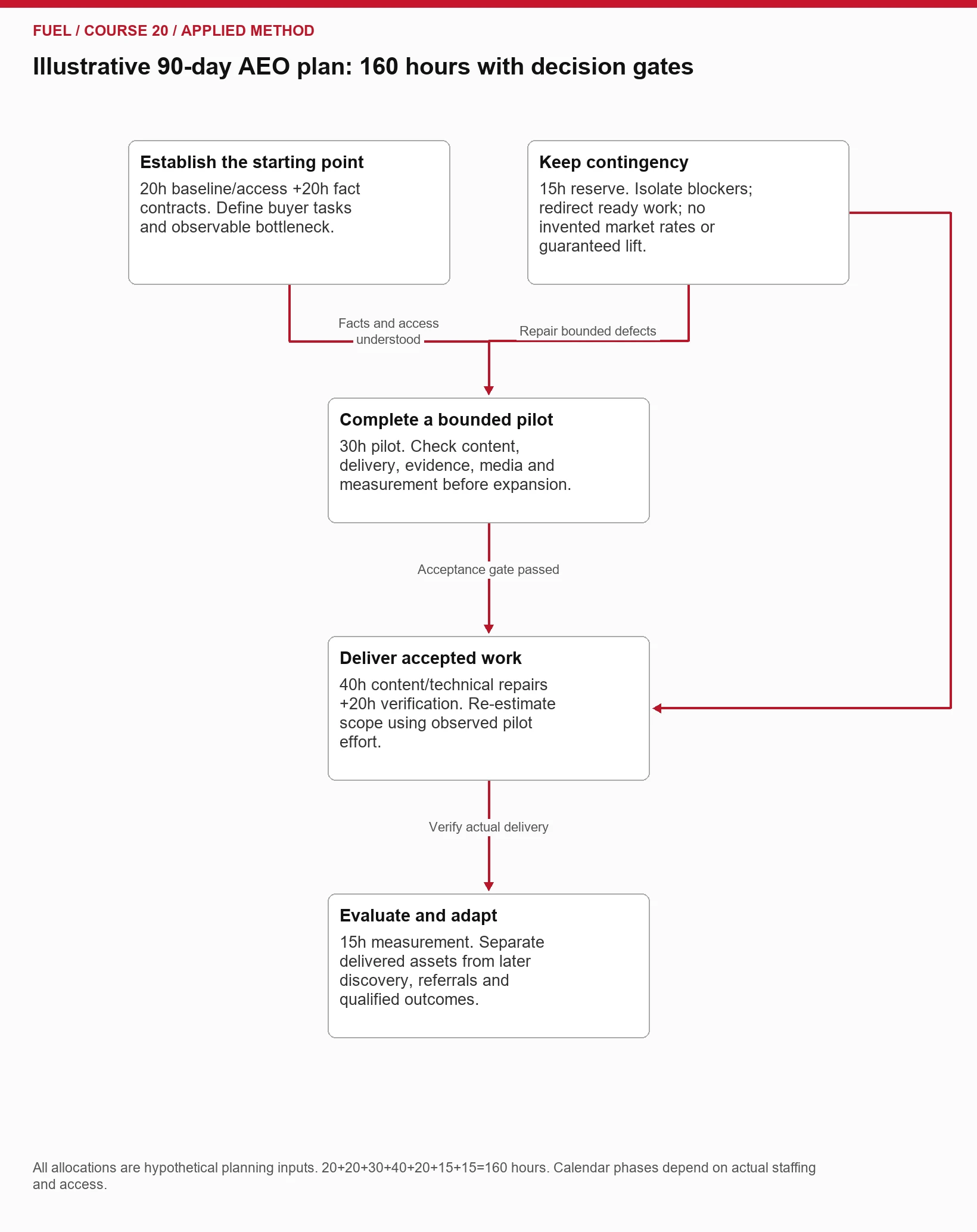
Allocate twenty hours to baseline and access inspection, twenty to fact contracts, thirty to a bounded pilot, forty to accepted content and technical repairs, twenty to verification, fifteen to measurement and fifteen to contingency. The total is 160. Each allocation needs a deliverable and an accountable role; a category name alone does not show what the team will finish.
Use the first phase to establish facts and the pilot
In the first phase, roughly days one through thirty in this example, establish the mandate, collect available baseline evidence, resolve high-impact facts and identify the pilot. A pricing explanation can be a good pilot when it exercises real calculations, claim review, media, internal links and an inquiry path. Choose the pilot for representativeness and business usefulness, not because it is the easiest page to draft.
In the second phase, roughly days thirty-one through sixty, complete and verify the pilot before expanding. Measure actual effort, review defects and identify reusable elements. Fix the process once where a shared template or field mapping caused the error. Preserve accepted text and evidence rather than restarting the entire program to improve a cosmetic score.
In the third phase, roughly days sixty-one through ninety, deliver the highest-value ready work, complete verification and review the available observations. Re-estimate scope using the pilot's actual effort. A smaller set of complete, supported assets can be more useful than a larger set of unfinished drafts with unverified claims.
Keep outcome observation windows separate from calendar phases. A page published late in the program has less post-release history than one published early. Do not compare their raw totals as equivalent exposure. Record delivery dates and conditions, and leave unobserved external behavior unknown.
The example's AEO implementation plan earns credibility through its explicit assumptions and acceptance gates. It does not earn credibility by attaching an expected citation multiplier to a ninety-day date. The schedule organizes authorized work; the evidence determines what was actually achieved.
| Work category | Hours | Completion evidence |
|---|---|---|
| Baseline and access | 20 | Recorded task panel, available starting observations and delivery findings. |
| Fact contracts | 20 | Approved consequential facts, owners and dependencies. |
| Representative pilot | 30 | One complete asset and a reviewable end-to-end path. |
| Content and technical repairs | 40 | Accepted task-specific assets and scoped fixes. |
| Verification | 20 | Delivered content, media, links and primary-action checks. |
| Measurement | 15 | Defined observations and available acquisition evidence. |
| Contingency | 15 | Explicit reserve for bounded repairs or uncertainty. |
| Total | 160 | Scope adjusted after actual pilot effort. |
Budget AEO Capacity Without Removing Verification
Recalculate scope when the pilot consumes contingency
Budget capacity at the task level before committing a publication count. If the pilot consumes forty-five hours rather than its allocated thirty, the program has a fifteen-hour variance. That equals the entire contingency reserve in the illustrative budget. Decide whether to use the reserve, reduce later scope or obtain genuinely available capacity. Do not preserve the original volume target by quietly removing review.
Separate planned and actual effort. A task may require two hours of active review but wait ten days for an owner. Both affect the calendar, but they are different constraints. The AEO implementation plan should identify whether the next improvement comes from reducing work, resolving a dependency or changing the sequence.
Compare alternatives using acceptance quality. Producing eight shallow pages and producing three verified decision assets are not equivalent workloads. Count completed assets only when the required content, evidence, media, implementation and checks are present. A lower draft cost can become a higher accepted-page cost after repair.
Include maintenance and exceptions. A pricing source may change while the comparison is being written. An integration claim may fail verification. A shared template may need a correction. Reserve capacity for these foreseeable categories without pretending to know exactly which one will occur. Record actual rework so the next estimate improves.
Avoid double counting staff availability. One subject owner cannot provide the same two hours simultaneously to several workstreams. A release coordinator may also be handling measurement or implementation. Build a simple role-by-week view and identify the actual bottleneck. More writing capacity will not solve a queue waiting on one factual approval.
Use the AEO implementation plan to make the tradeoff visible to leadership: which buyer decisions will be completed, what evidence they need, what work is deferred and why. An honest scope adjustment is more useful than a dashboard that calls drafts delivered because the original schedule left no time for verification.
Write Acceptance Gates for an AEO Agency Scope of Work
Set acceptance criteria before multiplying the pilot. The page should answer its intended buyer question, preserve material limits, use supported facts and supply a fitting next action. The delivered page should retain its answer, meaningful media, metadata and intended internal routes. The inquiry or purchase path should work under the conditions being tested.
Combine mechanical checks with substantive review
Distinguish mechanical and semantic review. A word count, link checker or schema validator can find concrete defects, but it cannot establish that a comparison is fair or a source supports the conclusion. Use deterministic checks for repeatable structure and a substantive review for evidence, reasoning, usefulness and originality. Record who actually performed each review without inventing a human sign-off.
Create stop and repair rules. Hold a consequential unverified claim, a broken delivery path or a misleading active offer. Repair the affected component and retest its dependencies. Do not repeatedly rewrite the whole corpus when one field fails, and do not wave through a known defect because the publishing target is approaching.
Define a rollback condition for material implementation work. A change that exposes protected content, breaks the primary action or delivers the wrong commercial rule needs a safe restoration path. Preserve the evidence and intended policy. A rollback is an operational response, not proof that the underlying business objective should be abandoned.
Keep accepted assets stable while unresolved work proceeds. An AEO implementation plan needs a ready queue and an exception queue, with dependencies stated. One blocked custom integration should not prevent a verified local-service correction, provided the work is genuinely independent. Conversely, a dependent comparison cannot pass while its shared pricing input remains unapproved.
Use the pilot review to decide whether to scale the method. If repeated defects arise from the brief or source contract, repair that shared process first. If the pilot succeeds, reuse the verified template and controls while preserving page-specific reasoning. Scaling means repeating a working production system, not copying one article's paragraphs into many destinations.
An AEO agency scope of work should state the buyer tasks, required evidence, actual roles, access dependencies, accepted artifacts and bounded repair responsibilities. The AI search optimization budget should cover factual approval, media, implementation, verification and maintenance as well as writing. Ask how pilot variance changes later scope and which outcome observations will remain inconclusive. A proposal becomes comparable when the assumptions and completion conditions are visible, not when it supplies an unsupported citation multiplier.
Evaluate AI Search Progress Before Scaling the Program
Evaluate AI-search progress in stages. A technical request, indexed page, citation, brand mention, suitable recommendation, referral session, qualified inquiry and closed sale represent different observations. Define each measure and its denominator. A change in one stage does not establish an equal change at the next.
Keep the observation panel stable enough to compare. Preserve exact prompts, task mix, engine or interface, search state, locale, dates and relevant session conditions. Repeated outputs are useful but related; do not treat every answer as an independent buyer. Record changes to the panel separately from changes in the results.
Inspect accuracy alongside visibility. A frequently named brand with wrong pricing or unsupported integration claims may need correction before broader exposure. Use the pricing-page method and integration capability contract when those facts drive the recommendation. The AEO implementation plan should reward accurate useful answers, not just mention counts.
Google Analytics distinguishes user, session and event scopes in traffic-source reporting. [1] Apply the appropriate scope when connecting visits to later records. The AI referral attribution course shows how to preserve evidence and avoid counting one opportunity several times. Attribution association remains different from incremental revenue.
Choose a scale decision the available evidence supports
Choose a decision the evidence can support. The team may scale a reliable content workflow, improve a source explanation or investigate a persistent conversion problem. It may conclude that the observation window is too short to assess external effects. That is a valid finding when the completed work and available evidence are clearly reported.
Do not use a ninety-day endpoint as permission to declare success or failure on every future outcome. Evaluate what was delivered, what was observed and what remains uncertain. An AEO implementation plan can produce valuable verified assets while still requiring later evidence about search selection and business impact.
Run a weekly operating review
Run a brief weekly operating review with the people who own decisions. Start with completed artifacts and acceptance evidence, then inspect active work, ready items and blockers. Review the highest-impact factual or technical risk. Finish by selecting the next tasks that fit available capacity. A meeting that only repeats activity counts does not improve the plan.
Maintain one durable queue. Each item should show its buyer task, owner, dependency, expected effort, current state and next verification step. Keep new ideas in an expansion queue so the original scope does not change invisibly each week. The AEO implementation plan needs controlled adaptation, not a frozen document or unlimited scope growth.
Reconcile changes across evidence and content. A revised product fact can affect several assets. Use content change control to identify those dependencies and record what needs reapproval. A new social hypothesis should enter research, not become an immediate requirement applied to every page.
Track a few production measures honestly: accepted assets, completed delivery checks, actual effort, first-pass acceptance and repair work. Record unavailable cost or usage metrics as unknown. Do not claim a throughput improvement from comparing a shallow draft batch with a fully verified production workload.
Use checkpoints after meaningful units. Save the brief, source packet, article revision, media bindings, review and delivery evidence so interrupted work can resume without repeating accepted tasks. A durable record reduces coordination mistakes and makes later review possible. It does not imply an unattended service keeps working when no execution is active.
Close the weekly review with a specific decision and its reason. Reassign an unavailable owner, reduce a low-value expansion, fix a shared source or start a ready asset. The AEO implementation plan stays useful when those decisions preserve the buyer objective and evidence standard while responding to actual constraints.
Exercise: rebalance an interrupted plan
Rebalance the illustrative 160-hour plan after two disruptions. Analytics access is unavailable during the first month, and pilot review takes fifteen extra hours. Which work can continue, and what must change?
Keep the unavailable measurement dependency explicit. Continue approved fact contracts, public delivery inspection and useful content work that does not require the missing account. Do not invent baseline conversion numbers. Define the access owner and retry condition, and preserve the original observation limitations in the later report.
Account for the pilot variance. Using the entire fifteen-hour contingency reserve leaves no remaining buffer. A defensible response may reduce later production scope or move a lower-priority task rather than remove factual review. Recalculate the remaining role capacity and explain which buyer decisions still fit.
Submit a revised AEO implementation plan with the seven budget categories, the changed allocation or scope, one isolated blocker and the pilot acceptance criteria. State which deliverables can be verified by day ninety and which external outcomes remain observations for later. The exercise succeeds when the arithmetic, dependencies and evidence boundaries remain coherent under pressure.
Sources and evidence notes
[1] Google Analytics, Scopes of traffic-source dimensions. Accessed October 25, 2026.
Apply the workflow
Ask Fuel Online to scope a 90-day discovery and content program against actual access, staffing, evidence and business priorities.
Explore the AI SEO and AEO course curriculum.
Discuss AI SEO and AEO implementation with Fuel Online.