
AI SEO – AEO Course 21
How do you correct outdated business information in ChatGPT?
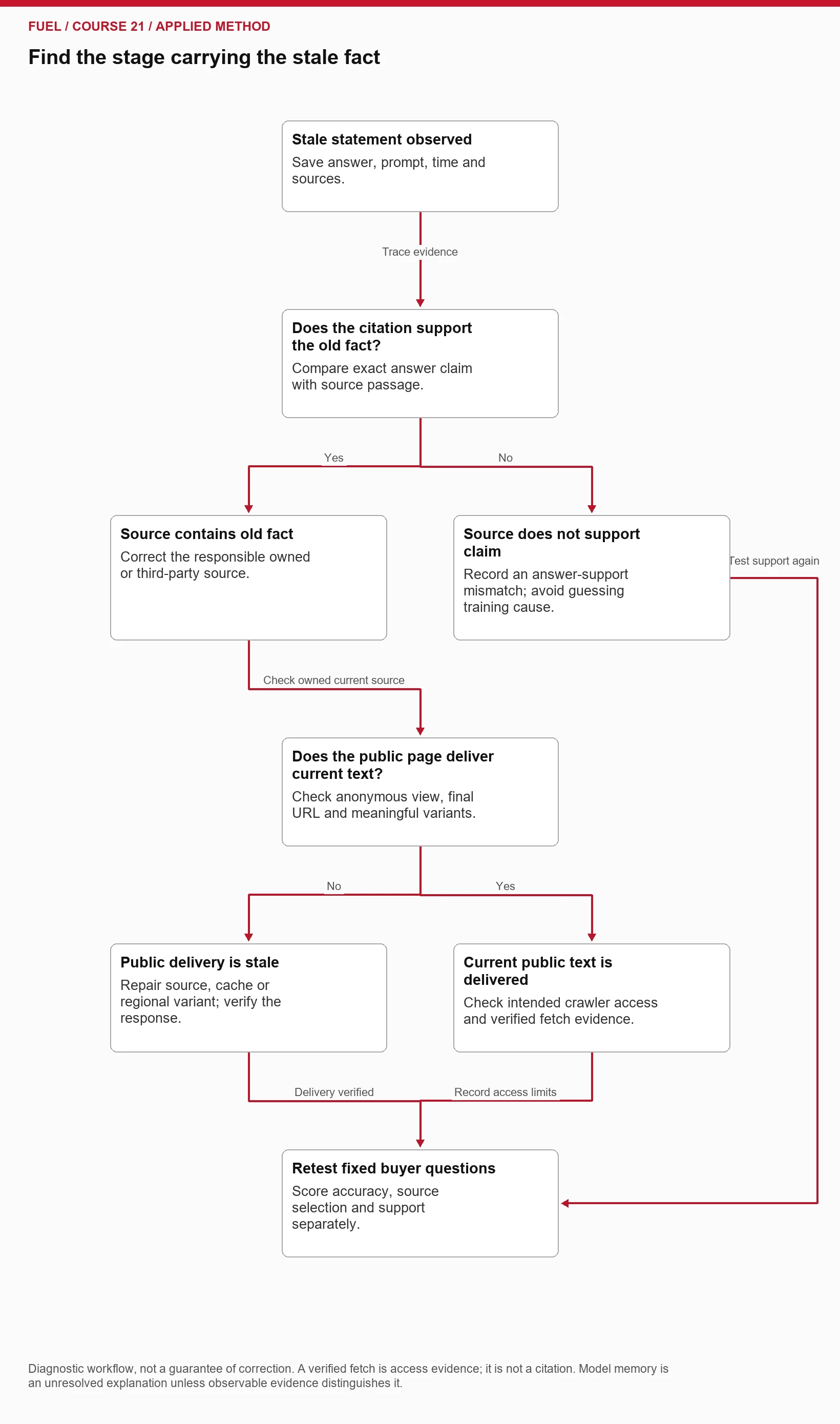
Correct outdated business information in ChatGPT with a source-specific diagnosis. Record the obsolete statement and the sources attached to it, then work backward through the page version, delivery layer and observed search behavior. Changing a training permission will not necessarily repair a search result. Updating a page will not necessarily replace a third-party source. The useful question is which observable stage still carries the old information, and what evidence would distinguish that stage from the alternatives.
Retrieved information and model training
AI search retrieval means finding external information for an answer at the time the system performs a search. Model training is a different process in which examples influence model parameters. A product can combine retrieved material with knowledge already represented in its model, and the final answer does not always expose how every sentence was produced. Consequently, an answer that contains last year's pricing does not reveal a training cutoff. It may have found last year's PDF, selected an outdated reseller page or generated an unsupported price despite receiving a current source.
Create a discrepancy record for outdated business information before trying to fix anything. Write the exact claim, the correct replacement, the effective date, the owning business team and the public page that substantiates the replacement. Preserve the full answer, prompt, engine, model if shown, search-enabled state, locale and observation time. An image of one sentence without the surrounding answer can omit a citation, qualification or follow-up that changes the diagnosis. Keep the original response alongside the short issue description.
Stale source, source mismatch or unsupported answer
Classify outdated business information into three evidence categories. A supported stale statement is backed by a source that actually contains the old fact. A source mismatch occurs when a citation is present but does not support the associated statement. An ungrounded stale statement has no observable supporting source. These categories lead to different work. The first points toward source correction or discovery; the second requires an answer-support check; the third remains uncertain unless the system exposes additional retrieval information. A citation icon alone does not settle the question.
Consider a hypothetical software vendor that changed its minimum contract from twelve months to one month. An assistant still describes an annual commitment. The team should first establish that the new policy is approved and publicly documented. It should then inspect the cited page, rather than assume the model remembers the former policy. If the source is a current pricing page with the correct month-to-month terms, repeatedly rewriting that page may solve the wrong problem. If the source is an old partner comparison, the owned pricing page may already be doing its job.
An AI SEO accuracy audit should begin with a disputed business fact and a reproducible answer, not an assumption about how the model learned it. When commissioning the work, ask for AI search source verification that connects the incorrect statement to an inspected passage, a public delivery check and a named correction owner. These are reviewable outputs even while the external answer remains unresolved.
This workflow treats AI search retrieval as an evidence trail. It does not require knowing the model's internal reasoning, which an outside publisher generally cannot inspect. Its purpose is to avoid expensive corrections based on a guessed mechanism. Record what is observed, what remains possible and which test could remove one uncertainty. A well-scoped unresolved finding is more useful than declaring that a model needs retraining because a single answer was wrong.
Which sources should an AI SEO accuracy audit check?
To trace outdated business information, open every cited destination relevant to the disputed statement. Follow redirects and record the final URL, visible page title, publication or update date, and the precise passage. Distinguish a source that states the old fact from one that merely discusses the company. If the answer claims an annual contract but its source only identifies the product category, classify support as absent. Do not turn topical proximity into evidence. Preserve the source version you inspected, because a later update can make a correct historical diagnosis appear inconsistent.
For outdated business information, build a small source lineage rather than a huge link inventory. The owned policy page might feed a help-center article, a downloadable sales sheet, a marketplace listing and a reseller comparison. Record which team controls each surface and whether the obsolete statement appears there. A source can be discoverable without being authoritative about the fact. A distributor may be credible about stock availability but unable to define a manufacturer's warranty. Match the claim to the source's actual responsibility before deciding where correction work belongs.
Build a fact-to-source correction record
The most useful lineage has four fields: fact, source version, relationship and correction owner. For the hypothetical contract example, the fact is minimum commitment; the authoritative source is the approved terms page; related sources include pricing explanations and partner listings; the owner is the commercial policy team. This makes escalation concrete. Instead of asking marketing to make the internet current, the team can ask the partner manager to correct a specific sentence on a named listing and retain the approval supporting that request.
Look for technically separate versions that a human editor may regard as one asset. A printer-friendly page, localized URL, old PDF, help-center subdomain and campaign landing page can each preserve an obsolete condition. Search the exact disputed wording and a distinctive fragment of the correct wording. This is a diagnostic search, not proof that every copy was found. Record the scope checked. If a stale copy is found, decide whether it should remain as an explicitly dated historical record, receive a correction notice, redirect or be replaced.
Keep historical terms accurate
Do not remove a source carrying outdated business information merely because an assistant selected it unfavorably. A historical annual-contract document can be accurate for customers who signed that agreement. The correction may be a prominent scope statement explaining which contracts it covers and pointing readers to current terms. Erasing context can create a new problem for existing customers. In freshness work, accuracy includes the effective period, product tier, region and audience, not just the newest sentence.
Separate source correction from source selection. If all inspected sources are current but the answer remains wrong, adding more copies of the same fact is an unproven response. A better next step is a source-support retest with the corrected page and a neutral question. If the wrong statement appears only when the assistant relies on a particular third-party page, prioritize that source. If the wrong statement persists with current evidence supplied, record an answer-generation error rather than claiming that crawling failed.
Is your current business information publicly accessible?
Before attributing outdated business information to an AI system, confirm that the corrected content is actually delivered. A CMS editor can show a saved revision while anonymous visitors receive an older cache. Compare the public page in an ordinary anonymous session with the approved text. Check the page after redirects, on mobile and desktop layouts, and in the main text extracted from the response. The key question is whether the relevant fact and its qualification survive delivery together. A correct screenshot is insufficient if the text another system receives omits the restriction.
Separate effective, publication and observation dates
Record three times separately: when the business fact became effective, when the public source changed and when the AI answer was observed. These are not interchangeable. A policy effective on Monday might be published on Wednesday and tested on Thursday. Reporting Thursday as the policy change date hides a two-day publication delay. Conversely, a document updated today may correctly describe a policy that began months earlier. A precise chronology prevents the team from blaming retrieval for a gap created by its own release process.
Inspect meaningful delivery variants, not every possible browser setting. Examples include a logged-out view versus an authenticated account, regional product selection, consent overlays, server-rendered text versus a client-side widget, and alternate-language versions. If the price appears only after choosing a country, the default page may be ambiguous even when the interface works for a returning customer. Record the conditions of the correct view and consider whether an explicit region-specific source would better serve both prospective buyers and retrieval systems.
A practical release ticket for outdated business information should name the exact acceptance condition. For example: an anonymous visitor opening the canonical US pricing URL sees the month-to-month minimum, the effective date and the enterprise-plan exception in the main content. The same facts appear in the relevant downloadable sales sheet. That is testable. A ticket that says improve freshness is not. Keep the inspection narrow enough that a developer can reproduce the failure and an editor can confirm the correction without interpreting an AI response.
When caches are involved, verify the final public response after the normal invalidation procedure. Save a content fingerprint or a distinctive approved sentence with the response time. Do not use a changed date alone as the fingerprint; a template can update its date while serving unchanged terms. If two requests receive different versions, record the request conditions and relevant cache evidence. Resolve the delivery inconsistency before treating a later AI observation as evidence about search freshness.
Keep access and correctness separate. A successful response means a page can be fetched under the tested conditions. It does not mean the provider has fetched that version, indexed it, selected it or used its decisive passage. Likewise, a simulated request using a crawler's name is only a simulation. It can reveal firewall behavior for that string, but it cannot establish that a genuine provider request succeeded. This distinction stops a passing website test from becoming an unsupported claim about the entire AI search retrieval chain.
Can AI crawler settings fix outdated information in ChatGPT?
OpenAI's crawler documentation separates OAI-SearchBot for search from GPTBot for potential model training. ChatGPT-User handles user-initiated actions. Those functions have different controls, and permitting one does not prove that an answer will cite a page. Read the current provider documentation before changing access.
Perplexity similarly distinguishes its search crawler from its user-triggered fetcher and publishes IP sources for request verification. Its documentation describes the latter as generally ignoring robots rules. Treat these as provider-specific behaviors, not a universal rule for every assistant.
Search access and training preferences
Build the access audit for outdated business information around the business decision. If the aim is to make a public help article eligible for search discovery, inspect the search crawler's relevant controls and the delivery infrastructure. If the organization intentionally limits training use, do not remove that preference merely because the answer is stale. The team needs a documented reason for each permission, with an owner who understands its purpose. Search visibility and training policy can be evaluated separately instead of collapsed into a blanket allow-all recommendation.
Review both declared rules and actual enforcement. A robots file may allow a search crawler while a firewall challenges its requests. An application may return the content successfully to a browser but require a cookie for an automated request. A security product may group several AI agents under one switch. Record the observed response, the affected rule and the relevant bot function. Do not change unrelated security settings to make a single test pass; correct the specific conflict and verify that ordinary visitors and intended protections still behave as expected.
For logs, preserve the request time, destination, response status, bytes served, user agent and verified network identity where available. An unverified user-agent match belongs in a separate category. Anyone can send a request with a familiar crawler name. A verified fetch of the canonical page is useful evidence of access at that time, but still does not reveal how the content was later used. A hit on robots or a sitemap is even earlier in the chain. Report those events as access observations, not citations.
Suppose the hypothetical vendor finds verified search-crawler requests after the policy update, but they all target the help-center overview rather than the pricing document. That finding narrows the issue without solving it. The team might improve the visible route from the overview to current terms, correct an outdated summary there and inspect discovery paths. It should not claim that the pricing page has been fetched. If a later verified request reaches that page, record a new observation rather than retroactively upgrading the earlier evidence.
A permissions correction should end with two receipts: the configuration change and the observed delivery result. Keep future answer accuracy as a separate follow-up outcome. This allows the technical team to complete a real access repair while the measurement owner continues observing source selection. It also avoids leaving a firewall task indefinitely open because a generative answer has not yet changed. The release is complete when its stated behavior is verified; the visibility result remains an observation to collect.
How do you test AI search content freshness after a correction?
Treat AI search content freshness as an accuracy question with dates and conditions. The first deliverable is proof that the approved current fact is publicly available; the next is a separate record of whether observed answers use it correctly. Keep those milestones separate in an agency statement of work.
Test outdated business information with a compact question family that tests the disputed fact from several legitimate buyer perspectives. For the contract example, include a neutral minimum-commitment question, an eligibility question for the relevant plan and a comparison question that includes the vendor among alternatives. Keep a separate exact-brand accuracy check. A prompt that states the desired answer tests whether the assistant can repeat supplied information, not whether ordinary discovery finds it. Save both kinds if useful, but never combine their success rates.
Freeze the wording, locale, search state and observation schedule before judging the result. Run repeated fresh observations because a single response can vary. Store the complete answer and citations for every eligible run, including failures and absent answers. Define an accurate result as the correct commitment period with its applicable plan and region; a bare mention of monthly billing may not answer whether a minimum annual commitment exists. The scoring rule must match the buyer's decision, rather than count a favorable keyword.
Calculate accuracy without claiming causation
Use a hypothetical worksheet with twelve observations before a correction and twelve after. Suppose three baseline answers correctly state the applicable commitment and seven follow-up answers do so. The observed accuracy rises from 25 percent to about 58 percent in that worksheet. It is a descriptive difference of roughly 33 percentage points, not proof that a single page edit caused the change. The example is invented to show the calculation. Model variation, altered sources and unrecorded platform changes remain possible explanations.
Add an unchanged comparison family when feasible. If another stable policy question improves at the same time, a provider change may explain part of the movement. If only the corrected fact improves and newly selected citations point to the revised source, the source-correction explanation becomes more plausible. It still does not become a randomized experiment. Explain the comparison's limitations: different facts may have different source coverage, and question families are not automatically exchangeable just because they concern the same brand.
Track the intermediate evidence alongside the final score. Did the answer stop citing the obsolete PDF? Did the current pricing URL appear? Did the correct source support the precise statement? Did the engine cite the page yet continue to state the former policy? These distinctions show which part of AI search retrieval changed. They also prevent a team from celebrating a source swap that leaves the buyer misinformed. A citation improvement is useful only in relation to the answer and the objective being measured.
Choose the observation window for the decision and available sample, not a promised universal refresh time. Record provider-stated processing notes where relevant, but do not convert them into a guarantee for the whole answer pipeline. A crawler-permission update, an index change and an answer-generation result can happen on different schedules. End the test with a dated finding: accurate in a stated number of observed answers under specified conditions, still stale, or unresolved because evidence is insufficient. Each is more useful than a claim of permanent correction.
What should an agency deliver to correct business information in ChatGPT?
Match the repair for outdated business information to the strongest evidence. If the public page is wrong, correct the approved fact and related variants. If the page is right but inaccessible under intended conditions, fix delivery. If a cited third-party source is stale, pursue a documented correction through its normal process. If the source is current but the answer misstates it, preserve the source-support mismatch and use the provider's available feedback channel when appropriate. These are different work items with different owners and verification conditions.
Prefer a rapid diagnostic pass when the issue is narrow and the likely source is visible. It can establish an incorrect source, stale cache or blocked request quickly. Its limitation is that it usually cannot isolate why a model selected one source or why a later answer changed. Use stronger repeated validation when the claim affects an important purchase decision, the error recurs across engines or the organization plans to describe the work as a performance result. The extra effort should buy better evidence, not more screenshots of the same favorable response.
Set acceptance and stop conditions
Set stop conditions before the repair begins. A content task stops when the approved source and required companion assets contain the correct scoped fact. An access task stops when the intended anonymous and verified-provider behavior is observed. An answer-quality task reaches provisional acceptance when the predefined repeated test meets its accuracy condition without a material qualification error. Provisional acceptance acknowledges that external systems can change. It should include a useful next check triggered by a new policy, source contradiction or recurring wrong answer.
Maintain a small exception queue instead of reopening every successful component. An unresolved third-party page should have a named owner, the exact inaccurate passage, evidence already supplied and the next retry condition. Meanwhile, correct other controlled sources and finish delivery checks. This makes progress visible without pretending the ecosystem is synchronized. The same approach applies when one engine continues to produce an unsupported answer while others use current evidence: retain the unresolved observation and avoid multiplying speculative on-site changes.
A request to correct business information in ChatGPT should specify who owns the underlying fact, which controlled sources need changes and what the agency will retest. Require an exception record for third-party sources or platform behavior outside its control. A proposal promising an immediate permanent correction exceeds what this diagnostic process can verify.
The final record should let another practitioner reproduce the diagnosis. Include the authoritative fact, effective and publication dates, source lineage, tested delivery conditions, access evidence, question set, scoring rule and results. State which stage was repaired and which remains uncertain. Keep the corrected source tied to its business owner so the same obsolete claim does not reappear during the next launch. The enduring asset is a reliable correction process, not a promise that a model will never repeat an old fact.
Fuel Online's AI SEO and AEO services can help scope the source, delivery and measurement work needed for an AI-search accuracy problem.
Source notes: OpenAI, Overview of OpenAI Crawlers; Perplexity, Perplexity Crawlers. Provider documentation checked October 25, 2026. The diagnostic framework and numerical worksheet are editorial recommendations and a hypothetical example, respectively.
Explore the AI SEO and AEO course curriculum.
Discuss AI SEO and AEO implementation with Fuel Online.