
AI SEO – AEO Course 14
How AI SEO for Ecommerce Protects Offer Accuracy
AI SEO for ecommerce needs current prices and stock that agree across the buyer’s journey. Maintain a controlled variant-and-offer record, publish matching facts on the product page, structured data, merchant submissions and checkout, and inspect each update checkpoint. Record external shopping answers as later observations. You can verify what your store delivers; you cannot promise when every assistant will refresh its answer.

Separate product identity from offer state. A product is the model or item being described. A variant distinguishes attributes such as size, color or capacity. An offer adds seller, price, currency, condition, market and availability. An assistant can name the right model while describing the wrong offer. Your verification process must reach the variant and market level when those differences affect a purchase.
Start with the buyer's actual constraint. “Available in blue for delivery to this region under $200” requires more than a product description. The price, selected variant, shipping eligibility and stock state need to agree. A generic model page showing the cheapest available variant may not answer that question accurately.
Build an observable product data freshness chain: source change, page publication, structured-data publication, merchant submission, accepted result and checkout state. Add external answer observations only when you actually collect them. A successful feed upload is not proof that a customer-facing listing changed, and a current listing is not proof that a particular assistant used it.
Treat the objective as transaction accuracy and useful discovery. Incorrect stock can waste customer effort; an expired price can undermine trust before checkout. Better operational consistency is valuable even when no citation score changes. Keep AI search visibility, offer correctness, referral visits and completed purchases separate so the program does not mistake activity at one stage for success at another.
AI SEO for ecommerce depends on an offer a buyer can correctly evaluate and purchase. ChatGPT product recommendations should preserve the selected variant, market and availability condition. Treat ecommerce AEO as the task of supplying and checking those decision facts across relevant explanations and commerce surfaces, rather than attaching an AI label to an unchanged product description.
Define Variant and Offer Facts for Ecommerce AEO
Create a product data contract for each offer you intend to distribute. Use stable product and variant identifiers, the seller or store context, destination market, currency, active price, availability, condition and the relevant effective times. Record which system owns each value. A product-information platform may own descriptive attributes while inventory and pricing services own volatile commercial state.
Define sellable stock and purchase eligibility
Define stock semantics precisely. “In stock” might mean physically present in a warehouse, available to reserve or available to ship to the customer's region. A preorder and a backorder involve different expectations even when both can accept an order. Keep the customer's purchase promise visible rather than collapsing every purchasable state into a vague availability label.
Keep time zones and effective dates with the offer
Define time boundaries with a time zone. A promotion ending at midnight needs an actual date, market and interpretation. If two systems use different time zones, the offer can remain active on one surface after another ends it. Record both effective time and publication time so the team can distinguish a late update from a deliberately future-dated price.
Maintain provenance for derived product data values. A localized price may involve currency conversion, tax treatment or a regional commercial decision. Do not let an editor infer those rules from a display format. The published number should come from an approved rule with the necessary jurisdictional and contractual review inside the business, not from a content team's guess.
Google's merchant-listing documentation describes active offer price, currency and availability fields. [1] Use the applicable requirements for that Google feature while keeping the visible offer true. Do not generalize one provider's supported fields into a universal AI shopping specification.
Choose a canonical product data reference for offer reconciliation. It should let you ask whether the page, markup, merchant data and checkout describe the same thing at a given time. If identifiers cannot join the records reliably, fixing that mapping may be more important than increasing feed frequency. A faster update to the wrong variant is still wrong.
Compare Product Feed Optimization for AI Search
Compare scheduled refreshes, event-driven updates and periodic reconciliation. Scheduled refreshes are straightforward for a stable catalog: export the approved current state at a defined cadence and inspect acceptance. Their weakness is the exposure window between a source change and the next successful update. The schedule should reflect actual price and stock behavior rather than a generic SEO recommendation.
Handle delayed and duplicated update events
Event-driven updates can reduce that delay when the source emits a meaningful change. They need reliable identity, ordering decisions, retries and a way to detect missed work. A duplicate stock event should not create two unrelated offers; a delayed event should not overwrite a newer state. Content teams need to understand these requirements even when engineering owns the implementation.
Product data reconciliation compares current downstream state with the source. It acts as a backstop for missed events, mapping defects and partial failures. Reconciliation does not prevent every mismatch, but it makes persistent disagreement visible. Keep a record of which field differs and the earliest checkpoint where it diverged.
Use all three methods where their roles justify the effort. A small stable catalog may need a scheduled submission and a simple mismatch check. A volatile catalog may need event updates plus a fuller reconciliation process. Choose based on consequence, volume, available systems and failure tolerance. Do not add a complex event architecture merely to claim an advanced AI strategy.
Google says Merchant Center automations are not a substitute for regular accurate product-data updates. [2] Treat provider corrections as a limited safety net within their documented scope. They do not transfer responsibility for your catalog to the discovery platform, and they do not establish freshness for unrelated assistants.
Set an internal service objective for important product data, then measure it. Specify what starts the clock, which checkpoint stops it, how failures are counted and which owner responds. Label any teaching target as illustrative. Avoid turning an internal aspiration into a public promise that an external platform will ingest an update within the same interval.
Worked AI Shopping Optimization Incident: Price and Stock Drift
Consider a fictional catalog with three variants of one desk lamp: SKU-A white, SKU-B blue and SKU-C black. A promotion ends at 18:00 in the store's approved market time zone. At 18:02, the last blue unit is sold. These events produce a new active price for all three variants and an out-of-stock state for SKU-B. The example is illustrative; no real store or provider latency was measured.
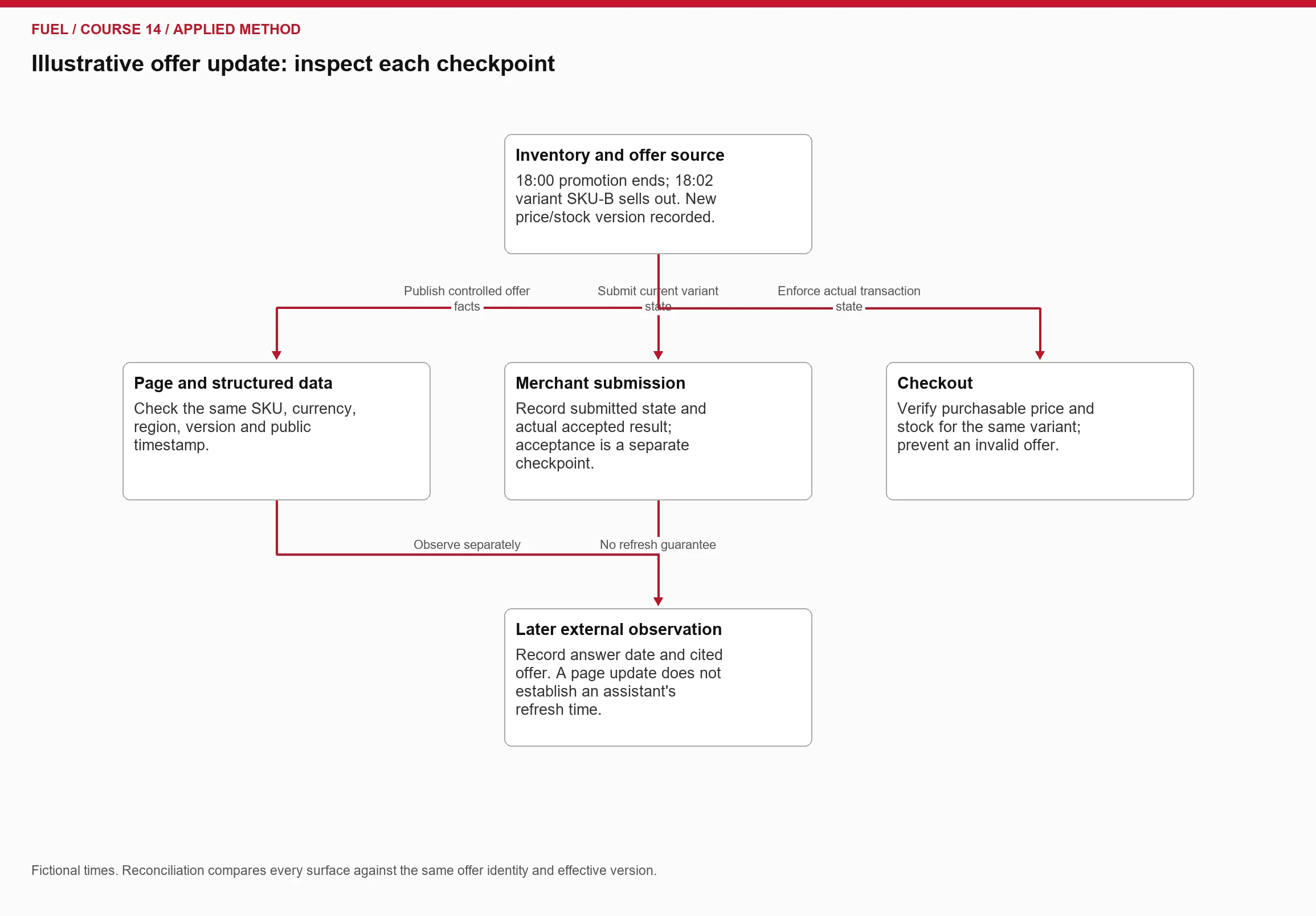
Inspect the source record first. Verify the promotion's effective end and whether the inventory event reduces sellable stock or only a warehouse count. Record the resulting version for each affected offer. If the source still says the old promotional price, the downstream page is not the earliest failure; the commercial state itself needs correction.
Preserve selected-variant identity through the buying path
Next inspect the product page with the blue variant selected. Does its visible price reflect the ended promotion? Does availability describe SKU-B rather than the default white variant? Does a direct variant URL preserve the selection? A page can appear correct at its default state while producing the wrong offer when a customer selects another option.
Inspect structured data for the same offer. If the page says out of stock but its markup still describes available blue stock, the outputs disagree. Find whether the markup uses a stale cache, a parent-level default or another identifier. Do not patch an isolated JSON value without identifying how the next render will regenerate it.
Check the merchant submission and actual processing result. Record what was sent, when it was accepted or rejected, and whether the destination market matches the page you inspected. A failed submission may leave the previous offer state active. A successful submission is useful evidence but still needs the appropriate customer-facing verification where available.
Finally try the safe test checkout path for the same variant and market. It should prevent an unavailable purchase or explain a genuine backorder state. If checkout rejects the offer while the page encourages immediate purchase, the customer journey remains inconsistent. The right repair addresses both the promise and the transaction rule.
| Checkpoint | Expected fact | Evidence to retain |
|---|---|---|
| Approved source | Regular price; SKU-B not sellable. | Effective time, variant identity and source version. |
| Page and markup | Same regular price and stock state. | Delivered text and matching structured fields. |
| Merchant path | Current submitted offer and actual result. | Submission identity, acceptance or rejection. |
| Checkout | No unsupported immediate purchase. | Safe test result for the same market and variant. |
| External answer | Current or explicitly qualified offer when observed. | Prompt, date, answer and source; no assumed refresh time. |
Validate the Facts Behind ChatGPT Product Recommendations
Use a comparison matrix for the same offer identity. Columns should include source, page text, structured data, merchant record and checkout. Rows should include price, currency, selected variant, condition, availability and relevant effective time. Record observed values rather than a series of unqualified green ticks. This makes a mismatch reviewable by someone who did not perform the check.
Test the initial delivered page and the interactive variant state. Some stores render a parent product's offer before a selected variant loads. Others change the visible price while leaving supporting data unchanged. Determine which state the buyer and the consuming surface receive rather than assuming every client executes the same interaction.
Separate valid markup from a current factual offer
Validate schema syntax and factual agreement separately. A syntactically valid price can be obsolete. A correct availability value can refer to the wrong variant. A valid product identifier can still map to a different market's offer. Keep the factual comparison beside validation results so a technical pass does not hide a commercial error.
Check cached variants deliberately. A cache key that omits region, currency or selection can deliver a plausible but incorrect offer. Use known safe test contexts and record the requested inputs. Do not expose private account-specific prices in a public inspection process; ensure that public and authenticated offers have intentional boundaries.
Look at the page's surrounding language. “Usually ships tomorrow” may survive in a shared description after inventory changes. A promotional banner may continue advertising a price that the offer block correctly ended. Important claims outside the main price widget belong in the same reconciliation scope.
Give each failed product data row a repair owner. Pricing operations may resolve the active amount, inventory may resolve sellable stock, engineering may fix cache invalidation, and ecommerce operations may handle merchant submission. One coordinator should verify that their combined repairs produce a consistent offer, rather than closing several tickets that leave the customer-facing contradiction intact.
Prioritize Product Data Freshness by Buyer Consequence
Prioritize freshness work by consequence and volatility. A frequently changing flash-sale price deserves a different control from a stable material description. An unavailable variant with heavy buyer exposure may need immediate attention, while a minor description typo can wait. The ranking should reflect the customer task and business risk, not simply the largest number of catalog records.
Define a few useful measures. Source-to-page lag measures publication after the approved source change. Source-to-accepted-submission lag measures another checkpoint. Mismatch rate measures the proportion of inspected offers with disagreement under a defined sample. Invalid purchase attempts measure a different customer outcome. Keep their denominators and collection conditions explicit.
Select a sample that can reveal failures. Include high-exposure products, frequently changing stock, recent promotions, localized offers and known mapping edge cases. Preserve a stable set for comparison and add targeted incident checks separately. A sample of only unchanged products can create an impressive freshness report while missing the system's actual weakness.
Use escalation rules tied to the failed promise. A wrong price on a live promotion, an unavailable product advertised as ready to ship and a stale descriptive attribute need different remedies. If the system cannot safely publish the intended offer, temporarily withdraw or qualify it through the business's approved process. Do not fabricate availability to preserve a listing.
Budget reconciliation work. Human review is useful for interpreting promises, while deterministic comparisons can find mismatched identifiers, currencies and prices at scale. Automate the repeated field checks and reserve people for ambiguous commercial rules. A high-volume export is not useful if nobody owns its exceptions.
Review objectives after incidents. If a modest delay repeatedly affects transactions, the current cadence or architecture may be inadequate. If a complex real-time path creates more mapping defects than a simpler approach, improve its integrity before increasing speed. The goal is a dependable buying promise, not the shortest update interval on a dashboard.
Handle discontinued, preorder and geographically limited stock
Handle preorder, backorder, discontinued and region-limited products as different customer states. Explain when an order can be placed, what is known about fulfillment and what requires confirmation. Do not convert an uncertain expected date into a guaranteed delivery promise. Match the public explanation to the actual commercial commitment.
A discontinued product may still deserve a useful informational page. People may need specifications, compatibility information or replacement guidance. Decide whether to retain that information while ending the active purchasable offer. Avoid leaving an obsolete purchase instruction simply because the URL receives traffic, and avoid deleting useful support information without considering the reader's task.
For regional offers, show the relevant market context early enough to interpret price and availability. A product available in one country may be unavailable elsewhere because of shipping or product constraints. A global description should not imply universal purchase eligibility. Keep the region attached to the offer in both public text and reconciliation records.
Treat bundles and substitutions carefully. A bundle's availability may depend on several components; a replacement item may have different specifications. Do not silently preserve the old product's price or identifiers after substituting another item. Explain the change and verify that the checkout receives the intended order.
Review images and captions when the offer changes. A photo can show accessories that the current package no longer includes. A diagram can describe a retired specification. The facts represented visually are part of the buying explanation even though they do not belong in the substantive text count. Retain accurate alt text and context without claiming an illustration documents actual inventory.
Use the pricing-page comparison workflow when offers involve commitments, allowances or nonstandard charges. Product freshness controls establish the current state; the pricing explanation helps the buyer understand what that state means for total cost.
Test AI Shopping Answers Without Assuming a Refresh Time
Verify observed external freshness without pretending you can inspect an assistant's private state. Record the prompt, engine, search state, locale, date, answer and supporting URL where shown. Compare the cited offer with the version actually delivered at the time you inspect it. Preserve the possibility that a source changed between the answer and your review.
Classify the observed answer error before repairing content
Classify errors by observation. An answer may cite a stale page, select the wrong variant, repeat an expired promotion or provide no visible source. These are useful categories for investigation. They do not prove a particular retrieval architecture or tell you exactly when the engine fetched the fact. Mark the unavailable part of the chain unknown.
After a repair, repeat comparable questions and inspect the purchasing path. Record whether the answer now qualifies availability and whether the store delivers matching current facts. A better answer is an observation under those conditions, not proof of permanent correctness or causal lift from the update.
Use content change control for dependency management across promotions, policy pages and explanatory content. Product data systems handle many volatile values, but a supporting guide can still repeat an expired offer. Keep those dependencies in the same change queue.
Connect visits and transactions with AI search referral attribution where observable evidence exists. A corrected product answer can be useful even if no click occurs; a referral session does not establish that a customer saw the price you tested. Avoid combining these stages into an invented revenue claim.
Close an incident with evidence of source agreement, delivered offer consistency and a working customer task. Track later discovery observations independently. This creates a useful operational record while respecting the parts of AI search that you cannot directly verify or control.
An agency brief for AI shopping optimization should identify which system owns price and stock, which offers will be sampled and how exceptions reach an accountable operator. Product feed optimization for AI search needs distinct evidence for source updates, submissions, processing results and the delivered buying path. Ask the provider to demonstrate the corrected controlled state and report later answer observations separately; do not contract around an invented universal ingestion deadline.
Exercise: trace a mismatch through the update chain
Try this exercise with the fictional blue lamp. The source says the promotion ended at 18:00 and stock reached zero at 18:02. At 18:06, visible page text shows the regular price and out-of-stock state, structured data shows the promotional price and in-stock state, a merchant submission was rejected, and checkout refuses the item. Identify the earliest confirmed mismatch on each downstream branch.
The markup branch first diverges at page generation or its data/cache input; inspect the version and variant mapping rather than assuming a provider error. The merchant branch has a known failed update that needs a valid corrected submission. Checkout appears to enforce the current stock state, but the public offer remains inconsistent because the other surfaces make conflicting claims.
Write two repair tickets and one verification checklist. Each ticket should name the offer identity, wrong field, approved source version, owner and safe retry condition. The checklist should compare page, markup, accepted merchant state where observable and checkout for the same variant and market.
Finish by explaining what the evidence cannot prove. It does not show whether any assistant has read the repaired page or which offer it will select next. A later prompt observation can add evidence at that stage. Keeping that boundary explicit is part of a complete freshness process, not an excuse to stop the controlled repairs.
Sources and evidence notes
[1] Google Search Central, How to add merchant listing structured data. Accessed October 25, 2026. [2] Google Merchant Center, Allow Merchant Center to update product information automatically. Accessed October 25, 2026.
Apply the workflow
Ask Fuel Online to evaluate the reader's evidence, content and measurement system using the defined task.
Explore the AI SEO and AEO course curriculum.
Discuss AI SEO and AEO implementation with Fuel Online.