
AI SEO – AEO Course 13
How Local SEO for ChatGPT Supports Suitable Recommendations
Local SEO for ChatGPT starts with business recommendations that fit the customer’s actual task, place and time. Establish accurate branch and service facts, reconcile the sources you control and test suitability against explicit constraints. A brand mention does not compensate for a wrong branch, an unavailable service or a booking instruction that sends the customer nowhere. Keep appropriate recommendation accuracy separate from visibility.

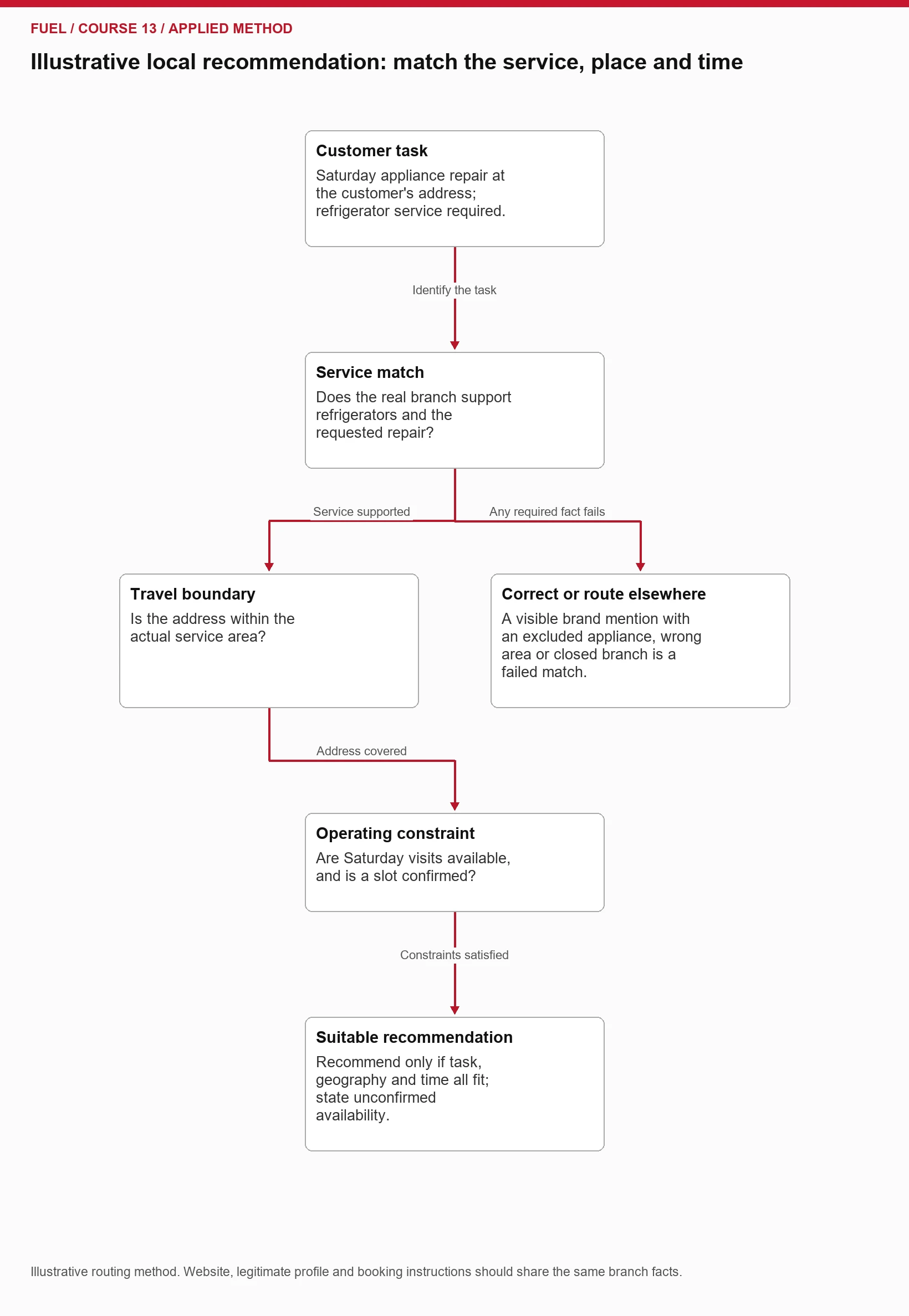
Define the customer task before testing local recommendations. “Find a refrigerator repair business that visits this address on Saturday” contains at least four requirements: appliance type, service location, travel coverage and operating time. “Best appliance company nearby” leaves those requirements unstated. Both questions may belong in a research panel, but they should not share the same acceptance rule.
For local recommendations, use a record with separate fields for business named, branch identified, service supported, address covered, hours correct and next action usable. Allow an unknown state. If the answer says “call to confirm Saturday availability,” it has not verified an available appointment, but it may have accurately described that limitation. Do not mark uncertainty as either a confirmed failure or a successful booking.
Google describes relevance, distance and prominence as major local ranking factors. [1] That documentation explains Google's local results; it does not disclose every assistant's recommendation process. The practical response is to give accurate, useful business information and measure what each observed surface actually does.
Prioritize the errors in local recommendations that most affect customers. A closed branch presented as open can waste a journey. A service-area business recommended outside its travel boundary can waste a call. An incorrect emergency claim can create more serious consequences. Rank correction work by customer impact, while recording mention rate and visibility as separate observations. This makes accuracy an operational responsibility rather than an attractive percentage with no clear meaning.
Local SEO for ChatGPT should begin with a specific service request, not a promise to appear for every nearby search. Evaluate ChatGPT local business recommendations against the task’s appliance, address, service-day and booking conditions. AEO for local businesses is useful here as a method for making those eligibility facts understandable and checkable; it does not create a new storefront, appointment slot or entitlement to a profile.
Build Verified Facts for ChatGPT Local Business Recommendations
To support accurate local recommendations, build one location-level fact record for each legitimate operating unit. Include its real identity, contact route, location or service boundary, public opening hours, appointment conditions, services, exclusions and booking destination. Record who can authorize a change and where the operational evidence lives. A page editor should not have to decide business hours from an old paragraph.
Separate office hours from actual service availability
Separate opening hours from appointment inventory. A branch can answer calls on Saturday without dispatching technicians that day. A booking page can accept a request without confirming a slot. Label these states accurately so a reader understands whether they are seeing office hours, service hours, telephone availability or an actual appointment. Avoid a generic “open now” explanation when the operational distinction matters.
Define the address-level dispatch boundary
Represent service boundaries with rules that the business can apply. A fictional repair company might serve a defined set of postal areas for routine visits and a smaller area for weekend dispatch. Preserve the difference in the fact record and public explanation. A large county name may be understandable marketing language but insufficient for a customer near its edge.
Capture exclusions as positive decision information. State which appliance categories, brands, building types or job conditions require another provider, when those facts are verified and appropriate to publish. An excluded job does not become suitable merely because it produces an inquiry. Accurate disqualification protects both the customer and the operations team.
Each fact needs a source, effective time, owner and trigger. The source might be the approved dispatch boundary, the current service catalog or the branch manager's holiday schedule. A trigger might be a branch move, staffing change, holiday, temporary closure or revised service offering. Keep the most consequential facts closer to operational updates instead of waiting for a broad annual content review.
Version the record. When a branch changes hours, retain what changed and when the new schedule applies. This helps an editor distinguish a future holiday exception from the current weekly schedule and prevents a later template update from restoring an obsolete default.
Reconcile website, profile and operational owner
When checking local recommendations, compare the facts customers encounter on the website, legitimate business profile, booking flow and direct contact instructions. Start with the same branch and task. Comparing a corporate homepage with a specific branch's appointment page can produce apparent contradictions that actually reflect different scopes. Resolve scope before changing copy.
Resolve conflicting profile and operational facts
Use a conflict ledger with the field, values found, source locations, operational owner and resolution. If the profile says Saturday service and dispatch says weekdays only, do not select whichever version looks more favorable. Ask the accountable operational owner, correct the controlled assets and preserve evidence of the decision. Record a third-party correction request separately from a verified public correction.
Google requires accurate real-world representation and precise address or service-area information. [2] Follow its applicable eligibility rules when maintaining a Business Profile. Do not create a mailing-office profile or a separate fictional location to fill a gap in geographic visibility. Legitimate branches, departments and practitioners can have different rules, so apply the actual business structure.
Check shared templates for silent defaults. A footer telephone number may belong to headquarters while a branch page needs its own booking line. A single hours block may overwrite a real branch exception. A shared service list may imply every branch offers a specialist service. Reuse layout while binding the facts to the correct operating unit.
Inspect the complete customer path after a correction. Follow the branch page to its booking destination, confirm that the branch remains selected, and check whether a central form preserves the requested service and location. A correct paragraph followed by a form that changes branches is still a broken recommendation experience.
Choose a manageable reconciliation cadence and event triggers. Stable identity facts and volatile appointment conditions need different attention. Keep failed or unavailable external edits in a queue with an owner and a retry condition, while completing corrections on assets you control. One unresolved directory entry should not prevent a useful website or booking repair.
Match AEO for Local Businesses to the Operating Structure
Compare three operating structures before choosing page and profile treatment. A real customer-facing branch has an actual place, a staffed operating model and branch-specific facts. Its content should explain what customers can do there, where to go and which contact route applies. A shared brand does not make all branches operationally interchangeable.
A traveling service business visits customers within a real service boundary. Its public content should explain coverage and booking conditions without inventing storefronts in every target town. A service-area page can answer a useful local task when it contains genuine, specific information, but a page title does not create a new business location or profile entitlement.
A legitimate department inside a larger organization can have its own task, hours and contact path. Customers may need to reach the department rather than the building's general reception. Use the actual organizational relationship and applicable provider rules. Avoid splitting one operating unit into several profiles merely because several keywords are commercially attractive.
The operating structure changes how local recommendations should be tested. A branch test asks whether the address and on-site activity are correct. A service-area test asks whether dispatch covers the customer's address. A department test asks whether the recommended contact reaches the appropriate function. An accuracy panel that checks only the brand name misses all three distinctions.
Consider how a location-aware question differs from a broad category question. A person can ask for a provider near a landmark but need service at another address. Preserve both the search context and the service location. Do not assume that a recommendation near the searcher's current position is automatically suitable for the job.
Use visible text for consequential distinctions, then align structured data where appropriate. Google documents LocalBusiness markup for business attributes such as hours and departments. [3] Markup should describe the real operating unit and match its page. Valid syntax does not prove that a particular assistant has retrieved the page, interpreted the branch correctly or selected it.
Worked Local AI Search Example: Service, Place and Time
Work through an illustrative appliance company with three fictional branches. North handles refrigerators and laundry appliances, with Saturday dispatch inside its usual northern boundary. Central handles the same categories on weekdays and answers telephone inquiries on Saturday. South offers laundry repair only and does not cover the northern postal area. Assume these facts have been verified for the teaching example; no real company was audited.
A customer in the northern area asks for refrigerator repair this Saturday. An answer recommending North with a request to confirm a slot can be a suitable qualified recommendation. It matches the appliance, geography and stated service day, while correctly preserving uncertainty about actual availability. The answer should not promise a confirmed technician visit without appointment evidence.
Identify a correct fact used for the wrong conclusion
An answer recommending Central because its phone line is open Saturday fails the dispatch requirement if it claims Saturday repair. The telephone-hours fact may be correct, but the service interpretation is wrong. Repair the public distinction between inquiry hours and dispatch hours, then test the same constraint again. Do not change a legitimate phone schedule to hide the problem.
An answer recommending South fails both appliance and coverage requirements. That is a different error from a missing phone number. Record which constraints failed so the correction can address the source of confusion. A broad brand-level service list copied onto every branch page is one possible cause to inspect, not a mechanism to assume without evidence.
Now change the question to a weekday laundry repair within South's boundary. South may become a suitable option. The example demonstrates why a universal list of preferred branches is less useful than a task-based decision record. Accuracy depends on the customer context as well as the business facts.
Score the answer against required constraints and label the outcome: suitable, unsuitable or insufficiently specified. Keep the individual failed fields, because an overall score can hide a severe mistake behind several correct minor details. A correct brand and phone number should not cancel an unsupported claim that the branch performs the requested service.
| Branch | Appliance fit | Area fit | Saturday dispatch | Decision |
|---|---|---|---|---|
| North | Refrigerators supported | Northern request covered | Available service day; slot unconfirmed | Potentially suitable with confirmation. |
| Central | Refrigerators supported | Assume request covered | Phone inquiries only | Unsuitable if Saturday dispatch is promised. |
| South | Laundry only | Northern request excluded | No relevant availability | Unsuitable on service and geography. |
Publish local constraints in visible content and markup
Publish a branch page as a usable task destination. Lead with the branch identity and what it actually serves, then show the location or service boundary, service conditions and contact path. Put common exclusions and material schedule distinctions near the action they affect. A visitor should not have to navigate several pages to discover that the branch cannot do the job.
Make the booking route in local recommendations unambiguous. Say whether the action requests an appointment, confirms one, opens a general inquiry or connects to a dispatch line. Preserve branch identity when a shared system handles the form. Explain any required confirmation step so neither a person nor an assistant converts “request received” into “visit booked.”
Use a consistent factual core across the visible page and eligible structured data. Compare name, telephone, address where applicable, hours and relevant organizational relationships. Check the actual delivered markup, because several plugins can publish conflicting values. A successful validation test checks format; operational verification checks whether the values are true.
Keep real exceptions accessible. Holiday hours, temporary service restrictions and unusual access instructions should be visible where affected customers look. Avoid adding a false new update date to unrelated pages. When a temporary condition ends, restore the current approved state and retain enough change history for an editor to understand what happened.
Provide textual explanations for complex boundaries. A map can help orient a reader, but it should not be the only place that states important coverage limits. Use an approved list, address checker or clear description that can support a booking decision. Do not label a schematic illustration as evidence that a precise street is covered.
Link relevant tasks naturally. If a branch page references a specialist service, make the destination explain that service's actual eligibility. If it references a central booking process, explain how the branch is selected. Each step should reduce uncertainty rather than merely add another branded page to the journey.
Test Local AI Search Optimization Against Real Constraints
Build an observation matrix across service, geography, time and intent. Choose common profitable tasks, frequent misroutes and known boundary cases. Include questions that should produce a qualified answer or a refusal to recommend your branch. A panel consisting only of easy requests inside your strongest market cannot reveal the errors most likely to frustrate customers.
Keep neutral discovery separate from branded accuracy
Separate neutral discovery questions from branded accuracy questions. A neutral question tests whether a suitable business is surfaced without naming it. A branded question tests whether the answer describes your business correctly. Both are useful, but mixing them makes a visibility score hard to interpret. Keep the same task definitions when comparing later observations.
Record the exact question, engine, search mode, locale, date and relevant context, plus the complete answer and cited pages where available. Preserve ambiguity about user location rather than assuming all interfaces use the same signals. If you supply a service address in the question, record it as an input using a safe fictional or appropriately handled test address.
Use repeated observations for selected cases. Different answers can expose conflicting sources or unstable interpretation. Do not call a single unfavorable answer a universal platform behavior, and do not call one favorable answer proof of a permanent correction. Store the observed result with its conditions so later reviewers can understand the comparison.
Define denominators before reporting. Suitable recommendation rate needs a stated set of opportunities where the offer could meet the task. Fact accuracy needs the individual claims you audited. Mention rate uses observed eligible answers. These are different questions and can move in different directions.
Bring customer operations into the review. They can recognize an impossible dispatch promise or a branch-selection issue that a content analyst misses. The review does not require invented expert credentials; it requires the actual operational owner to verify the facts within their responsibility. Keep unverified fields marked unknown until the right evidence exists.
Correct the Sources Behind Unsuitable ChatGPT Recommendations
Correct the source conflict before chasing the visible answer. Start with the approved operational fact, then update the relevant controlled page, booking explanation and legitimate profile where authorized. Record the effective version and verify the delivered content. A submitted edit is evidence of an action, not evidence that every public surface has adopted it.
Record correction and propagation as separate events
For corrected local recommendations, maintain a propagation record with separate dates for operational approval, publication, external submission and later observation. This helps distinguish a failed correction from an answer that may still rely on an older source. Avoid promising a universal refresh interval. If a surface continues to repeat the wrong fact, inspect the supporting page and current result rather than assuming a hidden penalty.
Use bounded retries. If an external edit is rejected, save the reason and the evidence needed for the next attempt. Continue fixing independent controlled assets and customer instructions. Escalate only the affected dependency instead of freezing all local content work. A clear current booking page can reduce harm while another source remains unresolved.
Treat prevention as change control. A new branch, holiday or service expansion should trigger the same fact record, dependency review and public verification process. The content freshness and change-control course explains how to manage those dependencies without relying on date rollovers.
Connect accurate recommendations to actual outcomes carefully. Website visits, inquiry submissions, qualified dispatch requests and completed jobs belong to different stages. The AI referral attribution workflow helps preserve observed acquisition evidence. It cannot identify every assistant-influenced customer or establish that a content correction caused the eventual sale.
Close an incident with evidence of the repaired customer task: the page states the right constraint, the booking route preserves it and the operational owner agrees. Record later assistant results as observations. This makes a correction reviewable even when the external answer has not yet changed or cannot be reproduced.
When commissioning local AI search optimization, give the agency a branch fact register and several documented misroutes. Ask for a source-conflict ledger, approved corrections, a checked booking path and a stable task panel. AI SEO for local businesses should name which operational owner verifies service coverage and which public surfaces were actually corrected. Keep external edit submissions, observed assistant answers and completed jobs in separate evidence records.
Exercise: score recommendations and fix the unsafe mismatch
Try this exercise using the fictional branch facts. Four answers recommend: North for Saturday refrigerator repair in its northern boundary; Central for confirmed Saturday dispatch; South for a refrigerator job in the north; and South for weekday laundry repair within its boundary. Assume only the first answer tells the customer to confirm an available slot.
For these local recommendations, classify the first as potentially suitable with an explicit availability condition. Classify the second as unsuitable because telephone opening does not establish dispatch. Classify the third as unsuitable on both appliance and geography. The fourth can be suitable if the answer accurately states booking conditions; if it omits a material condition, record what remains unknown rather than inventing a failure.
Prioritize the second and third for correction by customer consequence and exposure. Inspect whether Central's source conflates telephone and dispatch hours and whether South inherited a brand-wide service list. These are diagnostic checks, not conclusions. The exercise is complete only when you identify the actual conflicting field and a source that can resolve it.
Prepare a correction ticket with the task, wrong claim, approved fact, affected assets, owner and verification step. Add a later observation question that preserves the original constraints. A useful answer key explains why each case passes or fails; a bare score cannot show whether the reader understood the operational distinction.
Sources and evidence notes
[1] Google Business Profile, Tips to improve your local ranking on Google. Accessed October 25, 2026. [2] Google Business Profile, Guidelines for representing your business on Google. Accessed October 25, 2026. [3] Google Search Central, Local business structured data. Accessed October 25, 2026.
Apply the workflow
Ask Fuel Online to evaluate the reader's evidence, content and measurement system using the defined task.
Explore the AI SEO and AEO course curriculum.
Discuss AI SEO and AEO implementation with Fuel Online.