
AI SEO – AEO Course 24
How do sales calls reveal B2B AI search keywords?
Find B2B AI search keywords in sales calls by extracting the buyer's decision, constraints and exact question, then identifying the evidence needed to answer it. Group questions that require the same substantive answer and assign each family to an existing or justified new page. Keep the original call context and distinguish customer language from sales interpretation. The output is a reviewable question-and-evidence ledger, not a claim that your call sample represents search volume or reveals an assistant's hidden queries.

Use AI search keywords as a practical planning label for the language and concepts buyers may use during AI-assisted research. A sales question is evidence that a particular person needed an answer in a particular situation. It is not evidence that ChatGPT receives that wording at a known frequency. This distinction protects prioritization. A rarely asked integration question can decide a large contract, while a common introductory question may already have a satisfactory answer on the website.
Choose authorized material and a bounded sample
Begin with authorized material available to the research team. Approved notes, de-identified excerpts and structured opportunity summaries can be sufficient. Do not assume that access to a recording makes every detail suitable for a public brief. Remove unnecessary customer identifiers and keep confidential configurations, pricing negotiations and personal information outside the publishing packet. Preserve a private source reference so an authorized reviewer can verify the interpretation without distributing the entire conversation.
Choose a bounded sample across wins, losses and stalled decisions when those records are available. Record the period, product, market, deal stage and selection method. A set drawn only from recent wins can miss the objections that caused otherwise qualified buyers to leave. A set drawn only from support escalations can overemphasize operational problems among existing customers. Neither sample is useless, but its selection limits the conclusions the content team can draw.
Count opportunities separately from repeated questions
Count the right unit. One procurement team may repeat the same question on five calls while pursuing a single decision. Counting every repetition as a separate buyer can inflate apparent importance. Retain call-level occurrences for context, but also record distinct opportunities or buying groups when permitted. Avoid pretending that a contact database is a random sample of the market. State whether a reported count concerns utterances, calls, opportunities or separate organizations.
For AI SEO keyword research, ask an agency to show how one authorized excerpt becomes a public question, an evidence requirement and an existing page assignment. That sample handoff is more informative than a long list of generated prompts. The business still needs to verify the answer, particularly where the question concerns capability, service scope or implementation risk.
Prepare a research charter before extracting phrases. Name the offer, buyer group, decisions in scope, records available, excluded information and people who can verify the answers. For example, a fictional migration consultancy might investigate compatibility, audit-history continuity, customer responsibilities and implementation economics. It would not use those calls to establish market-wide preferences for every software category. A clear boundary makes the resulting AI search keywords commercially relevant and prevents an endless expansion into unrelated content.
Which buyer wording belongs in AI SEO keyword research?
Separate three layers in the ledger: what the buyer actually said, what the researcher thinks it means and which answer the business can support. Preserve short exact wording only when authorized, with the necessary context. Label paraphrases and inferred questions explicitly. A sales representative's summary that the customer wants an enterprise solution is not a verbatim request for a particular feature. Treat that summary as a lead for investigation rather than a completed content brief.
Find the condition behind a broad objection
Look for the decision-changing condition inside a broad question. A buyer asking whether migration is easy may be worried about downtime, responsibility for cleanup, preservation of old records or the availability of an internal administrator. Those concerns require different evidence. Review the nearby conversation and ask the account owner to clarify what remained unresolved. Replacing the question with a generic how-to article can miss the reason the buyer asked it.
Use a two-column interpretation check. In one column, write the narrowest supported question. In the other, write an alternative plausible interpretation. For the fictional question about retaining audit history, alternatives might concern record completeness, search access after import or contractual retention time. Identify which interpretation the call actually supports. If the record cannot distinguish them, retain uncertainty or propose an expert follow-up rather than choosing the interpretation that produces the most convenient article.
Retain negative and non-fit questions
Protect meaningful negative questions. Buyers may ask which environments are unsupported, when a project should be delayed or what the service does not include. These can make valuable AI search keywords because they help qualify an offer accurately. Do not rewrite every objection into a favorable promotional premise. A page that explains when a service is unsuitable can save both the prospect and the delivery team from a poor fit.
Distinguish a term from a task. A buyer might use an internal acronym for a compliance process, while the public audience uses a broader category name. Preserve the original term privately and identify a natural public explanation. Do not create a page around a confidential acronym simply because it appears several times in the sample. Use the task, recognized product names and approved terminology to make the explanation understandable beyond one account.
Run a small extraction calibration before processing a larger archive. Have two reviewers independently interpret the same authorized excerpts, then compare which questions they identified and why. Disagreements often reveal vague coding rules or missing context. Keep those cases visible instead of resolving every one by majority preference. Agreement can improve consistency, but it does not prove that either interpretation reflects a wider market or that the proposed AI search keywords will generate qualified traffic.
How do you code AEO keyword research by stage, risk and proof?
Use a compact codebook that captures the buyer role, decision stage, task, constraint, risk and requested proof. Define each field with a short example and a counterexample. The role describes the responsibility represented in the conversation, not a guessed job title. The stage identifies the decision being made, such as initial fit, technical validation or commercial approval. The proof field describes what would resolve the uncertainty rather than merely repeating the question.
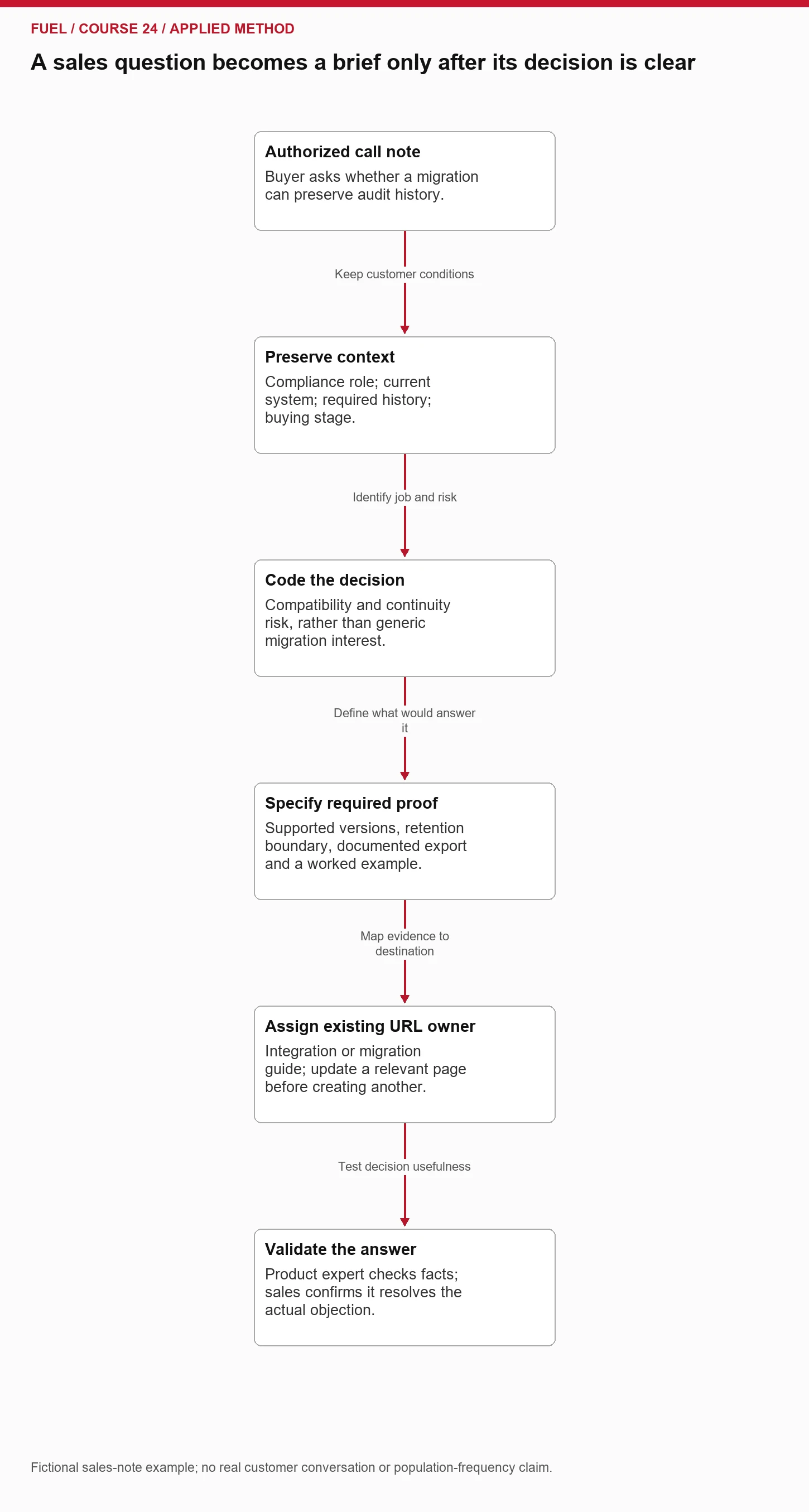
Allow one question to carry more than one relevant code. A retention question can concern compatibility and risk, while its immediate stage is procurement approval. Do not force it into a single keyword category if that erases the useful distinction. Keep the coding simple enough that another researcher can apply it consistently. An elaborate taxonomy that requires guessing dozens of hidden buyer motivations creates more precision in the spreadsheet than the records support.
Add a source-quality field. An explicit buyer question with a clear condition is stronger evidence of that person's need than a secondhand recollection lacking context. An account owner's interpretation can still be useful if labeled. A proposal boilerplate question copied across every opportunity may reveal the sales process rather than customer demand. Recording these differences helps the team prioritize verification before multiplying a weak interpretation into many content briefs.
A migration question coded into a proof requirement
Work through a fictional ledger row. The buyer is an operations lead evaluating a migration. The question asks whether imported approval history remains searchable. The stage is technical validation; the task is continuity of records; the constraint is the existing source system; the risk is losing a usable audit trail. Required proof includes supported versions, retained fields, exclusions and a validation procedure. The next action is a product-expert review, not immediate publication of a claim that all history is preserved.
Use a disagreement queue for unclear codes. A short note can identify the excerpt, competing interpretations, missing context and person who can resolve it. Continue coding unambiguous records while that item is reviewed. This keeps one difficult conversation from stopping useful research and prevents an analyst from silently imposing an interpretation to complete a quota. When the rule changes, revisit affected rows rather than recoding the entire archive.
AEO keyword research should preserve the condition that would make a recommendation suitable or unsuitable. Record B2B buyer questions for AI search with the role, decision stage and requested proof intact. An agency can then explain why a technical objection belongs beside a compatibility answer, while a commercial objection needs a different explanation.
Keep the AI search keywords attached to the coded decision. A phrase such as migration audit history is useful because its row specifies a buyer task and evidence need. Detached from that row, it can become a vague instruction to repeat words in a page. The codebook should support better answers and ownership, not produce a vocabulary list that writers must insert regardless of relevance. Maintain a version so future researchers understand which definitions governed earlier rows.
Calculate recurrence transparently before assigning priority. In a fictional sample of twelve calls from six opportunities, audit-history questions appear eight times across three opportunities. Report eight mentions, not eight buyers. The opportunity-level observation is three of the six sampled opportunities; it is not a market demand estimate. If two of those opportunities belong to the same organization, preserve that relationship rather than implying three independent companies. Record both the numerator and denominator so the next researcher can reproduce the description.
How do buyer questions become an AI search content strategy?
Group questions by the substantive answer and the evidence required, not only by shared wording. Questions about who prepares the inventory and what the customer must supply may share one prerequisite explanation. A request for an inventory template needs a usable artifact and instructions. A question about migration cost needs comparable scope and assumptions. These differences can justify distinct sections or resources, even when a keyword tool places them in one broad cluster.
Write a one-sentence reader decision for each question family. Follow it with the direct answer the business can currently support, the evidence still needed and the intended next action. If the answer is not known, the brief should contain a research task rather than a confident placeholder. A content model can help organize supplied material, but it should not fill missing product capabilities, client results or commercial terms with plausible inventions.
Choose a contribution that goes beyond summarizing familiar advice. Useful options include a responsibility matrix, a decision tree, a comparison with normalized scope, a documented process or a hypothetical calculation with explicit inputs. The artifact should resolve the uncertainty found in the calls. A generic introduction about the importance of digital transformation does not answer whether the customer's administrator must prepare the migration inventory.
Google's helpful-content guidance asks for original information and substantial added value rather than merely rewriting other sources. Treat that as a quality boundary, not evidence that sales-call mining causes AI citations. The practical reason to use calls is more direct: they can reveal specific questions and constraints that the team is able to answer accurately. The resulting content still needs factual review, readable structure and a coherent public destination.
Prioritize without inventing search volume
Prioritize without inventing search volume. Use a short rationale combining decision importance, observed recurrence, current answer quality and the effort needed to supply proof. Preserve the distinct-opportunity count alongside any call count. A family appearing in two high-fit lost opportunities can deserve investigation even if a broad introductory question appears in ten calls. This is a planning judgment, not a forecast of traffic, revenue or citation lift.
Require an expert handoff where the brief depends on product or service facts. The account owner can explain the buyer context; the product or delivery owner verifies what the business can do; the editor turns that knowledge into a useful explanation. Record which facts remain unverified and who owns them. AI search keywords should point the team toward evidence, not become a reason to publish beyond its actual expertise.
Make the AI search content strategy inspectable through a small set of approved briefs. Each should identify the original buyer concern, the evidence owner, the destination and the intended next action. This gives a hiring team a concrete way to assess research quality before committing to a larger writing program, without pretending that sales-call recurrence predicts search traffic.
Make prioritization inspectable with a short decision record. Suppose audit-history continuity occurs in three sampled opportunities and depends on missing technical proof, while inventory responsibility occurs in four and already has an approved checklist. The team can publish the checklist improvement first while the technical expert verifies the harder question. That sequence reflects evidence readiness and buyer usefulness. It does not mean the four-opportunity family has greater search demand or that the unresolved question matters less commercially. Give the research dependency an owner and review date so difficult, valuable questions do not disappear behind easy publishing tasks.
When should B2B AI search keywords update an existing page?
Inspect the current content inventory before assigning a new URL. Find the page that already serves the buyer's decision and assess the actual answer. A service page may need a clearer prerequisite section rather than a separate article about the same responsibility. A cost guide may need a better scope explanation. Updating an established owner can complete a task while reducing contradictory copies and maintenance work.
Decide whether the answer earns another URL
Use three ownership questions. Does the proposed content require a substantially different answer? Does it need distinct evidence or a functional artifact? Does the reader have a different next action? A separate implementation worksheet may earn its own destination when it is genuinely usable and maintained. A page containing only another phrasing of the service's inclusion list does not gain distinct value from a new keyword in its title.
Build a family-to-owner map for AI search keywords. Each row should identify the question family, current destination, missing explanation, planned change, evidence owner and relevant internal route. Mark whether the destination is live, proposed or awaiting evidence. Writers should not publish links to empty placeholders. A planned comparison can remain plain explanatory text until the destination exists and its content is verified.
Consider the fictional migration company's three families. Inventory responsibility belongs on the service page with the approved handoff checklist. First-year internal-versus-managed cost belongs in a substantial cost guide with explicit assumptions. Creating a reliable inventory may deserve a separate template resource if the company can provide a real artifact and instructions. The distinctions come from what the buyer needs to do, not from how many phrases the research produced.
Keep sales-stage and customer-stage content connected without confusing their purposes. A prospect evaluating whether an integration exists needs compatibility and scope. An existing customer configuring it needs operational instructions and the correct version. One asset can link naturally to the other. Forcing both into one unstructured article can make the purchase decision harder and bury the procedure. The ownership map should explain which task each page completes.
Apply change control when a fact supports several families. If the customer responsibility changes, update the service section, relevant comparison and any downloadable checklist that repeats it. Keep a source-of-record relationship so an editor knows which statement governs. The AI search keywords remain useful as discovery language, but the maintained business fact is the dependency. This avoids a content library that remembers obsolete promises because each phrase was treated as an independent page.
How do you validate AI search keyword briefs with sales and experts?
Validate the proposed briefs with sales and the relevant subject owners before publication. Ask whether the direct answer would have resolved the original concern and whether it preserves the buyer's conditions. A salesperson may confirm relevance without being qualified to verify a technical capability. A technical expert may approve the fact while missing the commercial objection. Keep those approvals distinct so a single check mark does not conceal different responsibilities.
A five-note extraction and briefing exercise
Run this fictional lab with five notes. One buyer asks who cleans the source inventory; another asks whether old approval records remain searchable; a third asks for the lowest price; a fourth asks whether a named integration is supported; the fifth is a salesperson's prediction that everyone wants faster onboarding. Classify the first four as observed questions with unresolved context to preserve. Classify the fifth as a hypothesis requiring evidence, not a verified buyer question.
Now turn the notes into useful briefs. The inventory question needs an approved responsibility boundary. The record question needs supported versions, retained fields and exclusions. The price question needs currency, scope and commitment before a comparison. The integration question needs a current capability source and applicable conditions. The onboarding hypothesis may justify checking additional records or asking an expert what actually determines the schedule. It does not justify inventing a universal faster-service claim.
Keep an answer key that explains the reasoning, not just the assigned labels. A strong researcher identifies what the record supports, what remains uncertain and which evidence would resolve the uncertainty. The exercise is not complete when every row has an AI search keyword. It is complete when another person can see how the question becomes a credible answer and why its proposed destination helps a real buyer make a decision.
Measure usefulness with appropriately narrow evidence. Sales teams can report whether a page answers a recurring objection, whether prospects use the supplied worksheet and which questions remain unresolved. Website behavior and qualified inquiry data can add context. These observations do not automatically show that the content caused a sale or that the original call wording matches broad AI-search demand. Keep citation, referral, inquiry and commercial outcomes separate when reporting the program.
Refresh the ledger when the offer, product, audience or sales process changes. Add new questions without continuously rebuilding accepted families. Retire a family when its decision disappears, merge duplicates and revisit uncertain rows when new evidence arrives. The durable outcome is a maintained question-to-proof system. It gives AI search keywords a clear purpose: helping the business publish accurate, distinctive answers that buyers can use during evaluation, whether they arrive through an assistant, a conventional search result or a direct sales conversation.
Close the loop with a small acceptance test for each revised destination. Give a reviewer the original de-identified question, its conditions and the proposed page without explaining the intended answer. Ask the reviewer to locate the answer, identify its supporting proof and name the next action. Record an unanswered condition as a defect even if the page contains the target phrase. This test can expose missing exclusions, ambiguous responsibilities or a buried worksheet. It evaluates the usefulness of the published answer; it does not simulate an assistant's retrieval process or establish a ranking effect.
For a scoped implementation discussion, explore Fuel Online’s AI SEO and AEO services.
Source notes: Creating helpful, reliable, people-first content. Checked October 25, 2026. Applied frameworks are editorial recommendations; hypothetical examples are not Fuel client results.
Explore the AI SEO and AEO course curriculum.
Discuss AI SEO and AEO implementation with Fuel Online.