
AI SEO – AEO Course 23
How do you separate language and country in multilingual AI search?
Test multilingual AI search by separating the language of the question, the buyer's country and the offer that is actually available there. Use native buyer questions alongside a smaller set of equivalent diagnostic questions, hold observation conditions stable and repeat the tests. Score factual accuracy, local applicability and source support for each market-language combination. A single global mention score can hide a wrong currency, an unavailable product or a translated answer that changes the buyer's requirement.
Language and market are different variables. French-speaking buyers in Canada and France may share a language while encountering different availability, support arrangements and commercial terms. English-speaking buyers in the United States and Canada may use similar words but need different answers. Treat these differences as part of the decision rather than noise to average away. A recommendation that is accurate in one country can be unsuitable in another even when the generated prose is fluent.
Build a buyer-task, language and market matrix
Build a three-axis multilingual AI search test record: buyer task, language and market. Add offer version when the product itself changes across countries. For every cell, name the intended audience, relevant country, permitted offer and evidence owner. Do not create a cell simply because a translation tool can generate it. The cell should represent a market the business serves or an explicit research question. This keeps the test useful for prioritizing investment rather than becoming a language-count competition.
Consider a hypothetical software company serving English-speaking buyers in the United States and English- and French-speaking buyers in Canada. Start with three cells: US English, Canadian English and Canadian French. Comparing the two Canadian cells helps examine language differences within one market. Comparing the two English cells helps examine country differences with a shared language. Neither comparison automatically identifies a cause, because wording, source coverage and product context can still vary.
Define what an accurate local answer requires before collecting outputs. For a support question, the decisive facts might be service hours, supported language and applicable plan. For pricing, they might be currency, billing basis and country availability. For compatibility, they might be the local product edition and supported integration. Keep a field for unknown facts. An assistant should not receive credit for inventing a reassuring local answer when the company has not established the underlying offer.
A brief for ChatGPT visibility by country should name the markets the business actually serves and the decisions each local audience needs to make. Ask an agency for a sample capture and scored local answer before buying a global dashboard. Country totals are less useful when the underlying questions, offers or languages are incomparable.
The first multilingual AI search deliverable is a compact market-language matrix with decision questions and acceptance rules. Keep the matrix separate from a translation glossary. The glossary helps people use consistent terms; the matrix defines which buyer decisions the test covers. This distinction makes it possible to discover a genuine market gap without mislabeling it a translation error, or to identify a wording problem without rewriting an otherwise accurate regional offer.
Which buyer questions should multilingual AEO testing use?
Native buyer questions and equivalent diagnostic questions
For multilingual AEO, use local expertise to establish the question as well as to translate the answer. The agency needs access to approved offer facts and a native reviewer who can explain the implied purchase decision. A translated keyword list cannot supply either responsibility on its own.
Use two multilingual AI search question sets with different purposes. A native-intent set captures how buyers in a market actually describe their task. An equivalent-question set preserves a common decision and constraints across languages so the team can inspect differences more systematically. The first supports useful discovery research. The second supports diagnosis. Mixing them without labels makes a later score hard to interpret, because an apparent visibility difference may come from asking substantially different questions.
Collect native phrasing from authorized sales notes, support questions, site searches and local subject experts. Ask a native reviewer which product category words buyers use, which alternatives they compare and which conditions they normally state. A literal translation can be grammatically correct while sounding like a phrase no buyer would use. Preserve the original question and its context so a researcher can distinguish customer language from an editor's polished interpretation.
For equivalent questions, translate the decision rather than force identical syntax. Keep the required outcome, budget basis, company size, time constraint and mandatory feature comparable. Record any term with no clean equivalent and explain the chosen substitution. If one market measures a service in a different unit or commonly buys a different package, that difference may need a separate scenario. Do not silently normalize away a condition that changes the suitability of the answer.
Stable product names and translation checks
Use a small glossary for names that should remain stable: organization, product, plan, integration, location and technical identifiers. Identify which names are officially localized and which are not. A reviewer should know whether a different product name is an approved translation, a former name or a hallucinated alternative. Keep the glossary tied to the product owner rather than letting every writer create a plausible local label. Consistency helps diagnose identity errors without assuming that naming alone controls AI visibility.
For multilingual AI search questions, back-translation is a useful check but an incomplete acceptance test. Translating the question back into the source language can reveal a dropped condition. It cannot establish that the local wording is natural, commercially relevant or culturally appropriate. Ask a native reviewer to explain what decision the question implies and which answer would satisfy it. If the explanation differs from the intended buyer task, repair the prompt before using it in a comparison.
In the fictional three-cell test, a question about a monthly plan must distinguish monthly billing from a monthly equivalent under an annual commitment in every language. If the French version asks only for the lowest monthly rate while the English version asks for cancelable monthly service, the two questions are not equivalent. The correct response is to revise the question record, retain the old version and restart that comparison, rather than interpret the difference as a language advantage.
How do you compare ChatGPT visibility by country?
For multilingual AI search comparisons, record the exact engine or product surface, available model identifier, search-enabled state, account conditions, language settings, market information, date and session approach. Distinguish a consumer interface from an API test. A test through one interface should not be described as a measurement of every way people use the same brand of assistant. Where a setting cannot be controlled or observed, mark it unknown and limit the comparison rather than inventing consistency.
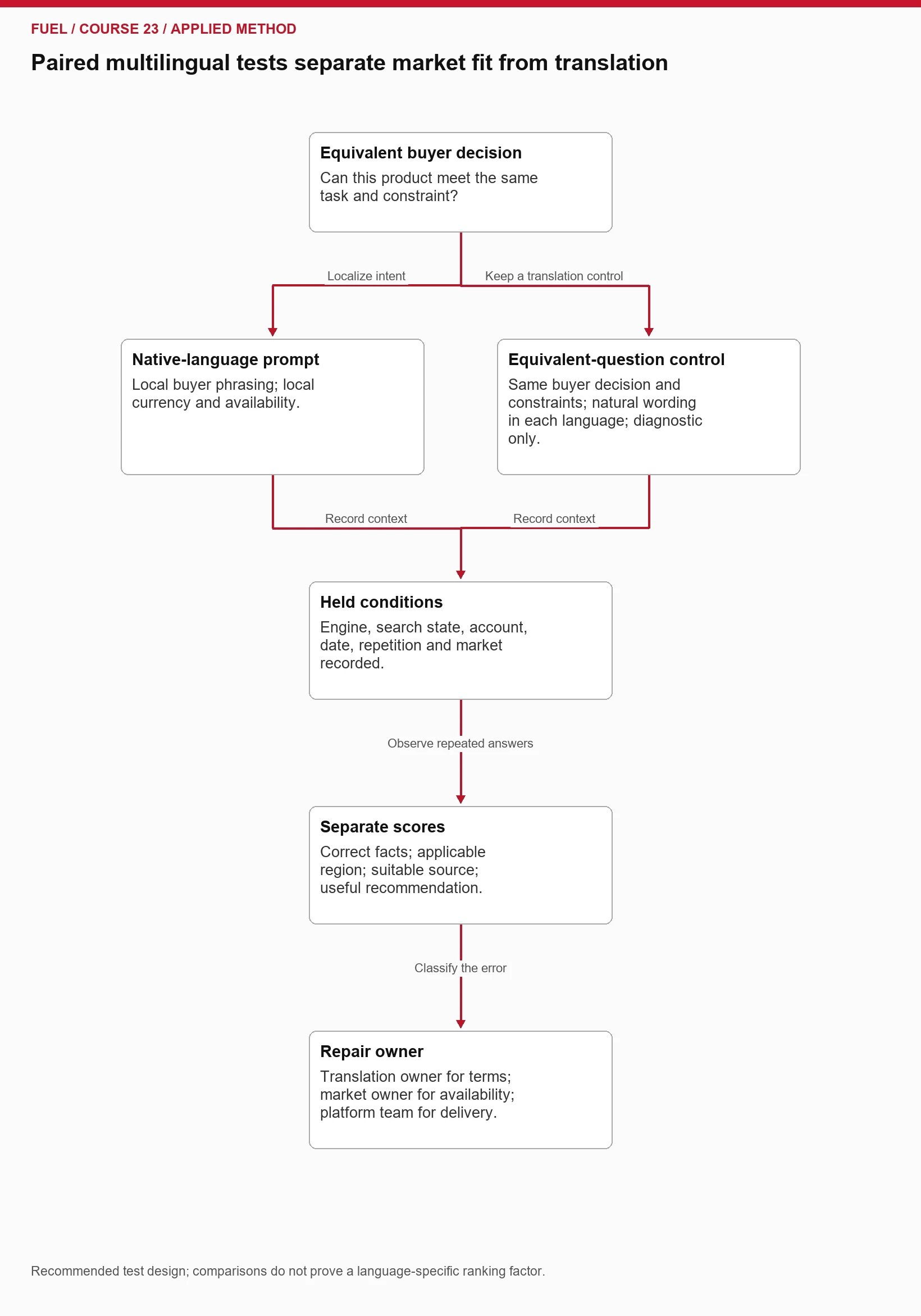
Keep the buyer's market explicit when it matters to the task. A question about a service available in Ontario should identify that location, while a general technical question may not need geography. Do not assume that the language of the interface establishes the buyer's country. Likewise, a regional network address alone does not establish every condition the platform uses. Capture the settings you can observe and the location stated in the question as separate fields.
Repeated observations and the limits of sample size
Use repeated multilingual AI search observations on a planned schedule. Interleave cells when possible so one language is not tested only before a platform update and another only afterward. Preserve the exact question versions, including punctuation and supplied context. If a native-intent prompt evolves during research, treat the new version as a new item. Repetition helps characterize observed variation, but it does not make uncontrolled account conditions or unequal question tasks disappear.
A hypothetical design might contain six buyer questions, three market-language cells and four observations per question-cell combination, giving seventy-two captured answers. The arithmetic defines the collection workload, not statistical sufficiency. The questions and repeated answers are related, so seventy-two outputs are not seventy-two independent experiments. Retain the question family and cell identifiers so later analysis does not pretend each response was randomly sampled from the entire market.
Choose failure and exclusion rules before looking at the results. If the service returns no answer, record an availability failure. If it provides an answer without sources, retain that output and mark source support unobservable rather than dropping it from the dataset. If a provider feature is unavailable in a market, state that limitation. Quietly excluding inconvenient cells can make a global score look better while removing exactly the market issue the test was meant to reveal.
Keep the capture packet useful to another reviewer. Store the original-language question and answer, a working translation for the central team, cited URLs, inspected passages and reviewer notes. The translation should not replace the original artifact. A local qualification can disappear during translation, and a central reviewer may otherwise approve an answer that the native audience interprets differently. Language review and factual review should meet in one record without pretending they are the same skill.
Prepare the collection order as part of the test packet. Rotate which cell is observed first and avoid placing a prior answer into the next question's conversation. If a system supports only one relevant market setting, record that restriction rather than simulate a setting it does not offer. A collection log can include planned time, actual time, question version and deviation reason. This makes a missed run or changed session visible without discarding the rest of the useful observations.
How do you score local accuracy and citation support?
Score multilingual AI search on at least four dimensions separately: answer accuracy, market applicability, source support and suitable recommendation. Accuracy asks whether the stated facts are correct. Market applicability asks whether those facts apply to the buyer's country, offer and constraints. Source support asks whether the cited material establishes the decisive claims. Suitable recommendation asks whether the proposed option fits the task. A fluent answer with a relevant brand mention can still fail the other dimensions.
Define consequential errors with concrete examples. Wrong currency, an unavailable local plan, an unsupported language promise and a misidentified regional entity can each change a buyer's decision. A stylistic translation preference usually does not carry the same consequence. Use a severity field with a written explanation rather than treating every wording variation as an equally serious defect. The aim is to prioritize repairs that improve actual understanding and suitability.
Source language is different from market applicability
Inspect the language and market of the cited source independently. An English source can accurately support a French answer about a universal technical capability. A French source can be unsuitable if it documents a plan available only in another country. Therefore, do not score same-language citation as an automatic success. Ask whether the source supports the fact for the intended audience and whether a buyer can reasonably verify the information it provides.
Compare rates within cells before considering any combined view. If Canadian French answers are correct in eight of twelve observations and Canadian English answers in ten of twelve, report those observed counts and the question coverage. Do not describe the difference as a proven language penalty. The example is hypothetical, and differences can reflect wording, source availability or ordinary output variation. Inspect which questions failed and which source facts explain the failures.
Use a factual reference table for multilingual AI search approved by the relevant business owners. It should identify the local plan, currency, availability, supported languages, product version and effective date where these matter. Give each row a source and an owner. If the reference itself is incomplete, the test can reveal a company-information gap but cannot fairly declare every uncertain assistant answer incorrect. Resolve the missing fact or mark that evaluation item unscorable with an explicit reason.
Separate source selection from answer translation. If the assistant cites a correct Canadian French page but reports the US price, the issue differs from one in which only the US page is retrieved. If both local languages cite the same obsolete global PDF, a shared source correction may help more than rewriting every translated page. The diagnostic record should identify the observed failing stage so a local editor, product owner or technical team receives a specific task.
Calibrate reviewers before dividing the language work
Calibrate the scoring with a small shared set before dividing language work. Give two reviewers the same original answers and reference facts, then compare the reasons for their judgments. Resolve a disagreement about whether the answer applies to the right country separately from a disagreement about translation style. Keep unresolved cases in an adjudication queue. Agreement between reviewers does not prove that an answer is true, but the exercise can reveal an ambiguous rubric before that ambiguity spreads through the whole collection.
Which source errors should international AI SEO fix first?
Scope international AI SEO around verified regional facts and delivered sources. AI search localization may require clearer currency, availability or support-language information, rather than more translated pages. The work order should identify the local fact owner, the publishing change and the answer conditions to observe afterward; it should not promise identical recommendations in every market.
Start with the smallest verified source correction. If the local offer is wrong on the website, correct it with the country owner and update dependent material. If product terms are translated inconsistently, maintain an approved glossary and revise the relevant pages. If the correct information is buried in an unrelated region's document, create a clear local explanation or discovery route. These are practical information improvements, not promises that the next generated answer will change.
Assign local offer and language owners
Use distinct locale ownership for multilingual AI search corrections. A central product team can approve a universal capability, while a regional commercial team verifies availability and terms. A native editor checks whether the explanation preserves meaning. Record the decision that each owner is responsible for, because a language reviewer should not be expected to validate billing rules and a finance reviewer should not be assumed to assess natural local phrasing. Missing ownership can make every translation look approved while no one has checked the decisive fact.
Keep entity relationships clear across locales. Explain whether a regional site represents the same company, a subsidiary, a distributor or a separately licensed operator. Identify former names and approved localized product names where they affect recognition. An assistant that blends two similarly named providers may need a different correction from one that mistranslates a feature. Trace the source of the confusion before adding more brand references to every paragraph.
Google's international-site guidance recommends separate language URLs and appropriate language-region annotations for Search. Its localized-version documentation describes reciprocal relationships among alternate pages. These are Google Search implementation practices, not evidence that an annotation causes an AI recommendation. Apply them where relevant to the website, then assess the actual delivered pages and observed answers rather than declaring the language cell fixed because a markup validator passes.
Check the delivered locale experience. A direct local URL should present its intended content without relying on a returning visitor's cookie. Verify that language navigation reaches the right page, that the main explanation uses the approved offer and that critical conditions survive narrow layouts and text extraction. If a translation appears only inside an interactive widget, inspect what a new visitor can access. Technical and editorial accuracy need to agree on the same delivered version.
Retain historical and cross-market context when it serves readers. A former offer may still apply to existing customers, and an international comparison may legitimately describe several markets. Label those scopes rather than deleting every nonlocal fact. The correction should prevent misapplication, not create a false impression that all products and terms are identical worldwide. Store the revised source version and its effective date so the next test can distinguish a source update from an unexplained answer change.
How should multilingual AI search results guide investment?
Prioritize the combination of business relevance, error severity and repairability. A wrong local eligibility statement for a core market can deserve attention even if that market produces fewer observations. A minor stylistic issue in a large language sample may be less urgent. Do not allocate resources solely by mention rate or by the number of languages a monitoring tool supports. Explain which buyer decision improves when the proposed repair is complete.
Separate a content opportunity from an offer limitation. If the company does not provide support in a particular language, publishing a fluent support page should not imply that it does. The accurate answer may direct buyers to the actual supported channel or explain the limitation. If the business intends to expand, treat new availability as an operational decision with its own evidence and launch date. Search content should describe that decision after it is real.
Route a wrong-country recommendation to the right owner
Use a practical lab to check the analysis. The fictional Canadian French answer recommends the lowest US plan, quotes a US-dollar figure without currency, and promises French telephone support. The Canadian English answer recommends the correct local plan but cites an outdated overview. Classify the defects. The first answer has market, pricing-context and unsupported-service errors; the second has a source-freshness issue that may or may not have changed its factual conclusion. A single language score would obscure the different repairs.
The answer key should assign owners and evidence. The Canadian commercial owner confirms the local plan and currency; customer operations verifies the actual support channel; the native editor corrects wording that creates the unsupported promise; the content owner replaces the obsolete overview where appropriate. Retest the same questions after those sources are verified. Keep the repaired facts separate from the later visibility observations, and retain unresolved platform behavior without endlessly rewriting accurate pages.
Close each multilingual AI search market-language cell with a dated finding, not a permanent certification. Record question coverage, eligible observations, correct answers, consequential errors, source-support limitations and unresolved facts. If a combined dashboard is needed, disclose its weighting and preserve the component cells. A weighted total can help planning, but it should not hide a failing market or suggest representative global share when the underlying questions were selected for a narrow business purpose.
Maintain the matrix when offers, names, regions or source pages change. Reuse stable terminology and capture methods, while revisiting questions that no longer reflect buyer decisions. The enduring output of multilingual AI search testing is a reliable process for finding local misunderstandings and routing precise corrections. It helps the business serve the right audience with accurate information, while keeping observed citations, recommendations and commercial outcomes distinct.
For a scoped implementation discussion, explore Fuel Online’s AI SEO and AEO services.
Source notes: Tell Google about localized versions of your page; Managing multi-regional and multilingual sites. Checked October 25, 2026. Applied frameworks are editorial recommendations; hypothetical examples are not Fuel client results.
Version the scoring reference when an offer changes during the observation period. An answer that was correct under yesterday's terms should not silently become a historical error because today's plan has a different allowance. Preserve both the fact's effective date and the evaluation date. If the business needs a current-accuracy view, calculate it separately from the as-observed historical view and explain the distinction. This protects the record while allowing a team to act on a newly introduced local discrepancy.
Explore the AI SEO and AEO course curriculum.
Discuss AI SEO and AEO implementation with Fuel Online.