
AI SEO – AEO Course 05
How should AI search keyword research begin with buyer tasks?
For AI search keyword research, query fan-out mapping turns a complex buyer question into a structured set of decisions, supporting questions and content owners. Begin with what the buyer must accomplish, identify the evidence each decision needs, and group questions that can be answered together. Use separate URLs when the answer, supporting evidence or next action genuinely differs. A generated list of related queries is a planning input; it does not prove demand or reveal every search an engine performs.
Google describes query fan-out as concurrent related searches used to address a user query. This provider description establishes a mechanism, not a requirement to publish a page for every variation. Source note: Google Search Central, Optimizing your website for generative AI features on Google Search, accessed October 2026. The mapping method in this course is a practical editorial framework rather than a reconstruction of private model behavior.
Consider the question “Which document-management service fits our distributed team?” A buyer may need to determine whether the service meets access requirements, what migration work is included, how costs compare and who maintains the system. Those decisions have different evidence requirements. A generic introduction that repeats “document management” cannot substitute for them. Equally, twenty nearly identical pages about small wording variations may create maintenance work without resolving an additional decision.
The deliverable is a task-to-evidence-to-URL map. Each row should identify the buyer question, its evidence status, the decision it affects, the content owner and the next useful action. Add the reason for merging or separating it from nearby questions. That reason makes the architecture reviewable. A colleague should be able to explain why two queries share a page without appealing to an unexplained similarity score.
Keep the map bounded to the commercial problem you can serve. An implementation consultancy may have strong evidence about migration responsibilities and weak evidence about every vendor's security controls. The map can identify that limitation. It should not convert a coverage gap into permission to invent expertise, imply certification or publish an unsubstantiated comparison.
Which query fan-out SEO observations are evidence and which are hypotheses?
Observed buyer needs versus exposed system evidence
For query fan-out SEO, use three evidence states in the map. Observed buyer evidence comes from actual search queries, approved sales notes, support records or research conversations available within scope. For AI search queries, observed system evidence comes from an exposed search trace, cited destination or saved answer under recorded conditions. Hypothesized expansion comes from a planner or language model suggesting related questions. All three can be useful, but they support different conclusions.
An exposed search trace describes that observation, not the complete behavior of a product forever. Save engine, date, locale, wording and search-enabled state with the trace. A citation can identify a source selected for an answer without exposing the query that found it. Do not fill that gap by asking a model to narrate its reasoning and then labeling the narration as a verified retrieval log. Model self-description can generate a useful hypothesis; it cannot supply missing telemetry.
Buyer evidence also needs context. A query in a support log may come from an existing customer trying to configure a feature, while a similar phrase in a sales conversation may indicate purchase evaluation. The wording overlaps but the task differs. Preserve the speaker's situation and intended outcome when permitted, without exposing personal or confidential details in a public content brief. Summarize the relevant need rather than copying an entire private conversation.
Validate a hypothesized expansion
For a hypothesis, record why it belongs in the map and what would validate it. “Implementation responsibilities may be a major selection concern because three approved sales summaries mention handoff confusion” is more useful than “AI suggested this keyword.” The next step might be checking additional public questions or reviewing the actual service scope. If evidence remains thin, mark the row exploratory instead of treating it as a confirmed content priority.
The evidence-state column prevents false certainty as the map moves between teams. A writer using AI search queries should know whether a question reflects repeated buyer demand or a plausible unanswered concern. A publisher should know whether a proposed URL is a committed destination or an idea awaiting ownership. A measurement analyst should know which questions were chosen before results were observed. Those distinctions make later decisions easier to defend.
How should an AEO content strategy map buyer decisions?
Start an AEO content strategy with the buyer’s constraints, then identify questions that could change the decision. Useful constraint groups include eligibility, operating fit, economics, implementation and ongoing responsibility. These groups are prompts for analysis, not a mandatory five-page architecture. A simple purchase may need only one substantial comparison, while a complex implementation may warrant separate evidence resources.
In a hypothetical document-management procurement, the team requires a specified data region and a defined approval process. The eligibility question is whether an option meets those requirements. The operating-fit question concerns document volume, user roles and integration needs. The economics question concerns a comparable scope over a stated period. The implementation question concerns migration sequencing and responsibilities. The ongoing question concerns support, ownership and exit arrangements.
Convert vague questions into evidence requests. “Is it enterprise-ready?” becomes “Who can approve access changes, and what evidence documents that approval process?” “Is migration easy?” becomes “Which migration activities are included, what must the customer supply, and what conditions change the schedule?” The revised questions can be answered by real service documentation, a tested process or an explicitly scoped explanation. They do not require promotional adjectives.
Then identify dependencies. A cost comparison is premature when included migration work is unknown. A timeline estimate may depend on inventory quality and customer approval capacity. Put those dependencies beside the relevant AI search queries so the writer does not produce an attractive answer that ignores prerequisites. A strong content architecture mirrors the reader's reasoning while letting an experienced reader jump directly to the evidence they need.
Do not expand forever. Stop when further questions repeat the same decision, need the same evidence or fall outside the offer and audience. Keep interesting but unrelated topics in a separate research queue. A bounded map protects depth: it lets the team spend effort explaining difficult tradeoffs instead of spreading thin answers across every phrase an expansion tool produces. Coverage is valuable when it completes a meaningful task.
How do you map AI search content strategy to existing pages?
The following scenario is hypothetical. An implementation provider helps buyers plan document migrations. The provider has verified process documentation and scope descriptions, but no evidence that every software vendor meets every buyer requirement. The architecture therefore teaches how to evaluate requirements and compares delivery models without inventing vendor-specific capabilities.
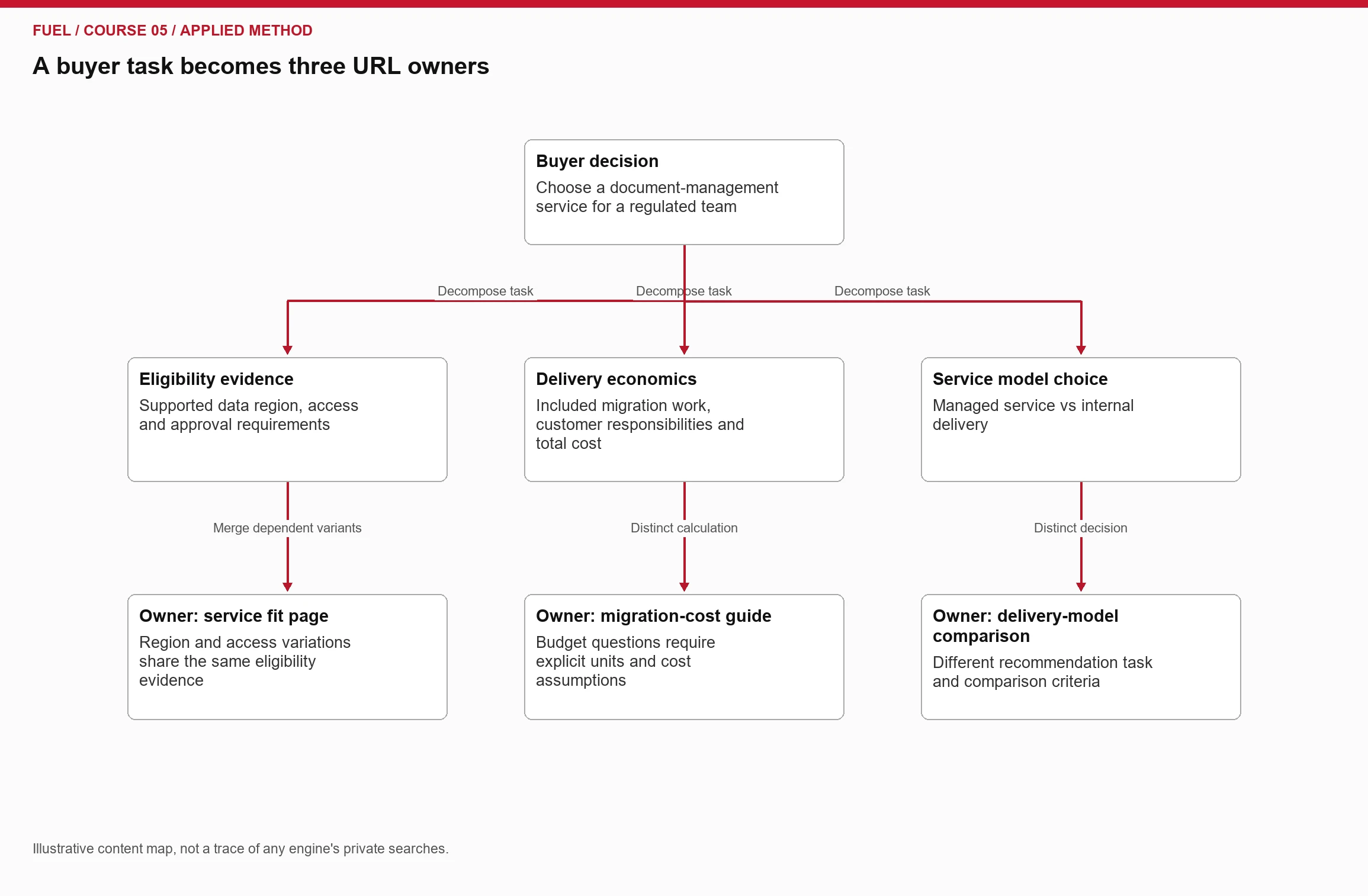
Assign three proposed content owners. The service-fit page explains prerequisites, responsibilities and coverage. The migration-cost guide explains cost components and comparison assumptions. The delivery-model comparison evaluates internal, advisory and managed approaches. These are example architecture labels, not instructions to create those exact pages on every site. Existing useful URLs should be considered before adding another owner.
Group AI search queries about data region and access approval on the service-fit page when they resolve the same eligibility decision using the same scope evidence. Give each a clear section and useful answer. A separate cost guide earns its place when it needs a substantive calculation, assumptions and exclusions that would overwhelm the service page. The delivery-model comparison earns a separate destination because it asks who should do the work, rather than whether one provider fits.
A useful mapping row reads: “Who prepares the migration inventory?” Decision: implementation responsibility. Evidence: approved scope and handoff checklist. Owner: service-fit page. Section: customer prerequisites. Next action: review inventory readiness. This row supplies enough direction for a writer to answer the question without cloning the title into a new article.
A second row reads: “What is the comparable first-year cost of internal versus managed delivery?” Decision: delivery economics. Evidence: explicit hypothetical model or verified actual quotes. Owner: migration-cost guide, with a contextual route to the delivery-model comparison. The cost page must state whether staff time, implementation and ongoing support are included. A number without those assumptions would not complete the task.
The map is successful when every important question has an appropriate owner and every owner has a distinct contribution. A large number of AI search queries is not a success measure. Several rows can resolve into one rich section; one difficult row may justify a substantial original resource.
When should AI SEO keyword mapping merge or split URLs?
Answer and evidence equivalence
For AI SEO keyword mapping, the first test is answer equivalence. Would the same substantive answer satisfy both questions? “Who supplies the migration inventory?” and “Does the customer need an inventory?” may share a single prerequisite explanation. “How do we create a reliable inventory?” asks for a process and may need a different asset. Compare the actual required answers rather than counting matching words.
The second test is evidence equivalence. AI search queries can sound different while relying on the same source and reasoning. They often belong together. Conversely, two questions with similar wording may need different regional facts, product versions or implementation evidence. A separate destination becomes more defensible when those differences are substantial and the audience benefits from a distinct maintained answer. Do not split merely because an expansion tool gives each phrase a separate row.
Action and maintenance independence
The third test is action equivalence. A buyer deciding whether to inquire about a service and an operator executing an approved migration have different next actions. A page can help both if the progression is coherent, but forcing them into one undifferentiated answer may weaken usability. Decide whether a section, a supporting resource or a separate URL best serves the transition. The smallest useful architecture is often easier to maintain.
The fourth test is maintenance independence. Ask whether a fact change should update one shared answer or multiple distinct resources. If ten proposed pages for AI search queries would all need the same scope sentence revised, the architecture may be multiplying a single answer. If the cost model and technical procedure change under different owners and schedules, distinct assets may be justified. Maintenance is not only an operational concern; inconsistent copies can confuse readers.
Document the result in plain language: merge because answer and evidence are shared; split because a distinct calculation and action are required; hold because evidence is missing. A hold state protects quality without discarding an idea. The writer can continue with validated rows while the research owner resolves the uncertain item. This prevents one ambiguous keyword cluster from stalling the entire content program.
When a comparison earns a distinct owner, use the service comparison content method to define comparable scope and selection criteria.
How do you prioritize AI search questions without invented volume?
Prioritization should reflect the decision value of an unanswered question, the strength of the gap and the effort required to supply a credible answer. Use observed demand where available, but do not invent volume for conversational questions that lack a reliable measure. A question asked infrequently can still matter if it determines whether a qualified buyer can proceed.
Create three simple priority states. For AI search queries, ready means the question matters, ownership is clear and evidence can support a useful answer. Research means the decision matters but a consequential fact or source remains unresolved. Defer means the topic is peripheral, duplicates another owner or requires evidence beyond the current scope. Explain the reason rather than hiding it in a numerical score.
For the hypothetical provider, unclear migration responsibility may be ready because approved scope documents exist and buyers need the answer before requesting a proposal. A precise market-wide cost benchmark may require research because the available quotes cover incompatible scopes. A page about every possible document-management platform may be deferred because it exceeds the provider's evidence and would distract from the buyer's immediate task.
If the team needs a score, define its inputs as a planning heuristic. For example, assign ordinal values to decision importance, observed gap and production effort, then review the resulting order with the owners. Do not label the score expected revenue or expected citation lift. Multiplying subjective values can help organize a queue, but it does not turn judgment into a measured forecast.
Prioritize repairs before new pages when an existing owner already attracts the right reader but fails to answer a decisive question. Adding a substantial scope explanation may complete a task more effectively than launching a competing guide. Check the current content inventory and intended owner first. Publication count is easy to measure; whether buyers can make a sound decision requires reading the actual answer.
Retain a reason to revisit deferred rows. A new service capability, verified dataset, product change or repeated buyer concern can make an old idea useful. Review those triggers at a practical interval instead of continually rebuilding the entire map whenever a tool suggests another phrase.
Which research methods resolve different keyword uncertainties?
Keyword expansion is useful for collecting familiar terminology and spotting related phrases. It can reveal that audiences use different names for the same task. Its limitation is that a phrase list does not explain who is asking, what evidence they need or whether a separate page is justified. Use it to improve language coverage and identify candidates for investigation.
Task decomposition is useful when the central problem is a complex decision with constraints and dependencies. It can expose missing explanations about responsibility, cost or implementation. Its limitation is planner bias. A knowledgeable team can still assume buyers care about a criterion they rarely use. Validate consequential branches against actual buyer evidence when possible and retain the hypothesis label when that evidence is absent.
Observed answer and source review is useful for understanding the questions a saved result appears to address and the evidence it cites. Its limitation is observability. A visible answer is not a complete query trace, and one run does not establish a stable source preference. Save the conditions, inspect source support and use repeated observations when the business decision justifies the effort.
Internal search and support review can expose unresolved operational questions after purchase. Their limitation is audience selection: existing customers are not the same population as prospects. The content may belong in documentation rather than a commercial comparison. A useful map records that distinction instead of treating every query containing the product name as an acquisition opportunity.
Combine methods for AI search queries when they address different uncertainties. Use expansion to find language, task decomposition to structure decisions and observed evidence to challenge assumptions. Do not add their outputs together as though three overlapping lists establish three times the demand. Deduplicate by the required answer and preserve the evidence behind the surviving row.
The strongest architecture review asks a counterfactual question: if this proposed URL were removed, which reader task would become materially harder to complete? If the answer is only “we would lose one keyword variation,” reconsider the destination. If the answer identifies a distinct calculation, process or comparison that no existing owner supplies, the proposed asset has a clearer purpose.
For passage-level clarity within an owner, apply answer passage engineering. When evidence is missing, the original research asset course shows how to design a bounded investigation.
How do you maintain content ownership and contextual links?
Give each owner a stable identifier, current route, intent, evidence packet and responsible person or team. Record related pages as relationships, such as prerequisite, deeper method or alternative decision. Links should help readers continue a task. An all-to-all link mesh adds noise when it does not explain why a destination is relevant.
Keep proposed and live destinations separate. A brief may mention a planned comparison before that resource exists. Do not publish a link that leads to an empty placeholder. Stage related pages coherently or expose the link after its destination is ready. The map should distinguish planned edges from verified public routes so a writer's intention is not mistaken for implemented navigation.
When content changes, revisit only affected dependencies. A revised service exclusion may require updates to the service-fit page and a comparison row. It does not automatically invalidate every article in the cluster. Conversely, a change to a shared cost assumption can affect several calculations even if only one page was edited. The evidence-to-owner relationship identifies that impact.
Use a change log with the old decision, new evidence, affected owners and required action. Consolidation, redirecting and deletion are different actions with different consequences. Preserve useful existing URLs unless there is a reason to change them. When consolidation is appropriate, identify the destination that best completes the task and update relevant internal references rather than leaving duplicate explanations behind.
Track outcomes separately from map completion. An accepted brief proves that ownership and evidence needs were defined. A published page proves that an asset exists. A verified answer test describes an observed result under its conditions. Qualified inquiries describe a business outcome. The architecture can support those outcomes without allowing a planning milestone to masquerade as a citation or revenue result.
An AI search content strategy should make an agency proposal auditable at the row level. Ask for one priority question, its buyer evidence, the required factual source, the intended existing or new URL and the reason another page cannot answer it. Request a held example as well as a ready one: the held row shows whether unsupported comparison or fastest-service claims are kept out of production. Agree on who resolves each missing fact and who updates dependent pages. That gives procurement a useful scope boundary without converting unverified conversational variants into claimed demand.
Can you reduce eight keyword ideas to useful content owners?
Work this hypothetical expansion list: migration prerequisites; who supplies the inventory; inventory template; migration cost; cost of managed migration; internal versus managed delivery; fastest migration service; and document-management implementation timeline. Assume an existing service page already explains basic prerequisites, a cost guide has incomplete scope assumptions, and no delivery-model comparison exists.
First, mark evidence needs before assigning URLs. The prerequisite questions require an approved responsibility statement. An inventory template requires a genuinely usable artifact with instructions. Cost questions require comparable scope, units and exclusions. A delivery-model comparison requires shared decision criteria. A fastest-service claim requires comparative performance evidence that the scenario does not provide. The timeline question needs stated prerequisites and conditions.
A defensible map improves the existing service page for prerequisites and inventory ownership. It treats the inventory template as a potential supporting resource if the team can build and maintain one. It repairs the existing cost guide to address managed-migration scope rather than creating a nearly duplicate cost article. It proposes one substantial delivery-model comparison. It holds the fastest-service claim until suitable evidence exists.
Place the timeline explanation on the service page if it remains a scoped overview. A separate implementation-planning guide could be justified later if the team can provide a substantive process, dependencies and reproducible schedule example. The wording alone does not decide. The required answer and useful contribution determine whether the separate guide earns its destination.
Your submission should contain the map, the evidence state for each row, the merge or split rationale and one next action per owner. Include a rejected or held item and explain why. A strong answer does not maximize the number of pages. It gives every supported question a coherent home, protects the buyer from unsupported comparisons and leaves a clear path for future evidence to expand the architecture.
Use the finished map to brief writing and technical teams together. The writer owns the explanation, the subject owner verifies the facts and the platform owner ensures the content is delivered and linked correctly. Mapping AI search queries becomes valuable when that shared contract produces better answers to real decisions, not when it merely produces a longer spreadsheet.
Source and method notes
Google Search Central. Optimizing your website for generative AI features on Google Search. Accessed October 25, 2026. The task mapping, evidence-state system and hypothetical procurement lab are Fuel planning methods rather than claims about a provider's private query trace.
Apply a buyer-task architecture
Discuss a scoped AEO and AI SEO architecture engagement with Fuel Online when your team needs to turn a validated buyer-task map into maintained content.
Explore the AI SEO and AEO course curriculum.
Discuss AI SEO and AEO implementation with Fuel Online.