
AI SEO – AEO Course 25
What proves author expertise for AI search content?
Demonstrate author expertise for AI search with relevant, verifiable evidence and an honest account of who contributed to which claims. Collect the contributor’s actual work, role and qualifications; match review responsibilities to technical, numerical and commercial assertions; then publish accurate attribution. Keep a private approval trail tied to the reviewed version. A byline, credential or profile can help readers evaluate a source, but it does not guarantee indexing, rankings or AI citations.

Match expertise to the claim rather than the biography
Begin with the claim rather than the biography. An article explaining data migration can contain product capabilities, a cost calculation, delivery responsibilities and research interpretation. Those assertions require different knowledge. A person who understands the implementation may not be able to verify the statistical inference. A person who approves current service scope may not have tested a connector. Treat expertise as relevant to an actual question instead of a universal property transferred to every sentence.
Distinguish the author, contributing expert, editor and reviewer. The author develops the explanation and should be credited only when that role occurred. A contributing expert may supply a procedure or resolve a specific factual question. An editor improves structure and language. A reviewer checks an agreed scope against evidence. One person can perform several roles, but naming those roles clearly prevents a narrow technical check from appearing to endorse every conclusion.
Define an acceptance record before requesting review. Include the article revision, claim identifiers, source material, questions to resolve and proposed public credit. A request to check whether supported versions are accurate differs from a request to approve the entire article. Ask the reviewer to identify unsupported conclusions, not merely confirm that familiar terminology appears. The record should make the expected work clear enough that both parties know what an approval means.
Keep authorship evidence proportionate to the reader’s need. A useful profile explains why the person can contribute to this subject, what work they actually do and which relevant evidence supports that account. A long career history can obscure the connection. A short, specific account of responsibility for a documented implementation procedure may be more informative than an impressive but unrelated title. Relevance and verifiability should determine what the profile includes.
Commercial expertise and independent evidence
For an agency brief, make E-E-A-T for AI SEO concrete: who can substantiate the relevant work, who can verify consequential claims, and who corrects the published answer? Request a sample contribution record and its matching public credit. This turns an abstract authority discussion into responsibilities the hiring team can inspect; it does not establish a score or a promised search outcome.
For a commercial publisher, separate expertise from independence. An employee can accurately explain a service while having an obvious commercial relationship to it. An external consultant can also have a paid relationship. Neither relationship makes every statement false or independently verified. Record the relevant connection and avoid describing a paid product review as independent research unless that description is justified by the actual arrangement and method.
Google’s helpful-content guidance encourages accurate authorship information where readers would expect it. Use that as a transparency principle, rather than a recipe for manufacturing authority. The operational goal is accountable evidence: readers understand who stands behind consequential statements, and the publishing team can trace those statements to a real contribution. Authorship evidence is useful when it clarifies responsibility, not when it decorates an unsupported answer with a name.
What evidence belongs in AI SEO author profiles?
Build a contributor record with approved name, current role, relevant subject area, evidence references, verification date and permitted public description. Separate a fact supplied by the contributor from a fact checked against an appropriate record. The person may accurately explain private work that cannot be published in detail. In that case, agree on a truthful bounded description and retain the authorized verification privately; do not invent a public case to make the profile look stronger.
Verify qualifications, roles and work artifacts
Choose evidence according to the assertion being made. A professional qualification should be checked through an appropriate credential record when available. A current affiliation should be confirmed through the organization or an authorized source. A claim of having developed a method needs evidence of that contribution. A presentation on a topic establishes that a presentation occurred; it does not by itself establish successful delivery of a client project using the method.
Collect relevant work artifacts when permission allows. A documented test procedure, approved technical explanation, maintained reference implementation or substantive published analysis can show what the contributor knows. Record the person’s actual role in the artifact. Participation in a team project does not automatically justify sole ownership of the result. A portfolio summary should preserve shared responsibility rather than turning every organizational achievement into a personal credential.
Verify time-sensitive details separately from durable history. A former position can remain a true historical fact after the person changes jobs, while a claim that they currently lead a department becomes stale. A credential may have an expiry or scope condition. Keep effective dates and avoid silently converting past experience into present responsibility. This makes authorship evidence maintainable without repeatedly rewriting a person’s entire biography.
Publicly verifiable, privately verified or unresolved
Use a source-quality distinction inside the contributor record. Mark evidence as publicly verifiable, privately verified, contributor-reported or unresolved. These states need not all appear in a public profile, but the editor should know which wording each permits. Contributor-reported experience may support a cautious description when appropriate; it should not be presented as independently audited. An unresolved credential should not become an asserted fact simply because publication is scheduled.
Ask permission for the attribution itself. Review participation does not automatically authorize publication of a photograph, personal contact information, an extended biography or an endorsement quotation. Confirm the proposed credit and its scope. Keep unnecessary personal data out of the production packet. A business article can usually establish accountability through a professional name, relevant role and appropriate profile without exposing private information.
AI SEO author profiles should explain the contributor’s relevance to the service or research being discussed. When reviewing an agency proposal, ask which profile statements are verified and which technical claims the named person will actually check. A credible biography cannot substitute for access to the product owner, current offer facts or the analytical evidence an article needs.
Finish with a relevance test. For every biography sentence, ask which reader uncertainty it resolves and which record supports it. Remove unrelated awards, vague claims of thought leadership and unsupported numerical experience. Preserve genuine distinctions that matter to the subject. The result should help a skeptical reader understand why this contributor is qualified to address the article’s particular claims, while leaving clear boundaries around what they did not evaluate.
Who should perform expert review for AI SEO content?
Create a claim-to-reviewer responsibility matrix. Each row contains a consequential assertion, its supporting artifact, the expertise required, the assigned reviewer, the result and unresolved conditions. Use several categories when one assertion crosses responsibilities. A migration cost estimate can depend on a technical assumption and a current commercial rate. Approval of the arithmetic alone does not establish that either input is applicable to the buyer.
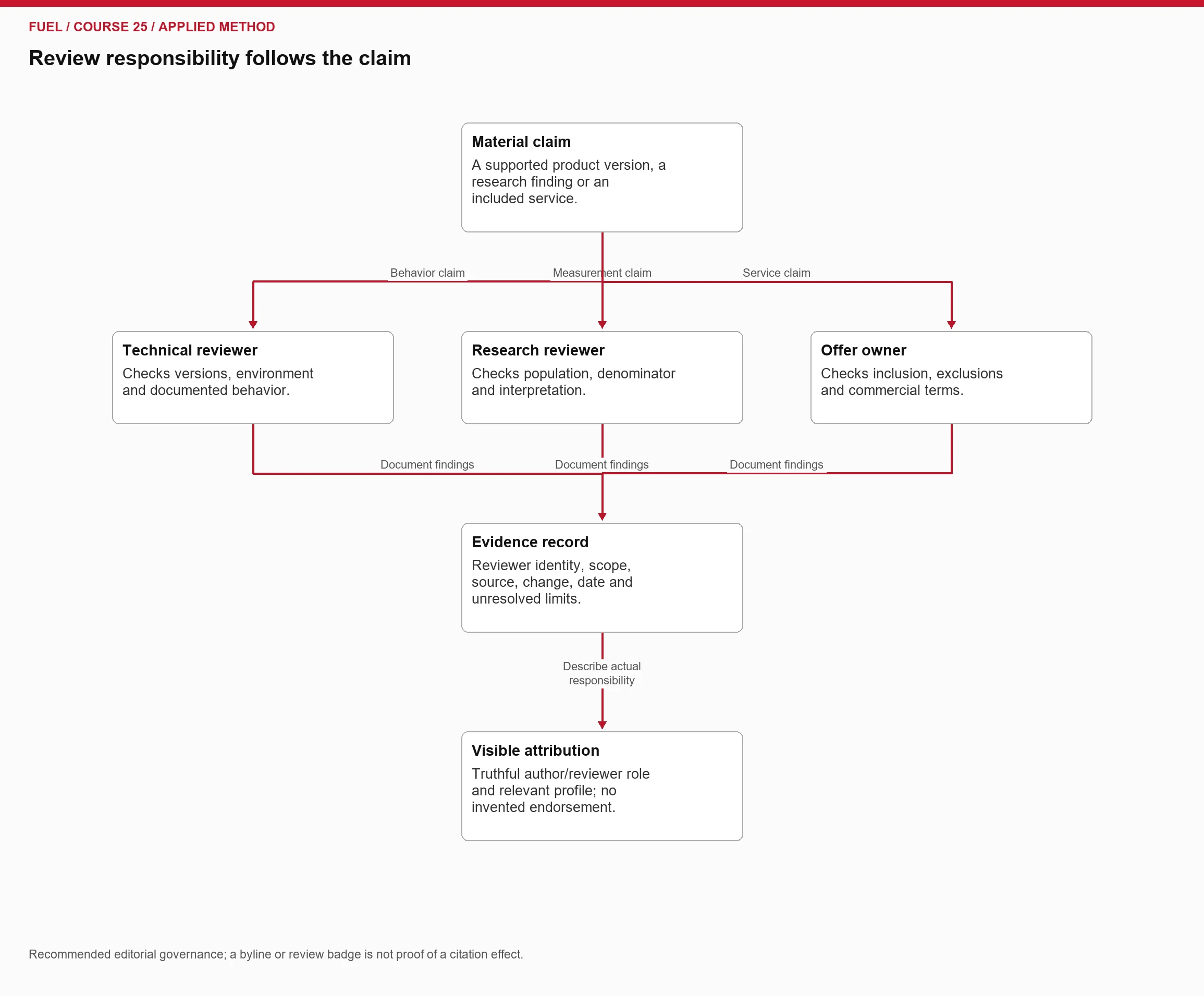
Assign technical capabilities to someone able to verify the relevant system and version. The reviewer should examine the stated behavior, conditions, exclusions and evidence. An assertion that a connector preserves approval records needs more than familiarity with migration terminology. It needs a current capability basis and a clear account of which fields and environments were evaluated. Authorship evidence should describe that actual contribution rather than imply universal product certification.
Assign calculations and research interpretations to an appropriate analytical reviewer. Check inputs, units, denominators, missing observations, transformations and the strength of the inference. Someone can confirm that twelve divided by eighteen is about 66.7% without confirming that the selected sample represents a market. Keep computational accuracy and inference validity as separate review questions. This makes it harder for a correct percentage to carry an unjustified commercial conclusion.
Assign current offer facts to the owner who can approve them. Scope, customer responsibilities, exclusions, commitment periods and applicable pricing conditions often depend on business decisions rather than technical documentation. The reviewer should verify the actual offer described by the page. Do not ask a technical contributor to approve a discount policy they do not control or treat an editor’s familiarity with earlier proposals as evidence of current terms.
Eight claims can require more than eight review assignments
Work through a fictional eight-claim article. Three claims describe connector behavior, two interpret a study, two describe the service offer and one combines a cost calculation with implementation assumptions. The technical reviewer takes the three capability claims; the analytical reviewer takes the two interpretation claims; the offer owner takes the two commercial claims. The combined claim needs the relevant input owners plus a calculation check. Eight rows can therefore require more than eight review assignments.
Now introduce an unresolved dependency. The offer owner approves the rate, but the technical reviewer cannot verify the estimated implementation hours. The combined claim remains unapproved even if its multiplication is correct. The team can remove the estimate, label a clearly hypothetical calculation with explicit assumptions or obtain the missing evidence. It should not average several approvals into a pass that hides the unsupported input.
Expert review for AI SEO content should be an assigned task with an input packet, a defined scope and a completed result. Ask whether the reviewer saw the final consequential wording and whether later edits trigger renewed approval. AEO content credibility depends on that truthful responsibility trail; a familiar name copied across an entire content library does not establish that each claim was reviewed.
Use result states that preserve the distinction: approved within stated scope, approved with a required revision, out of scope and insufficient evidence. A reviewer declining an unfamiliar claim is useful information. Assign the claim elsewhere or narrow it. The matrix turns authorship evidence into an operational control by showing where responsibility is complete and where the article still depends on an unverified assertion.
How do you document an expert’s actual contribution?
Record material review changes with the original statement, proposed correction, rationale, supporting artifact and final disposition. Focus on changes that alter the reader’s understanding. Correcting a version boundary or removing an unjustified causal conclusion deserves a durable note. Every punctuation edit does not. The objective is a concise trail showing that substantive review happened and which consequential facts it improved.
Use a fictional example. A draft says that all historical approvals remain available after migration. The technical contributor changes it to specified approval fields remain searchable for supported source versions, with a separate exclusion for attachments not included in the tested export. That is a meaningful contribution. A useful review record names the evidence and revised conditions; a generic reviewed-by label would conceal what the contributor actually established.
Preserve disagreements until they are resolved. An expert may believe a process is typical while the available record establishes only one configuration. The editor should ask which stronger statement the evidence supports and which qualification is necessary. A commercial preference for a simpler sentence does not resolve that disagreement. Publish the scoped statement, obtain better evidence or remove the claim. Keep the rationale with the revision so a later editor does not restore the overstatement.
A contribution is different from an endorsement
Distinguish a contribution from an endorsement. Providing a factual correction does not imply agreement with the publisher’s sales positioning or every recommendation in the article. A quotation requires an accurate record and approval for its intended use. Do not turn a private review comment into a public testimonial. Proposed attribution should describe the actual relationship, such as technical review of compatibility claims, when that is what occurred.
Compare three review arrangements. An expert interview fits a topic where the writer needs missing knowledge; its limitation is that the final interpretation still requires checking. A claim review fits a developed manuscript with specific assertions; its limitation is the assigned scope. A full subject review can assess the broader explanation, but still depends on the reviewer’s expertise and supplied evidence. Choose the arrangement that resolves the actual uncertainty.
Tie approval to a stable revision. Save the document identifier or content fingerprint, review date and claim scope. If a later edit changes an approved capability or conclusion, the earlier approval cannot automatically cover it. A layout change may leave the approved meaning intact, while changing a single word from some to all can invalidate the factual approval. Review dependencies should follow meaning rather than the number of characters changed.
Keep a compact contribution summary for the publication team. It should state who did what, what changed, which claims remain unresolved and which public credit was approved. This summary helps implement truthful authorship evidence without distributing every private comment. Retain the detailed record where authorized reviewers can inspect it. The public article needs an intelligible account of responsibility, while the private trail preserves reproducibility and accountability.
How should bylines and review dates support AI SEO?
Publish attribution that agrees with the underlying record. Name the actual author when that attribution is justified. Credit a contributing expert or reviewer with a useful scope description where appropriate. Link the visible name to the correct profile when a profile exists. Do not assign a staff name to content that the person neither authored nor reviewed, and do not publish a pending review as a completed one.
A profile should connect identity, relevant expertise and the subject matter. Use a consistent professional name and a clear description of the contributor’s current role. Include appropriate references to verified work rather than an unrelated list of promotional claims. When several people share a name, the profile’s context should help a reader distinguish them. Authorship evidence should resolve identity, not accidentally attribute another person’s work to the contributor.
Use a review label that names its scope
Make review labels understandable in ordinary language. Technical review of supported integration versions is more precise than expert approved when only that scope was checked. If an article contains a separately reviewed calculation, explain the relevant role without implying academic peer review. A concise attribution can preserve those distinctions. The reader should understand what kind of confidence the review adds and which other assertions remain the publisher’s responsibility.
Google’s Article documentation supports author identity information such as a profile URL. Implement the relevant fields with the correct person and visible attribution. Treat structured data as a representation of verified facts. It cannot make a fabricated contributor real, expand the scope of a review or establish that the person performed the work. Check the actual delivered markup because a template can retain an obsolete author after the visible byline changes.
Use publication and review dates for their actual events. A publication date identifies the release; a substantive update date reflects a meaningful change; a review date identifies completed review of a stated revision or scope. These events can occur at different times. Replacing a photograph or changing a button label should not silently imply that product claims were freshly checked by the named expert.
Google’s date guidance emphasizes consistency between visible and structured dates. Preserve that consistency when implementing attribution and updates. It does not guarantee which date a search system will display. More importantly for the reader, the date should not suggest verification that did not happen. If the relevant technical facts were last checked earlier, keep that limitation clear instead of advancing every date together.
Inspect the complete attribution path before release: byline, profile, review label, visible dates and delivered structured data. Confirm that the links reach the intended person, that the profile does not contain obsolete affiliation language and that pending states are absent from public claims of completed review. This is a focused implementation check. It should verify the approved record rather than invent new biography material while filling empty template fields.
How do you maintain AEO content credibility after updates?
Assign a correction owner and a usable reporting route. A reader who finds a false capability statement should not need to determine which of four contributors can edit the site. The publisher coordinates the correction, then involves the relevant fact owner. Record the affected claim, evidence, revision and whether the public interpretation changes. An attribution system is incomplete if it names experts at launch but cannot respond when the underlying answer becomes wrong.
Define refresh triggers around consequential dependencies. A product version change can affect a technical approval. An offer revision can affect commercial scope. A corrected dataset can affect a reviewed calculation. A contributor’s role change can affect the profile without invalidating the historical fact that they reviewed an earlier version. Handle these events separately so maintenance stays accurate and proportionate.
Reuse unaffected evidence carefully. If an update changes only a navigation link, the technical claim review may remain applicable. If the update changes supported environments, revisit the corresponding capability rows and public review scope. Keep the old approval as a historical record rather than overwriting it. The new release needs evidence covering its current meaning, not merely a familiar name carried forward from an earlier page.
Find the unsupported estimate added after approval
Run this fictional acceptance lab. An article has a verified author profile, a completed review of two compatibility statements and an unchecked new savings estimate added after approval. The editor advances the review date and applies expert reviewed to the entire article. Identify two defects: the new estimate lacks the necessary review, and the broader label misrepresents the completed work. The existing profile does not compensate for either defect.
A sound repair keeps the genuine author credit, narrows the review label to the checked scope and removes or verifies the new estimate. Update the relevant dates only after the corresponding work occurs. If the estimate is retained as a hypothetical example, clearly state its assumptions and avoid presenting it as an observed customer result. Save the revised approval record so the next editor understands why the attribution is limited.
Measure the program through completed responsibilities and useful corrections. Track unresolved consequential claims, stale profile facts, changes requiring renewed review and whether readers can find the right supporting explanation. These operational observations can improve accountability. They do not establish that adding a reviewer caused more AI citations or qualified leads. Those outcomes require separate measurement with their own conditions and alternative explanations.
The final authorship evidence packet should let another editor trace a consequential statement to its evidence, contributor, approved wording and current revision. It should also show where the publisher chose not to make a stronger claim. That is the durable value of proving expertise for Google and AI search content: a useful answer supported by identifiable responsibility, with a maintained process for correcting it when the facts change.
For a scoped implementation discussion, explore Fuel Online’s AI SEO and AEO services.
Source notes: Article structured data; Influence your byline dates in Google Search; Creating helpful, reliable, people-first content. Checked October 25, 2026. Applied frameworks are editorial recommendations; hypothetical examples are not Fuel client results.
Explore the AI SEO and AEO course curriculum.
Discuss AI SEO and AEO implementation with Fuel Online.