
AI SEO – AEO Course 27
What can an AI SEO case study honestly claim?
An AI SEO case study should define its outcome, observation universe and comparison before selecting examples. Preserve the baseline, shipped changes and raw evidence. Report mentions, citations, suitable recommendations, referrals and qualified leads separately, with counts and dates. Match the final language to the design: an observed improvement, a comparative estimate or a causal conclusion requires different support. A favorable screenshot is an illustration of one answer, not a complete result.
Write a claim card before building the presentation. It should identify the business, permitted public description, relevant offer, intervention period, affected pages, question panel and primary result. Add the proposed sentence the case would justify if the evidence is adequate. If the objective is accurate recommendations for qualified buyers, a rise in raw brand mentions is an intermediate observation rather than a substitute for that objective.
Descriptive, comparative and causal claims
Choose the claim strength deliberately. A descriptive claim says what happened under recorded conditions. A comparative claim reports a contrast with a defined reference, while explaining the design’s limitations. A causal claim says the intervention produced the difference and needs a design capable of addressing plausible alternatives. Commercial enthusiasm does not move a case from one level to the next. The evidence and assumptions determine the strongest defensible wording.
Separate completed work from results. Publishing a corrected comparison page, repairing access and supplying a current dataset are implementation artifacts. A later answer that cites the revised source is an external observation. A qualified inquiry is a commercial event. An AI SEO case study can explain their sequence without asserting that each step necessarily caused the next. This distinction makes a useful technical success report possible even when downstream results remain uncertain.
Agree on what may be published and which records support the public claim. A client’s permission to use its name does not verify the result. An analyst’s approval of a chart does not authorize disclosure of private revenue or customer details. Keep factual review and publication authorization as distinct records. Use only genuine approvals and retain a safe evidence trail for the assertions that appear in the case.
When comparing agency claims, ask whether the reported AI SEO results concern a problem like yours: accurate recommendations for an eligible buyer, supported citations, observed visits or qualified demand. Request the metric definition and period before judging the size of the improvement. A case can be genuine yet poorly suited to the decision your business needs to make.
Define material failure conditions alongside the desired result. More citations can be a poor outcome if they increasingly attach to an inaccurate price or recommend an unsuitable offer. A case should retain these errors rather than hide them behind the favorable metric. Decide how accuracy, offer fit and broken customer actions affect the conclusion. The primary result remains useful only when its meaning and guardrails are clear.
The original GEO study evaluates bounded visibility interventions, not a universal business-outcome guarantee. Treat research as context for a local question, not borrowed proof that a case generated revenue. The practical contribution of an AI SEO case study is an inspectable account of a real program and its limits. All numbers in the worked examples below are fictional teaching inputs; they are not Fuel client results.
What baseline makes AI search performance measurement reproducible?
Freeze the observation universe before comparing periods. Record the relevant page cohort, buyer-question families, engines, interfaces, markets, languages and collection schedule. Preserve exact question versions and search settings where observable. A panel chosen because it already gives favorable answers cannot represent general AI-search performance. State how items were selected and which buyer decisions they cover. Keep a count of the intended universe, not only the outputs that were easiest to collect.
Use a baseline that matches the decision and available history. A site migration may require distinguishing old and new routes. A product launch may have no directly comparable earlier offer. A new monitoring account may provide only a short preperiod. Do not manufacture a longer baseline from memory or combine incompatible exports to make the chart smoother. Explain the limitation and choose a narrower statement when the historical record cannot support the desired comparison.
Define outcomes and preserve missing observations
Create a metric dictionary for the AI SEO case study. Define citation presence, destination normalization, brand mention, suitable recommendation, material factual error, referral session and qualified lead. Include allowed values and missing states. The definitions should tell two analysts how to code the same difficult record. A bare success flag cannot distinguish an accurate recommendation from a mention of the brand in a list of options the assistant rejects.
Preserve collection failures. A timeout, unavailable market feature or uncaptured answer differs from a completed answer without a citation. Record planned attempts, completed observations and exclusions. If a rate is conditional on completed answers, say so and report availability separately. Do not quietly discard the period with more failures or treat every missing output as evidence of a provider’s content-selection decision.
Retain original exports and captures before transforming them. Keep full answers, citation destinations, inspected source passages and relevant analytics extracts in the authorized evidence store. Record when exports were generated and which filters were applied. A dashboard screenshot can communicate a result, but it rarely contains everything needed to reproduce it. The working dataset should preserve the link from each reported number to its source records.
Use stable units across periods. If the question panel changes, identify common items and describe new coverage separately. If the business changes its qualification definition, recode comparable historical inquiries where possible or report a break in the series. A rise caused by counting more kinds of leads should not appear as improved commercial performance. The same principle applies when a monitoring tool begins exposing a new citation surface.
Deduplicate forms, bookings and CRM records
Check duplication before freezing the totals. One inquiry can create a form event, a booking record and a CRM lead. Those records may describe one person or buying group rather than three separate opportunities. Define the deduplication key and permitted exceptions, then retain a reconciliation between raw events and qualified records. The published count should correspond to the unit named in the claim, with unresolved joins visible instead of silently counted as new business.
AI search performance measurement becomes useful in a buying discussion when the agency can explain one denominator, one excluded observation and one source-supported claim from its report. Ask for a safe worked reconstruction rather than confidential client exports. The test is whether the evidence supports the published wording, not whether the presentation includes a large monitoring total.
Close the baseline packet with a short reproducibility check. Ask another analyst to recover one reported count and one rate from the frozen definitions and artifacts. Resolve ambiguity before drafting a success narrative. This does not independently validate every result, but it can reveal hidden filters, duplicated answers or inconsistent units. A credible AI SEO case study begins with a record another person can follow.
Which changes must an agency’s AI SEO results disclose?
Keep a dated intervention log with the change, affected pages, owner, intended mechanism and verified release evidence. Distinguish writing changes from technical delivery, internal navigation, offer changes and external activity. If the program launched several changes together, describe the bundle honestly. A result observed after a combined release cannot automatically be assigned to the most marketable individual tactic.
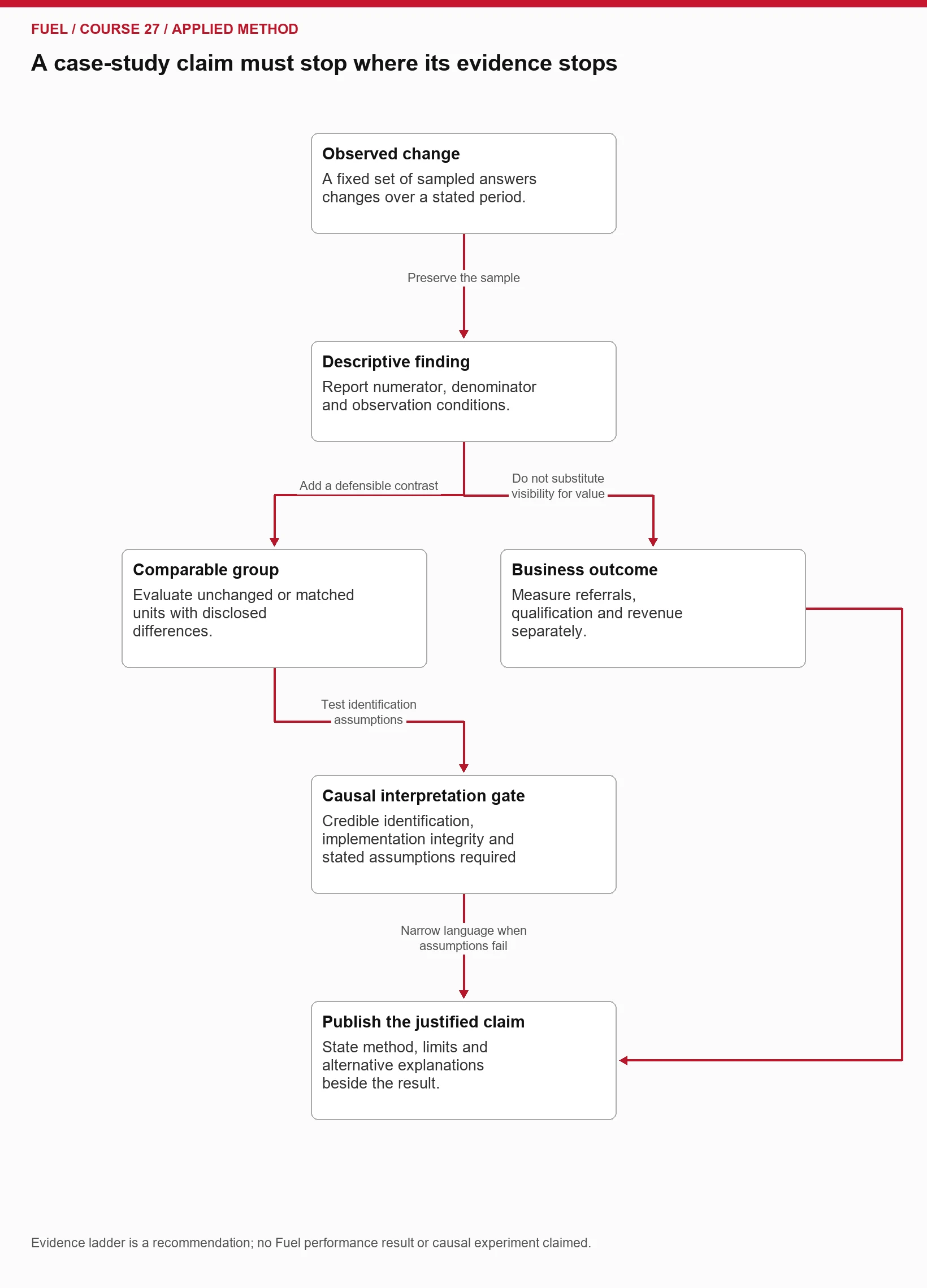
Include concurrent business events that could affect interpretation. A launch, pricing change, paid campaign, earned coverage or sales-process revision may influence discovery, inquiry volume or lead quality. Preserve the events known to the team and their timing. Do not invent a complete account of the external environment. A change log makes plausible alternatives visible; it does not remove confounding simply because they have been listed.
Record external-source changes when observed. A comparison publisher may update a recommendation, a vendor directory may correct a category or an assistant may begin citing a different source. Inspect whether the new source supports the decisive statement. Source transitions can help explain an outcome, but the case should not present them as proof of the assistant’s internal reasoning. An observed citation is evidence of the displayed answer and source relationship under its recorded conditions.
Separate approval, publication and observation dates
Use a timeline that separates approval, publication, delivery verification and answer observation. A policy may become effective before its public documentation changes. A page may be saved before a cache serves the new version. An answer may be collected later still. These distinctions can reveal whether a delay belongs to the business’s own release process or remains external and unresolved.
In a fictional program, a team improves a comparison page, fixes a client-only qualification and releases a research asset during the same week. Later observations show more accurate citations. The AI SEO case study can describe improvement after that program. It cannot isolate the contribution of the prose change, rendering repair or research asset without a suitable comparison. Retaining the bundle is more informative than inventing a single winning trick.
A 2026 citation-driver preprint associates retrieval with citation variation in its studied answers and separates citations from remembered brands. That is background for recording source evidence, not proof that this hypothetical program changed retrieval. Keep the research design and period distinct from the case’s records. A provider, interface or topic difference may limit how much the earlier observation contributes to the local explanation.
Connect each claimed mechanism to an observable intermediate check. If the team intended to repair delivery, retain the before-and-after content captures. If it intended to clarify eligibility, retain the corrected scope and answer-support scoring. If it intended to make data reusable, retain the actual downloadable dataset and method. These artifacts can establish completed work even when the case cannot isolate a causal performance effect.
Which comparison makes an AI SEO case study more credible?
Choose a comparison for the question it can answer. A repeated before-and-after panel can describe movement on the same buyer tasks. An unchanged page or question group can provide context for broader shifts. Random assignment among suitable page clusters can strengthen an intervention design when sufficient units and manageable spillover exist. None of these labels alone establishes a valid causal conclusion; assignment, timing, outcomes and assumptions still matter.
Inspect matched comparisons before using them. Similar baseline citation rates do not make two topic groups interchangeable. They may differ in source availability, commercial demand, product changes and the questions an assistant can answer. State why the comparison was selected and which relevant differences remain. A credible AI SEO case study treats matching as a design judgment rather than a certificate that every external influence has been controlled.
Repeat observations under a predeclared schedule and keep the question structure. A hundred responses to one question are not a hundred independent buyer decisions. Keep family identifiers and inspect whether improvement is widespread or concentrated. A result driven by one branded question can be valuable for correcting that fact while providing little evidence about broader category recommendations. Report the concentration rather than describing the total as universal visibility growth.
Calculate absolute, relative and comparison changes
Use a simple fictional comparison. In each period, the treatment panel has 120 completed eligible answers. Citations rise from 24 to 36, or from 20% to 30%. The absolute change is ten percentage points and the relative change is 50%. An unchanged comparison panel rises from 18 to 24 cited answers out of 120, or 15% to 20%. The descriptive difference in changes is five percentage points.
Publish those counts with the conditions. The five-point contrast does not prove causality in a nonrandomized program. Topic-specific changes, unequal trends or contamination can still affect it. If the treatment combined several improvements, the contrast concerns the program under the design’s assumptions rather than an isolated headline tactic. The hypothetical calculation illustrates a transparent report, not statistical sufficiency or a promised effect size.
Keep constructed source tests separate from live discovery. A test that supplies documents directly can investigate whether an answer preserves their claims. Rotate or randomize supplied-source order when position is a plausible influence. Such a test does not show that ordinary AI search would retrieve those documents. A case can include both tests if it labels what each demonstrates and avoids merging their success rates.
Predeclare the observation window and decision rule. Report deviations such as an unavailable interface, changed question or early stop. A factual error may require immediate repair regardless of the experiment plan; retain that incident and its effect on interpretation. The purpose of the AI SEO case study is a useful account of evidence and action, not preserving a clean chart by withholding a necessary correction.
How should AEO reporting connect citations to qualified leads?
Use an outcome chain with distinct records. A brand mention is a named reference; a citation links a source; a suitable recommendation meets the buyer’s conditions; a referral is an observed visit with available source evidence; a qualified lead meets a stated business rule. A deal or recognized revenue belongs later in the commercial process. Do not assume that one event implies every subsequent stage.
Define qualification before reporting the AI SEO case study. Relevant criteria can include the actual service need, supported market, realistic scope and the required next action. Choose rules appropriate to the offer and apply them consistently. A form submission from an unsupported market may be a genuine inquiry without being a qualified opportunity. Counting every submission as success can reward content that attracts the wrong audience.
Qualified inquiry counts and conversion rates
Work through a second fictional worksheet. The baseline has 60 observed referral sessions and three qualified inquiries; follow-up has 75 sessions and six qualified inquiries. The observed session-to-qualified-inquiry rates are 5% and 8%. The inquiry count doubles, while the rate increases three percentage points. The different descriptions answer different questions. Preserve session identification and qualification rules rather than calling the entire change a proven conversion effect.
Do not divide the lead count by captured AI-answer citations unless the data actually connect those units. The monitoring panel and website visitors may be different populations. An answer can be cited without a click, and a buyer can visit through another route after using an assistant. Keep monitoring outcomes and site outcomes on separate rows unless a defensible measurement design establishes their relationship.
Use referral evidence and self-reported discovery as distinct observations. An available referrer can identify a recorded visit under the analytics configuration. A prospect saying they used ChatGPT describes their recollection and may involve several earlier touches. Preserve both where authorized, but avoid adding them together as unique assistant-acquired leads without deduplication and a clear rule. Missing source data should remain unknown rather than being assigned to the campaign.
Give opportunity cohorts equal time to mature
Account for outcome maturity. A recent inquiry cohort has had less time to become an opportunity or sale than an older cohort. Compare equivalent follow-up windows where possible and identify pending outcomes. A pipeline amount is not recognized revenue, and an influenced opportunity is not automatically an exclusively attributable sale. Use the commercial record’s actual definitions rather than upgrading its stage in the case narrative.
Keep AEO reporting aligned with the measured stage. AI SEO ROI requires a defined investment and a defensible value outcome; a citation percentage alone supplies neither. If the agency can verify only qualified inquiries, evaluate the case at that scope rather than relabeling pipeline as return. The next commercial result may require a later cohort update and additional records.
Present the business finding at the strength supported by the evidence. The fictional program can report observed referral and qualified-inquiry changes with its limits. It cannot establish how many deals the assistant caused from those counts alone. A useful AI SEO case study can still connect improved answers to a coherent business objective while being explicit about which links were measured and which remain hypotheses.
What evidence should you request before accepting an AI SEO ROI claim?
Build a compact public evidence package: business context, offer, scope, dates, intervention, outcome definitions, baseline and follow-up counts, comparison, consequential limitations and a clear statement of claim strength. Put the essential conditions near the result. A reader should not need a private sales call to learn that the reported improvement concerns a selected question panel on one interface rather than the entire market.
Keep the private audit packet more detailed. Retain raw records, coding dictionary, exports, transformations, release receipts, approvals and the mapping from each public number to its calculation. Protect confidential material and provide safe summaries where public disclosure is not permitted. A privacy limitation does not justify a stronger unsupported claim. If the available record cannot substantiate a number, remove or narrow that assertion before publication.
Choose screenshots as illustrations after verifying the aggregate. Identify their date, question and relevant conditions. Avoid presenting one unusually favorable response as typical without evidence. Show the source support that matters to the case, including a limitation if the answer remains partly wrong. The image should explain a finding the dataset supports, not replace the dataset with a persuasive visual.
Reject a revenue claim when only inquiries were measured
Use this fictional lab. A proposed headline claims that one comparison paragraph generated twice as much revenue. The records show a bundled release, a selected citation panel, six qualified follow-up inquiries instead of three and several pending opportunities. Reject the revenue assertion because recognized revenue was not measured. Reject the isolated-paragraph attribution because the intervention was bundled and alternative explanations remain.
A defensible replacement describes the program, the observed citation counts and the qualified-inquiry counts under their stated periods. Include the comparison and qualification definition. Explain that the design does not isolate causality or establish completed revenue. This version remains commercially useful because it shows what was done, what improved and which evidence a prospective client can inspect without promising that the same result will recur.
Assign a correction owner and preserve the published version. If a coding error changes a rate, update the dataset, calculation, chart and interpretation together. If later opportunities close, publish a separately dated outcome update with the applicable cohort and follow-up period. Do not silently transform a preliminary pipeline observation into an earlier revenue success.
The completed AI SEO case study should survive a skeptical reconstruction: another analyst can identify the units, recover the calculations, distinguish the program from concurrent changes and explain the limits. That is the commercial value of disciplined measurement. It creates a credible account of useful work and observed results while giving future buyers a clear basis for deciding whether the approach fits their own problem.
For a scoped implementation discussion, explore Fuel Online’s AI SEO and AEO services.
Source notes: GEO: Generative Engine Optimization; What Drives AI Citations? Content, Retrieval and Model Knowledge in GEO. Checked October 25, 2026. Applied frameworks are editorial recommendations; hypothetical examples are not Fuel client results.
Explore the AI SEO and AEO course curriculum.
Discuss AI SEO and AEO implementation with Fuel Online.