
AI SEO – AEO Course 28
Which AI SEO content is worth publishing at scale?
Audit AI SEO content quality before scaling by checking the buyer’s task, distinct page value, consequential claims and delivered experience. Use mechanical checks for countable defects, then a separate substantive review for evidence, reasoning and usefulness. Hold the affected page or dependency when a critical check fails, repair the specific defect and verify the actual revised artifact. A large word count, clean template or favorable detector score does not establish that an answer is accurate or worth a separate URL.
Require a distinct buyer decision before drafting
Begin with a page contract. Name the intended audience, decision, primary question, existing destination and original contribution. Specify the facts the writer must establish and the artifact the reader should leave with, such as a usable comparison, calculation or decision procedure. If two proposed pages require the same answer and evidence, investigate shared ownership before drafting both. Keyword differences alone do not create two distinct reader needs.
Google’s scaled-content-abuse policy concerns large-scale content produced primarily to manipulate rankings without helping users, regardless of how it is created. That boundary does not imply that every large publication program or every use of AI is prohibited. The practical question is whether the actual pages provide useful value and satisfy the relevant policies. Publishing volume is a production variable, not evidence of quality.
Apply a distinct-value test before the writing queue expands. Ask what a reader can do after the new page that the current owner does not already support. A real implementation worksheet can add a function. A detailed compatibility explanation can resolve a previously unanswered condition. Renaming the same introductory advice for several near-identical searches usually does not create that contribution. AI content quality begins with the decision to publish, not with a final proofreading pass.
Distinguish a reusable layout from reusable conclusions. A shared template can keep navigation, spacing and source-note treatment consistent. The explanation, evidence, worked reasoning and recommendation must still fit the page. A polished template can make weak pages look complete while repeating the same unsupported assertions. Use the common layout to reduce delivery errors, then judge each article’s actual answer on its own merits.
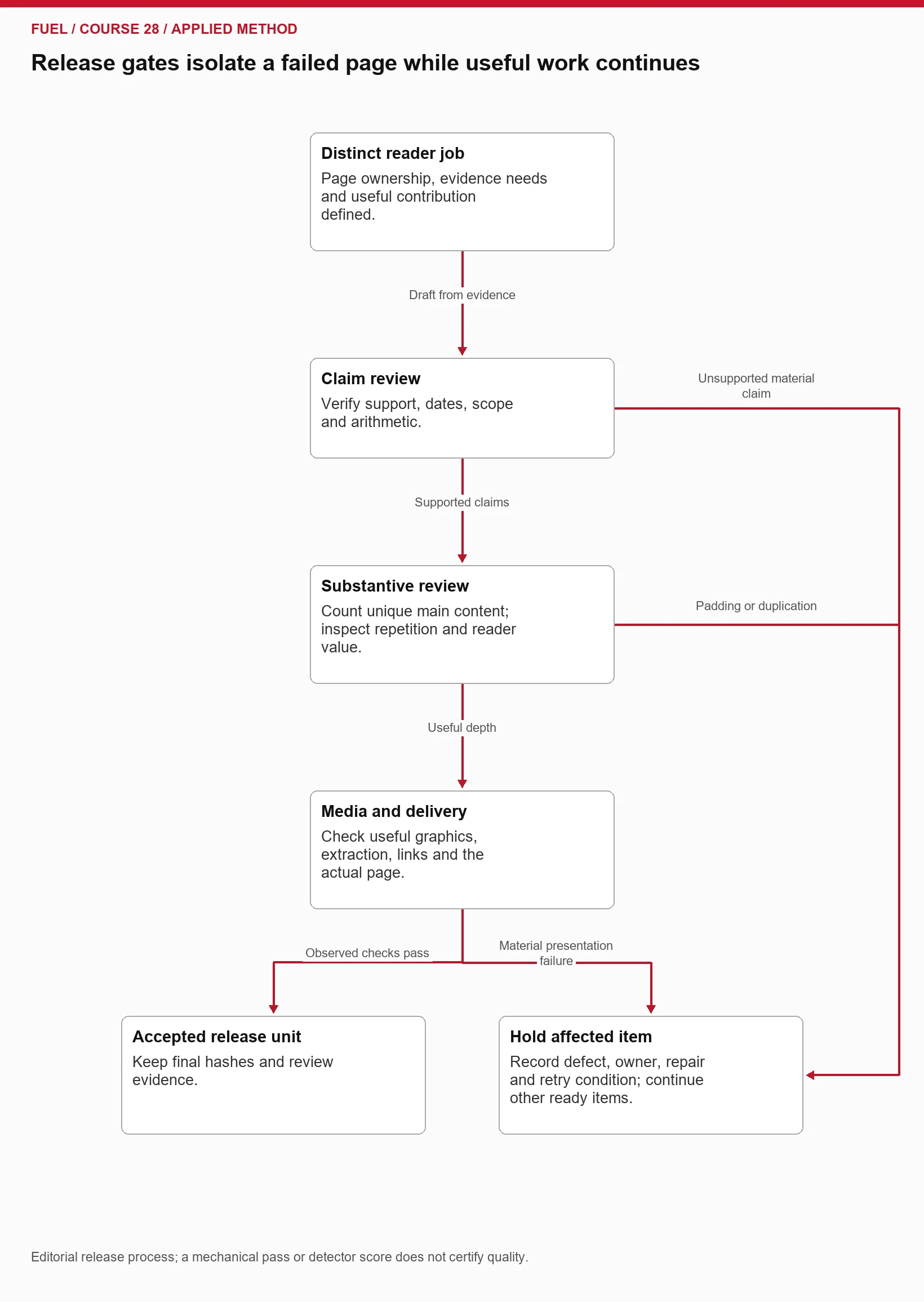
Create explicit states for the work: ready for writing, awaiting evidence, drafted, awaiting independent review, repair required, accepted and delivered. Define what each state means and which artifact supports it. A file existing in the content system does not make it accepted. A completed editorial review does not prove that the public page contains the reviewed text. These distinctions make a scaled program understandable without a vague percentage-complete claim.
When reviewing scaled AI content for SEO, ask an agency to demonstrate one accepted page, one held page and the evidence that explains each decision. The samples should address recognizable buyer questions for the actual offer. A production count alone cannot show whether the work improves the answers your prospective customers need.
The output of this course is a release packet containing the page contract, claim register, count evidence, substantive review, media inspection and delivery checks. The hypothetical batch examples demonstrate the method; they are not records of Fuel client production. Their purpose is to make AI content quality actionable when several pages share sources or components, while preserving a clear acceptance standard for every page.
What evidence should an AI SEO content brief contain?
Build a bounded evidence packet before generating the explanation. Each consequential fact needs a source identifier, relevant passage, date, scope and limitation. Separate provider documentation, measured research, observational findings, anecdotes and editorial recommendations. A primary document can establish what a provider describes without proving that an optimization causes better rankings. A social post can reveal a useful concern without becoming a verified experiment.
Separate documented facts from recommended tests
Write claims at the strength the evidence supports. A documentation statement about a crawler’s function should remain scoped to that crawler. A historical benchmark should remain scoped to its systems, tasks and period. A hypothetical calculation should identify its invented inputs. AI content quality fails when a source is technically relevant but the draft adds a stronger conclusion the source does not establish.
Keep evidence and recommendation separate in the brief. The fact may be that a documented format is supported. The recommendation may be to test whether your particular file preserves a critical table. That recommendation can be useful without being a proven ranking intervention. Label the reasoning so writers do not turn every practical instruction into a claim that research has demonstrated an outcome.
Create a do-not-infer field for tempting extensions. A study of citation frequency does not automatically establish qualified traffic. A supplier’s current feature description does not establish performance in every environment. A verified customer count does not establish satisfaction. These boundaries are especially useful in a shared packet because one ambiguous source summary can multiply into many confident articles.
Use explicit missing-evidence states. If a result depends on an unavailable client record, the writer should not fill it with a plausible statistic. Obtain the record, narrow the assertion, replace it with a clearly hypothetical example or omit the claim. A publication deadline does not turn a placeholder into a fact. Retain the unresolved item and owner so useful independent sections can continue without concealing the dependency.
Prepare examples that teach reasoning rather than imitate evidence. State the situation, supplied inputs, calculation, decision and limitations. An invented service price can illustrate cost normalization if it is unmistakably fictional. It should not appear as a current Fuel offer or a market benchmark. Keep that label near the example, including in any chart or caption that might be viewed separately.
Freeze the evidence and brief version used for the draft. When a source changes, identify the claims and pages that depend on it. This avoids two failures: rewriting accepted work unnecessarily and allowing an obsolete claim to survive because every writer assumed someone else owned the source. AI content quality at scale depends on traceable dependencies as much as on fluent prose.
How should AI content fact checking verify consequential claims?
AI content fact checking should follow a claim back to the source passage and the applicable product, market or period. For an agency engagement, require a correction record for consequential mismatches and a named reviewer for unresolved claims. The record should show what changed; a source list appended after drafting is not the same evidence of review.
Review consequential assertions against the actual supporting passages. Ask whether the source establishes the same subject, condition, period and outcome as the draft. An accurate source title does not establish entailment. A page about a product category may not support a claim about one plan’s availability. Preserve the mismatch and correct the assertion or evidence instead of adding more sources that remain only topically related.
Check arithmetic and the inference separately
Check numerical claims from their inputs. Verify currency, units, period, denominator, missing observations and arithmetic. Then inspect the inference. A correct relative percentage does not establish causality, and a correct total does not establish that the included costs cover the same scope. The factual reviewer should be able to explain what the number describes and why a stronger interpretation would be unsupported.
Assign review by claim type. Technical capabilities need relevant technical evidence; commercial terms need the current offer owner; statistical conclusions need suitable analytical review. An editor can check readability without having verified a product test. A subject expert can approve one capability without endorsing the whole article. Record the actual responsibility and approved revision rather than applying a universal expert-reviewed label.
Review titles, captions and calls to action
Extend the review to the headline, summary, captions and next action. A carefully qualified body can be undermined by an absolute title or a graphic labeled proven results. A call to action can introduce a service promise that the offer owner never approved. These fields are part of the reader’s experience and can be encountered without the full article. AI content quality requires their agreement with the evidence.
Google’s generative-content guidance calls for manual accuracy review, including metadata and image descriptions. Implement that through specific checks rather than a decorative approval badge. Confirm that an image description matches what is visible, that structured data reflects real facts and that a summary preserves material limitations. The checklist’s completion is a record of performed work, not a certification of future Google or AI-search performance.
Use an independent reviewer when the claim consequence justifies it. Give the reviewer the actual manuscript and relevant evidence, with clear criteria for usefulness, depth, factual support, query coverage and distinct value. A writer’s self-check is useful but is not independent review. Another model repeating the writer’s conclusion does not by itself verify a capability or an underlying dataset. Keep the limits of each review method visible.
Close factual review with specific evidence. Record the verified passages, calculations, corrections and unresolved claims. A simple pass should point to what was checked. A failure should identify the smallest repair that would change the result. This turns AI content quality into an inspectable process and makes the next handoff faster than asking every reviewer to reconstruct the whole article from a source list.
How does an AEO content audit identify repetition and weak answers?
An AEO content audit should ask whether each page answers a useful question accurately, not merely whether it repeats an AI-related phrase. Treat AI search content optimization as the work of improving that answer, its supporting evidence and its delivered path. A keyword insertion does not repair unsupported advice, a missing condition or two pages doing the same job.
Use a content-length floor only as a production requirement, not as proof of usefulness or a search-engine optimum. Count substantive explanations, distinct answers, meaningful table rows and worked reasoning. Exclude navigation, metadata, headings alone, image descriptions, source lists, generic calls to action and repeated boilerplate. A page can meet a numerical floor while failing its reader’s task.
Define the counting method and retain the result for the actual manuscript. Exact repeated blocks should not be counted several times as unique substance. A long comparison table can contribute useful content when its rows contain meaningful distinctions; a table filled with repetitive promotional labels adds little. AI content quality depends on the reasoning the reader receives, not the number of words the template renders.
Paraphrased repetition and sibling-page ownership
Inspect paraphrased repetition separately. Two paragraphs can use different words to repeat the same instruction without adding a condition, example or decision. Ask what each paragraph contributes. Keep a clarification when it resolves a likely misunderstanding. Remove a restatement that merely lengthens the page. A similarity tool can identify candidates, but a reviewer must decide whether the overlap is legitimate shared context or a missing distinct contribution.
Compare likely sibling conflicts against intent and evidence. A source-gap analysis and a general audit may share terminology while serving different decisions. Two articles explaining the same scope boundary with the same examples may need consolidation. Do not infer cannibalization from a shared keyword alone, and do not infer distinct value from different titles alone. Read the actual answers and identify which URL should own each task.
Four held pages in a twelve-page example
Use a fictional twelve-page batch. Two pages, P11 and P12, repeat an existing owner’s answer without a new function. A source problem affects P4, P5 and P12. The affected set contains four unique pages, not five, because P12 belongs to both groups. Eight pages remain outside those two identified holds. This is a release-status calculation for the invented batch, not an estimated error rate for all generated content.
The repair paths differ. P4 and P5 need corrected source-dependent assertions. P11 and P12 need an ownership decision: revise for a real distinct task, merge useful material into the existing owner or remove the proposed duplicate. Fixing P12’s fact does not automatically resolve its duplication. An acceptance record should preserve both reasons so one successful check cannot accidentally clear another unresolved defect.
Reconcile the final scope honestly. If two proposed URLs are merged, report the accepted destinations and how the original reader needs are served. Do not count a merged draft as an additional published page. This distinction keeps AI content quality aligned with delivery. A program should optimize for completed useful tasks while accurately reporting its requested, accepted, published and held items.
What should AI search content optimization verify on the delivered page?
Judge every visual by the explanation it contributes. A diagram can show a decision branch, causal boundary, comparison or calculation that is harder to follow in prose. A contextual photograph can establish the working setting. Neither should be presented as evidence of a client result unless that provenance is real. A page does not gain information value merely because it contains a decorative image.
Inspect actual pixels after rendering. Check labels, units, arrow direction, legends, text fit and limitations. A mathematically correct specification can still render an unreadable formula or put a label behind a box. A caption can accidentally expose production instructions. Repair the actual output and inspect it again. AI content quality review should bind the artifact the reader will receive, not only the plan that described it.
Check the image’s public context. Alternative text should describe relevant visible content; it should not be a list of target keywords. A hypothetical chart should remain recognizable as hypothetical when viewed outside the article. A stock analytics screen should not imply that its numbers are the publisher’s measured performance. Keep private provenance and rights records while using accurate public labels.
Inspect the rendered page and the complete reader path
Inspect the rendered page at representative desktop and narrow widths. Confirm that tables preserve their associations, captions remain readable and critical qualifications stay near the relevant claim. Test the primary action and important internal destinations. A source-rich explanation followed by an empty resource or broken inquiry path leaves the reader’s task incomplete. Record actual observations rather than assuming the shared template always behaves identically.
Compare the delivered content with the approved manuscript. A stale cache, import error or field mapping can remove a paragraph, substitute metadata or attach the wrong image. Save the relevant revision and public response evidence. An editorial pass applies to the reviewed content; it does not automatically transfer to a different public artifact. Verify the specific deployed version before marking delivery complete.
Use representative template checks efficiently, but retain page-specific acceptance. A shared table fix can justify checking affected table pages. A new visual needs its own label and accuracy review. Broaden testing when a failure reveals a shared defect. Do not repeatedly inspect unrelated templates without a changed input or unresolved concern. Proportionate checks protect useful work while keeping the review process practical.
Test one complete reader journey after the individual checks. Give a reviewer a realistic decision and ask them to find the answer, inspect the relevant evidence and complete the next action. Do not coach them through a hidden qualification or a difficult download. Record where they become uncertain and whether the page supplies the needed information. This can reveal a usable-looking collection of components that fails as a coherent explanation. The walkthrough assesses the chosen task; it does not establish search demand or future conversions.
Finish the delivery packet with the accepted manuscript identifier, media bindings, meaningful link results and observed public state. Keep indexing, citations and conversions as later outcomes with separate evidence. Publishing completion and AI content quality do not establish that an external search system has selected the page. They establish that the publisher released the intended useful artifact and verified the relevant delivery conditions.
How do you repair scaled AI content for SEO without losing useful work?
Hold the smallest affected release unit consistent with the defect. A wrong capability statement can hold the pages that repeat it. A shared template that drops every pricing exclusion can hold that template’s affected pages. A misspelled caption can require a local correction. Identify the dependency before deciding the scope. The response should address the demonstrated risk without treating every unrelated accepted page as unreviewed.
Create a concise repair record: affected item, observed defect, evidence, owner, proposed correction, acceptance test and next retry condition. Keep the approved portions intact when possible. If the source no longer supports a paragraph, repair that assertion and its dependent summary or graphic. Rewriting the entire article can introduce new errors and discard useful work without resolving the original evidence gap.
Use bounded repair attempts and investigate repeated failures. If two focused changes do not restore a missing qualification, the problem may be a shared renderer, component or content contract rather than wording. Escalate that dependency while independent work proceeds. The exact retry limit is a team operating choice, not a provider rule. The principle is to learn from failure rather than repeat the same ineffective action indefinitely.
Detector scores cannot verify a factual claim
Keep detector scores in their proper role. A score cannot check whether a product version exists, whether a calculation is correct or whether an image caption fabricates a result. If a team uses a detector as a weak triage aid, investigate the actual text and evidence. Do not publish an undetectable, human-written or Google-safe guarantee based on the score, and do not distort useful writing merely to change a classification.
Run this final fictional lab. P12’s unsupported statistic is corrected, its word count passes and its graphic is readable, but it still repeats the existing service guide without a new answer. Decide the release state. The page remains held for distinct value. The answer key should name the unresolved criterion, preserve the accepted factual repair and assign an ownership decision rather than asking for arbitrary extra paragraphs.
Calibrate the reviewers on a small shared example before dividing a larger batch. Ask them to identify the exact missing evidence or repeated reasoning behind a failure. Resolve differences in criteria rather than demanding matching scores. Keep an ambiguous item pending when the evidence remains incomplete.
After repair, rerun the failed checks and affected dependencies. A changed number requires its calculation and chart to be checked. A title-only revision needs alignment and readability review, not an invented claim that the underlying product was retested. Record what changed and why prior unaffected evidence still applies. This makes AI content quality auditable without turning each small correction into an expensive complete restart.
The final release decision should answer a practical question: does this specific page deliver a distinct, accurate and useful answer through a verified reader experience? Preserve a hold when the evidence says no, and continue accepted independent work. That is how AI content quality scales responsibly: through clear ownership, real evidence, meaningful artifacts and precise repairs rather than unchecked volume or a checklist that declares itself complete.
For a scoped implementation discussion, explore Fuel Online’s AI SEO and AEO services.
Source notes: Spam policies for Google web search; Google Search guidance on generative AI content. Checked October 25, 2026. Applied frameworks are editorial recommendations; hypothetical examples are not Fuel client results.
Explore the AI SEO and AEO course curriculum.
Discuss AI SEO and AEO implementation with Fuel Online.