
AI SEO – AEO Course 26
PDF vs HTML for AI search: which format fits your reader?
Choose PDF vs HTML for AI search according to the reader’s task and the evidence you need to preserve. Use an HTML page for a maintained, navigable explanation; offer a PDF when readers need a stable downloadable edition; provide a data companion when they need to inspect or reuse calculations. Test the delivered text and its relationships in each format. Neither a file extension nor a successful download guarantees that an AI search system will select, understand or cite the research.
Choose a format for the reader’s actual task
Begin with the artifact’s job. A buyer comparing current options needs the central finding, scope, method and next step without searching through an unrelated download. A procurement team may need a dated report it can circulate internally. An analyst may need rows, definitions and units rather than a chart image. Those are different needs. Publishing several formats can be appropriate when each has a distinct purpose and the team can maintain their relationship.
A useful PDF vs HTML decision includes maintenance responsibility. An attractive report becomes a liability when its central result changes but its download remains untouched. An HTML explanation can also become stale or inaccessible behind an application error. Assign owners for the explanation, downloadable edition and supporting data. A format choice should account for the complete update path, not just the effort required to export the first release.
Google lists both HTML and PDF among its indexable file formats. That establishes a supported capability for Google, not the indexing status of your file or a preference shared by every AI product. Inspect the actual artifact and the relevant engine separately. A current PDF can be a useful source, and a broken HTML page can fail its intended task. Avoid turning a publishing recommendation into a universal statement about model behavior.
Identify the current explanation and the dated edition
Define the source of record in ordinary language. State which destination contains the current interpretation and which download preserves a particular edition. Give related files descriptive labels, an applicable period and an intelligible relationship. A reader arriving directly at the PDF should be able to determine what it covers and where corrections are maintained. A reader arriving at HTML should know whether the downloadable edition matches the current page.
Consider a fictional implementation-duration report. Its public page explains the sample and conditional median; its PDF preserves the dated release; its data file contains permitted rows and definitions. The same research supports three tasks. The team should not create three inconsistent claims or assume that publishing three copies triples its visibility. The practical goal is one coherent evidence package delivered through useful representations.
AI SEO research publishing should make the firm’s actual expertise inspectable: what was studied, how it was measured and which conclusion the evidence supports. When hiring an agency, distinguish presentation work from research verification. Ask who checks the calculations and who maintains the public explanation when a report is corrected.
The deliverable for this course is a format decision record, extraction checklist, version map and maintenance plan. It connects PDF vs HTML to observable reader outcomes rather than an imagined format-ranking formula. The following examples are hypothetical. They show how evidence can lose meaning across representations and how to repair that loss before claiming that a source is ready for discovery.
How do PDF SEO checks preserve research evidence?
Inspect the actual response before judging the document. Open the final destination after redirects and confirm the intended content is delivered under anonymous conditions where public access is intended. Record status, content type, retrieval time and revision. A URL ending in PDF can return an error page, while an HTML route can deliver only a navigation shell. A download button working for an authenticated editor does not establish the public path.
For PDF SEO, include AI-search evidence checks alongside the public file test. A researcher or prospective buyer should be able to recover the central claim and its qualification from the delivered document. Treat this as a test of your artifact, not proof that every external parser or assistant will preserve the same relationships.
For PDF vs HTML testing, define decisive facts before extracting text. Include the finding, population, observation period, unit, denominator and major limitation. Add any association that changes the interpretation, such as which value belongs to which category. Compare meaning rather than count all visible words. A document containing the number eighteen somewhere has not necessarily preserved the fact that eighteen tasks were included in a particular analysis.
Check PDF reading order and HTML extraction
In the PDF, inspect selectable or searchable text, reading order, headings, tables, notes and meaningful image descriptions. A visually correct two-column layout can produce interleaved extraction. A chart can retain its title while losing the values and qualification. Record the extraction method and version, because tools can behave differently. The test establishes what that method preserved; it does not expose every external search system’s internal document parser.
In HTML, inspect the initial content, ordinary rendered view and a documented readable extraction where those representations differ. Confirm that the primary finding does not depend entirely on a delayed chart widget or an interaction a new visitor may never perform. Keep the critical qualification with the result in the main explanation. A separate PDF containing the limitation does not repair an unqualified claim on the public page.
Use an evidence-preservation table with facts as rows and formats as columns. Mark accurate, altered, absent and unverified separately. For the fictional duration report, the HTML may preserve completed tasks while the PDF extraction drops completed and leaves a broader statement about all projects. That is a consequential change. The repair should restore the condition in the PDF’s readable text and retest the result, rather than declare one entire format unsuitable.
Inspect several real reader paths when relevant: a narrow screen, keyboard navigation, a direct file link and the downloadable edition opened outside the website. These checks answer different questions. Successful text extraction does not establish an easy mobile reading experience, and a beautiful mobile view does not establish reusable data. PDF vs HTML quality needs both semantic preservation and completion of the format’s intended task.
End with a reproducible ticket. Identify the missing fact, affected edition, request conditions, extraction method and expected meaning. Attach the relevant text and a visual reference without distributing confidential data. A useful ticket might state that the footnote defining the sample is detached from the median in the PDF extraction. That gives the designer and editor a repair target and an acceptance condition they can verify together.
How do you keep PDF and HTML research versions consistent?
Assign a stable identity to the research project and a separate version to each substantive release. Record the observation period, publication event, correction history and files belonging to the edition. These dates describe different things. A report published in October can analyze data collected in September. A November correction can repair the October calculation without creating a new September observation. Keep those relationships explicit.
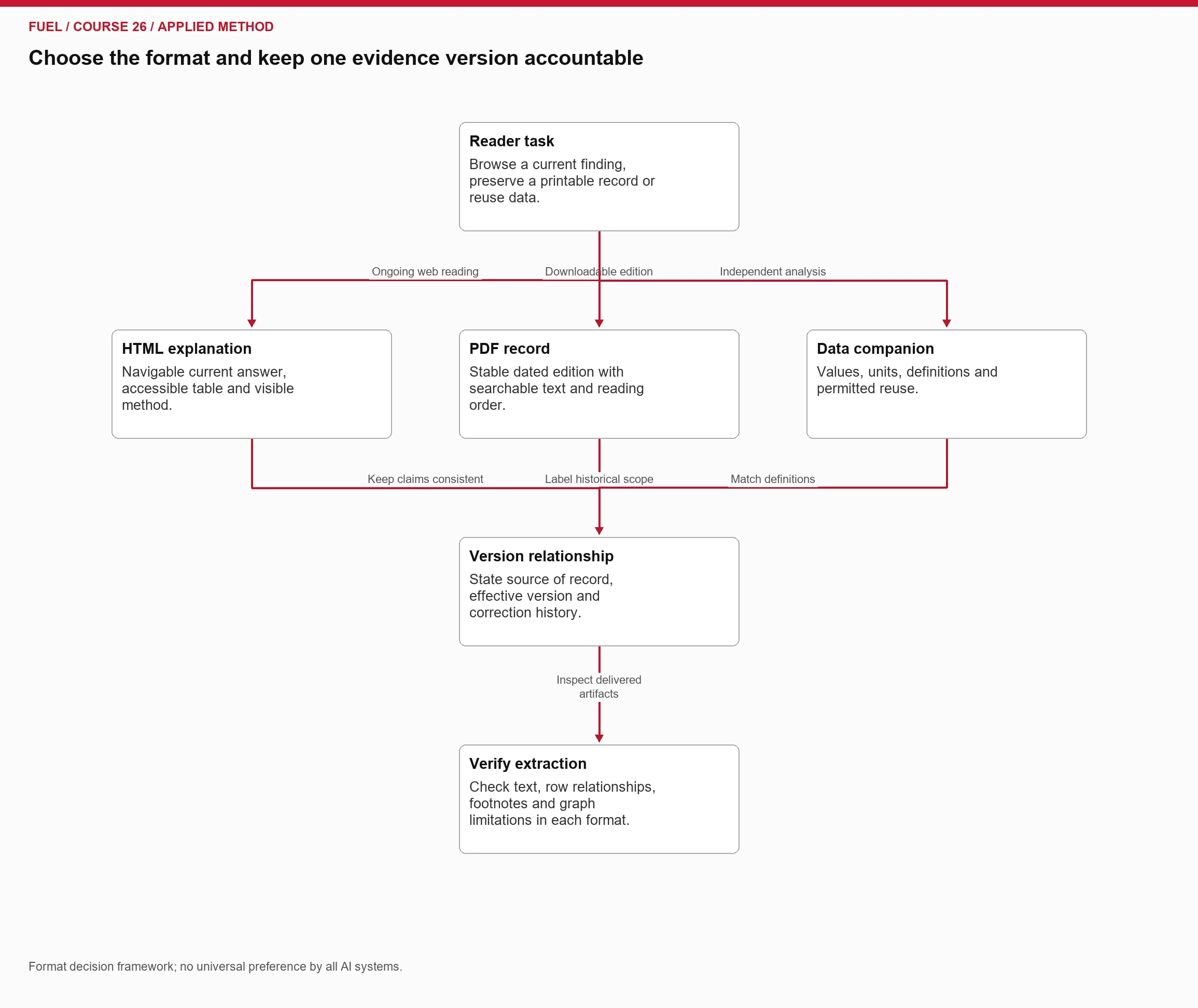
Create a version map linking the current explanation, dated PDF and supporting dataset. For each asset, record its identifier, revision, purpose, current or historical state and correction owner. Match numerical claims to the version that supports them. The map is especially useful when a sales team circulates downloaded reports after the website changes. It allows the publisher to preserve an accurate historical record while directing current decisions to current information.
Equivalent documents and related resources
Distinguish equivalent representations from related resources. An HTML version containing the complete report and a PDF of the same report may be substantially equivalent. A short landing-page summary and a detailed PDF with additional methods are related, but they are not automatically duplicate documents. A data file adds a different function. The PDF vs HTML decision should preserve these distinctions instead of applying one canonical rule to every asset in the package.
A correction is different from a performance improvement
Work through a hypothetical correction. Edition 1 reports a median completion time of five days. A transcription correction changes one observation and the recalculated median becomes 4.5 days. Update the data, calculation, HTML interpretation and downloadable edition together. State that the change is a correction to the earlier release, not evidence that implementation became faster. Keep the relevant prior version or correction note where readers can understand the discrepancy.
Use an explicit release manifest for the corrected package. It can list the report version, matching data version, calculation revision, asset destinations and approval state. Verify the actual public files after replacement; a content delivery cache can retain an older download even when the page links to the intended destination. The editor should check the artifact a new reader receives, not only the file stored in the publishing system.
Google supports an HTTP Link canonical declaration for non-HTML files such as PDFs. Use it to express an appropriate preference among duplicate or very similar documents. It does not force every engine to select that destination or replace clear version labels for readers. Configure the signal only after deciding the relationship between the assets, then inspect the delivered response to confirm that the implementation expresses that decision.
When formats are materially different, explain their relationship through useful labels and navigation rather than pretending they are interchangeable. The current HTML overview can identify the dated full report and its data companion. The PDF can identify the current project destination and edition period. This version model makes PDF vs HTML a maintenance design: readers can find the appropriate evidence without losing the history needed to interpret an older citation.
What makes research content for AI search interpretable?
Publish the central interpretation as readable text alongside the visual. Include the unit, population, denominator, period and limitation necessary to understand the result. A chart’s shape alone is insufficient evidence. A reader should be able to explain the finding even if the chart image fails to load. The text should also distinguish an observed count from a modeled estimate or a hypothetical teaching input.
For a table, preserve header-to-value relationships and explain missing states. A blank cell can mean unavailable, not applicable, zero or intentionally withheld; those meanings are not interchangeable. Use explicit labels and definitions. In PDF vs HTML comparisons, inspect whether the extracted sequence still connects each value to its row and column. If it does not, repair the table structure or provide a clear companion representation rather than relying on visual alignment alone.
A 4.5-day median with two unfinished tasks
Consider a fictional dataset of twelve selected implementation tasks, ten completed during the observation window and two unfinished. The completed durations, in days, are 2, 3, 3, 4, 4, 5, 6, 8, 9 and 16. Their median is the average of the fifth and sixth values: 4.5 days. Ten of twelve tasks completed, about 83.3%. These numbers describe different outcomes. The median concerns completed tasks and should not be presented as the completion time of every selected task.
A useful chart caption would preserve that condition: median 4.5 days among ten completed tasks, with two of twelve selected tasks unfinished at the cutoff. The main explanation should carry the same limitation. If an extracted PDF says projects take 4.5 days, it has strengthened the claim beyond the inputs. If the HTML page omits the unfinished tasks while the PDF explains them, the evidence package is inconsistent even though the files are related.
Keep method notes near the finding they qualify. Define the start and finish events used to measure a day count, how partial days were handled and whether different task types were combined. The exact method in a real study depends on its question. The format lesson is that those definitions must remain discoverable and associated with the result. They should not become an unlabeled footnote several pages away from the central claim.
Provide permitted data in a usable companion file when independent inspection is part of the promise. Include a dictionary, units and calculation instructions. Remove unapproved identifiers rather than hiding them in a supposedly anonymous download. A screenshot of a spreadsheet may illustrate the layout, but it does not provide reusable rows. Explain any withheld fields and the resulting limit on reproduction instead of implying complete reproducibility.
Use a reader test to evaluate the finished package. Ask someone to locate the denominator, identify the population and recompute one result from the supplied data. Have them explain what the finding does not establish. Failure can reveal a navigation, labeling, extraction or method problem. PDF vs HTML performance matters here because each format must preserve an interpretable finding, not merely present a polished page.
How do you correct stale PDFs found in AI search citations?
Inventory actual public destinations, not just the files shown in the current media library. Older downloads may remain in campaign folders, email-linked paths, partner pages or translated editions. Record the destination, edition, central claims, current status and known dependencies. The scope can be bounded to the research package and important discovery paths. A modest, documented inventory is more useful than claiming that every copy on the internet has been found.
Retain, correct or redirect the right edition
Choose the disposition from the artifact’s continuing purpose. A historically accurate dated edition may remain available with clear context. A duplicate superseded download may be redirected to a genuine equivalent when that serves the reader. A materially erroneous report may need a conspicuous correction or withdrawal explanation. Do not automatically redirect every old study to an unrelated sales page; that can remove the evidence a reader followed the link to inspect.
Keep corrections visible for readers arriving directly at a file. An HTML notice does little for someone opening an old PDF from a saved link if the file contains no version context. Where the publishing system permits, update the downloadable record or provide a clear correction route while preserving the historical meaning. The specific implementation depends on the document and retention needs. The acceptance condition is that a reader can identify the applicable edition and consequential correction.
Prioritize contradictions that change the decision. An obsolete title treatment is different from a stale denominator or an unsupported current-price claim. The PDF vs HTML inventory should identify which discrepancy can mislead a buyer or researcher. Assign that item to its fact owner and publication owner. This keeps a cosmetic cleanup from consuming the attention needed to repair a material inconsistency.
Check internal routes after a change. The research page, relevant service explanation, download button and data companion should point to the intended edition. Inspect the delivered destination after any redirect. A correct manifest does not prove a button was updated, and an updated button does not prove the server stopped serving the old file. Keep the link check and artifact check as separate observations in the repair receipt.
Handle external copies as a separate queue. Record the specific obsolete statement, source, correction evidence and available owner or process. Correct controlled versions while that work continues. A partner’s old download should not prevent the publisher from releasing an accurate current package. Conversely, correcting the website should not be reported as proof that the partner or an AI search system has adopted the new version.
Close the inventory with a dated scope statement. List which destinations were retained, corrected, redirected or left unresolved and why. Keep current and historical observations distinguishable. This gives PDF vs HTML maintenance a practical stopping point and a trigger for future checks, such as a new edition, recurring stale citation or changed calculation. It avoids endless republishing based solely on one external answer that has not changed.
How do you evaluate ChatGPT citations without inventing a format advantage?
Measure successful delivery, reader completion and external reuse separately. Delivery asks whether the intended artifact and decisive facts are accessible under the tested conditions. Completion asks whether the reader can perform the task, such as inspect the method, download the edition or reuse the table. External reuse includes observed citations and their factual support. A citation to the file does not establish that its finding was quoted accurately or that a prospective buyer completed an action.
Evaluate research content for AI search against a defined buyer question. In a review of ChatGPT citations, preserve the exact file or page selected and inspect whether it supports the answer’s claim. A citation to a report can demonstrate observed source selection; it does not by itself verify the report’s method or establish that the research generated a sales inquiry.
Use a modest PDF vs HTML evaluation before making claims about search performance. Record the question, engine, interface, date, locale, full answer and exact destination cited. Inspect whether the cited edition supports the claim. A PDF citation and an HTML citation can both be successful uses of the package. Count them according to the stated objective instead of declaring that one extension wins merely because it appears in a single favorable response.
Keep content and format changes separate
A format comparison needs a credible contrast. If the PDF is a short outdated brochure and the HTML is a new detailed study, different outcomes cannot isolate format. Content, age, discovery paths and evidence quality changed together. Keep the substantive claims comparable when testing a format question, and record the limitations that remain. Do not remove a useful reader format solely to create a cleaner-looking monitoring chart.
Run this hypothetical lab. The HTML page reports the conditional 4.5-day median correctly, the downloadable PDF reports five days without the correction, and both link to the corrected data. An assistant cites the PDF and repeats five days. Identify the strongest supported diagnosis: the cited edition is stale. The evidence does not show that PDFs are inherently unreadable, that HTML ranks better or that model training contains the wrong median.
The answer key should repair the version inconsistency, verify the delivered file and retest the original question under recorded conditions. Preserve the earlier answer as an observation of the old state. If a later answer cites the corrected edition and reports 4.5 days with the completed-task limitation, record that source-supported result. A before-and-after change still does not isolate format because the evidence content was corrected.
Assess operational cost alongside usefulness. Multiple maintained formats may serve readers well when one source pipeline produces consistent editions. A manual PDF export that repeatedly diverges from the current explanation may need a better workflow or a narrower role. The decision concerns the value each representation provides and the reliability with which the team can maintain it, rather than a universal preference attributed to all AI search systems.
The final format decision should name the reader tasks, chosen assets, source-of-record model, extraction results, correction responsibilities and observations still needed. That record makes PDF vs HTML a defensible publishing choice. It helps people find and inspect the evidence while allowing the team to measure actual retrieval, citations and commercial outcomes without confusing a document’s format with proof of performance.
For a scoped implementation discussion, explore Fuel Online’s AI SEO and AEO services.
Source notes: File types indexable by Google; How to specify a canonical URL. Checked October 25, 2026. Applied frameworks are editorial recommendations; hypothetical examples are not Fuel client results.
Explore the AI SEO and AEO course curriculum.
Discuss AI SEO and AEO implementation with Fuel Online.