
AI SEO – AEO Course 04
How does AI search citation optimization begin with a supported answer?
For AI search citation optimization, make each important passage specific, supported and understandable outside its surrounding page. Start with the answer, name the subject, preserve the conditions that change the answer, and connect consequential claims to evidence. Then test whether a copied sentence, paragraph or table row still means what the full page means. This method improves editorial control; its effect on AI citations must be measured separately.
Google rejects a required tiny-chunk format or universal ideal page length. That boundary matters when applying this course. A paragraph should be as long as its reasoning requires, while a page should satisfy its reader's task. Repeatedly cutting passages to an arbitrary word limit can remove the exclusion that makes an answer correct. Source note: Google Search Central, Optimizing your website for generative AI features on Google Search, accessed October 2026.
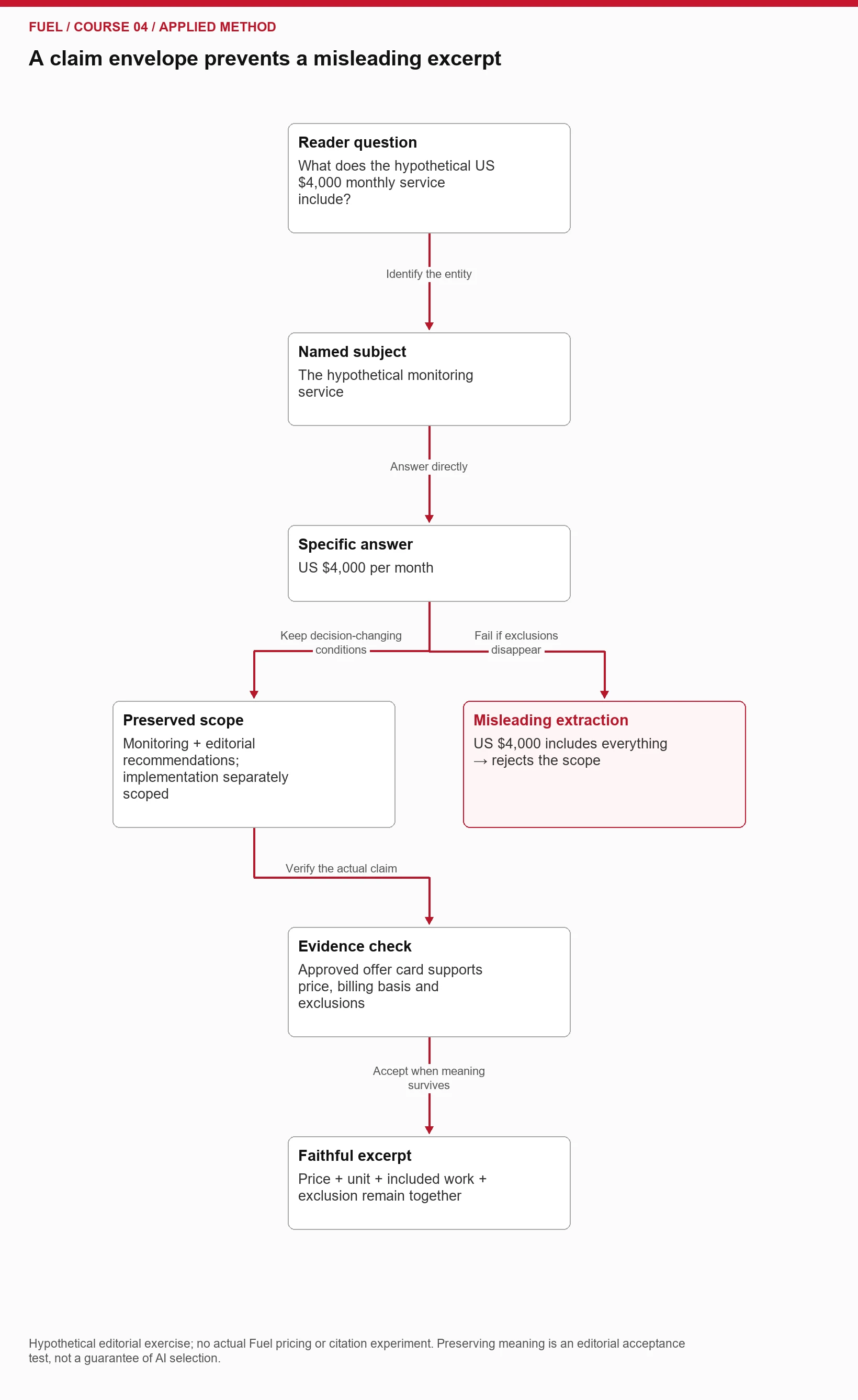
Use a claim envelope with five fields: subject, answer, scope, support and consequence. The subject identifies the entity or process. The answer states what the reader needs to know. Scope supplies the relevant conditions, population or time. Support identifies where a factual assertion comes from. Consequence explains the decision that follows. For AI answers, these are editorial checks, not five mandatory sentences. One well-constructed sentence may carry several fields; a complicated answer may need a paragraph plus a table.
Begin with a consequential passage rather than rewriting the entire site. Good candidates include a price explanation, compatibility statement, service exclusion or research finding. Save the original and describe the misunderstanding you want to prevent. For example, “Readers may interpret implementation time as a guarantee for every migration.” That is a testable editorial problem. “Make this more AI-friendly” gives the editor no acceptance condition and invites cosmetic changes.
By the end of this course, your deliverable is a passage inventory with corrected examples, retained evidence and a reproducible acceptance test. It should help another editor explain why a version is safer to reuse. Citation observations can inform a later experiment, but they are not needed to decide whether the writing accurately answers its own question.
How should ChatGPT citation optimization clarify the subject?
Resolve actors before replacing pronouns
For ChatGPT citation optimization, the first passage defect to inspect is a missing subject. A paragraph beginning “It takes two weeks” may work beneath a heading and fail when copied into a brief. Replace “it” with the actual operation: “The illustrated migration schedule reserves two weeks for content validation.” The revised subject narrows the statement to a schedule, a phase and an example. It does not promise that every migration finishes in two weeks.
Resolve three kinds of shorthand. Referential shorthand includes “this,” “that” and “they” when the referent is outside the excerpt. Category shorthand assumes the reader knows whether “the platform” means a vendor, software product or delivery service. Organizational shorthand uses an internal acronym that prospects cannot identify. Keep an acronym when its expansion would distract a specialist audience, but define it near the first substantive use and check important excerpts independently.
Naming the subject is different from inserting the company name into every sentence. Consider a service page paragraph about editorial approvals. The process may belong to the customer's legal team rather than the agency. Replacing every pronoun with the agency name would change responsibility. Annotate who acts, who approves and who receives the output before editing. Agency, customer and platform are distinct actors, even when promotional copy collapses them into “we.”
Use actor, action, object and condition
A useful revision order is actor, action, object, condition. For example: “The customer's product owner approves the compatibility table after engineering verifies the supported versions.” That sentence can stand alone because it identifies responsibility and the prerequisite. A neighboring paragraph can then explain evidence storage and escalation without restating the same facts. Self-contained writing should reduce ambiguity while preserving a readable sequence across the page.
Run an adversarial identity check: substitute the nearest competing entity for the subject. If the passage still appears to say exactly the same thing, determine whether it is a generic explanation or an unsupported differentiator. Generic explanations can be useful teaching. A claimed differentiator needs a specific, verifiable fact. Do not manufacture distinctiveness by adding a brand name to an ordinary industry practice.
Which numerical limits must AI search content optimization preserve?
AI search content optimization must preserve a number’s unit and population so its meaning survives reuse. “The process improved results by 30%” leaves the reader unable to identify the result, baseline, sample or time. Before polishing that sentence, recover the underlying record. Was the outcome a citation count, the share of observed answers containing a link, qualified visits or completed inquiries? Different outcomes require different language and cannot be exchanged because they share a percentage sign.
Use a numerical editing card with the measured quantity, numerator, denominator, unit, period and comparison. Add an evidence-status field: observed, calculated, estimated or hypothetical. If the original record is missing, the editor cannot repair the problem by making the sentence more confident. Remove the unsupported number or replace it with an accurate qualitative explanation until evidence is available. A source title pasted after a sentence does not establish that the source measured that claim.
Consider a hypothetical audit in which 18 of 60 sampled passages omit an important qualification. The omission rate is 18 divided by 60, or 30%. That is a description of the sample. It is not a finding that 30% of every page on the site is inaccurate, nor evidence that repairing the passages will raise citations by 30%. The numerator refers to passages with omissions, and the denominator refers to inspected passages, both under a stated selection method.
A reusable sentence would say: “In this hypothetical audit, 18 of 60 selected passages omitted a decision-relevant qualification.” A following sentence can explain how passages were selected and what counted as a qualification. When selection is deliberately concentrated on risky pages, state that purpose. The audit can still identify important defects without pretending to estimate a sitewide population rate.
For prices, preserve currency, billing basis, included scope and exclusions. For time estimates, preserve the starting event, prerequisites and major delay factors. For compatibility, preserve product version, environment and tested or documented status. For AI answers, treat these details as part of the answer rather than removable fine print. If they change the reader's decision, they belong close enough to survive the excerpt test.
Which AEO content structure fits prose, lists and comparisons?
Prose and lists for conditional reasoning
Choose AEO content structure from the relationship or conditional explanation the answer needs. A paragraph can explain why an apparently simple recommendation changes when access, scope or evidence changes. Keep the decisive condition near the recommendation. If the exception appears several screens later, a copied recommendation may become overbroad even though the complete page technically contains the caveat.
Use a list when order, completeness or parallel criteria matter. A migration acceptance sequence might require inventory approval before redirects are built and redirect checks before launch. The list should distinguish prerequisites from optional improvements. Readers cannot execute a checklist that mixes “validate the source data” with “consider stronger messaging” as though both have the same completion condition. Describe the artifact that demonstrates each important step is done.
Tables that preserve scope without visual styling
Use a table when several options share stable comparison attributes. A comparison table is weak when the cells contain only “good,” “better” and “best.” Replace those judgments with the actual scope or criterion. A cell might say “Customer supplies the approved source inventory” or “Supplier delivers a redirect map for customer approval.” Those facts let a buyer evaluate responsibility. They also remain more meaningful when the visual styling disappears.
Keep the table's subject in its caption or surrounding introduction, then make important rows understandable without assuming that every extractor preserves the caption. Avoid relying on color alone to indicate inclusion or exclusion. If a row says “Not included,” the relevant service or deliverable must remain identifiable. For a long explanation, use the table as an index to prose that states assumptions and tradeoffs rather than forcing the entire argument into compressed cells.
For content intended for AI answers, read this course's method diagram as a set of semantic checks: question, claim, scope, support and decision. A passage can move backward in the sequence when support proves weaker than expected. That is useful editorial feedback, not a production failure to hide. If the supporting evidence only establishes access, revise a claim about guaranteed selection instead of searching for a layout that makes the stronger statement look plausible.
How do you repair four misleading commercial passages?
The following passages are hypothetical teaching examples. They describe invented offers and observations, not Fuel client results. They illustrate factual boundaries AI answers should retain. Read each revision as a reasoning exercise: identify the missing field, repair it using supplied information, and state what remains unknown. An elegant sentence that adds facts absent from the input is an unacceptable repair.
Example one concerns pricing. Input: “Plans start at $4,000 and include everything you need.” Supplied facts: the invented service charges $4,000 per month in US dollars for monitoring and editorial recommendations; implementation is separately scoped. Revision: “The hypothetical monitoring service costs US $4,000 per month for monitoring and editorial recommendations; implementation is separately scoped.” The revision gives the buyer a usable comparison basis. It removes an unlimited inclusion claim without inventing a market price range.
Example two concerns access. Input: “Allow the AI bot and your content will appear in answers.” Supplied facts: the team verified that an intended public page is retrievable under its chosen policy. Revision: “The access check confirmed retrieval of the intended public page under the tested configuration; selection in future answers remains unmeasured.” The narrower statement reports the actual observation. A screenshot of a successful request cannot repair a missing citation outcome.
Example three concerns a survey. Input: “Most companies cannot measure AI traffic.” Supplied facts: 14 of 20 respondents from an invited practitioner group reported difficulty separating AI referrals. Revision: “In this hypothetical invited practitioner survey, 14 of 20 respondents reported difficulty separating AI referrals.” The revision preserves the self-report and the selected group. It does not recast a small invited survey as a representative estimate of all companies.
Example four concerns a comparison. Input: “Managed service is the best choice for enterprise teams.” Supplied facts: a buyer lacks implementation capacity, needs one accountable delivery owner and can support external access. Revision: “For the hypothetical buyer without implementation capacity, a managed service fits the requirement for one delivery owner, provided the access arrangement is acceptable.” Another buyer with a mature internal team may reasonably choose differently. A useful answer makes that conditional logic visible.
How do you test answer engine optimization content as excerpts?
An extraction stress test for answer engine optimization content deliberately removes surrounding context to find where meaning breaks. Prepare four views: the complete section, its decisive paragraph, its decisive sentence and any relevant table row. Compare the recommendation, scope and evidence status across the views. You are testing semantic preservation, not simulating every proprietary retrieval system.
Ask a second reader to answer three questions from each isolated excerpt: What is being claimed? To whom or what does it apply? What action would you take? Compare those answers with the full section's intended meaning. A disagreement about wording may be harmless. A disagreement about price inclusion, eligibility, evidence strength or responsibility usually warrants repair. Save the disagreement as an observable defect so the editor knows what to change.
Use a risk-based acceptance rule. A missing decorative detail should not block publication. A missing exclusion that turns an estimate into a guarantee should. Classify defects by their possible effect on the reader's decision, then revise the smallest passage that restores meaning. This keeps the method practical for a large content inventory. Rewriting every paragraph to sound similar would erase useful differences among definitions, arguments, instructions and examples.
For AI answers, the same test can be applied to a generated summary, but inspect the summary as a new artifact. An accurate page can be summarized badly. If a summary omits the crucial condition, record whether the page places that condition near the claim and whether the summary tool ignored it. Repair a page-level ambiguity when present, while keeping downstream tool behavior separate from the source's factual correctness.
Repeat the test after layout changes that move evidence or hide qualifiers. A desktop design may place a condition alongside a claim, while a narrow layout sends the condition far below the recommendation. Text extraction may flatten a two-column comparison into the wrong reading order. The editorial and technical checks therefore meet at the delivered page. For the detailed capture process, continue to content extraction QA and compare actual representations rather than relying on visual proximity alone.
For capture and regression checks, use the content extraction QA course to trace the same critical facts through the initial response, rendered page and readable text.
Which editing method addresses the observed content defect?
Question-first editing starts with the specific question a passage should answer. It works well when a page delays its answer behind a long introduction. Its limitation is premature compression: an editor may write a concise answer before checking the conditions. Use the question as a boundary for research and explanation, then restore the qualifications that make the answer defensible.
Claim-envelope editing starts with an existing assertion and checks its subject, answer, scope, support and consequence. It works well for passages containing pricing, performance, compatibility or a recommendation. Its limitation is local focus. A perfect paragraph does not establish that the complete page covers the buyer's task or that another URL should not own the topic. Use a separate task-to-URL map for architecture decisions.
Table-first editing starts with shared comparison criteria. It works well when buyers repeatedly compare deliverables or service responsibilities. Its limitation is false comparability. A table can make two offers appear equivalent even when their units, scope or evidence differ. Normalize those inputs before writing a recommendation, and preserve an explicit unknown state when a meaningful field cannot be verified.
Narrative editing works through the sequence of a reader's reasoning. It can explain how a decision changes as assumptions change. Its limitation is that the decisive answer may remain buried in a story. Pull the usable answer forward while retaining the reasoning that helps an advanced reader assess it. A worked example earns its length when it shows a decision process the summary cannot convey.
Choose a method by the defect you observed. If readers misunderstand who approves the work, fix actor clarity. If they mistake a sampled observation for a market estimate, fix population and evidence language. If they cannot compare scope, rebuild the criteria. For AI answers, do not select a format simply because someone reported one favorable response after changing several things at once. That observation may suggest a future test; it does not identify which editing method caused the outcome.
For architecture decisions outside the passage, continue to query fan-out content mapping. For an evidence asset that supports original claims, study original research asset design.
How should an AEO content agency document acceptance?
An acceptance rubric for AI answers should separate factual correctness, semantic preservation and usability. Factual correctness asks whether consequential claims have adequate support. Semantic preservation asks whether an isolated passage retains the qualifications necessary to interpret it. Usability asks whether the reader can answer the intended question and identify a reasonable next action. An excerpt can pass one dimension and fail another.
Use hard failures sparingly and clearly. Unsupported performance figures, invented first-hand experience and missing decision-changing exclusions are hard failures. A long sentence, unfamiliar term or repeated subject may merit improvement without invalidating the underlying answer. Record why a defect matters rather than treating stylistic preference as a factual finding. The reader should be able to distinguish “incorrect” from “could be easier to scan.”
A practical review record includes passage ID, intended question, original wording, evidence reference, changed wording, risk, reviewer rationale and acceptance result. Keep the evidence reference private if your publication policy excludes outbound source links, while using an intelligible public source note near the relevant assertion. This preserves internal accountability and reader context without filling the article with an undifferentiated source dump.
Assign maintenance responsibility according to the fact. A service owner should verify included scope, an engineering owner should verify compatibility, and a research owner should verify statistical interpretation. Do not invent an expert-review label when only an editorial review occurred. A second reviewer can challenge the reasoning without pretending to have performed a product test or audited the underlying dataset.
Finish with a small review sample from each consequential passage type, then expand where you find a repeated defect. If several price paragraphs lose billing basis, repair that pattern across the relevant template. If one paragraph is ambiguous, fix that paragraph. Recheck accepted text when its inputs change, including the offer, source evidence or layout. A clean record lets the next editor update a specific dependency instead of repeating the entire audit.
For an agency content brief, select three consequential passages before commissioning a wider rewrite: one price or commitment, one capability boundary and one recommendation. Supply approved evidence and require the editor to return the original, revision, missing qualification and isolated-excerpt result. Compare those artifacts with the proposed scope and maintenance owner. A provider that changes sentence length without explaining which misunderstanding was removed has not demonstrated the core method. A small accepted passage set also gives your internal reviewers a reusable standard for later work.
Can you repair unsupported claims without inventing evidence?
Use this hypothetical lab input: “Our system delivers a 50% improvement in two weeks. Setup is included, and it works with all platforms.” The evidence card says that a demonstration workflow reduced a manual task from 40 minutes to 20 minutes in one prepared example. The example excluded data cleanup. The invented offer includes an initial configuration workshop; custom integration is separately scoped. Compatibility was documented for the invented Atlas 8.2 and Birch 3.1 products, with other environments unverified.
First, separate the claims. The improvement concerns task duration, not revenue, traffic or AI citations. The two-week statement has no supporting evidence and should be removed rather than disguised as an expectation. “Setup” needs an inclusion boundary. “All platforms” conflicts with the compatibility record. Notice how four different defects sit inside two short promotional sentences. Shortness did not make the passage precise.
A defensible revision is: “In this hypothetical prepared demonstration, the manual task took 20 minutes instead of 40 minutes, excluding data cleanup. The illustrated offer includes an initial configuration workshop; custom integration is separately scoped. Compatibility is documented for the invented Atlas 8.2 and Birch 3.1 products, while other environments remain unverified.” The invented identifiers are teaching inputs, and the qualification prevents the comparison from silently expanding to unverified environments.
The duration decrease is 20 minutes, calculated as 40 minus 20. Relative to the original 40-minute task, that is a 50% reduction in duration. Calling it a 50% improvement without naming the outcome is less informative. Calling it twice the revenue would be false. The single prepared demonstration also cannot establish an expected saving for every customer or isolate the contribution of one component.
Submit the revised passage with your claim envelope, arithmetic, omitted unsupported statements and excerpt-test results. A strong answer explains both what the evidence permits and what additional observation would justify a stronger claim. That habit transfers to research summaries, service comparisons and technical documentation. The final passage should help a reader make the right decision even if no answer engine ever selects it.
Sources and evidence notes
Google Search Central. Optimizing your website for generative AI features on Google Search. Accessed October 25, 2026. Provider guidance supports the stated boundary on special passage formatting. The claim-envelope method and hypothetical labs are Fuel editorial teaching frameworks, not published causal citation findings.
Apply the method to a consequential page
Bring a high-value page, its evidence and the reader decision it must support to a Fuel Online AEO and AI SEO discussion.
Explore the AI SEO and AEO course curriculum.
Discuss AI SEO and AEO implementation with Fuel Online.