
AI SEO – AEO Course 06
What should an AI crawler access audit verify?
For an AI crawler access audit, identify the relevant search agent, permit the intended public paths under your policy, and verify that the delivery stack returns the actual content. Test robots rules, network enforcement and application responses separately. Preserve training preferences as a distinct decision. A passing browser request or a familiar user-agent string is useful diagnostic evidence, but neither proves that a genuine provider has retrieved or selected the page.

Start the policy for AI crawlers with a record that answers four questions: which public content may be discovered, which provider functions are allowed, which information remains protected, and who approves a change. Define the intended behavior before inspecting configuration. Otherwise, teams can spend hours debating a robots file without agreeing whether the goal is search discovery, user-requested browsing or training participation.
Choose a small representative URL set. Include a public guide, a commercial page, an asset required to understand the page, an intentionally unavailable route and a protected area. Record the expected response for each. The public guide should deliver its answer anonymously. The protected area should require appropriate access. The unavailable route should communicate its real state. A test for AI crawlers that checks only the homepage may miss the actual path a buyer or search system needs.
Capture the current robots file, relevant response headers, edge rules and application behavior before editing. Record the change owner and rollback condition. A narrow diff is easier to review than a wholesale replacement of existing policy. Preserve comments explaining intentional exceptions; they often encode business decisions that a crawler-name cleanup could accidentally erase.
This course produces a policy matrix, a scoped change plan and an evidence-backed access receipt. It does not require removing security controls across the site. The operational goal is to make the intended public material reliably available while preserving the protections and preferences the organization actually chose.
Which agents matter for ChatGPT website crawling?
OpenAI search, training and user actions
ChatGPT website crawling requires a function-specific access decision, not a provider-wide allowance. OpenAI distinguishes OAI-SearchBot for search, GPTBot for potential training and ChatGPT-User for user-directed actions. Source note: OpenAI, Overview of OpenAI Crawlers, accessed October 2026. Keep those roles as separate rows in the policy rather than creating one undifferentiated “OpenAI allowed” flag.
PerplexityBot access and other provider controls
For PerplexityBot access, distinguish search crawling from Perplexity-User user-requested fetching. Source note: Perplexity, Perplexity Crawlers, accessed October 2026. A team investigating search discovery should identify the search-crawler row first. A user-fetch success can answer a different diagnostic question and should retain that label in the evidence record.
Anthropic distinguishes ClaudeBot training, Claude-SearchBot search and Claude-User user-directed retrieval. Source note: Claude Help Center, crawler guidance, accessed October 2026. Do not assume that similarly named functions across providers share every control or enforcement behavior. The role map establishes what to investigate; current documentation establishes the applicable provider-specific rule.
Track AI crawlers in a matrix with provider, agent, function, desired permission, applicable hosts, path scope, verification method, owner and review date. An allowed search row and a restricted training row can coexist when supported by that provider's controls. A user-fetch row should state its separate policy and actual enforcement mechanism. Treat missing documentation or unavailable logs as an evidence gap rather than silently copying another provider's assumptions.
For Google Search AI inclusion, inspect the current Search Console generative AI setting and inheritance separately from crawler access. Source note: Search Console Help, Search generative AI control, accessed October 2026. This adds an eligibility-policy layer to the audit. A retrievable page can still be subject to a product-level inclusion choice, so a robots-only review is incomplete for that objective.
Assign one person to maintain this role map for AI crawlers, with technical and policy owners reviewing consequential changes. Record when the underlying documentation was checked. Agent names, published verification mechanisms and product controls can change. A useful policy system makes those dependencies visible instead of presenting a static list of bots as a permanent implementation recipe.
How should OAI-SearchBot robots.txt rules preserve training choices?
An OAI-SearchBot robots.txt change should express the agreed crawling preference for the correct host and agent. It should not be treated as authentication for private information. Keep protected material behind appropriate access controls regardless of crawler preference. The test set should prove that public discovery improves without making a restricted application route available anonymously.
Consider a hypothetical public documentation host whose approved policy allows OpenAI search discovery while declining potential training use. Its proposed search group contains “User-agent: OAI-SearchBot” and “Allow: /”. Its separate training group contains “User-agent: GPTBot” and “Disallow: /”. This is a teaching example for a public host, not a replacement file for an arbitrary site. Existing groups, protected routes and other providers still require review.
Before applying a diff, inspect which host serves the robots file and which host serves the content. The main domain, help center and media subdomain may have separate infrastructure and policies. A correct file on the marketing host does not establish the behavior of an independently hosted knowledge base. Include redirects and final destinations in the URL inventory so the test does not stop at an intermediate response.
When configuring AI crawlers, review existing wildcard groups and provider-specific groups with a parser or test appropriate to the relevant implementation. Do not assume that moving a line visually lower in the file changes precedence. Check the intended path against the resulting rules, and save the evaluated result with the exact file version. If a plugin or edge product generates the file, identify the actual editable source so the next deployment does not overwrite the correction.
Keep the diff small enough to explain. A good change description says which agent and paths are affected, which preference is preserved, and which test will demonstrate success. An unclear description such as “unlock all AI” hides the policy decision and the blast radius. A reviewer should be able to compare the old and new behavior without reverse-engineering an unrelated configuration rewrite.
After deployment, retrieve the public file from the intended host and inspect the actual response. A saved control-panel setting is not proof of delivery. Record caching or propagation limits where observed, then test the representative URLs under the relevant conditions. Leave citation selection outside this configuration acceptance gate.
Which delivery layers should technical SEO for AI search test?
Status, challenge body and anonymous delivery
Technical SEO for AI search must test whether another delivery layer defeats the declared allowance. Build the diagnostic sequence around the response the requester actually receives: destination, status, redirect chain, content type, body, important headers and response time. A successful status with a challenge page is a failure to deliver the guide. A redirect to a login screen may be correct for a private account and incorrect for a public article.
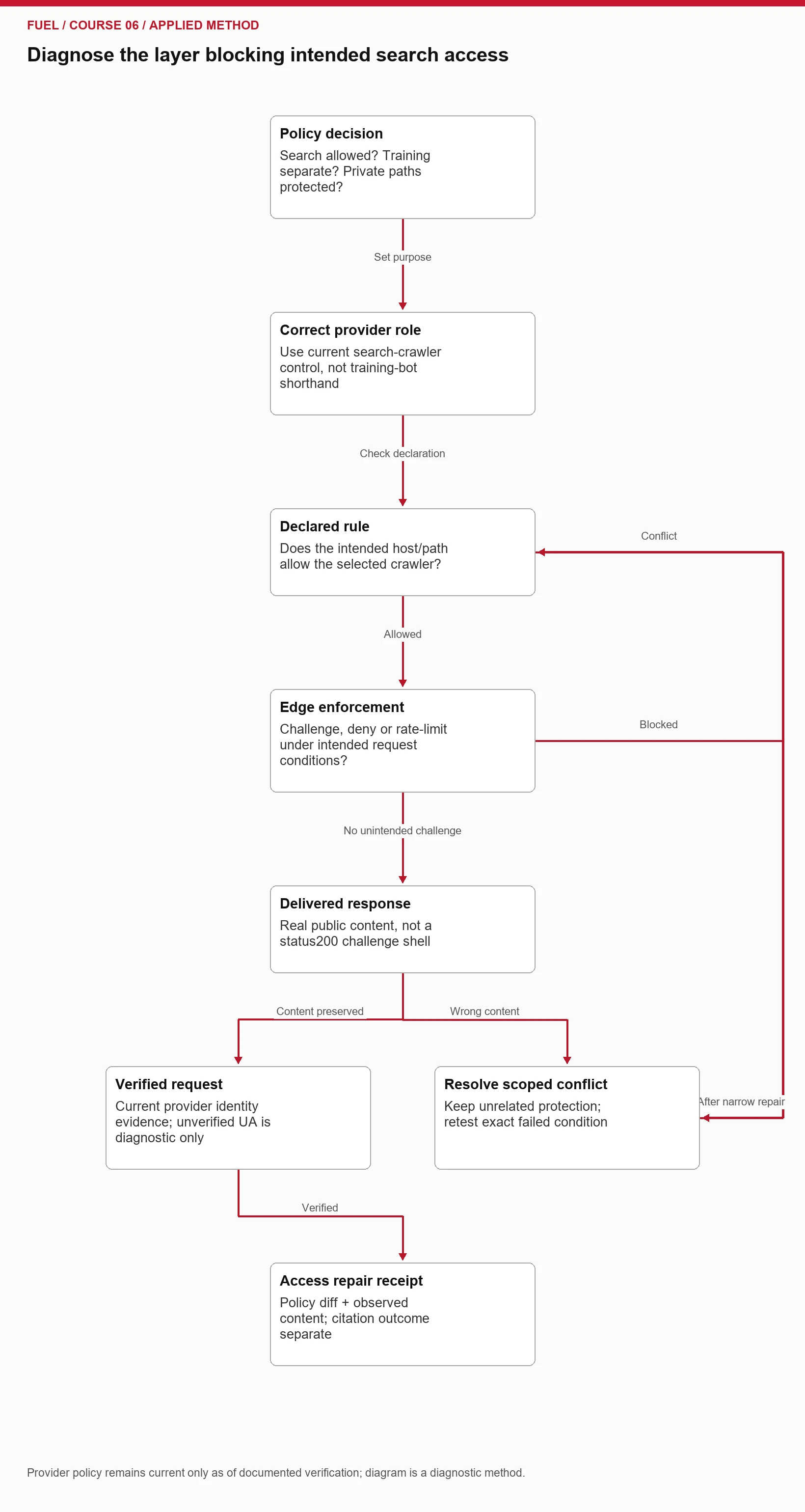
For an initial test of AI crawlers, use an ordinary anonymous request and a fresh browser session. Compare them with the approved content. Then perform a clearly labeled simulated request under the agent conditions you want to diagnose. That simulation can reveal a rule matching the agent string or request pattern. Record it as a simulation, not as proof of provider identity or actual index inclusion.
Identify the edge rule before a narrow exception
Inspect edge events for a matching request time and destination. Identify the rule responsible for a denial, challenge or rate limit. Confirm whether the rule used verified identity, an unverified user-agent string, network reputation, geography or another signal. A general bot category can group several functions together. The remedy should target the observed conflict rather than disable the whole protection layer.
For AI crawlers that pass the edge, check the application response next. Consent handling, regional selection, cookie requirements or a client-side fetch can still replace the answer with an empty shell. Compare the decisive facts, not only response size. A page may return a large navigation document while omitting the body that the intended requester needs. The diagram's layered sequence is designed to catch that false success.
Define the narrow correction. It may be an exception for a verified provider function on public content, a corrected route rule or removal of an accidental challenge from a public guide. Preserve authentication and unrelated restrictions. Include an explicit rollback condition such as unintended access to a protected route, unacceptable error growth or a verified mismatch between the approved policy and delivered behavior.
Retest both success and protection cases after the change. The public article must deliver its main content, and the protected route must retain its expected access requirement. This dual check makes the access receipt meaningful: it establishes the intended behavior on both sides of the boundary.
When the response succeeds but the answer text disappears, continue with JavaScript content extraction QA.
How do you verify provider requests in logs?
A user-agent field is an assertion made by a requester. Keep unverified matches separate from verified provider traffic. Use the provider's currently documented verification mechanism and retain the source version and check time. A log filter that finds a familiar name can identify candidates for investigation; it does not authenticate those requests.
When published network feeds help verify AI crawlers, retrieve them through the normal trusted process, validate their structure and record when they were updated. Avoid copying a list into a permanent rule with no refresh owner. A stale list can reject legitimate requests or preserve obsolete assumptions. Define what happens if a refresh fails: keep the last verified configuration for a bounded period, alert the owner and investigate before broadening access.
Account for the network path. Behind a reverse proxy, the application may log the proxy's address rather than the original requester. Determine which log source provides trustworthy client identity and which forwarded fields are accepted from trusted infrastructure. Do not treat an arbitrary client-supplied forwarding header as verification. The goal is an auditable identity decision grounded in the actual delivery architecture.
For each verified event, save destination, time, response status, relevant content fingerprint and verification evidence. A verified request for a robots file establishes that request, not a fetch of every article. A verified request for a guide establishes access at that time, not that the current revision was selected for a later answer. Keep those stages separate while preserving the useful technical proof.
Use a content fingerprint that reflects the decisive passage or approved revision, not merely a changing date. If the logs cannot show the body version, state that limitation and connect the event to deployment and cache evidence where available. Avoid upgrading uncertain historical requests into proof that the latest content was fetched.
An effective report about AI crawlers ends with a precise statement: a verified provider request reached the stated public URL and received the expected response under the recorded conditions. That statement is valuable enough on its own. Adding unsupported claims about citations or customers would weaken the evidence rather than make the repair more impressive.
How do you repair a status-200 challenge without broad access changes?
This hypothetical incident begins with a public guide that loads normally for a returning employee. A diagnostic automated request receives status 200, so the monitoring sheet marks access as healthy. A closer body comparison finds a browser-verification interstitial instead of the guide's opening answer. The status code was real; the interpretation was wrong.
The investigator captures the final URL, timestamp, response headers and a body excerpt identifying the challenge. An anonymous browser session also encounters the interstitial under the tested conditions. Edge logs show that a recently changed automation rule matched the request. The record identifies a delivery conflict without claiming that any genuine provider has already attempted the same request.
The policy owner confirms that the guide is intended for public search discovery and that the organization's training preference remains unchanged. The technical owner scopes a correction to the relevant verified search function and public path class, using the infrastructure's supported identity mechanism. The team retains the protection for unrelated traffic and keeps the account area behind its normal access controls.
The acceptance test compares the guide's critical facts before and after the correction. The public response must contain its actual answer and a relevant qualification. The account route must continue to require access. The robots file must still express the approved training preference. If any condition fails, the repair is incomplete even if the original automated test now reports a successful status.
A later verified provider request can add a new evidence row, but the team does not invent one to close the ticket. The immediate receipt states the configuration diff and tested public-delivery result. A separate observation queue tracks genuine provider fetches when available. Another queue tracks answer inclusion or citations under a defined measurement plan.
This division lets the access repair finish when its real acceptance conditions are met. It also keeps the external-visibility question open without repeatedly changing unrelated rules. A technical team can demonstrate useful progress while being exact about which part of the pipeline remains unobserved.
Which controls govern public crawling and private accounts?
Robots directives communicate crawling preferences to cooperating agents. They fit a policy decision about automated access to public material. Their limitation is that they do not protect confidential content from arbitrary requesters. A private route needs an actual access boundary even when the robots policy discourages crawling it.
Edge controls enforce network-level or request-level decisions before the application serves content. They fit abuse management, verified-provider exceptions and scoped handling of unwanted automation. Their limitation is classification error and configuration complexity. A broad rule may challenge a legitimate search function or group training and search together. Inspect actual events and verify the intended identity signal before changing the exception.
Authentication and authorization determine who may access protected resources. They fit private accounts, customer data and restricted workflows. Their limitation for public discovery is intentional: an unauthenticated crawler should not be expected to read a protected dashboard. If a useful public explanation belongs outside the account area, publish an appropriately scoped public resource rather than treating private access as a search optimization problem.
Product-level inclusion settings express participation choices within a provider's service. They fit an eligibility decision that is distinct from raw HTTP access. Their limitation is scope: a setting for one product should not be assumed to govern every crawler, training use or third-party source. Record the applicable service and inherited state in the policy matrix.
Choose controls by the requirement they satisfy, then test their combination. A public guide can need an affirmative crawling policy, no unintended edge challenge, readable application content and an intended product-inclusion state. A private account can correctly remain inaccessible even when it shares a domain with that guide. There is no contradiction when the paths serve different purposes.
Avoid an allow-all versus block-all debate when the actual policy is more precise. For AI crawlers, the useful design question is which function may access which material under which conditions. That formulation supports narrow changes, clearer review and reproducible proof.
For inconsistent business facts after access is verified, use the schema and entity reconciliation course to repair the underlying identity evidence.
How should an agency maintain crawler-access evidence?
Keep one change record with the policy reason, affected function, hosts, paths, old configuration, new configuration, deployment time and acceptance results. Attach evidence artifacts that another operator can inspect. Remove secrets and personal data from any shared or public record. Access troubleshooting does not require publishing raw visitor logs.
Assign refresh triggers to the dependencies that can change. A provider documentation update can require a role-map review. A new edge rule can require a representative delivery test. A hosting migration can change the relevant log source and client-identity path. A new public content area can require a host-specific policy review. These triggers are more useful than a vague instruction to “monitor AI bots.”
Use a small regression suite for AI crawlers that includes intended public success and intended private restriction. Run it after changes to the relevant delivery layers. The suite should compare meaningful content and access behavior, not only a status code. Keep a known expected passage or revision marker for the public sample so a challenge or empty shell cannot pass by returning 200.
Define rollback before rollout. Record who can restore the previous rule, which symptoms trigger restoration and which evidence must be preserved. A rollback should not erase the incident record or silently change the business policy. If the problem is an incorrect rule implementation, restore safe behavior and investigate that implementation while keeping the intended policy explicit.
Report three separate outcomes: policy configured, tested delivery verified and genuine provider activity observed. A fourth measure, answer or citation outcome, belongs to the visibility program. This reporting structure prevents a team from calling a configuration save a completed access repair, or calling a provider fetch a business result.
Review the smallest affected scope when a defect appears. One broken help-center route should not force a rewrite of every crawler policy. Conversely, a shared edge rule affecting all public articles warrants a template-level repair and representative retesting. Match the response to the evidence.
Ask a technical provider to scope the access receipt before implementation. It should name the public URL classes, relevant provider functions, policy version, verified identity method and expected content fingerprint, plus one protected-route negative test. Clarify whether the scope includes CDN or firewall changes, application fixes and later regression checks. A robots-file edit alone is a smaller deliverable than a verified delivery repair. Keep that distinction in the statement of work so a completed configuration task is not sold as proven search inclusion.
Can you classify simulated, sitemap and verified-content requests?
Use three hypothetical records. Record A shows a request labeled OAI-SearchBot with no verified network identity; it receives the correct guide. Record B shows a verified search-provider request to a sitemap; it receives the sitemap successfully. Record C shows a verified request to the target guide after deployment; the response fingerprint matches a challenge page.
Record A supports a diagnostic statement about the tested agent string and response. It does not establish genuine provider access. The next useful test is identity verification using the current provider method and trustworthy network logs. Preserve the successful content comparison because it still helps diagnose the delivery path.
Record B establishes a verified sitemap request. It does not prove that the target guide was fetched or selected. The next useful work is to inspect the guide's discovery route and relevant verified requests, while retaining uncertainty about unobserved downstream behavior. Repeatedly changing training permissions would not answer the missing-fetch question.
Record C establishes a concrete delivery failure for the target under a verified request. The next work is a scoped edge or application investigation, using the challenge fingerprint and timestamp to identify the responsible rule. A status-only health check should fail this case. Retest the critical guide content and the protected-path boundary after a narrow correction.
Submit a policy matrix, the three evidence classifications and one next discriminating test for each record. Include a rollback condition for the proposed correction to record C. A strong answer preserves the value of partial evidence without inflating it. It also identifies an actionable repair instead of ending with uncertainty alone.
Your completed audit of AI crawlers should make the public-content objective operational: the right function can reach the right content, policy choices remain explicit and the evidence is reproducible. Search selection and commercial outcomes then become separate questions to measure, supported by a delivery foundation you can actually demonstrate.
Provider source notes
OpenAI, Overview of OpenAI Crawlers; Perplexity, Perplexity Crawlers; Claude Help Center, crawler guidance; Search Console Help, Search generative AI control. Accessed October 25, 2026. Policy examples and incidents are hypothetical teaching scenarios, with provider-specific roles kept separate.
Scope a verified access repair
Discuss your public-content policy, delivery evidence and implementation scope with Fuel Online for AEO and AI SEO support.
Explore the AI SEO and AEO course curriculum.
Discuss AI SEO and AEO implementation with Fuel Online.