
AI SEO – AEO Course 09
How do you design original research for AI citations?
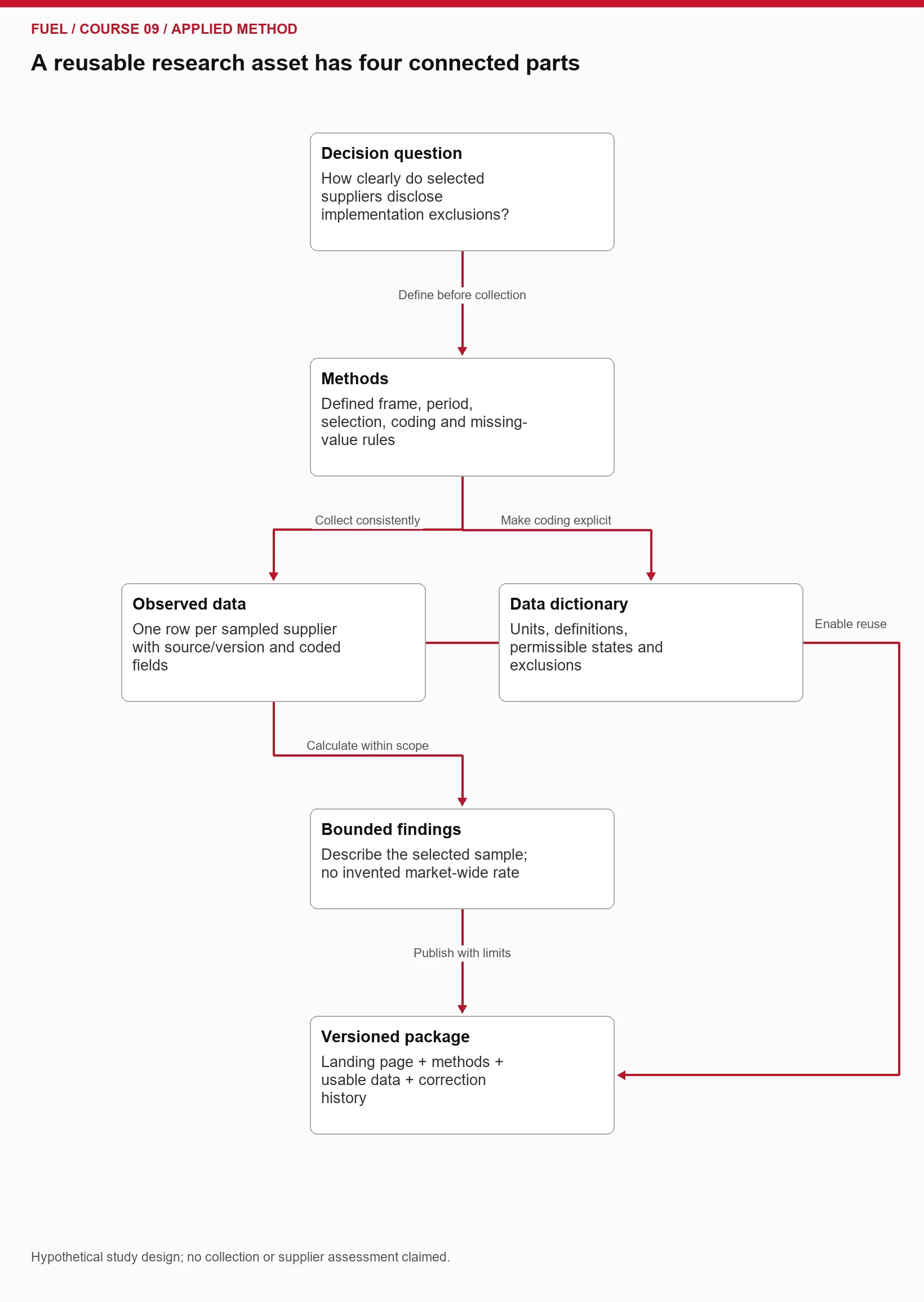
Create original research for AI citations by investigating a useful question, measuring it honestly and publishing an evidence package that other people can inspect and reuse. Define the population, selection method, variables and limitations before collection. Connect the findings to a buyer decision, preserve the underlying data and maintain corrections. Original evidence can make a page worth consulting; publication alone does not guarantee that an answer engine will cite it.

The strongest starting point is a decision that existing material does not adequately support. A buyer may need to understand which implementation responsibilities suppliers disclose, which integration failure cases documentation addresses, or how a defined process behaves under repeatable conditions. Choose a question you can investigate with authorized access and meaningful expertise. A fashionable statistic with no decision behind it is a weak research brief.
Separate original research from original-looking presentation. Redrawing another report's numbers does not create a new study. Combining public sources can produce useful analysis when the transformation is transparent and the sources permit the intended use, but it should not be presented as first-party measurement. A survey, website audit, controlled task test and source synthesis have different evidence contracts.
Write a one-sentence research objective that names the unit and question. For example: “Describe how a selected set of supplier websites disclose implementation exclusions on their public service pages.” That objective can lead to a defined collection and coding plan. “Prove that our service is best” predetermines the answer and undermines the exercise.
This course produces a research-design packet, data dictionary, bounded calculation and publication plan. The worked example is entirely hypothetical. It teaches how to create reusable evidence without implying that Fuel conducted the study, evaluated named suppliers or observed a citation result.
Which buyer question should GEO content research investigate?
For GEO content research, evaluate candidate questions on decision value, novelty, feasibility and verification. Decision value asks which choice becomes easier after the answer is known. Novelty asks what the study adds beyond a summary of existing material. Feasibility asks whether the necessary observations can be collected within approved access, time and cost. Verification asks whether another reviewer could inspect the method and reproduce the calculation.
A narrow study can be more useful than a broad claim. An audit of clearly defined public disclosure fields can establish what appeared on the inspected pages. It cannot establish the suppliers' full contract terms or operational performance. A timed task test can compare a specified procedure under stated conditions. It cannot automatically establish the experience of every customer in every environment.
Define the target population and the actual sampling frame separately. The population is the group you would like to describe. The frame is the set from which you can select observations. A directory of suppliers may omit businesses outside that directory. A customer survey reaches a selected customer group rather than all buyers. The difference is not a reason to abandon every modest study; it is a reason to bound the finding.
For original research intended to support a commercial page, ask which inference would be tempting but unsupported. A disclosure study may tempt readers to infer service quality. A customer satisfaction survey may tempt a publisher to infer market-wide preference. Write that risk in the brief and plan language that prevents the jump. The limitation should shape the study, not appear as a disclaimer after an overbroad headline.
Choose the smallest design that can answer the useful question. If the team only needs to identify missing explanations on its own ten service pages, a controlled internal audit may suffice. A market-wide prevalence estimate requires a different sampling and analysis plan. Match the strength of the published claim to the actual evidence rather than enlarging the claim to make the project look more impressive.
What should an AEO research methodology define before collection?
Define variables before the collection
An AEO research methodology needs a data dictionary before the final collection. Each variable needs a name, definition, allowed values, unit, source location and missing-value rule. For a disclosure audit, “implementation exclusion stated” could mean that the inspected page explicitly identifies at least one activity outside the quoted service scope. A vague phrase such as “terms apply” may not satisfy that definition.
Keep no, unknown and not applicable separate
Distinguish no, unknown and not applicable. “No” can mean the inspected page does not contain the defined disclosure. “Unknown” can mean the page could not be retrieved or the wording could not be resolved. “Not applicable” means the variable does not apply under a stated rule. Combining these states can change the denominator and conceal a collection problem.
Pilot the coding scheme on a small set outside the final selection when feasible. Ask two reviewers to apply the definitions and explain disagreements. If one person counts a generic disclaimer and another requires a named excluded activity, the variable is not yet stable. Clarify the rule, version the dictionary and recode affected observations. Agreement helps expose ambiguity; it does not independently prove that a factual interpretation is correct.
An original research record should preserve provenance at the observation level. Store the inspected destination, retrieval date, relevant passage, page version or fingerprint and coding decision. Keep private or sensitive information out of the public dataset. Public findings should be traceable without requiring the publisher to expose credentials, personal records or unapproved customer material.
Freeze the core measurement plan before evaluating the outcome. Record the primary question, inclusion rules, planned exclusions and calculations. If a new pattern appears during collection, it can become an exploratory analysis with a clear label. Do not quietly redefine the main variable to produce a stronger result. That practice makes the final story easier to promote and harder to trust.
How does a bounded supplier-disclosure study work?
This hypothetical study selects twenty supplier websites from a documented, limited frame of implementation providers. The unit is one public service page per selected supplier, chosen under a stated rule. The study asks whether those pages explicitly disclose an implementation exclusion and a customer responsibility. It measures public explanation on the selected pages, not the contents of every contract or the quality of the service.
Suppose eighteen selected pages are retrievable and two are unavailable under the collection conditions. Among the eighteen inspected pages, twelve state an implementation exclusion, six state a customer responsibility and four state both. These counts are invented teaching inputs. Retain the two unavailable observations in the collection log rather than silently deleting them from the project.
The disclosure proportions among inspected pages are twelve divided by eighteen, about 66.7%; six divided by eighteen, about 33.3%; and four divided by eighteen, about 22.2%. The retrieval-failure share of the selected set is two divided by twenty, or 10%. State the denominator beside each result. A reader should not have to infer whether a percentage refers to selected sites or inspected pages.
The overlap also permits a consistency check. Twelve pages with an exclusion plus six with a responsibility minus four with both gives fourteen pages with at least one of the two disclosures. Four of the eighteen inspected pages therefore show neither under the coding rule. Those arithmetic relationships help detect coding or transcription mistakes before publication.
The original research finding would be scoped to the inspected sample and collection period. A defensible statement might describe the observed disclosure counts and explain the selection limitation. It should not say that one third of the market hides customer responsibilities, that undisclosed activities are never performed or that a supplier with fewer disclosures delivers worse service.
The next useful asset is a buyer-facing scope checklist grounded in the measurement categories. That checklist can help readers ask better questions even when the sample is too limited for a market estimate. The study's practical contribution comes from a transparent question and reusable definitions, not from exaggerating its representativeness.
What should AI citation research assets contain?
Readable findings, methods and reusable data
Publish AI citation research assets with enough supporting material to evaluate their interpretation. A useful package contains a readable landing page, methods, data dictionary, reusable data where permitted, calculation notes and a version history. The landing page should state the question, sample, period, central finding and major limitation near the result. Readers should not need a download to discover the condition that changes its meaning.
For the data file, use stable column names and explicit values. A row might contain a supplier reference, sampled page, collection date, retrieval state, exclusion-disclosure state, responsibility-disclosure state and evidence note. Avoid ambiguous blanks. Explain whether a blank means missing, not applicable or intentionally withheld. The public file may use safe references while a private audit record retains details that cannot be shared.
The data dictionary should explain the unit of observation and variable definitions, including edge cases. A page that discusses optional work is not automatically a page that clearly excludes that work from its standard service. Preserve the rule used in coding. If a reviewer changes an interpretation, record which rows and calculations changed rather than silently overwriting the earlier release.
FAIR packaging and accountable corrections
The FAIR principles emphasize findable, accessible, interoperable and reusable research objects. Source note: Wilkinson and colleagues, The FAIR Guiding Principles for scientific data management and stewardship, 2016. These principles inform evidence packaging; they do not establish a causal AI-citation benefit. Apply them through useful identifiers, clear metadata, understandable formats and documented provenance.
Original research also needs a responsibility record. Identify who owns the method, who checked the calculations and who can correct a published error. Use only review and authorship credits that actually occurred. A professional-looking report should not imply peer review, expert validation or a completed experiment when the underlying work was an editorial audit.
Which research design can support the intended claim?
A census of a defined frame attempts to inspect every unit in that frame. It fits a bounded inventory, such as all public integration pages on one controlled site. Its limitation is that completeness within the frame does not establish completeness of the broader market. State exactly what the frame contains and whether any units remain unavailable.
A sample audit selects part of a larger frame. It fits questions that can be measured consistently from available artifacts. Its limitation depends on selection: a convenience or purposive sample can identify patterns and problems without supporting a representative prevalence estimate. Do not add a confidence interval to a biased selection and assume that it repairs the sampling problem.
A survey measures what respondents report under the chosen questions and recruitment method. It fits experience, preference or perceived difficulty that cannot be inferred from a public page. Its limitations include nonresponse, wording effects and the difference between self-report and observed behavior. Preserve the question wording and recruitment context with the findings.
A controlled task test compares defined alternatives under repeatable conditions. It fits a process question when the team can hold relevant conditions stable and measure the outcome. Its limitations include environment specificity, learning effects and the possibility that the test task does not represent real use. A transparent small test can still be useful when those limits are explicit.
Choose the method before designing the headline. Original research should answer the question the method can actually address. A disclosure audit cannot become a reliability benchmark because that sounds commercially stronger. A preference survey cannot become a performance test because respondents like one option. The comparison between methods is a claim-boundary decision as much as a production decision.
For intervention claims and uncertainty, use the GEO experiment evaluation course before treating a descriptive research asset as causal evidence.
When is Dataset schema for AI search appropriate?
Give the research a stable, descriptive destination with a clear relationship to its supporting files. Make the principal finding and essential method readable in the page's main content. A chart can explain a pattern, but its numbers, denominator and qualification should also appear as accessible text. A screenshot of a spreadsheet is a poor substitute for an inspectable dataset.
Use a title that names the actual question and population. “Selected supplier pages often omit scope details” is still too vague unless the sample and measured fields are clear nearby. A title that claims the whole industry is failing would exceed the hypothetical design. Strong packaging helps readers understand the result without amplifying the claim beyond its evidence.
Dataset schema for AI search is an implementation decision for a real dataset, not a substitute for readable evidence. Google's Dataset guidance describes metadata for discoverable datasets, including provenance and distribution information. Source note: Google Search Central, Dataset structured data, accessed October 2026. Apply relevant metadata only when the asset is genuinely a dataset and the fields describe it accurately. Structured data does not replace the readable methods, data or source record.
Connect original research to related decisions on the site. A buyer evaluating a service can benefit from a scope checklist informed by the study, while a technical reader may need the coding dictionary or calculation notes. Use contextual paths that explain the relationship. Do not repeat the same research summary across many thin pages merely to create additional destinations.
Measure reuse separately from publication. A working dataset download, a source citation in an observed answer, a mention by another publisher and a qualified inquiry are different events. Record each honestly. A study can be useful even before it is cited, and a citation does not establish that the citing system represented the finding correctly. Inspect the context of important reuse.
Preserve the result's scope with answer passage engineering so an extracted finding keeps its denominator and limitations.
How should an agency maintain and correct a research asset?
Plan corrections before release. Keep a contact or reporting route for substantive errors, a responsible owner and a revision history. When a coding error changes a result, update the affected data, calculation and interpretation together. State what changed and whether the conclusion changed. A silent replacement prevents readers from understanding differences between versions.
Distinguish an updated observation period from a correction. A new collection can show a real change in the inspected pages. A correction repairs an error in the earlier record. Those are different events and should have different version notes. Keep the historical method and results available where appropriate so later readers can compare like with like.
For original research with changing source pages, preserve enough evidence to support the historical observation. A supplier may later add the missing disclosure. That update should not make the original coding look fabricated if the captured version shows what was present at the time. Retain collection date and source-version evidence, while respecting access and reuse constraints.
Define refresh triggers according to the decision. A study of current prices may need a different review schedule from a terminology audit. A major market or product change can invalidate the earlier selection frame. Revisit the question and method when those inputs change; do not simply advance the displayed date on an unchanged report.
Evaluate whether the asset still earns its maintenance cost. A small research project can remain valuable as a reproducible method even when its numerical snapshot ages. Label the period and explain the appropriate use. If the finding no longer supports a current decision, revise the interpretation or retire the claim rather than preserve a dramatic statistic without context.
Before commissioning a study, require a research brief that names the buyer decision, permitted observations, frame, coding owner, missing-value rules and publication artifacts. Agree whether the engagement supplies only a report or also a reusable dataset, methods page and correction process. Review an inconvenient pilot record before approving final collection; that reveals whether ambiguous disclosures will be coded consistently. The agency should be able to explain which stronger marketing claim the design cannot support. This procurement check protects the asset’s credibility without requiring an invented prediction of citation volume.
Which claims exceed the evidence in a limited page audit?
Use the hypothetical supplier-disclosure study from this course. A proposed headline says, “Most implementation providers hide important responsibilities, causing projects to fail.” The dataset contains only public-page disclosure codes from eighteen inspected pages in a limited selected frame. It contains no project outcomes, buyer interviews or evidence of intent.
Reject three inferences. The selected pages do not automatically represent all providers. The absence of a defined disclosure does not establish deliberate hiding. The dataset does not measure project failure or a causal relationship between disclosure and outcomes. These are separate reasons to narrow the claim, not minor wording preferences.
A defensible interpretation would describe the observed counts on the inspected pages and offer a practical scope-checking resource. Explain that the study assesses public disclosure under a defined coding rule. State the two retrieval failures separately. Preserve the data dictionary and overlap calculation so another reviewer can reproduce the results.
Design a stronger follow-up only if the decision requires it. A representative disclosure estimate needs an appropriate frame and sampling plan. A question about buyer understanding may need a separate user study. A claim about project outcomes requires outcome data and a design capable of addressing alternative explanations. Do not pretend that collecting more of the same page codes answers every stronger question.
Submit the objective, frame, coding rules, dataset structure, four bounded calculations, rejected headline and corrected interpretation. The best original research asset is one whose usefulness survives skeptical inspection. That makes it a credible resource for people and a defensible source when AI search does cite it, without requiring an invented citation promise.
Source and method notes
Google Search Central, Dataset structured data, accessed October 25, 2026. Wilkinson and colleagues, The FAIR Guiding Principles for scientific data management and stewardship, Scientific Data, March 15, 2016. All supplier-study counts and findings are hypothetical; no collection or client result is claimed.
Design a useful evidence asset
Discuss a defined research question, available evidence and publication scope with Fuel Online as part of an AEO and AI SEO content program.
Explore the AI SEO and AEO course curriculum.
Discuss AI SEO and AEO implementation with Fuel Online.