
AI SEO – AEO Course 11
How should you compare an AI SEO agency vs in-house delivery?
Compare an AI SEO agency vs in-house delivery by defining the buyer outcome, required implementation work, available capacity and evidence each model must supply. Compare an AEO consultant as a separate advisory option when your team can execute recommendations. Apply mandatory gates before preference scores, normalize first-year costs and preserve unknowns. A service comparison page is useful when another qualified buyer can replace the assumptions and reach a different defensible decision.

The decision is which team will improve your public evidence, implement approved content or technical changes and measure the resulting observations. An in-house team, specialist adviser and managed AI SEO agency may divide those responsibilities differently. A comparison that labels your agency best in every row does not show who verifies commercial facts, edits the website, reviews claims or maintains the reporting panel. Start with those delivery responsibilities before comparing provider names.
Google's review guidance emphasizes user-relevant comparison criteria, evidence, benefits and drawbacks. Source note: Google Search Central, Write high quality reviews, accessed October 2026. That supports an editorial standard of useful comparison; it does not establish a special format that guarantees AI citations. The gated scoring and cost examples in this course are teaching methods.
Make the publisher's relationship clear. A service provider can publish a valuable comparison of delivery approaches while openly standing behind one of them. It should not impersonate an independent testing organization or imply firsthand evaluation it never performed. When the comparison uses supplier documentation rather than testing, describe that evidence state accurately.
The deliverable is an AI SEO selection contract, normalized scope table, evidence ledger and scenario-based recommendation. The figures below compare hypothetical in-house delivery, advisory AEO support and managed agency execution. They are not Fuel prices or market rates. The method can also guide a fair published comparison page, provided it retains the actual buyer conditions and evidence limits.
What does an AEO consultant vs agency comparison need?
Define the AI search buyer task, operating constraints and decision horizon. “We need more AI visibility” is too broad to support a supplier recommendation. “We need an accountable team to correct pricing and integration evidence, deploy approved changes and maintain a buyer-question panel while we retain site ownership” gives the comparison a concrete purpose. Separate mandatory implementation and access requirements from preferences about reporting, speed and internal knowledge transfer.
Separate activity from delivered work. A monthly AI visibility meeting is an activity; an implemented page correction with acceptance evidence is an output. An audit differs from deployment of its recommendations. A research brief differs from a verified published evidence asset. Price those responsibilities explicitly. A lower advisory fee is not comparable to managed execution until the customer’s implementation, factual review and maintenance effort are included.
For an AEO consultant vs agency comparison, verify who executes each workstream rather than relying on the label. In-house delivery needs available editorial, technical and measurement capacity. Advisory support needs a customer owner able to implement and maintain recommendations. Managed agency delivery needs an approved scope, access arrangement and internal fact owners. Any provider can offer a narrower engagement, so its real statement of work must establish the responsibilities.
Write the decision contract in ordinary language: audience, required outcome, mandatory conditions, important preferences, evidence period and next action. If the buyer has several materially different scenarios, use separate sections with clear recommendations rather than average them into one universal winner. A small team without implementation capacity and a mature internal team may reasonably choose different models.
Identify exclusions early. If the page compares implementation services, it may not answer a question about buying a software license. If the examples use a one-year planning period, they do not establish lifetime cost. These boundaries improve usefulness because they tell the reader whether the comparison applies before asking them to interpret scores.
Build a responsibility table before requesting proposals. Use rows for buyer-query research, source verification, content preparation, CMS implementation, crawler/rendering repair, reporting and maintenance. Mark the agency, consultant and internal team as accountable, contributing or out of scope for each row, then name the approver and completion artifact. Do not assume one supplier must own every row; a clear hybrid can work. The nonnegotiable requirement is that no consequential work is left unowned and that the combined capacity fits the buyer’s actual constraints.
Which AI SEO agency deliverables should buyers verify?
Verify claims, supplier statements and unknowns
Use distinct evidence states: directly verified, supplier-stated, tested under stated conditions and unknown. A capability copied from a current provider page is supplier-stated unless you separately verified its operation. A real test should include the environment, method and result. Unknown means the evidence is missing or unresolved; it should not be converted to a reassuring checkmark.
Define AI SEO agency deliverables in a criteria ledger with decision relevance, evidence requirement, source date and owner. For technical implementation, require a named owner, scoped change and delivery check. For content, require an approved brief, factual review and published-page acceptance. For reporting, require question versions, raw answer evidence and clear denominators. For handoff, require transferable records and ownership. Ask whether each artifact is included, optional or customer-supplied.
Keep the same standard across options. Do not require independent testing for a competitor while accepting your own promotional copy as proof. A criterion can legitimately favor your approach when it matters to the defined buyer, but the evidence rule should remain consistent. Explain the criterion instead of hiding the commercial preference inside a scoring formula.
In comparison pages, absence of public evidence does not automatically establish absence of a capability. State “not established in the inspected material” when that is what you know. A buyer can then ask the supplier for the missing fact. If the answer is necessary for a mandatory requirement, hold the eligibility decision until it is resolved.
Preserve evidence versions. A real price, service boundary or support commitment can change. The comparison should show when consequential information was checked and identify the field owner. A later reader should be able to distinguish a historical observation from a current offer. This protects both the buyer and the publisher from outdated certainty.
Which delivery gates must pass before an agency score matters?
A mandatory gate tests whether an option can satisfy a nonnegotiable requirement. Use pass, fail and unknown with explicit evidence. A weighted preference score answers a different question: among eligible options, which tradeoff best fits the buyer's priorities? A high score cannot compensate for failing a mandatory requirement.
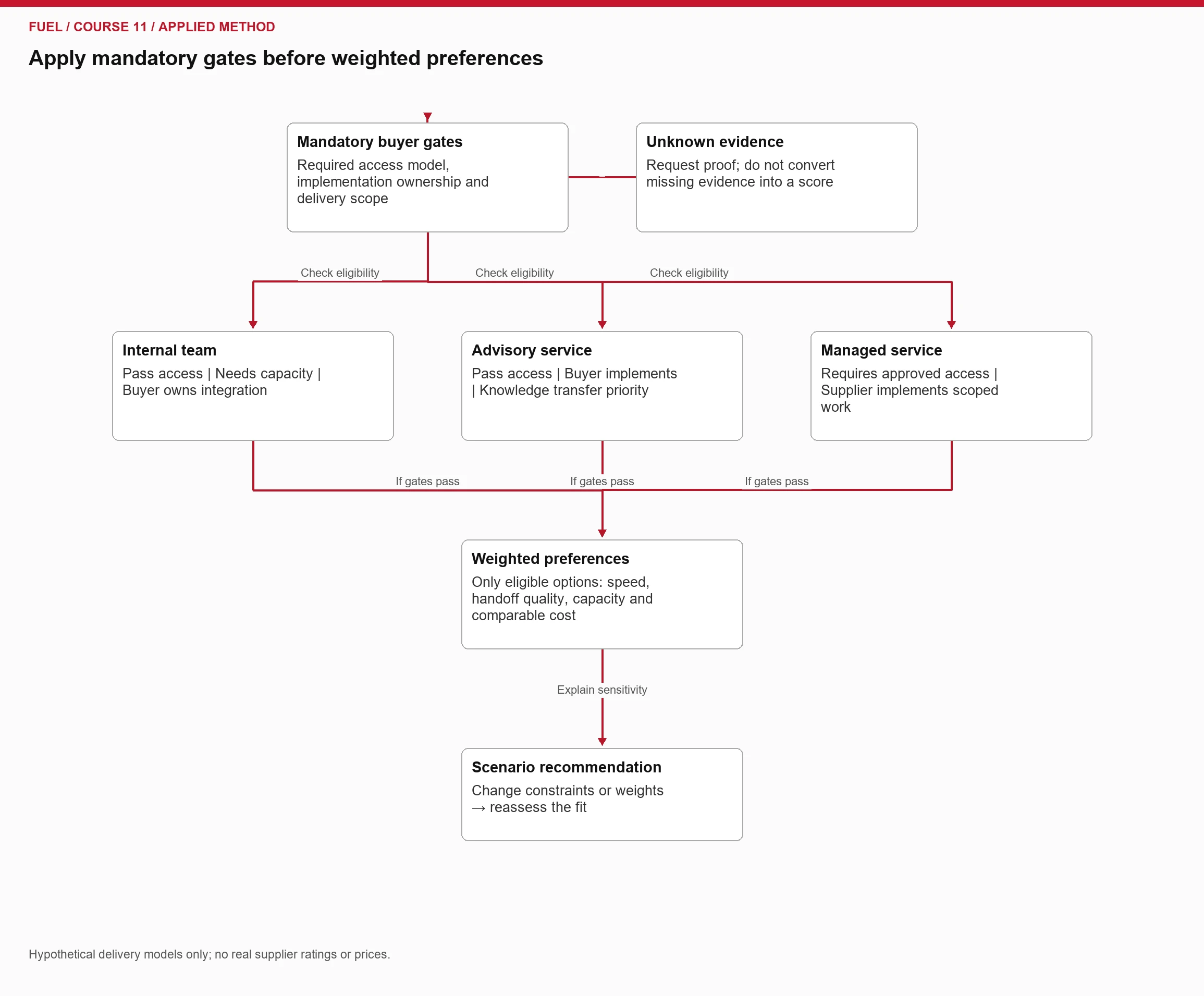
Check implementation capacity and approved access
Consider a hypothetical buyer that needs approved AI search content and access repairs deployed, has no available internal implementation team and has not approved external site access. In-house delivery fails the capacity gate. Advisory AEO support fails the implementation-ownership gate because the buyer still has to execute. A managed agency option remains unknown until its operating scope and access arrangement are approved. More citations in a sales deck cannot resolve those missing delivery conditions.
The honest initial recommendation is not to declare an agency winner. Resolve bounded access for a suitable managed option, add internal capacity or reduce the implementation scope. Once access and execution ownership are verified, that option may pass. Another business with a mature SEO and engineering team may instead prefer an AEO consultant for a narrow evidence or experiment question. The conclusion follows the scenario rather than the supplier category.
A second buyer with a capable internal team may pass all three models through the gates. That buyer can then compare handoff, implementation speed and comparable cost. Keeping the two scenarios separate prevents comparison pages from using one buyer's constraints to justify a recommendation for everyone.
Write gate failures in terms a buyer can act on. “Customer must supply an implementation owner” gives a useful next step. “Poor fit” without a reason does not. When a criterion is unknown, identify the exact evidence needed: approved access plan, current scope, named operating owner or relevant acceptance test. That turns the comparison into a decision tool instead of an attractive dead end.
How do you normalize AI SEO agency pricing and internal costs?
Normalize AI SEO agency pricing against the same agreed outcome over the same period. Include customer work left outside the quote: factual approval, implementation, analytics configuration, review and maintenance. An audit fee, recurring retainer and internal labor estimate are different inputs. The worksheet below uses invented annual in-house, advisory and managed-agency assumptions in US dollars; it is a sensitivity model, not a current service-price benchmark.
A hypothetical first-year cost worksheet
Use this hypothetical first-year worksheet in US dollars. Internal delivery uses twenty staff hours per month at a loaded planning rate of $100 per hour, forty setup hours at the same rate and $1,200 of annual tools. Its illustrated total is (20 × 12 × 100) + (40 × 100) + 1,200 = $29,200. The hourly rate is an invented planning input, not a market benchmark.
The advisory model has a fictional $12,000 annual fee, ten customer staff hours per month, twenty setup hours and the same $1,200 of tools. Its total is 12,000 + (10 × 12 × 100) + (20 × 100) + 1,200 = $27,200. The customer labor remains visible because advisory support does not automatically perform the implementation.
The managed model has a fictional $24,000 annual fee, four customer hours per month, eight setup hours and $1,200 of tools. Its total is 24,000 + (4 × 12 × 100) + (8 × 100) + 1,200 = $30,800. These figures are teaching assumptions only. They are not Fuel prices, supplier quotes or observed customer costs.
Comparison pages should expose sensitivity rather than hide it. If customer time costs more, if implementation scope grows or if tool fees differ, the totals change. List the inputs a buyer should replace with actual approved values. A low quoted fee can become a higher comparable cost when substantial customer work is omitted from the initial table.
Find the break-even monthly staff input
Calculate a break-even input rather than merely saying costs vary. Hold the hypothetical internal setup and tool assumptions fixed: forty setup hours at $100 plus $1,200 of tools creates $5,200 before recurring staff time. Let h be monthly internal hours. First-year internal cost is $5,200 + ($1,200 × h). Equating that expression to the advisory worksheet total of $27,200 gives h = 22,000 / 1,200, approximately 18.33 hours per month. Above that input, this internal model costs more than the illustrated advisory model; below it, internal delivery costs less, with the other assumptions unchanged.
For example, fifteen monthly internal hours produce $5,200 + ($1,200 × 15) = $23,200. That changes the cost ordering relative to the original twenty-hour case. If the chosen rubric swaps internal and advisory cost scores accordingly, the original 40/35/25 weighted totals become 3.70 for internal and 3.40 for advisory, while managed remains 3.45. The example shows a recommendation boundary, not a universal labor-saving claim. A real buyer should replace h with credible capacity estimates and include the work the cheaper option leaves undone. Record the source of each input, who approved it and the plausible range before selecting a final recommendation. Do not reduce the hours simply to make the preferred model win; unsupported assumptions can manipulate a comparison as easily as biased weights.
Which preferences and sensitivity checks change the decision?
Weight preferences only among eligible options
After all mandatory gates pass, define preferences and weights before scoring. In this hypothetical scenario, handoff has weight 40%, implementation speed 35% and comparable cost 25%. The weights sum to 100%. Scores use a one-to-five rubric chosen for the exercise; they are judgments under stated assumptions, not measured performance ratings of actual providers.
Assign illustrative scores in the order handoff, speed and cost. Internal delivery receives five, two and three. Advisory receives four, three and four. Managed service receives three, five and two. The cost ordering matches the hypothetical worksheet, while the handoff and speed judgments represent this buyer's assumed delivery conditions. A real page would need evidence for those conditions.
The weighted scores are 3.45 for internal delivery, 3.65 for advisory and 3.45 for managed service. For example, advisory is (0.40 × 4) + (0.35 × 3) + (0.25 × 4) = 3.65. The small numerical gap should not imply scientific certainty. If the evidence behind one score is weak, the ranking may be fragile.
Test whether speed changes the recommendation
Now make speed more important: 20% handoff, 60% speed and 20% cost. The scores become 2.8, 3.4 and 4.0 respectively. Managed service leads under that different preference structure. Nothing about the models changed; the buyer's priorities did. That is precisely why comparison pages should publish the decision logic rather than present one score as objective truth.
Use sensitivity checks on both weights and uncertain inputs. Ask whether a plausible change reverses the recommendation. If so, explain the condition that determines the choice and request the missing evidence before a firm conclusion. A comparison that reveals its own boundary can be more helpful than a confident rank that hides the assumptions.
| Model | Handoff | Speed | Cost | 40/35/25 score | 20/60/20 score |
|---|---|---|---|---|---|
| Internal | 5 | 2 | 3 | 3.45 | 2.8 |
| Advisory | 4 | 3 | 4 | 3.65 | 3.4 |
| Managed | 3 | 5 | 2 | 3.45 | 4.0 |
How should buyers compare AEO agencies fairly?
For buyers who compare AEO agencies, lead with the scenario and the conclusion the evidence supports. Explain who supplies strategy, factual research, implementation, quality review and ongoing measurement under each scope. A capable internal team may prefer specialist advice; a team without execution capacity may need a managed delivery option. A fair comparison should identify a suitable alternative even when it is not the publisher’s offer.
Use tables for shared attributes and prose for conditional reasoning. A comparison row should name the feature or responsibility and preserve its scope. Avoid icons that require color alone to distinguish included, excluded and unknown. A readable cell such as “Customer supplies the implementation owner” carries more information than a green checkmark under “support.”
Keep material limitations near the recommendation. If an advisory model requires internal execution capacity, place that condition beside its fit statement. If a managed service requires approved access, do not bury the dependency after the inquiry form. Comparison pages can be concise at the decision point while providing deeper evidence and calculations below.
State commercial relationships plainly. Identify the publisher as a provider when that is true, and disclose relevant sponsorship or affiliate arrangements where applicable. Do not invent customer endorsements, expert testing or independent rankings. A clearly positioned provider can still publish a rigorous comparison when the criteria and evidence are transparent.
For AI search observation, inspect what the answer repeats. A citation is less useful if the system drops the access condition or recommends a model that failed the buyer's gate. Record factual support, suitable fit and source presence separately. The public comparison should be useful on its own, while later answer tests reveal whether its decisive conditions survived reuse.
Use business entity reconciliation when supplier identities or provider relationships conflict. Map distinct comparison intents with AI search query mapping.
How do you keep agency scope, cost and evidence current?
Assign owners to volatile agency-comparison inputs: current scope, implementation responsibility, review capacity, reporting access, fees, included tools and handoff terms. A page-level date does not establish that every field was rechecked. Keep a private ledger with the approved value, evidence, owner, valid period and dependent cost or scoring assumptions. A change from managed implementation to advice-only support can invalidate eligibility even when the headline fee remains the same.
When an input changes, update the relevant reasoning as well as the cell. A new implementation exclusion can invalidate a gate. A revised fee can change the comparable cost. A new handoff deliverable can affect the preference rubric. Do not refresh the visible date while leaving the old recommendation intact.
Preserve historical examples when they remain useful and clearly labeled. The invented cost worksheet in this course should not be converted into a current market estimate by updating its date. A real comparison with verified historical quotes should retain their period or replace them with newly checked inputs and a clear revision record.
Test delivery and the next action. A useful comparison followed by a broken scope document, obsolete inquiry form or empty destination is still an incomplete buyer task. Check the actual public text, tables, links and critical qualifications after material changes. Verify representative mobile and text-only presentations so layout does not detach an exclusion from the option it qualifies.
Keep observation separate from maintenance completion. Comparison pages can be factually updated and their delivery verified before a search engine uses the revision. Record future citation and recommendation behavior under saved conditions rather than repeatedly rewriting accurate content in response to one unexpected answer.
Can you reject an AEO advisory option that fails implementation needs?
Evaluate this fictional recommendation: “The advisory model wins because it is cheapest and scores 3.65.” The buyer has no implementation capacity and requires an accountable party to execute approved changes. The advisory offer supplies recommendations but requires the customer to implement. The table uses the hypothetical scores and costs from this course.
Reject the recommendation before debating the weights. The advisory model fails the mandatory implementation-ownership requirement in this scenario. Its lower illustrated cost and higher preference score cannot repair that failure. The score belongs to the separate scenario in which all models passed the gates. Moving it between scenarios changes the decision contract.
Write a corrected answer: the buyer must first identify a delivery path that provides implementation responsibility under an approved scope and access arrangement. An appropriate managed option may fit once those conditions are verified. Internal or advisory delivery could become viable if the buyer adds the required capacity. No option should be described as eligible while a consequential gate remains unknown.
Now test a different buyer with a capable internal team. All models pass the gates, so the published preference analysis becomes relevant. Advisory leads under the first weight set, while managed service leads when speed receives 60%. A strong answer explains the change in priorities and the uncertainty in the assumed scores instead of declaring that the scoring system contradicted itself.
Submit the decision contract, evidence states, gate table, comparable cost model and one sensitivity check. Include a recommendation and a non-fit statement for the actual scenario. The best comparison pages make their logic reproducible: another reader can replace assumptions with real evidence and understand why the answer changes. That is useful commercial content for human buyers and a sound source when AI search does reuse it.
If a performance claim needs testing, the GEO claims and AI search experiment course provides the outcome and comparison design.
Source and illustrative-model notes
Google Search Central, Write high quality reviews. Accessed October 25, 2026. Delivery models, fees, labor rates, scores and buyer situations in this course are hypothetical teaching inputs. They are not Fuel prices, supplier evaluations, market benchmarks or client results.
Build a defensible buyer comparison
Discuss your buyer requirements, current evidence and comparison scope with Fuel Online for an AEO and AI SEO content implementation.
Explore the AI SEO and AEO course curriculum.
Discuss AI SEO and AEO implementation with Fuel Online.