
AI SEO – AEO Course 29
What kind of ChatGPT brand confusion is occurring?
Diagnose ChatGPT brand confusion when an answer combines identities that share a name, category, location or historical relationship. Diagnose brand confusion by preserving the mistaken statement, establishing the correct identity facts and inspecting the sources attached to that statement. Then repair the responsible public evidence and test the ambiguous question separately from an exact-identity control. A corrected page can remove a demonstrated contradiction; it cannot promise a permanent change to model memory.
Begin with a claim rather than a screenshot of the company name. “Harbor Ledger is a UK boat-repair company that sells US accounts-payable software” contains several separable assertions: location, service category, product and organization identity. The error might be a false merge of two businesses, an outdated rebrand, a product mistaken for its publisher or an unsupported geography. Different classes require different evidence. Repeating the name more often will not identify which relation is wrong.
Use five collision classes. A same-name collision combines unrelated organizations. A historical collision treats a former name or former owner as current. A hierarchy collision swaps parent, subsidiary or division. A distribution collision treats reseller and producer as the same business. A category collision attaches a product, person or place to a company that merely shares its label. Record more than one class when necessary, but identify the precise assertion each class explains.
Check whether the question is actually resolvable. “What does Harbor Ledger do?” may legitimately refer to several entities. A cautious answer that asks for location or domain is not necessarily a failure. A test that requires your company to win every ambiguous name query encourages false attribution. Define the task so success includes a useful clarification when the supplied context cannot distinguish the intended business. Accuracy matters more than making the answer choose one entity prematurely.
Preserve the complete response, question, date, interface, search state, locale and visible supporting destinations. A name can be correct in one paragraph while the founding date or service area belongs to another organization. Save the surrounding language so a reviewer can identify that mixed bundle. If the answer exposes no sources, describe source provenance as unobserved. Do not claim to know whether an owned page, an external profile or prior model knowledge supplied the mistaken fact.
Finally, define the business consequence. Wrong support details can misdirect customers; a mistaken product relationship can produce unsuitable inquiries; an irrelevant same-name mention may be harmless. The brand confusion ticket should state which decision the error affects and which entity owns the correct fact. This creates a bounded repair target instead of a vague campaign to increase entity authority. It also prevents a cosmetic name variation from outranking a consequential ownership or eligibility error.
Which facts support AI brand entity disambiguation?
Separate identity facts from service eligibility
For AI brand entity disambiguation, create a minimal approved identity reference before editing public descriptions. For each real entity, record current trading name, legal name when relevant, primary public destination, product category, operating geography, material parent or subsidiary relationships, former names and effective dates. Attach an evidence owner and reference for consequential facts. Include only facts needed to distinguish the business or support a decision; a long list of identifiers can create more contradictions if nobody verifies them.
Separate identity from eligibility. A company incorporated in one country may serve customers elsewhere. A headquarters address does not establish a nationwide service area, and a language option does not establish local availability. Put operating location, service geography and offer conditions in separate fields. An answer can identify the company correctly while still recommend it outside its actual market. Your reference needs enough precision to detect that second problem without relabeling it as a different organization.
Use a compact identity sentence as an editorial test. For example: Harbor Ledger Software is a fictional US accounts-payable application for finance teams; Harbor Ledger Marine is a separate fictional UK boat-repair business. The sentence deliberately keeps category, geography and independence together. In real content, use the organization's actual approved name and relationships. Do not invent an expanded trading name merely to create a keyword-rich label that the business does not use.
Verify identifiers and effective periods
Treat each identifier as a fact with a type. A public company registration reference can help distinguish legal organizations when relevant, but it does not establish service quality or product compatibility. A real profile may identify the same organization; a partner's profile identifies the partner. Never manufacture a registration number, location, award or official relationship to make a reference look complete. Leave an unavailable identifier absent and explain internally what evidence would be needed to use it.
Google documents Organization markup as a way to clarify identity in its search systems. Source note: Google Search Central, Organization structured data, accessed October 2026. That is a bounded provider statement. The identity reference here is a business and editorial control, useful even without markup. It should drive consistent visible descriptions and applicable structured representations, while making no promise about ChatGPT citations or the private process that produced a previous answer.
Define negative identity constraints carefully. “Not affiliated with the other Harbor Ledger business” may be useful when an actual recurring collision is documented and the statement is approved. A page listing dozens of unrelated competitors as entities you are not affiliated with is unlikely to help a buyer. Use the smallest truthful distinction necessary. A product page should primarily explain the product; a disambiguation note should clarify a real ambiguity without displacing the useful answer.
Version the reference when relationships change. Acquisition, divestiture, product retirement and rebranding need effective dates and clear continuity statements. A former owner can remain relevant to historical material without being current. Preserve the evidence behind continuity rather than treating a similar logo or redirected page as sufficient proof. Resolving brand confusion requires knowing which facts apply now, which applied before and which belong to another organization entirely.
How do you trace ChatGPT business identity errors to sources?
Investigate ChatGPT business identity errors with a claim-to-source matrix rather than a directory of every brand mention. Put the mistaken assertion in one column, the approved fact in another and each inspected source beside it. Mark support, contradiction, missing detail or unresolved identity. A source that mentions the name without defining the disputed relationship is incomplete evidence, not necessarily a false source. This distinction keeps the repair focused on what the publication actually claims.
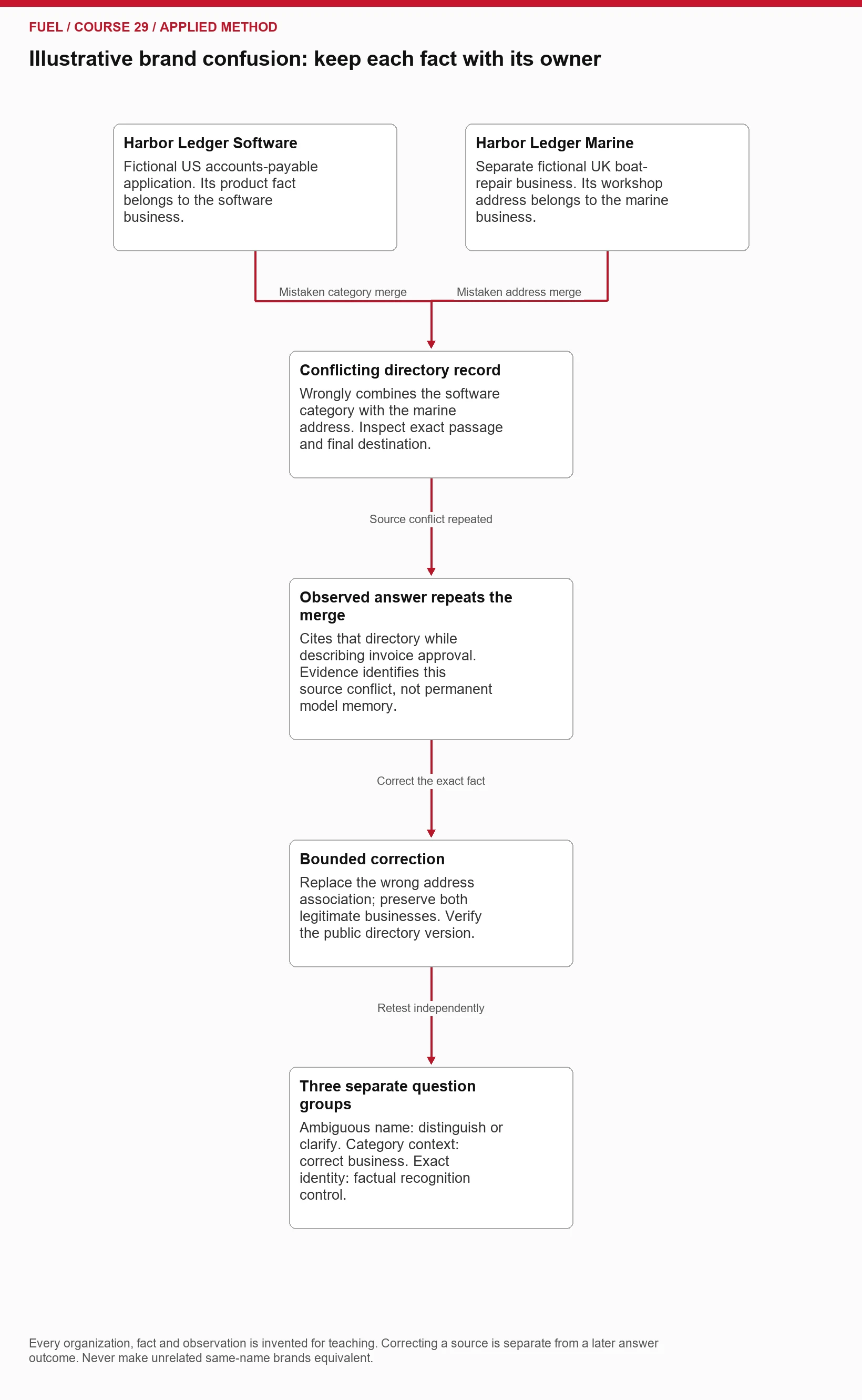
Work through an invented collision. The software company's public about page correctly says it builds accounts-payable software in the US. A marine repair company's page correctly describes its UK workshop. A third-party directory mistakenly assigns the marine address to the software company. A captured answer cites that directory while describing invoice approval. The visible evidence establishes a mixed directory record and a source-supported identity error in this answer. It does not prove that every system has permanently merged the companies.
Inspect redirects and destination identity. A profile labeled with the right brand may lead to a different business after a sale, expired domain or editorial mistake. Record the final destination, inspected date and relevant passage. Compare the actual page's claims with the reference, rather than trusting the title or thumbnail. A familiar logo can be stale, and a correct name can appear beside the wrong product or geography. The diagnostic unit is the supported relationship, not visual resemblance.
Separate three repair paths. An owned contradiction can be corrected through the responsible internal owner. An external factual error needs a reviewable correction packet containing the exact passage, approved replacement, current evidence and effective date. An answer that misstates a correct source needs a saved source-support record and, where appropriate, the provider's available feedback process. Do not pretend that editing the owned about page also updates an independent directory or an already captured answer.
For the fictional directory, prepare a correction that replaces the address association and explicitly separates the two businesses. Preserve the old record privately and later inspect the corrected public destination. Avoid asking the directory to award the software company a broader category or remove truthful competing listings. The objective is accurate identity evidence. Sending a correction request is an action with its own authority; preparing the exact reviewable packet is part of the diagnosis.
Compare inspection methods. A rapid citation trace works well when the wrong answer names a visible source; its limitation is that it covers only the exposed source set. A broader owned-profile reconciliation helps when contradictions exist across several controlled surfaces; its limitation is that agreement among those surfaces does not show which one influenced the answer. Repeated stable-question observations test persistence; their limitation is that platform variation and unobserved sources remain. Choose the method that addresses the actual uncertainty.
Close the source investigation with a bounded finding. For example: the directory mixed the marine address with the software category on the inspected date, and the captured answer repeated that association. The next artifact is a verified directory correction and a new observation, not a claim that a knowledge graph has been repaired. Brand confusion reporting becomes more credible when it states precisely which source conflict was observed and which broader explanation remains unknown.
How should content distinguish brands, products and subsidiaries?
Describe the relationship a buyer needs rather than compressing every name into one identity. A product is offered by an organization; a subsidiary can have a parent; a reseller can distribute another company's product. These relations are different from equivalence. In visible prose, name the subject and the relationship explicitly. A statement such as Product Pine is distributed by Company Birch does not establish that Pine and Birch are alternate names for the same organization.
For a product family, distinguish the publisher, product and plan. A brand name shared across a company and application can be legitimate, but the page should make the role clear where it matters. Support instructions may concern the application, contract terms the selling legal entity and acquisition history the parent organization. Record those roles in the identity reference instead of assigning every fact to whichever brand label appears most prominently in the design.
Handle acquisitions with dates and scope. Buying one product line does not necessarily transfer every service, account or geographic business associated with the former name. A current ownership sentence should state what was acquired and when, using approved evidence. Historical pages can retain the former relationship with a clear period. A global replacement of the old company name may erase useful context or create a false claim that today's owner operated the product during earlier events.
Treat regional entities similarly. A local subsidiary, franchise or independent distributor may have different terms, support routes and responsibilities. A shared visual brand does not make those obligations identical. Place the relevant seller and service region near the offer decision. When an AI answer uses the right brand but gives the wrong regional contact, classify the failure at that relationship rather than collapsing all regional organizations into one generic record.
Keep people distinct from organizations. A consultant with the same name as a founder at another firm needs a relevant biography and an accurate current role. Google recommends a unique author reference in Article markup. Source note: Google Search Central, Article structured data, accessed October 2026. That supports a limited author-identification practice. It does not authorize claiming a person authored or reviewed material merely to gain a more recognizable identity association.
Align structured representations only after the relationships are approved. An equivalence reference should not point to a parent, reseller or unrelated namesake as though it were the same subject. Validation of code syntax cannot establish that these relationships are true. Use the schema reconciliation procedure for implementation details; this lesson's decision is which real entity each statement concerns. A technically valid false merge is still a factual error and can deepen brand confusion across controlled pages.
Check fragments as a practical editorial safeguard. Read the service description, contact block and relationship sentence separately. Can a reader still tell who provides the offer and where it applies? An isolated “part of Harbor” claim may lose the product, date or subsidiary qualification that makes it accurate. Bring the necessary qualifier into the relevant passage instead of relying on a distant corporate history page to repair every interpretation.
How do you test same-name brand confusion in AI search honestly?
Ambiguous, contextualized and exact-identity questions
Test same-name brand confusion in AI search with three question groups that have different purposes. Ambiguous-name questions test whether the system handles uncertainty sensibly. Naturally contextualized questions include a category, country or buyer task that should distinguish the intended entity. Exact-identity controls supply an approved domain or full identity so reviewers can inspect factual recognition under explicit context. Keep the groups separate. A correct control answer cannot substitute for a correct neutral discovery result.
For the fictional businesses, an ambiguous prompt asks what Harbor Ledger does. A contextualized prompt asks which Harbor Ledger offers accounts-payable approval software for US finance teams. An exact control identifies the software company's approved public destination and asks for its product category. These prompts establish progressively more identity context. They do not represent equal difficulty or equal market frequency, and the final control should not be celebrated as an unsolicited recommendation.
Avoid corrective prompting during baseline capture. “Harbor Ledger is not the marine company; why is its finance software suitable?” supplies both the desired identity and a favorable premise. It may help a user continue a conversation, but it cannot show that ordinary discovery recovered the distinction. If a correction-assisted conversation is useful, label it as a separate task and preserve the initial unassisted answer. Otherwise the test can appear to solve brand confusion by embedding the solution in the question.
Accept clarification when identity is unresolved
Define success for each group before collection. An ambiguous question can pass by clearly distinguishing the entities or asking a meaningful clarification; it fails when it confidently combines incompatible facts. A contextualized question should identify the intended entity and preserve relevant constraints. A control can reveal whether explicit identity is enough to obtain supported facts. Score unsupported assertions separately from outright contradictions, because absence of evidence does not establish that the opposite claim is true.
Freeze exact questions, question group, expected identity, applicable reference facts and evaluation rule. Capture product surface, model label where shown, search state, date, locale, session approach and complete responses. Preserve visible source destinations and inspect decisive passages. Unknown conditions remain unknown. Repeat observations on a planned schedule and interleave question groups where practical so one group is not measured only before a platform change and another only afterward.
Use a small calibration set for reviewers. Give both reviewers the same identity reference and several saved answers: a correct entity, a false merge, a legitimate clarification and a correct name with an unsupported address. Ask them to explain their classifications. Disagreement may reveal that the expected identity or task is underspecified. Repair the rubric before interpreting a large collection; agreement on a convenient but incorrect reference would not establish accuracy.
Include an exclusion test. A buyer seeking UK boat repair should not receive a recommendation for the US finance application just because the application has the same name and stronger marketing. Preserving that boundary is part of success. The aim is to reduce brand confusion while maintaining correct distinctions, not to make your organization dominate every occurrence of an ambiguous phrase. This test catches an apparent improvement that merely moves the false association in the opposite direction.
How should you measure AI search brand accuracy after correction?
Measure AI search brand accuracy by question group and failure class. Count false merges, correct separations, appropriate clarification, unsupported identity facts and unscorable answers. Preserve the total attempted runs and the eligible answered denominator. A corrected brand string alone is insufficient if the address, ownership or product still belongs to another entity. Report the supported fact bundle that matters to the buyer rather than searching the response for a preferred name.
Use this fictional arithmetic lab. A team selects twelve questions: four ambiguous, four contextualized and four exact controls. Two waves create twenty-four attempts. Two attempts fail to return usable answers, leaving twenty-two eligible observations. Of those, fourteen correctly separate the entities, three ask an appropriate clarification, four falsely merge them and one remains unscorable because the answer contains no assessable identity claim. Every count is an invented teaching input.
For an eligible-answer operational view, seventeen of twenty-two responses either separate the entities correctly or ask an appropriate clarification: 77.3%, rounded to one decimal. Four of twenty-two falsely merge them: 18.2%. The unscorable response remains visible as one of twenty-two, or 4.5%. The two capture failures are two of twenty-four attempts, or 8.3%. These measures describe different states. They should not be added to create a combined success score with mixed denominators.
If the team also reports accuracy among scorable answers, it excludes the one unscorable response and uses twenty-one as that denominator. The acceptable-handling proportion becomes seventeen of twenty-one, or 81.0%. Both views can be reported when their rules are clear. Selecting only the larger percentage without disclosing the excluded case would mislead. Keep question-group counts beside the aggregate because strong exact controls can otherwise conceal continuing errors on ambiguous questions.
After a source repair, repeat the frozen questions under recorded comparable conditions and inspect the source versions again. Report a later correct answer as a dated observation, not a permanent memory repair. If a directory correction is verified but answers still merge identities, the source work is complete while the broader behavior remains unresolved. If answers improve before the directory changes, preserve that timing instead of crediting the repair for an outcome that preceded it.
Define an escalation condition around consequence and recurrence. A repeated false support number deserves a different priority from an occasional harmless historical reference. Keep an unresolved third-party conflict in the evidence register with its owner, attempted remedy and next check. Continue independent corrections that are ready. This prevents one unavailable external editor from freezing every owned identity repair, while avoiding the false claim that the full ecosystem has been synchronized.
Finish with a practical submission: one mistaken claim, its collision class, an approved identity reference, a claim-to-source matrix, one bounded correction ticket and three question groups. Show the numerator and denominator for each outcome. A passing exercise preserves the legitimate second business and allows clarification when the query is underspecified. A failing exercise merges entities through an equivalence reference, invents an identifier or promises that one correct answer proves brand confusion has ended.
An agency identity-correction scope should name the mistaken claim, approved entity reference, controlled surfaces, external correction packets and repeated test groups. Ask which changes it can actually implement and which independent publishers remain outside its control. Require a non-fit test showing that the other legitimate business stays distinct, not merely more answers favoring your brand. A completed source correction and a later accurate answer are separate evidence rows. Use that separation to evaluate delivery quality without accepting a promise of permanent memory repair.
Sources and evidence notes
Google Search Central, Organization structured data; Google Search Central, Article structured data. Accessed October 25, 2026. Provider facts are limited to the named Google understanding and author-reference statements. Collision classes, diagnostic workflow, examples and scoring are Fuel teaching synthesis.
Apply the workflow
Bring a specific identity conflict and its evidence to Fuel AI SEO and AEO services for a scoped implementation discussion.
Explore the AI SEO and AEO course curriculum.
Discuss AI SEO and AEO implementation with Fuel Online.