
FUEL ONLINE / Audiology and Hearing Clinics / Industry growth plan
Audiology Marketing

Audiology clinics need appointment demand matched to the service, provider, location, and payment path, not device-support traffic they cannot serve. Fuel builds an audiology marketing program around service need, age and clinical fit, payment path, clinic, provider, and timing. We connect decision pages, approved proof, channel priorities, and the inquiry path, then use scheduling team feedback to improve fit. The goal is appropriate booked appointments, with work prioritized against evidence and operating capacity rather than traffic alone.
Clinic geography and appointment capacity; Hearing evaluations versus device support; Services and age groups served; New-patient scheduling process
Separate evaluation demand from hearing-device research
An audiology marketing agency should make it easy to understand the clinic’s evaluation and consultation offer while giving product researchers an appropriate route into the practice. Fuel Online can build that distinction into search campaigns, service pages and local discovery. The goal is a better-informed inquiry, supported by the clinic’s actual services and appointment process.
Someone comparing devices may not yet understand what the clinic provides before or after a purchase. Someone seeking an evaluation may be distracted by a page dominated by product terminology. Start with an audience map that distinguishes the question being asked, the service the clinic offers and the person who handles the inquiry.
| Visitor’s question | Page’s commercial job | Relevant next step |
|---|---|---|
| Where can I arrange an evaluation? | Explain the clinic, location and appointment process | Contact scheduling for the appropriate visit |
| How do I compare available options? | Describe the practice’s approved consultation approach | Ask what the consultation includes |
| Can this clinic support an existing patient? | Identify the service contact and current patient route | Reach the team responsible for that request |
A strong consultation page explains the experience without prescribing an outcome. Describe what the administrative team can clarify, how a visit is requested and which office receives the appointment. Have clinical staff approve descriptions of evaluations and services. This keeps the marketing useful without presenting an online page as a substitute for individualized assessment.
Proof should answer a real selection question. Team biographies can establish who provides care. Accurate location information helps visitors judge access. Existing reviews and genuine practice material can add context when presented appropriately. Product names alone do not explain why someone should choose the clinic or what support is actually included.
Make the clinic’s service model visible
If the organization offers ongoing support, describe the actual process and its boundaries in plain language. If services vary by location, show that difference rather than placing an identical offer on every office page. People researching hearing care often need practical clarity about whom they will contact after the first appointment as well as how to begin.
An agency proposal should identify which parts of the journey it will own. Search visibility, local profiles, page content, appointment requests and reporting are connected tasks, but responsibility should remain clear. Ask how the agency will update public information when the clinic changes its service scope, staff or scheduling arrangements.
Channel selection follows the audience question. A focused campaign can introduce a defined evaluation offer. Organic pages can explain recurring service and comparison questions. Local visibility can help people identify a nearby clinic. Assigning those jobs explicitly makes it easier to see whether a weak result calls for better content, different targeting or a scheduling improvement.
Measure evaluation interest separately from service traffic
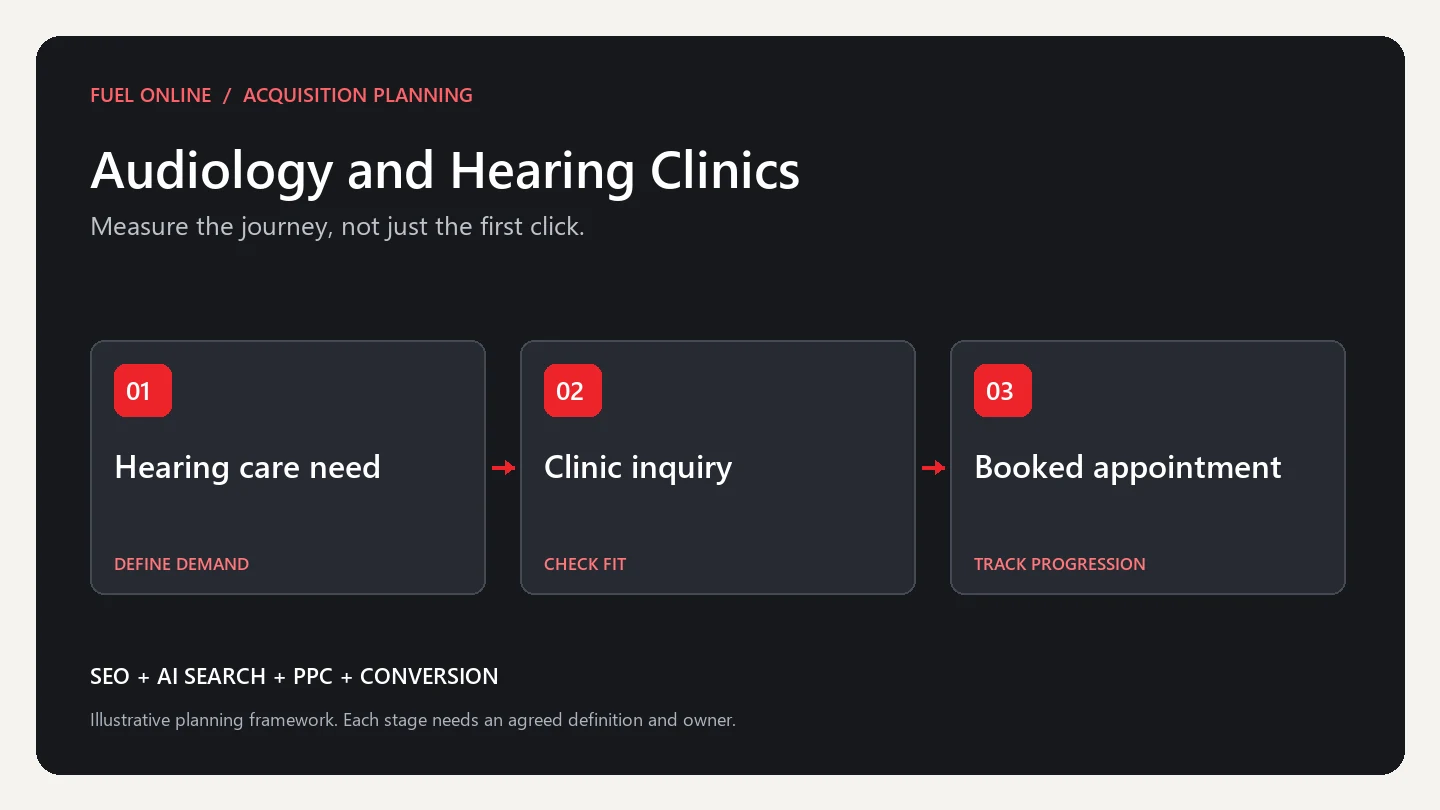
Track new evaluation inquiries, successful scheduling contacts and attended first appointments as distinct events. Separate existing patient service requests and product-only questions when the team can do so reliably. This prevents a busy phone line from being mistaken for growth in new appointment demand.
Review broad loss reasons with the front desk. A caller may be asking about a service the location does not offer, seeking support for an existing device or unable to find the correct office. Those patterns should inform the next content change. Report aggregate commercial findings rather than individual health details.
A useful pilot is one clinic and one audience question. Improve the relevant page, confirm the contact route and compare inquiry dispositions before and after launch. Document any staffing or availability changes that affect the comparison. Scale the clearer journey when both the website and receiving team can support it.
Explore medical practice marketing for the wider framework and optometry marketing for another local specialty model. Fuel’s starting brief should clarify the actual evaluation offer, the intended audience and the appointment experience worth promoting.
Compare agencies through a service and product boundary exercise
Give finalists a small set of approved clinic facts and ask them to explain how those facts become a usable page. Include the evaluation or consultation offering, the supported product information, the relevant location, and the current patient contact route. The response should show how the team distinguishes those information jobs. It should not make a product label stand in for the clinic's service model or imply a recommendation for an individual visitor.
Ask for a proposed page map before a large content calendar. Each destination should state the question it answers, the facts it requires, the reviewer responsible, and the next action. A new page needs a distinct contribution. If the current site already contains a useful explanation, the agency should be able to recommend better organization or a clearer connection rather than another overlapping article. This makes the proposal's logic visible and helps the clinic manage review work.
Use an illustrative comparison question that the approved material cannot answer fully. A capable team should identify the missing fact and the person who can resolve it. It should not strengthen a product or service claim merely because a concise comparison would look better. Record the approved editorial decision so future writers understand the boundary. The exercise tests judgment under uncertainty without asking a marketer to determine which option an individual patient needs.
Give product information an explicit maintenance owner
Where the clinic publishes product-related material, identify its current source, factual reviewer, affected pages, and review trigger. The source map should distinguish a statement about an item from a statement about the clinic's services. A product description supplied for one resource should not spread automatically across every consultation or location page. The organization should be able to see which statements require review when a product reference or service arrangement changes.
Rehearse a fictional change in the approved product information while keeping the clinic's general evaluation offering unchanged. Ask the agency to identify what needs a correction and what should remain as it is. This reveals whether the team can make a proportionate update instead of rewriting the entire site or leaving connected assets inconsistent. The record should show approval, implementation, and verification as separate stages, with an owner for each.
If a manufacturer resource, external platform, or another team controls part of the information path, name that dependency. The agency should state what it can change directly, what it can request, and what it can inspect afterward. A correction request is not proof that a third-party destination now reflects the clinic's current information. The client should receive an honest open-items record rather than a claim of universal control over every public reference.
Review the appointment explanation as a separate asset
The clinic can have accurate product information while still leaving the visitor uncertain about the first appointment. Ask the agency to identify which public explanation describes the supported consultation or evaluation process and who approves it. The page should use the clinic's facts and make the next action understandable. It should not imply a confirmed booking when the supported action is an administrative request or a conversation with staff.
Give the team a fictional new evaluation request and a fictional existing patient service question. Ask how the site distinguishes them and where each goes. The visitor should not need to know internal departments to choose the appropriate route. The exercise should inspect the public information and receiving workflow without collecting unnecessary sensitive details or turning the scenario into an individual clinical assessment.
Record the result from both sides of the handoff. Confirm the message the visitor sees and the context available to the receiving team. Label test activity so it does not inflate routine reports. If another system owns a step, involve its owner and state the evidence needed. A confirmation page is not sufficient proof that the correct workflow received the request, while a delivered request is not proof that the visitor understood the service.
Specify the delivery evidence in the agreement
Separate strategy, writing, implementation, and acceptance checks in the proposal. A recommendation to clarify the evaluation offering is different from producing approved copy, publishing it, and checking the intended task. Ask which activities the agency supplies and which depend on the clinic or another provider. A smaller contract with clear implementation responsibility can be more inspectable than a broad package that leaves the client to convert recommendations into changes.
Request an initial handoff containing the approved references, page map, implemented assets, representative checks, and unresolved questions. Name the owner of future updates. Ask someone outside the launch team to locate the source for a meaningful statement and identify how a correction begins. If the process depends on the original writer's memory, improve the documentation before increasing the number of pages that rely on the same facts.
Use feedback to choose a distinct next task
At the first review, separate completed implementation from the later observations. Product research, new evaluation interest, existing patient requests, and other supported actions should preserve their actual meanings. Approved aggregate feedback may reveal that a particular page attracts the wrong kind of question or that appropriate inquiries reach an unclear route. Those findings should lead to different decisions rather than a uniform recommendation for more content or more spend.
The agency should explain which conclusion the evidence supports and where uncertainty remains. A clearer service explanation can be verified even before later appointment patterns develop. Conversely, a busy contact channel does not establish growth in the specific appointment category the clinic wanted. The next investment should address the most consequential verified gap and the clinic's capacity to maintain the change, leaving a coherent operating process rather than a collection of disconnected assets.
For genuine practice material included in the proposed release, identify the source and the question it helps the visitor answer. A team biography, clinic photograph, and approved service explanation serve different purposes. The agency should preserve useful existing material and show why any proposed addition belongs at a particular point in the journey. The acceptance review should check that the material describes the actual clinic and does not silently imply a product or service relationship the practice has not confirmed.
AGGRESSIVE FROM THE START
One month. The work many agencies stretch across three.
Our mandate: move faster, go deeper and put experienced specialists to work immediately.
Fuel attacks the work in parallel: site audits, technical errors, new content, internal links, backlink outreach and conversion improvements. Your agreed scope determines the channels; urgent fixes do not wait behind a drawn-out planning phase.
The audiology marketing brief identifies visibility and lead barriers. Actionable fixes move into production while deeper analysis continues.
Your audiology marketing agency work runs alongside industry-specific content, relevant links and earned-authority outreach, based on your agreed scope.
The marketing for audiology clinics review shows completed work, lead quality and the next opportunities. You see who owns each action.
Fast execution is the operating standard. Access, approvals and scope shape delivery; search and revenue results have their own timelines.
What audiology marketing changes for audiology demand
A useful audiology marketing plan starts with the commercial constraint. Fuel identifies which buyers the organization wants more of, what they need to believe before contact, and which requests consume time without a realistic next step. For audiology, the fit decision turns on service need, age and clinical fit, insurance or financing path, location, provider availability, and timing.
Fuel turns that definition into service, technology, provider, insurance, financing, and location pages, channel priorities, proof requirements, and a handoff that retains reason for visit, preferred clinic, age group when relevant, payment path, and scheduling need. Work that cannot be supported by audiologist-reviewed service details, current credentials, accurate device and financing information, and permissioned patient evidence stays out of the public claim set.
A practical audiology hub diagnostic
Use this diagnostic when channel activity improves but the receiving team does not see a comparable change in appropriate booked appointments. The diagnostic for audiology marketing starts with the observable symptom, checks the page, source, campaign, or handoff responsible for it, and ends with one reviewed action, owner, and validation method.
Observable symptom
Marketing activity rises, but the team still cannot tell why 'hearing test in Brookline' inquiries are mixed with demand closer to 'hearing aid repair manual'.
What to inspect in audiology marketing agency
Review source, page, offer, contact path, and the final acceptance or rejection reason together.
Decision criteria for marketing for audiology clinics
Prioritize the page, message, exclusion, or handoff with the clearest connection to unsuitable demand.
Inspectable output
A one-page audiology marketing decision record naming the symptom, evidence, owner, release, and measure tied to appropriate booked appointments.
Marketing for audiology clinics deliverables you can inspect
The team receives a demand map, evidence register, prioritized channel backlog, conversion specification, and commercial decision cadence it can inspect and own.
- Buyer and offer map, used to define the audiology marketing scope.
- Evidence and approval register, used to govern the audiology marketing agency release.
- Prioritized page and campaign backlog, used to evaluate the marketing for audiology clinics decision.
- Conversion and routing specification
- Commercial scorecard and decision cadence
Illustrative audiology example
Illustrative example, not a client result: Fuel would compare the path taken by a new patient seeking an evaluation or hearing-care service the clinic actually provides with the activity created by device support, unavailable age groups, existing-patient requests, and out-of-area demand. The decision is whether to fix the decision page, proof, contact path, or channel sequence before adding spend.
The audiology marketing agency work would produce a one-page demand map showing fit, friction, evidence, owner, and the next controlled release. The example becomes useful only when the team can trace the change to appropriate booked appointments.
Within marketing for audiology clinics, the buyer team can inspect the artifact, approval, and next investment decision.
How commercial progress is judged
Fuel connects page, query, campaign, or source context with acceptance, rejection reasons, response, capacity, and new-patient evaluation requests, booked appointments, attendance, and inquiry type by clinic. Diagnostic measures explain where the journey breaks; they do not replace the business outcome.
The decision record for audiology marketing states what changed, why it changed, who approved it, and whether the next action is to expand, revise, consolidate, or stop.
Reporting for marketing for audiology clinics must connect the service-specific diagnostic to appropriate booked appointments, explain data limits, and name the next decision rather than treating activity as proof of value.
Questions to ask an audiology agency
Ask for the first demand map and channel decision, then confirm who owns pages, campaigns, tracking, approvals, and the handoff to the receiving team. A useful proposal explains which channel waits and why.
When reviewing audiology marketing, require a named practitioner, implementation owner, approval path, and sample artifact. Reject unsupported promises of rankings, citations, lead volume, cost, or revenue.
How we measure audiology marketing agency
- new-patient evaluation requests
- booked appointments
- attendance
- inquiry type by clinic
Separate inquiry volume from usable demand
Qualified-inquiry rate = inquiries meeting your agreed criteria ÷ total inquiries reviewed.
Illustrative arithmetic: 20 suitable inquiries out of 50 reviewed inquiries is a 40% qualified-inquiry rate. Record why the other 30 did not fit before increasing investment.
Agree on the baseline, data source and qualification criteria before comparing results. Separate visibility from inquiries and accepted business opportunities.
CONNECTED SERVICES
Choose the right next step for your business
Explore Fuel’s Industry growth plan capabilities, published campaign work and team to evaluate how we would support your organization.
BEFORE YOU CHOOSE AN AGENCY
Questions about audiology marketing agency
What will Fuel deliver in the first 30 days?
During the first month, the audiology marketing scope produces a demand map, evidence register, prioritized journey decision, and the owner of the first controlled release. Fuel also records the client inputs and approval needed for the first release.
What does Fuel need from our audiology team?
Effective audiology marketing agency work requires a commercial owner, account and page access, approved proof, acceptance criteria, capacity limits, and feedback from the receiving team. Fuel identifies missing access or ownership before work is scheduled around it.
How will we know the work is commercially useful?
Under marketing for audiology clinics, commercial usefulness depends on whether the diagnostic connects to appropriate booked appointments, the data limits are stated, and the evidence supports a clear keep, revise, or stop decision.
Should we invest in SEO or paid acquisition first?
Choose the channel that addresses the closest constraint to appropriate booked appointments. In audiology marketing, paid acquisition can test active demand quickly, while SEO is better for durable decision pages; both wait if the offer, proof, contact path, or receiving capacity is the real problem.
What does a credible audiology marketing agency scope include?
A credible audiology marketing agency scope includes buyer-fit criteria, evidence governance, journey priorities, channel sequencing, conversion ownership, and a commercial decision cadence. It also names the client dependencies, practitioner, deliverable, and approval path.
How should marketing for audiology clinics report commercial progress?
Reporting under marketing for audiology clinics should connect the service-specific diagnostic to appropriate booked appointments, show what changed and why, state data limits, and name the next decision.
Make your next agency conversation specific.
Show us where audiology demand becomes unclear between 'hearing test in Brookline' and 'hearing aid repair manual'. The first working session on audiology marketing agency will identify the priority artifact, evidence, owner, and approval decision for appropriate booked appointments.
Talk with a Fuel strategist →