
FUEL ONLINE / Audiology and Hearing Clinics / Digital marketing
Audiology Digital Marketing Agency

Audiology clinics need appointment demand matched to the service, provider, location, and payment path, not device-support traffic they cannot serve. As your audiology marketing agency, Fuel Online gives search, paid media, decision content, landing pages, and follow-up one commercial job. We build around service need, age and clinical fit, payment path, clinic, provider, and timing, exclude low-fit demand, and connect channel decisions to scheduling team feedback. You receive a 30/60/90 plan aimed at appropriate booked appointments, not a generic package of activity.
Clinic geography and appointment capacity; Hearing evaluations versus device support; Services and age groups served; New-patient scheduling process
Choose audiology marketing around an accessible first-contact journey
Choose an audiology digital marketing agency by comparing a complete journey from discovery to the practice's administrative contact process. A useful first release names the reader task, connects the relevant service or product explanation and shows what the receiving team sees afterward. New prospective contacts, returning patients and people asking about an existing device may need different routes. The practice supplies those distinctions. The agency should make them understandable rather than treat every interaction as the same acquisition event.
Select the contact journey before the channel mix
Begin with one journey the practice wants to improve. A new reader may need to understand an offered service before requesting contact. A returning person may need the established route for an ongoing conversation. Someone researching a product may first need to understand the practice's actual relationship with it. Ask the agency which journey leads the initial release and why. This gives the proposed channels a concrete purpose before the scope expands into multiple destinations and recurring creative production.
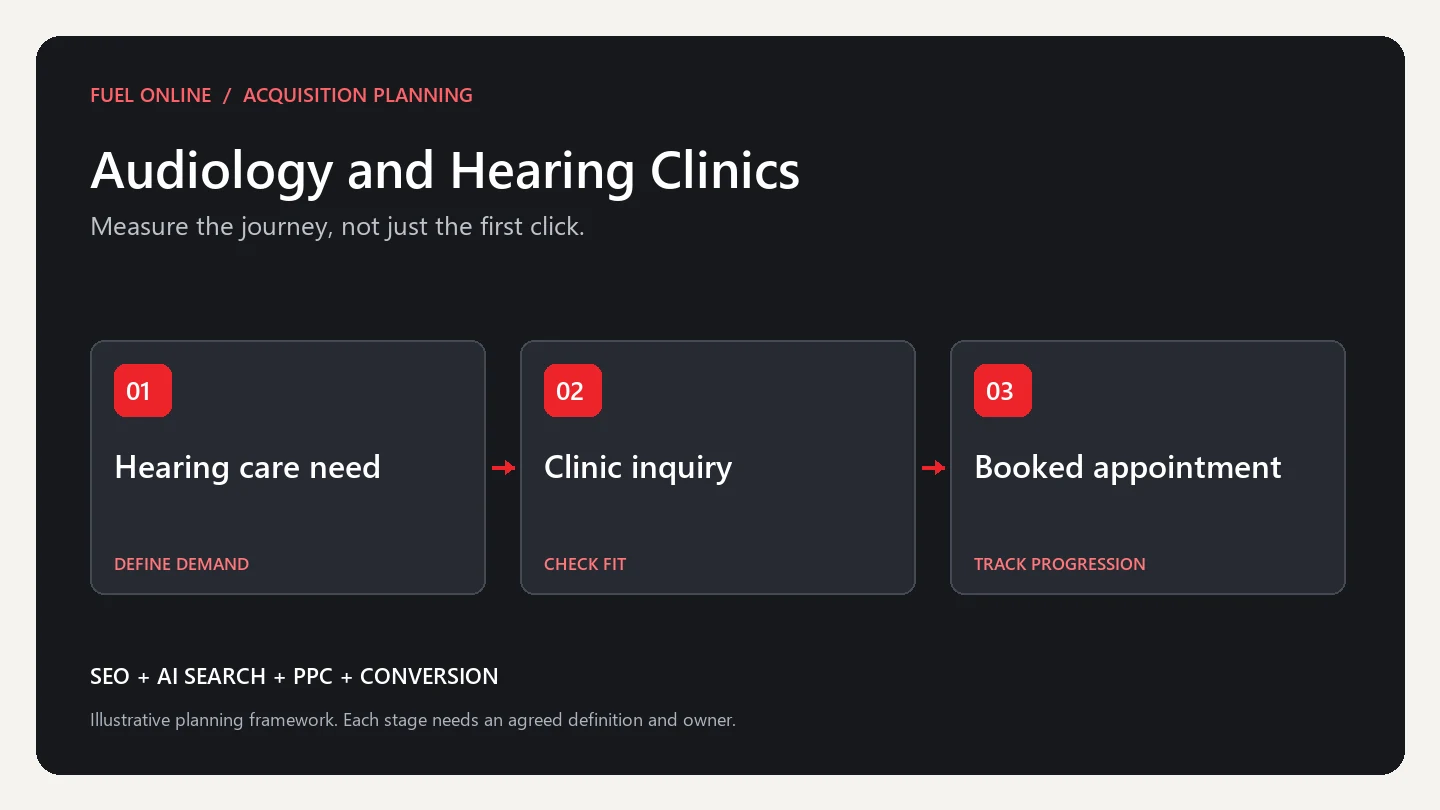
Map the journey using the message, supporting resource, next action and receiving role. Record what each step establishes. A resource visit, submitted request and booked appointment have different meanings and require different evidence. The agency's plan should keep these stages understandable while showing how the selected channels contribute. A joined proposal becomes easier to compare when the practice can see the actual transitions rather than infer integration from a list containing search, advertising, content and analytics.
Service descriptions and product resources should remain connected without becoming interchangeable. The practice supplies the services and offering relationships it actually wishes to publish. Manufacturer information may support a product statement but does not establish the practice's administrative arrangements or an individual outcome. Ask the agency to identify the source behind a campaign introduction and the destination where fuller context appears. This gives the practice a specific editorial check when the same fact is adapted into several formats.
| Release component | What the proposal should show | How to compare delivery |
|---|---|---|
| New-prospect journey | The supported service explanation connected with the selected message and administrative contact action. | The complete path is inspectable rather than assumed from a list of channels. |
| Returning-contact path | The route and wording supplied by the practice for a continuing administrative conversation. | The destination helps a returning person continue without automatically becoming a new acquisition claim. |
| Communication option | The actual supported contact method and the receiving record created by its use. | A fictional test confirms the administrative meaning without inventing universal access or response promises. |
| Source maintenance | The service, product and professional facts shared by active assets and their update owners. | Another contributor can identify the particular resources affected by a supplied practice change. |
Keep the explanation and administrative route connected
Professional biographies add context about the people associated with the practice. Ask how the selected journey links to that information where it helps the reader understand the service. The source relationship should be clear enough to maintain after a title or location association changes. An indiscriminate biography link is less useful than a deliberate connection answering a real reader question. The agency can explain why the professional context belongs at that point rather than using the same introduction across every destination.
The communication route deserves an explicit release decision. Where the practice supports more than one way to make administrative contact, ask how the destination describes the options and how the receiving team handles each. The agency should work from the actual arrangements supplied by the practice. It should not invent a new contact option or assume a route works for every person. A practical scope tests the supported paths and records what each creates in the administrative system.
Compare implementation responsibilities before accepting a joined campaign label. Who edits the service explanation, who builds the destination, who maintains contact fields and who checks the resulting record? Another supplier may control one of those components. Ask which artifacts the agency will provide to that supplier and how completion will be inspected. This makes the full release easier to coordinate and prevents a finished creative presentation from being mistaken for an implemented customer journey.
A worked comparison can start with the same approved service explanation and contact destination for every finalist. Ask each agency to show a new-prospect introduction and a returning-contact path. Which facts remain shared, which wording differs and what should the receiver recognize? The differences should follow the practice's actual administrative process rather than invented patient categories. The exercise makes the proposed strategy concrete enough to compare while preserving useful resources that already have a clear role.
Rehearse the release as a complete experience
Rehearse the selected journey from its initial message. Follow the relevant resource, complete the agreed fictional contact action and inspect the record received. Ask the receiving role to explain what the person requested and which next administrative step the practice supports. A successful browser event is one part of this exercise. Acceptance should also show that the intended context survives and that the confirmation describes the event accurately instead of implying a later arrangement already exists.
Source labels should have a stated meaning in reporting. A campaign source explains how someone reached a destination where that information is available. It does not necessarily explain the person's clinical needs, device relationship or eventual care. Ask the agency to keep those meanings separate. The report should show what can be linked with the practice's records and what remains unknown, allowing the receiving team to interpret the information without turning an advertising label into an unsupported conclusion.
Use broad administrative reasons to choose a specific next improvement where records support them. An inquiry about an unsupported product relationship, a returning-contact question and a missing contact value point to different tasks. The remedy may be clearer source information, a more recognizable continuing-contact route or a field-label repair. A combined low-quality total does not identify which transition needs attention. The agency should explain the observed problem and the concrete artifact that would address it.
An update exercise tests the joined system. Introduce a practice-supplied change to a service description, professional role or supported contact destination in the review materials. Ask which campaign assets and resource introductions depend on it. The agency should retain accurate unrelated material and distinguish completed edits from another supplier's dependency. This gives maintenance a practical meaning and prevents an older saved destination from continuing to present a relationship that the central practice resource no longer describes.
Leave useful dependencies with the practice
Separate strategy, production, publishing, contact implementation and ongoing review in the commercial scope. Each component should leave a named artifact and an acceptance exercise. The contract label alone does not establish how much implementation is included. A bounded release and an ongoing arrangement can both be useful when their actual contributions are clear. The practice can compare the work required to complete its chosen journey instead of assuming that every broadly described marketing package delivers the same system.
At handover, ask another employee to follow the released path using the retained documentation. They should locate the source information, explain the public action, find the receiving record and identify the resources affected by a future change. This checks whether the documentation describes the actual working relationships. It also makes the delivered assets more reusable when a new supplier or internal contributor takes responsibility for a destination, campaign or service introduction.
The next release should answer a genuinely different reader task or improve a specific inspected transition. More channels or content pieces are not an automatic requirement. The practice should be able to explain why the next assignment matters and which existing assets remain useful. This creates a practical basis for selecting an audiology marketing partner: coherent resource roles, supported communication routes, understandable receiving records and a maintainable release that another person can inspect after launch.
A useful proposal comparison starts with the same practice-approved service explanation and contact route for every agency. Ask for two short release briefs: one introducing the service to a new reader and one helping a returning person find an established administrative destination. Which information is shared, which orientation differs and what should the receiver recognize? The answer shows whether the agency adapts the journey to an actual task or simply changes the audience label in the same broad introduction. It also makes the production effort comparable with assets the practice already maintains.
Then remove an assumed implementation dependency. Suppose another supplier must configure part of the contact record. Ask what can progress and what cannot yet be accepted as a complete release. The agency may prepare source-linked creative and a test specification while the connection waits. The useful plan names that boundary and the evidence required afterward. This lets the practice coordinate the work without mistaking ready copy for an operating public journey or assuming that an attractive destination proves its context reaches the receiving team.
Use a practice-supplied contact-route change to test the dependency map. Ask which current destinations, saved campaign resources and recurring introductions depend on the earlier route. A paused campaign setting alone does not explain what a person sees when they revisit a saved page. The agency should identify the public experience and the maintained destination that now supplies the correct information. This is a practical maintenance responsibility that can differ substantially between proposals with similar monthly service descriptions and similar counts of creative assets.
For the first review, place the completed release beside the next proposed assignment. A need for broader discovery differs from a confusing service explanation or a lost context field. Ask which observed condition supports the next task and which concrete asset will change. The practice can then evaluate a focused correction separately from expanding every channel. This makes the roadmap easier to understand and gives another contributor a clear reason for the work instead of a calendar whose activity repeats regardless of what the completed journey actually needs.
Keep the two journey briefs, dependency example and accepted test with the handover. An incoming employee should understand why the invitations differ and which sources they share. If the explanation relies on an unexplained campaign nickname, translate it into the reader task and receiving purpose. This leaves the practice with reusable information and acceptance examples, allowing future production to build on the coherent parts of the first release while improving the specific transition that evidence shows is still unclear.
For the related practice-wide scope, explore audiology marketing.
AGGRESSIVE FROM THE START
One month. The work many agencies stretch across three.
Our mandate: move faster, go deeper and put experienced specialists to work immediately.
Fuel attacks the work in parallel: site audits, technical errors, new content, internal links, backlink outreach and conversion improvements. Your agreed scope determines the channels; urgent fixes do not wait behind a drawn-out planning phase.
The audiology marketing agency brief identifies visibility and lead barriers. Actionable fixes move into production while deeper analysis continues.
Your audiology digital marketing work runs alongside industry-specific content, relevant links and earned-authority outreach, based on your agreed scope.
The digital marketing for audiology clinics review shows completed work, lead quality and the next opportunities. You see who owns each action.
Fast execution is the operating standard. Access, approvals and scope shape delivery; search and revenue results have their own timelines.
What audiology marketing agency changes for audiology demand
The problem is rarely a missing channel. It is a broken link between audience, promise, evidence, page, and follow-up. Fuel gives each channel a job in winning appropriate appointments with patients the clinic can evaluate and serve and uses service need, age and clinical fit, insurance or financing path, location, provider availability, and timing to keep the message consistent.
Organic search handles durable discovery, paid media tests controllable demand, and decision content supports evaluation. Every path uses audiologist-reviewed service details, current credentials, accurate device and financing information, and permissioned patient evidence and carries reason for visit, preferred clinic, age group when relevant, payment path, and scheduling need into the receiving workflow.
A practical audiology digital diagnostic
Use this diagnostic when digital activity improves but the receiving team does not see a comparable change in appropriate booked appointments. The diagnostic for audiology marketing agency starts with the observable symptom, checks the page, source, campaign, or handoff responsible for it, and ends with one reviewed action, owner, and validation method.
Observable symptom in audiology marketing agency performance
Channel reports improve while appropriate booked appointments stay flat and requests closer to 'hearing aid repair manual' keep consuming follow-up time.
What to inspect in audiology digital marketing
Compare the channel promise with the landing page, form or call path, follow-up owner, and final business outcome.
Decision criteria for digital marketing for audiology clinics
Reassign the channel, revise the page, repair the route, or stop the activity based on the broken stage.
Inspectable output
A channel decision with a named page or handoff change, owner, release date, and measure tied to appropriate booked appointments.
Digital marketing for audiology clinics deliverables you can inspect
The team receives a journey map, page and campaign backlog, measurement specification, release log, and ownership record for every digital change.
- Channel role and budget map, used to define the audiology marketing agency scope.
- Priority plan for service, technology, provider, insurance, financing, and location pages, used to govern the audiology digital marketing release.
- Campaign exclusions and landing-page requirements, used to evaluate the digital marketing for audiology clinics decision.
- Conversion, routing, and tracking specification
- Weekly operating and monthly commercial review
Illustrative audiology example
Illustrative example, not a client result: A caregiver reaches a hearing-service page but cannot distinguish evaluation, device support, age group, clinic, and scheduling path. Fuel would trace the entry page, proof viewed, next action, fields, routing, and final disposition, then repair the first break rather than redesigning the whole site without evidence.
The audiology digital marketing release would include the revised page or path, measurement event, receiving owner, and validation record. The test stays only if it improves the journey toward appropriate booked appointments.
Within digital marketing for audiology clinics, the buyer team can inspect the artifact, approval, and next investment decision.
How commercial progress is judged
Fuel connects page, query, campaign, or source context with acceptance, rejection reasons, response, capacity, and new-patient evaluation requests, booked appointments, attendance, and inquiry type by clinic. Diagnostic measures explain where the journey breaks; they do not replace the business outcome.
The decision record for audiology marketing agency states what changed, why it changed, who approved it, and whether the next action is to expand, revise, consolidate, or stop.
Reporting for digital marketing for audiology clinics must connect the service-specific diagnostic to appropriate booked appointments, explain data limits, and name the next decision rather than treating activity as proof of value.
Questions to ask an audiology agency
Ask to see a journey map, release ticket, and measurement specification. Confirm who changes the site, campaigns, analytics, forms, CRM connection, and quality feedback loop.
When reviewing audiology marketing agency, require a named practitioner, implementation owner, approval path, and sample artifact. Reject unsupported promises of rankings, citations, lead volume, cost, or revenue.
How we measure audiology digital marketing
- new-patient evaluation requests
- booked appointments
- attendance
- inquiry type by clinic
Compare channels using the same qualification rules
Cost per qualified inquiry = attributable channel spend ÷ inquiries meeting the agreed criteria.
Keep the reporting window and included costs consistent. A cheaper contact is not necessarily a cheaper customer; compare later progression where the data supports it.
Agree on the baseline, data source and qualification criteria before comparing results. Separate visibility from inquiries and accepted business opportunities.
CONNECTED SERVICES
Choose the right next step for your business
Explore Fuel’s Digital marketing capabilities, published campaign work and team to evaluate how we would support your organization.
BEFORE YOU CHOOSE AN AGENCY
Questions about audiology digital marketing
What changes first in a digital marketing engagement?
During the first month, the audiology marketing agency scope produces a journey map, page and campaign backlog, measurement specification, and the first release ticket. Fuel also records the client inputs and approval needed for the first release.
What does Fuel need from our audiology team?
Effective audiology digital marketing work requires site, campaign, analytics, form, and CRM access plus reviewers, approved proof, capacity limits, and accepted or rejected inquiry feedback. Fuel identifies missing access or ownership before work is scheduled around it.
How will we know the work is commercially useful?
Under digital marketing for audiology clinics, commercial usefulness depends on whether the diagnostic connects to appropriate booked appointments, the data limits are stated, and the evidence supports a clear keep, revise, or stop decision.
What should the first audiology marketing agency priority be?
Start with the break closest to appropriate booked appointments, not a predetermined channel. The diagnostic for audiology marketing agency may prioritize the page promise, proof, form, measurement, route, or response owner before recommending more acquisition.
What does a credible audiology digital marketing scope include?
A credible audiology digital marketing scope includes journey mapping, page and campaign priorities, measurement, implementation ownership, release validation, and inquiry-quality feedback. It also names the client dependencies, practitioner, deliverable, and approval path.
How should digital marketing for audiology clinics report commercial progress?
Reporting under digital marketing for audiology clinics should connect the service-specific diagnostic to appropriate booked appointments, show what changed and why, state data limits, and name the next decision.
Make your next agency conversation specific.
Bring the channel, page, or follow-up problem preventing more appropriate booked appointments. The first working session on audiology digital marketing will identify the priority artifact, evidence, owner, and approval decision for appropriate booked appointments.
Talk with a Fuel strategist →