
FUEL ONLINE / Audiology and Hearing Clinics / Lead generation
Audiology patient acquisition: Conversion Strategy

Audiology clinics need appointment demand matched to the service, provider, location, and payment path, not device-support traffic they cannot serve. For audiology patient acquisition, Fuel defines fit through service need, age and clinical fit, payment path, clinic, provider, and timing, then aligns pages, forms, calls, routing, and follow-up with that decision. The scheduling team receives useful source and qualification context, while marketing receives rejection and progression feedback. The aim is more appropriate booked appointments without rewarding raw lead volume.
Clinic geography and appointment capacity; Hearing evaluations versus device support; Services and age groups served; New-patient scheduling process
Make audiology inquiries preserve the intended conversation
Choose an audiology patient acquisition agency by comparing the administrative usefulness of the request it helps create. A new appointment inquiry, a returning-contact question and a device-related administrative message can have different purposes. The practice decides which distinctions its process needs. A useful conversion scope makes the public action understandable and preserves the person's stated context in the receiving record. It should not treat a completed form as proof of a booked appointment or an individual clinical outcome.
Define the request before adding qualification fields
Start by naming the first event in ordinary language. The destination might let a person request contact or begin an appointment inquiry, depending on the practice's actual process. Ask the agency to show the button, fields, confirmation and received record together. They should describe the same event. A reassuring message is useful only when its meaning matches the supported next step. The agency should not strengthen the wording by assuming a later arrangement or response promise that the practice has not supplied.
The initial field set should have a receiving purpose. For each value, ask what administrative task it supports and who uses it. The practice determines which information belongs at first contact and which is handled later through its professional process. The marketing proposal should not assemble a clinical questionnaire from assumptions. A field dictionary can make the actual scope clear by connecting each label with its destination and explaining why it helps the receiving team continue the intended conversation.
A person may contact the practice for themselves or state that they are helping someone else. Where that distinction matters to the practice's administrative process, ask how the route preserves the person's stated role. The agency should not infer authority, patient status or a professional relationship from a selected field. The useful design keeps the supplied context understandable and leaves the receiving team to follow the practice's established procedure. This is a specific contact-design question rather than a universal qualification rule.
| Inquiry case | Context to preserve | Useful acceptance evidence |
|---|---|---|
| New appointment inquiry | The public action and receiving record use the same practice-supplied administrative meaning. | The confirmation does not silently turn a request into a booked appointment or clinical conclusion. |
| Contact for another person | The sender can state the role the practice needs for its actual initial process. | The record retains that statement without inferring authority, patient status or a professional relationship. |
| Returning device question | The person can locate the appropriate established administrative route where the practice supports it. | The destination does not imply that every device task belongs to new-patient acquisition. |
| Repeated interaction | The documented rule explains which records can be related and which remain separate. | Reported contacts stay distinct from identifiable requests and later appointment stages. |
Preserve the stated purpose and contact role
Returning contacts need a recognizable route. Someone asking about an existing device or continuing a prior conversation may arrive through a destination intended for new inquiries. Ask how the page helps that person find the appropriate practice-supplied contact process. The agency can improve orientation without inventing a new service operation or promising that the practice supports every device-related task. The destination should use actual service and administrative information rather than infer the appropriate route from a product name alone.
Communication options should follow the practice's actual supported arrangements. Ask how a visitor identifies the available route and what the receiving team sees when it is used. If several options exist, test them separately with the same fictional administrative purpose. They may preserve different information. The agency should explain those differences rather than assume every path has identical context or make a universal accessibility claim. A concrete release shows which supported route was tested and what the record establishes.
Uncertain administrative context can be represented without forcing a misleading answer. The practice decides which distinctions it needs at this stage. Ask the agency how the route lets a person describe a question that does not fit a supplied category where that option is supported. A superficially complete record is not necessarily more useful than a clear statement of uncertainty. The receiver should understand what the person actually supplied and what still needs clarification through the practice's process.
Use a repeated-contact exercise during selection. A fictional person submits a request and later corrects a contact detail or uses another supported communication route. Ask how the records relate using the actual systems available. The useful demonstration distinguishes automatic relationships, administrative review and records that remain separate. It should not assume every interaction can be joined. This makes reporting more interpretable and helps the practice understand whether the proposal configures continuity or merely documents an existing process.
Test the receiving interpretation
The receiving role should interpret the completed test in ordinary language. What did the person ask for, what context survived and what administrative step follows? Compare that interpretation with the public invitation and confirmation. A mismatch can reveal a field-label, source-context or routing problem. The agency should identify the specific repair it will implement. This is more useful than treating every unclear inquiry as a reason for a longer form or a completely redesigned destination.
Reporting should distinguish interaction events, identifiable requests and later appointment stages where the practice records them. Ask for one record example behind each proposed metric. A source label may explain how the destination was reached without establishing the person's service need or later care. Keep those meanings separate. The practice can then compare an acquisition report with its own administrative records and understand where counts differ because of repeated contacts, event definitions or information that cannot reliably be linked.
Acceptance cases can include a new request, a returning-contact question, a stated companion role, a corrected detail and an agreed missing required value. For each test, retain the public action, confirmation, received record and receiving interpretation. These cases inspect different parts of the administrative journey without fabricating clinical outcomes. Another contributor should be able to repeat them after a form or destination change, making the retained examples a practical release baseline rather than a presentation artifact.
Implementation ownership belongs in the commercial comparison. The agency may control the public page while another supplier maintains notifications or the receiving system. Ask what each party changes and how the final connection is checked. The practice should know which parts are included in the proposed engagement and what information it must supply. This makes two conversion packages easier to compare even when they use the same service name but leave different amounts of implementation work to the practice.
Make continuity repeatable after handover
At handover, retain the action definition, field dictionary, route map and tests with their actual configuration owners. Another employee should identify what a request establishes and which context belongs to a continuing conversation. If the meaning depends on an unexplained campaign nickname, add the ordinary-language purpose. The handover should help the practice maintain its administrative journey without asking a future agency to reconstruct every decision from form labels or disconnected notification messages.
A bounded first assignment can improve one specific transition. The source page may lose the selected service context at a shared form, the confirmation may describe the wrong event or a returning contact may have difficulty locating the supported route. Each problem needs a different artifact. Ask the agency to identify the evidence and acceptance exercise for its proposed remedy. This gives ongoing work a concrete purpose instead of selecting the next task solely because another production period has begun.
The final comparison should follow the same fictional inquiries through every agency's proposed route. Look for a clear public action, preserved stated context and a receiving record the practice can interpret. This is a useful basis for evaluating audiology patient acquisition work: the administrative conversation becomes more understandable for the person contacting and the team receiving it, while clinical assessment, individual care and appointment decisions remain within the practice's established professional process.
For a concrete agency comparison, give finalists two fictional contact examples: a new appointment inquiry and a question described by the sender as continuing an existing device-related conversation. The practice supplies the supported administrative routes. Ask what the public destination says, which information is carried forward and how the receiver interprets each record. The useful distinction follows the practice's actual process. It should not depend on a marketing supplier guessing the person's service needs from a product word or deciding that every completed contact action belongs in the same acquisition category.
Next, introduce a companion contacting on another person's behalf. Ask which stated role the practice needs at the initial administrative step and how it should appear in the record. Compare that interpretation with the confirmation. The route can preserve what the sender actually states without inferring authority or a professional relationship. This gives the buyer a concrete contact-design decision to evaluate. It also exposes whether the agency is configuring a supported field, documenting the current process or depending on another supplier to maintain the receiving representation.
Use an uncertain administrative answer in the third example. A person may know why they want contact but not which supplied category best describes the request. The practice decides how its process handles that situation. Ask the agency how the destination preserves uncertainty while retaining the useful stated purpose. A forced confident label can make a record appear complete without helping the receiver. The comparison should identify the field or explanation that needs attention rather than assume a larger questionnaire is the appropriate solution to every ambiguous interaction.
For measurement acceptance, ask the agency to explain a small set of repeated records in ordinary language. The same fictional person submits a request, corrects a contact detail and later uses another supported route. Which totals describe events, which describe identifiable requests and which cannot be connected? The useful report makes those definitions reproducible. It does not silently relabel several interactions as several new patients. This exercise gives the receiving team a shared vocabulary for reviewing the program without requiring a fabricated clinical or appointment outcome.
At the final handover test, ask an employee unfamiliar with the project to repeat one case using only the retained materials. They should find the destination, explain the public action, locate the received information and identify the next administrative role. If they need private project knowledge, clarify the documentation at that specific point. This leaves a usable conversion baseline rather than a collection of screenshots. It also gives future form changes a practical test grounded in the actual conversation the practice intends its contact route to support.
For the related practice-wide scope, explore audiology marketing.
AGGRESSIVE FROM THE START
One month. The work many agencies stretch across three.
Our mandate: move faster, go deeper and put experienced specialists to work immediately.
Fuel attacks the work in parallel: site audits, technical errors, new content, internal links, backlink outreach and conversion improvements. Your agreed scope determines the channels; urgent fixes do not wait behind a drawn-out planning phase.
The audiology patient acquisition brief identifies visibility and lead barriers. Actionable fixes move into production while deeper analysis continues.
Your audiology lead generation company work runs alongside industry-specific content, relevant links and earned-authority outreach, based on your agreed scope.
The lead generation services for audiology clinics review shows completed work, lead quality and the next opportunities. You see who owns each action.
Fast execution is the operating standard. Access, approvals and scope shape delivery; search and revenue results have their own timelines.
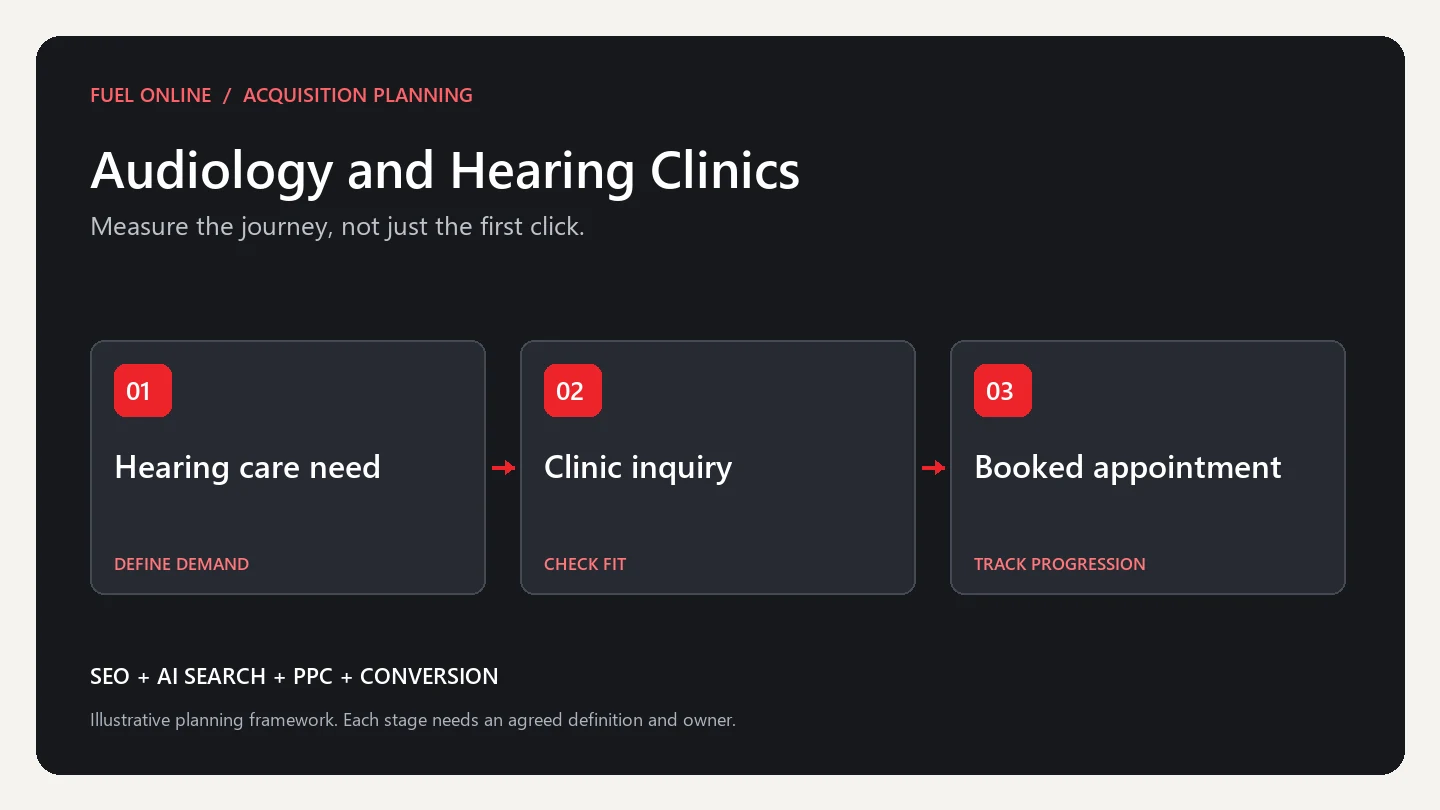
What audiology patient acquisition changes for audiology demand
Lead generation starts with the receiving team's decision. Fuel documents what counts as an accepted next step, what does not fit, and who owns each route. For audiology, acceptance depends on service need, age and clinical fit, insurance or financing path, location, provider availability, and timing.
The conversion path asks only what changes fit, routing, or preparation. It preserves reason for visit, preferred clinic, age group when relevant, payment path, and scheduling need, keeps sensitive details in approved systems, and gives unsuitable visitors a clear alternative instead of forcing every request into sales.
A practical audiology leadgen diagnostic
Use this diagnostic when form submissions and calls increase but the receiving team does not see a comparable change in appropriate booked appointments. The diagnostic for audiology patient acquisition starts with the observable symptom, checks the page, source, campaign, or handoff responsible for it, and ends with one reviewed action, owner, and validation method.
Observable symptom
Forms and calls increase, but suitable requests related to 'hearing test in Brookline' lose context, wait too long, or reach the wrong owner.
What to inspect in audiology lead generation company
Review the page promise, fields, call handling, routing, response time, follow-up attempts, and final sales, intake, or scheduling decision.
Decision criteria for lead generation services for audiology clinics
Change the question, route, response rule, or follow-up step responsible for the lost or unsuitable request.
Inspectable output
A tested routing or follow-up change with an owner, acceptance rule, and measure tied to appropriate booked appointments.
Lead generation services for audiology clinics deliverables you can inspect
The team receives an accepted-request definition, path map, routing and response rules, CRM dispositions, and a controlled conversion-test log.
- Accepted-lead and exclusion specification, used to define the audiology patient acquisition scope.
- Page, form, and call-path map, used to govern the audiology lead generation company release.
- Routing, response, and follow-up ownership, used to evaluate the lead generation services for audiology clinics decision.
- CRM fields, dispositions, and duplicate rules
- Quality review and controlled test log
Illustrative audiology example
Illustrative example, not a client result: The request loses reason for visit, preferred clinic, age group, payment path, or scheduling need. Fuel would test the page, form or call path, route, response rule, follow-up, and final disposition to find the first point where useful context disappears.
The audiology lead generation company test would document the changed field, route, response rule, or follow-up step and its owner. The revision stays only when the receiving team sees a clearer path to appropriate booked appointments.
Within lead generation services for audiology clinics, the buyer team can inspect the artifact, approval, and next investment decision.
How commercial progress is judged
Fuel connects page, query, campaign, or source context with acceptance, rejection reasons, response, capacity, and new-patient evaluation requests, booked appointments, attendance, and inquiry type by clinic. Diagnostic measures explain where the journey breaks; they do not replace the business outcome.
The decision record for audiology patient acquisition states what changed, why it changed, who approved it, and whether the next action is to expand, revise, consolidate, or stop.
Reporting for lead generation services for audiology clinics must connect the service-specific diagnostic to appropriate booked appointments, explain data limits, and name the next decision rather than treating activity as proof of value.
Questions to ask an audiology agency
Ask for an accepted-request specification, route test, disposition set, and response ownership map. Confirm how the agency reviews missed, duplicate, unsuitable, and progressed inquiries.
When reviewing audiology patient acquisition, require a named practitioner, implementation owner, approval path, and sample artifact. Reject unsupported promises of rankings, citations, lead volume, cost, or revenue.
How we measure audiology lead generation company
- new-patient evaluation requests
- booked appointments
- attendance
- inquiry type by clinic
Find the drop between interest and a useful next step
Next-step completion rate = qualified inquiries completing the agreed next step ÷ qualified inquiries reviewed.
Illustrative arithmetic: 15 completed appointments from 25 qualified inquiries is 60%. Use the next step that fits your business, such as a consultation, estimate or discovery meeting, and record the time allowed for completion.
Agree on the baseline, data source and qualification criteria before comparing results. Separate visibility from inquiries and accepted business opportunities.
CONNECTED SERVICES
Choose the right next step for your business
Explore Fuel’s Lead generation capabilities, published campaign work and team to evaluate how we would support your organization.
BEFORE YOU CHOOSE AN AGENCY
Questions about audiology lead generation company
What happens before Fuel changes the form?
During the first month, the audiology patient acquisition scope produces an accepted-request definition, tested page and call paths, routing ownership, dispositions, and the first conversion repair. Fuel also records the client inputs and approval needed for the first release.
What does Fuel need from our audiology team?
Effective audiology lead generation company work requires page, form, call, CRM, routing, and response access plus an accepted-request definition, receiving owners, and consistent dispositions. Fuel identifies missing access or ownership before work is scheduled around it.
How will we know the work is commercially useful?
Under lead generation services for audiology clinics, commercial usefulness depends on whether the diagnostic connects to appropriate booked appointments, the data limits are stated, and the evidence supports a clear keep, revise, or stop decision.
Should we buy more traffic before fixing lead handling?
Usually not. The audiology patient acquisition plan should first correct the form, call path, routing, response, follow-up, or disposition problem that is losing suitable requests. Additional traffic is useful only after the receiving path can handle it.
What does a credible audiology lead generation company scope include?
A credible audiology lead generation company scope includes acceptance criteria, path testing, field and call design, routing and response ownership, CRM dispositions, and controlled conversion tests. It also names the client dependencies, practitioner, deliverable, and approval path.
How should lead generation services for audiology clinics report commercial progress?
Reporting under lead generation services for audiology clinics should connect the service-specific diagnostic to appropriate booked appointments, show what changed and why, state data limits, and name the next decision.
Make your next agency conversation specific.
Bring a sample of suitable and unsuitable requests and show us where response, routing, or follow-up breaks. The first working session on audiology lead generation company will identify the priority artifact, evidence, owner, and approval decision for appropriate booked appointments.
Talk with a Fuel strategist →