
FUEL ONLINE / Optometry Practices / Industry growth plan
Optometry Marketing

Optometry practices need appointment requests matched to service, insurance, clinic, and provider capacity, with urgent eye problems routed safely elsewhere. Fuel builds an optometry marketing program around visit reason, clinical fit, payment path, clinic, provider availability, and timing. We connect decision pages, approved proof, channel priorities, and the inquiry path, then use scheduling team feedback to improve fit. The goal is appropriate booked optometry appointments, with work prioritized against evidence and operating capacity rather than traffic alone.
Location and appointment availability; Eye exams versus specialty services; Age groups and services actually served; New-patient versus existing-patient request
Decide which optometry demand the practice wants to grow
Optometry marketing works best when the agency distinguishes eye-care appointment demand from optical shopping and existing patient requests. Fuel Online can organize the website and campaigns around those different jobs. The practice gains a clearer growth brief, and visitors gain a more useful route to the service or location they actually need.
Begin with the commercial mix rather than a list of channels. Identify the services each office provides, the appointment types the practice wants to promote and the role of its optical offering. A group may share a brand while operating different facilities or retail experiences. Public pages should explain genuine differences without creating unsupported claims about clinical suitability.
| Priority | Information that earns interest | Observable handoff |
|---|---|---|
| New eye-care appointments | Actual appointment categories, team and office details | New patient request reaches scheduling |
| Optical discovery | Real product selection and the in-office shopping experience | Relevant inquiry or documented visit request |
| Current patient support | Clearly labeled service and contact route | Request reaches the responsible team |
A location page should help someone choose an office, not merely repeat the brand introduction. Include accurate contact information, access details the practice can maintain and the services actually offered there. If visitors can request an appointment online, explain what happens after submission. A request should not appear to be a confirmed booking when staff still need to arrange it.
Optical content has a different selection task. Show the actual shopping experience and available categories using approved, current material. Keep promotions precise and maintainable. A visitor should understand whether they are researching products, arranging an appointment or contacting the team about an existing order. Clear distinctions reduce unnecessary calls and misdirected form submissions.
Give each channel a specific commercial role
Local search can connect the practice to nearby demand. Service pages can answer questions about the practice’s offer and appointment process. Campaigns can support a defined growth priority when the receiving office has capacity. The agency should explain which of these roles is currently limiting performance rather than recommend every channel at equal weight.
Ask for a sample brief for one office. It should name the intended audience, the appointment or shopping objective, the destination page and the follow-up process. Include an owner for keeping public details current. This simple requirement helps distinguish an operational plan from a content schedule that produces pages without a clear reason for their existence.
Where nearby offices overlap, use a helpful directory rather than forcing visitors to infer differences from duplicated pages. Explain real location choices. If an office lacks a particular service, direct people to the appropriate existing location only when that routing is accurate. The value lies in helping someone choose, not multiplying geographic phrases.
Review demand by its purpose
Measure new appointment inquiries, successful scheduling contacts, booked visits and attended first visits separately. Track optical inquiries through the events the practice can actually observe. Current patient support should remain distinguishable from acquisition so routine service volume does not inflate the apparent effect of a growth campaign.
Compare locations alongside their capacity and service mix. A page that attracts many relevant inquiries may still encounter a scheduling bottleneck. Conversely, a campaign can produce inexpensive contacts that rarely match the intended offer. Broad inquiry dispositions provide a more useful basis for changes than an undifferentiated cost per lead.
Choose an initial pilot with a clear need and a cooperative office team. Improve the page and follow-up process together, record the launch and review the resulting inquiry mix. Expand what proves usable. Keep clinical descriptions approved by the practice and use aggregate reporting that does not expose individual health information.
See medical practice marketing for the broader structure and ophthalmology marketing when specialty consultation journeys require separate positioning. Fuel’s plan should make the eye-care, optical and location priorities explicit.
Compare the agency on an eye-care and optical change exercise
Give finalists the same approved practice information and ask them to propose a bounded release for one office. Include the eye-care appointment route, the optical information the practice maintains, and the contact process for existing patients or orders where supported. The response should distinguish these jobs rather than combine them into a generic conversion page. It should show the factual owner, intended reader action, and implementation responsibility for each proposed asset.
Use an illustrative change affecting only the optical offering at one office. Ask which pages, creative versions, and managed destinations within scope require attention and which should remain unchanged. The team should not alter clinical service information merely because it shares a template with the optical material. Nor should it assume that a local commercial arrangement applies to every office. The exercise reveals whether the agency can preserve the practice's real operating distinctions.
Ask for the resulting decision record. It should contain the approved reference, original statement, replacement, affected assets, owner, and verification result. A task sent to another platform or team should remain identified as a dependency until the agreed evidence confirms completion. This gives the practice a practical basis for acceptance instead of relying on an assurance that the campaign has been updated everywhere the agency has not actually inspected.
Give product and promotional material a maintained reference
Where the practice chooses to publish optical product or promotional information, identify who approves it and how the current version is maintained. The marketing team should not infer a product characteristic, availability, or offer condition from an image or an old campaign. A missing consequential fact should become a targeted question rather than a stronger public claim inserted to make a page or advertisement sound complete.
Create a source map linking important statements to the relevant record and owner. Distinguish a fact specific to an item or local offer from a general explanation of the practice. A shared design can present different local information without making the underlying facts interchangeable. Ask the agency to show how a future correction would reach the pages and active assets that reuse a statement, including the boundaries of its control.
Keep the reason for meaningful changes. A future writer should be able to distinguish a factual correction from a creative experiment. This helps prevent a superseded offer from returning through a familiar template or a copied location page. Ask a staff member outside the launch team to identify the current reference for one active optical statement. If that requires reconstructing the project history, improve the handoff before expanding production.
Test the customer choices without assuming the result
Use agreed fictional scenarios to inspect the appointment, optical inquiry, and existing patient routes that the practice actually supports. The visitor should understand which action serves the question without knowing internal department names. Confirm the destination, relevant retained context, and message displayed afterward. Label test records so they cannot inflate routine reporting or be mistaken for genuine customer activity.
Include an incomplete attempt and a wrong-office scenario where relevant. The agency should identify the issue, responsible owner, and next action. A confirmation screen is not proof that the intended team received a useful request. A delivered request also does not establish that the visitor understood the offering. Record system and information issues separately so a correction addresses the actual problem rather than automatically increase traffic to the same unclear path.
If a separate scheduling, ordering, or customer platform controls a step, involve its owner in the acceptance plan. State what the agency can inspect directly and what requires separate confirmation. The marketing exercise should not require unnecessary clinical or personal detail. Its purpose is to verify a defined customer task within appropriate boundaries, while the practice retains its authorized process for individual service decisions.
Put implementation responsibility into the proposal
Ask finalists to separate recommendations, content production, implementation, and acceptance checks. A page map is different from approved copy, and both are different from a published change that has been inspected on the intended route. The buyer should know which activities are included, what input the practice must supply, and which actions belong to another provider. An impressive content schedule is not proof that the team can complete the work the practice needs.
Require the initial release to identify its unresolved questions and dependencies. Work supported by confirmed information can proceed while an approval remains open, but uncertainty should not silently become authorization. At review, distinguish factual decisions awaiting the practice, implementation waiting on another system, and completed customer-facing changes. This gives leadership an honest picture of readiness without forcing every stakeholder to reread the entire website.
Make reporting reflect the purpose of the release
Define the observed stages separately for eye-care appointments, optical activity, and supported service requests. A product inquiry should not become a new appointment outcome simply because both reach a phone line. State which later stages the systems can identify and where authorized aggregate feedback is required. Label duplicates and tests consistently. The agency should preserve gaps in visibility rather than fill them with a confident but unsupported commercial total.
At the first review, ask what the release changed and which next decision the evidence supports. Recurring product questions may call for a clearer explanation; wrong-office requests may call for better location context; unanswered appropriate requests may expose a handoff constraint. Those are different tasks. The next investment should address the most consequential verified gap and the practice's capacity to maintain the solution, leaving a coherent eye-care and optical information process rather than another disconnected campaign asset.
For a proposal comparison, ask each finalist to name one asset it would keep, one it would clarify, and one task it would defer using the same approved office information. Require a reason for each choice. This reveals whether the team can prioritize the practice's real eye-care and optical decisions instead of replacing useful work merely to demonstrate activity. The resulting comparison should make implementation responsibility and review effort visible alongside the proposed deliverables.
AGGRESSIVE FROM THE START
One month. The work many agencies stretch across three.
Our mandate: move faster, go deeper and put experienced specialists to work immediately.
Fuel attacks the work in parallel: site audits, technical errors, new content, internal links, backlink outreach and conversion improvements. Your agreed scope determines the channels; urgent fixes do not wait behind a drawn-out planning phase.
The optometry marketing brief identifies visibility and lead barriers. Actionable fixes move into production while deeper analysis continues.
Your optometry marketing agency work runs alongside industry-specific content, relevant links and earned-authority outreach, based on your agreed scope.
The marketing for optometry practices review shows completed work, lead quality and the next opportunities. You see who owns each action.
Fast execution is the operating standard. Access, approvals and scope shape delivery; search and revenue results have their own timelines.
What optometry marketing changes for optometry demand
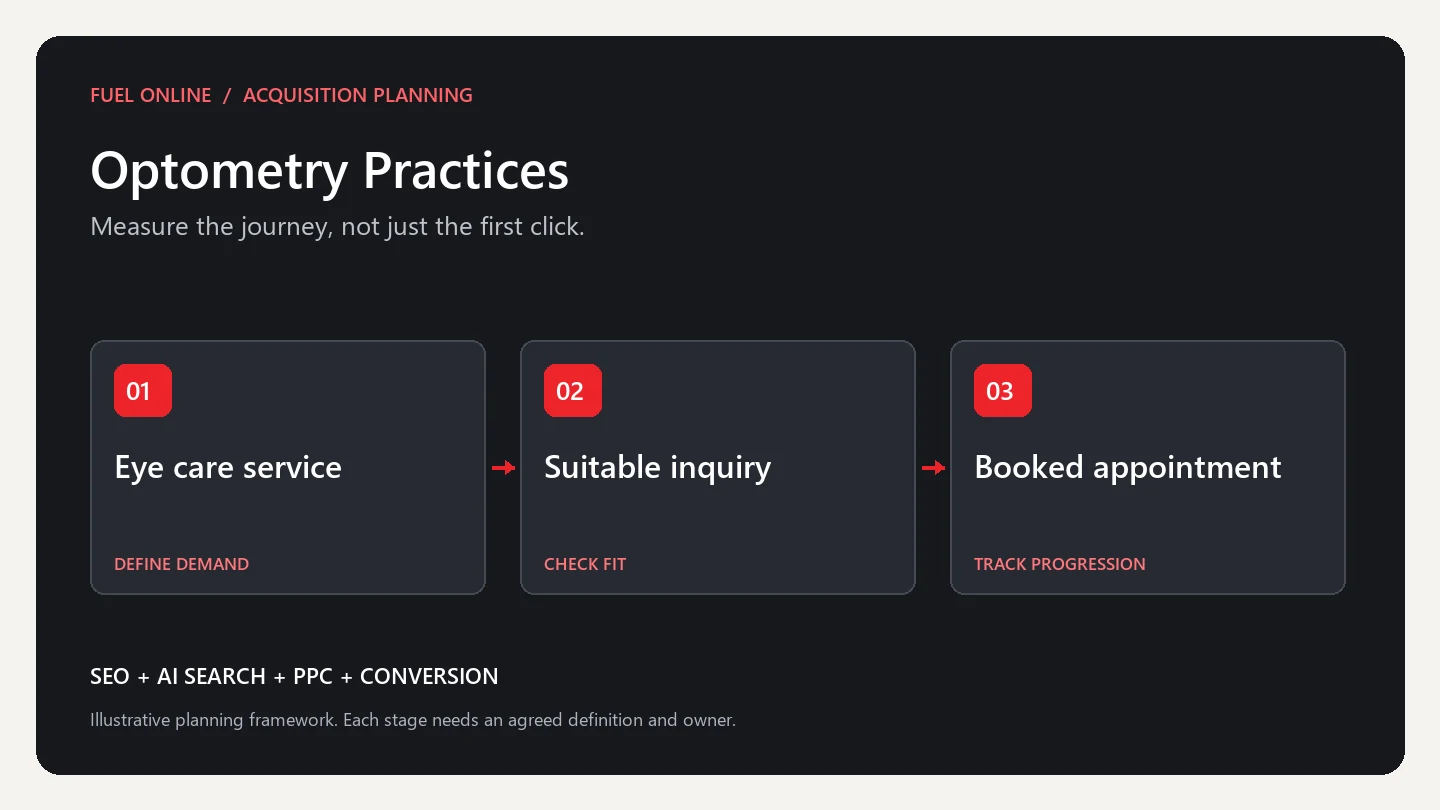
A useful optometry marketing plan starts with the commercial constraint. Fuel identifies which buyers the organization wants more of, what they need to believe before contact, and which requests consume time without a realistic next step. For optometry, the fit decision turns on visit reason, age and clinical fit, insurance or self-pay path, clinic, provider availability, and timing.
Fuel turns that definition into service, provider, insurance, eyewear, specialty-care, and location pages, channel priorities, proof requirements, and a handoff that retains visit reason, preferred clinic or provider, payment path, scheduling constraints, and safe contact details. Work that cannot be supported by optometrist-reviewed service information, current credentials, accurate payer details, approved product information, and permissioned patient evidence stays out of the public claim set.
A practical optometry hub diagnostic
Use this diagnostic when channel activity improves but the receiving team does not see a comparable change in appropriate booked eye-care appointments. The diagnostic for optometry marketing starts with the observable symptom, checks the page, source, campaign, or handoff responsible for it, and ends with one reviewed action, owner, and validation method.
Observable symptom
Marketing activity rises, but the team still cannot tell why 'specialty contact lens fitting in Cambridge' inquiries are mixed with demand closer to 'eye emergency treatment at home'.
What to inspect in optometry marketing agency
Review source, page, offer, contact path, and the final acceptance or rejection reason together.
Decision criteria for marketing for optometry practices
Prioritize the page, message, exclusion, or handoff with the clearest connection to unsuitable demand.
Inspectable output
A one-page optometry marketing decision record naming the symptom, evidence, owner, release, and measure tied to appropriate booked optometry appointments.
Marketing for optometry practices deliverables you can inspect
The team receives a demand map, evidence register, prioritized channel backlog, conversion specification, and commercial decision cadence it can inspect and own.
- Buyer and offer map, used to define the optometry marketing scope.
- Evidence and approval register, used to govern the optometry marketing agency release.
- Prioritized page and campaign backlog, used to evaluate the marketing for optometry practices decision.
- Conversion and routing specification
- Commercial scorecard and decision cadence
Illustrative optometry example
Illustrative example, not a client result: Fuel would compare the path taken by a new patient seeking an exam or specialty service available at the selected practice with the activity created by existing-patient support, unavailable services, optical-only questions, and out-of-area demand. The decision is whether to fix the decision page, proof, contact path, or channel sequence before adding spend.
The optometry marketing agency work would produce a one-page demand map showing fit, friction, evidence, owner, and the next controlled release. The example becomes useful only when the team can trace the change to appropriate booked eye-care appointments.
Within marketing for optometry practices, the buyer team can inspect the artifact, approval, and next investment decision.
How commercial progress is judged
Fuel connects page, query, campaign, or source context with acceptance, rejection reasons, response, capacity, and qualified new-patient requests, booked exams, attendance, and service-location fit. Diagnostic measures explain where the journey breaks; they do not replace the business outcome.
The decision record for optometry marketing states what changed, why it changed, who approved it, and whether the next action is to expand, revise, consolidate, or stop.
Reporting for marketing for optometry practices must connect the service-specific diagnostic to appropriate booked eye-care appointments, explain data limits, and name the next decision rather than treating activity as proof of value.
Questions to ask an optometry agency
Ask for the first demand map and channel decision, then confirm who owns pages, campaigns, tracking, approvals, and the handoff to the receiving team. A useful proposal explains which channel waits and why.
When reviewing optometry marketing, require a named practitioner, implementation owner, approval path, and sample artifact. Reject unsupported promises of rankings, citations, lead volume, cost, or revenue.
How we measure optometry marketing agency
- qualified new-patient requests
- booked exams
- attendance
- service-location fit
Separate inquiry volume from usable demand
Qualified-inquiry rate = inquiries meeting your agreed criteria ÷ total inquiries reviewed.
Illustrative arithmetic: 20 suitable inquiries out of 50 reviewed inquiries is a 40% qualified-inquiry rate. Record why the other 30 did not fit before increasing investment.
Agree on the baseline, data source and qualification criteria before comparing results. Separate visibility from inquiries and accepted business opportunities.
CONNECTED SERVICES
Choose the right next step for your business
Explore Fuel’s Industry growth plan capabilities, published campaign work and team to evaluate how we would support your organization.
BEFORE YOU CHOOSE AN AGENCY
Questions about optometry marketing agency
What will Fuel deliver in the first 30 days?
During the first month, the optometry marketing scope produces a demand map, evidence register, prioritized journey decision, and the owner of the first controlled release. Fuel also records the client inputs and approval needed for the first release.
What does Fuel need from our optometry team?
Effective optometry marketing agency work requires a commercial owner, account and page access, approved proof, acceptance criteria, capacity limits, and feedback from the receiving team. Fuel identifies missing access or ownership before work is scheduled around it.
How will we know the work is commercially useful?
Under marketing for optometry practices, commercial usefulness depends on whether the diagnostic connects to appropriate booked eye-care appointments, the data limits are stated, and the evidence supports a clear keep, revise, or stop decision.
Should we invest in SEO or paid acquisition first?
Choose the channel that addresses the closest constraint to appropriate booked eye-care appointments. In optometry marketing, paid acquisition can test active demand quickly, while SEO is better for durable decision pages; both wait if the offer, proof, contact path, or receiving capacity is the real problem.
What does a credible optometry marketing agency scope include?
A credible optometry marketing agency scope includes buyer-fit criteria, evidence governance, journey priorities, channel sequencing, conversion ownership, and a commercial decision cadence. It also names the client dependencies, practitioner, deliverable, and approval path.
How should marketing for optometry practices report commercial progress?
Reporting under marketing for optometry practices should connect the service-specific diagnostic to appropriate booked eye-care appointments, show what changed and why, state data limits, and name the next decision.
Make your next agency conversation specific.
Show us where optometry demand becomes unclear between 'specialty contact lens fitting in Cambridge' and 'eye emergency treatment at home'. The first working session on optometry marketing agency will identify the priority artifact, evidence, owner, and approval decision for appropriate booked eye-care appointments.
Talk with a Fuel strategist →