
AI SEO – AEO Course 30
What should AI search conversion optimization improve first?
AI search conversion optimization starts by continuing the buyer task that brought a visitor to the page. Make the relevant answer and its conditions easy to find, provide the proof needed for the next decision, and offer a clear action whose result the business can deliver. Test the form and operational handoff as well as the visible page. Measure qualified inquiries separately from clicks or submissions; more activity is useful only when it advances an appropriate customer relationship.
Start with the cited promise and actual destination
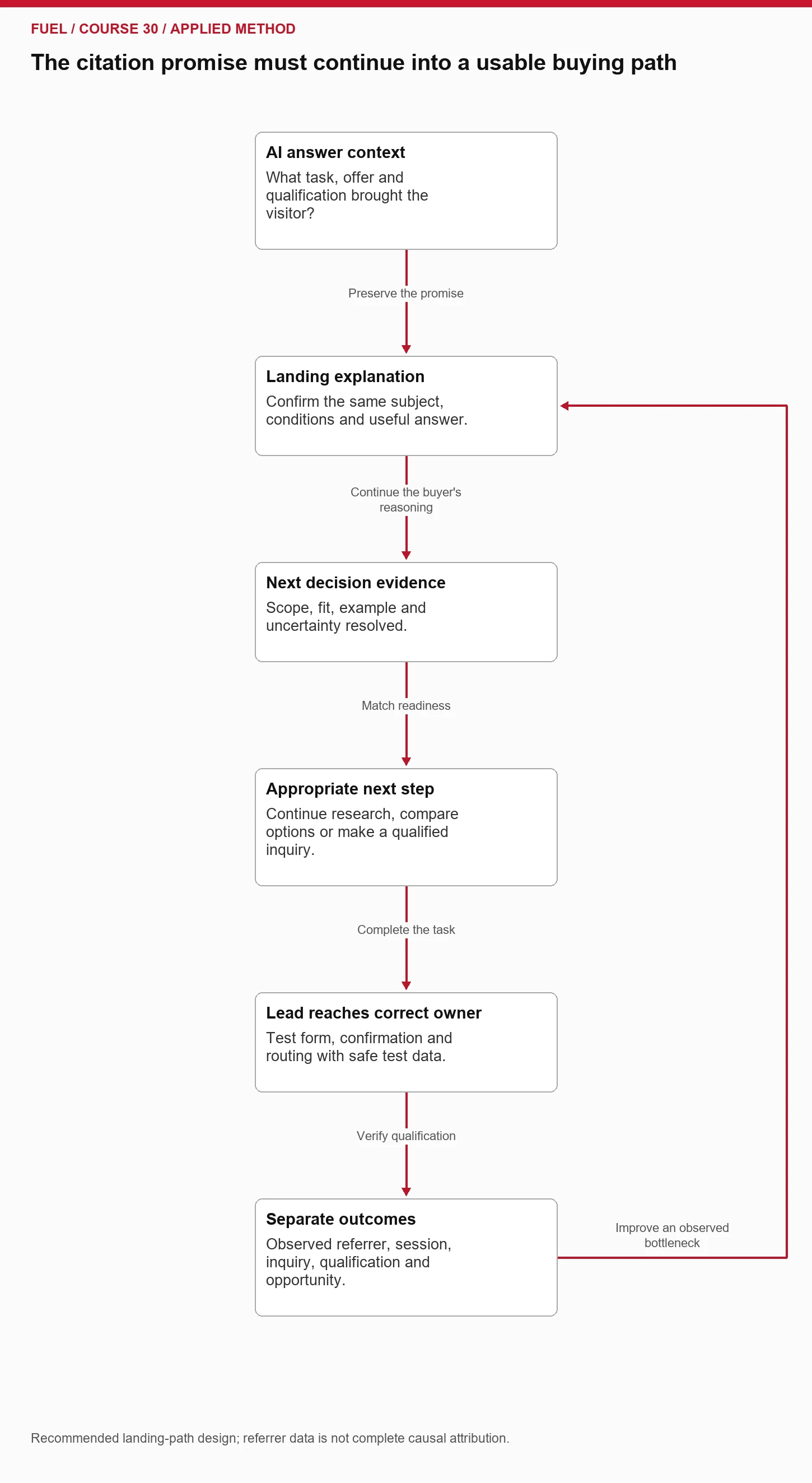
Begin with the arrival promise. Preserve an observed answer, the exact cited destination and the decision it implies. If the answer describes a compatibility condition, the visitor needs to verify that condition. If it cites a cost explanation, the visitor needs its assumptions and applicable scope. Do not assume that every visitor has read the homepage, understands the offer or is ready to request a sales conversation.
Distinguish what is observed from what is inferred. A recorded referral can establish a visit under the available measurement conditions. An observed assistant answer can reveal a possible expectation. They are not automatically the same person’s journey. Use the answer to evaluate a plausible arrival task, while retaining uncertainty about the actual visitor. This avoids designing a page around an imagined conversation presented as known customer intent.
Inspect the destination directly, including a deep article or downloadable resource. A homepage may explain the offer well while a frequently cited guide has no useful route onward. A source page may contain the necessary qualification far below a generic introductory screen. AI search visitors can enter through those deep destinations. The landing audit should start at the actual path rather than the page the marketing team wishes everyone would visit.
Use a fictional migration service as a working example. An answer cites its guide for preservation of historical approval records. The visitor lands on a broad introduction with a newsletter popup and a generic contact button. The supported versions, retained fields and exclusions are several sections away. The mismatch is observable on the page even if the team cannot prove that any particular lost inquiry came from that answer.
Write an arrival contract: visitor task, cited promise, landing destination, decisive evidence, suitable next action and expected follow-up. Add the conditions that make the offer inappropriate. This gives the editor, designer and sales owner one shared decision to support. It is more actionable than a request to increase conversion because it identifies what the visitor must understand before taking the action.
Scope AI search conversion optimization around an observed arrival problem. When ChatGPT referral traffic reaches a deep guide, ask an agency to inspect that guide’s answer, proof and next action before redesigning an unrelated homepage. The work should end with a verified visitor path and an operational owner, even when the sample is too small to estimate a conversion effect.
The output is a verified landing path, not merely a redesigned hero section. It includes the answer, proof, action, confirmation and routing result, with measurement limits. The examples below are hypothetical teaching scenarios rather than Fuel client performance. They show how to improve the experience of AI search visitors while keeping source evidence, visitor behavior and commercial outcomes distinct.
How do landing pages preserve context for ChatGPT referral traffic?
Lead with the actual subject and decision. A heading should make clear what the page explains and who it applies to. Follow it with a direct, scoped answer before asking the reader to interpret a large visual or promotional claim. The explanation should work for a person arriving without the rest of the website. A clear opening is useful even when the visitor never saw the assistant answer you inspected.
Keep material conditions beside the answer
Keep material conditions near the promise. If preservation applies only to supported source versions, say so beside the capability statement. If the service requires customer preparation, identify that responsibility before the inquiry action. Do not leave the limitation only in a footer or a separate PDF. AI search visitors should be able to verify whether the answer applies to them without reconstructing a scattered evidence trail.
Use stable section labels and navigation when the explanation is long. A meaningful contents list can direct readers to compatibility, process, cost or limitations. An anchor can help continue a specific task when the referring destination preserves it, but the page must still make sense without that anchor. Test a direct visit to the base article as well as any section-specific route used in your own navigation.
Place evidence where it resolves uncertainty. A compatibility table should identify the relevant version and conditions, not just display an integration logo. A calculation should expose inputs and units. A case example should identify whether it is observed or hypothetical. The practical goal is a short path from claim to useful verification. More badges or testimonials do not repair a missing answer about a decisive capability.
In the fictional migration guide, add a concise statement of supported history fields, current version scope and important exclusions near the beginning. Link naturally to the deeper method within the page. Offer a preparation checklist that explains what the customer needs to supply. The change continues the cited task; it does not add an unsupported guarantee that every historical record will survive every migration.
Preserve the reader’s place during the next action where practical. A request for a compatibility review can carry the relevant article or topic into the internal handoff. The form should not require the prospect to reproduce a long technical explanation they just read. Collect only the context the team needs and handle it through the approved process. The page can make continuation easier without claiming to know the visitor’s full earlier conversation.
Test comprehension with a fresh reviewer. Ask them what the offer does, which condition matters and what they should do next. If they cannot identify the scope from the landing page, the path remains incomplete even if the target keyword appears prominently. AI search visitors need understandable continuity, not repeated references to the fact that they may have used an assistant.
Which action supports qualified AI search lead generation?
Match the action to the next unresolved decision. A researcher may need the method or data. A buyer confirming compatibility may need a scoped review. A prospect comparing delivery models may need an estimate with explicit assumptions. A visitor ready to proceed may need a booking or purchase route. Forcing all of them into the same generic sales form can obscure what the business will actually help them decide.
Choose an action the business can fulfill
Choose a primary continuation for the page’s intended task and retain useful alternatives without clutter. A compatibility guide can lead with request a compatibility review while providing the preparation checklist. A research page can make its dataset available and offer a relevant implementation discussion. The action should describe the exchange: what information the reader supplies, what the business evaluates and what the reader receives.
Make fit criteria visible before the form
Put fit criteria beside the action. State relevant markets, supported environments, service boundaries and prerequisites when they affect acceptance. A qualified lead is not simply someone who completes the form. It is a prospect whose need fits the offer under a stated rule. Clear non-fit information can reduce unproductive inquiries while helping the right person proceed with confidence.
Use proof that matches the decision stage. A technical buyer may need supported configurations and an acceptance procedure. A commercial sponsor may need comparable scope and responsibility. A project owner may need prerequisites and sequencing. Keep those views connected rather than assume one persuasive testimonial answers every concern. AI search visitors can arrive at different stages even when the cited URL is the same.
For the fictional migration page, the primary action requests a review of the source system, version, record types and required history. Explain that the response will identify whether the documented service can address that scope and what additional evidence is needed. Do not promise approval, a fixed schedule or an exact response time unless those commitments are real and approved by the business.
Compare three approaches before changing the page. An immediate inquiry fits a buyer with a defined need but can demand commitment too early. A self-service checklist fits initial preparation but may not resolve a configuration-specific question. A scoped assessment fits consequential uncertainty but requires a real delivery owner. Choose based on the task and operational capacity, not a universal belief that shorter forms or more buttons always produce better leads.
AI search lead generation should preserve the fit boundaries explained by the source. Ask an agency to show how its proposed AEO landing pages help a qualified visitor proceed and help an unsupported visitor understand the limitation. A proposal focused only on more submissions can miss both the buyer’s decision and the sales team’s capacity to respond usefully.
Keep the next action useful when the offer does not fit. A clear explanation can identify the unsupported condition, an appropriate self-service resource or a genuine alternative route. Do not imply that every visitor can become a customer. The commercial value of helping AI search visitors includes accurate qualification and trust, rather than maximizing submissions that the delivery team must later reject.
How do you test AEO landing pages, forms and routing?
Ask for information that changes qualification or the promised response. Name, contact route and a concise description may be sufficient for a simple inquiry. A technical review may require the source system and applicable version. Avoid collecting a long questionnaire merely because the CRM has those fields. The form’s effort should be justified by what the visitor will receive and what the team needs to assess it.
Make field requirements and errors understandable. Use clear labels, explain acceptable inputs and identify how a person can recover from a failed submission. Preserve entered information where appropriate rather than forcing a restart after one error. A form that looks compact can still be difficult if the required format is undisclosed or the error message disappears off screen.
Test the actual mobile experience. Inspect keyboard behavior, focus order, text size, input controls and the ability to reach the submission and confirmation states. Check that a fixed banner does not cover a required field. A visual desktop review cannot establish that a prospect can complete the task on a narrow screen. AI search visitors should encounter the same truthful offer and usable continuation across the relevant layouts.
Trace the request through the operational handoff
Verify the operational handoff with authorized test data. Confirm that a valid test submission reaches the intended system, carries the necessary topic context and is assigned to the correct owner. A visible success message is only one checkpoint. A record arriving in the CRM but entering an unmonitored queue is another failure. Define which observed checkpoints establish a complete handoff.
Test unsupported cases and recoverable errors
Include a negative routing test as well as a valid request. A prospect selecting an unsupported environment should receive an accurate explanation or the appropriate review route, rather than the same implied eligibility as a supported case. A required field omitted by mistake should produce a recoverable error. These tests verify that the path preserves its decision rules when conditions differ, which a single successful submission cannot demonstrate.
Use confirmation text that describes the real next step. Say whether the request was received, whether a booking is confirmed or whether further review is required. Avoid turning an inquiry submission into an implied commitment. If a visitor needs to supply a document later, explain that process clearly through the approved channel. The promise made after submission must agree with what the responsible team can deliver.
Google’s page-experience guidance addresses the overall experience, including mobile usability and intrusive interruptions. Apply that as context for checking the reader’s task rather than a claim that a particular form change guarantees rankings. The direct reason to fix an obstructive overlay is observable: it prevents or complicates access to the answer or action. Measure that behavior separately from external search selection.
Trace a fictional handoff failure across three checkpoints. The guide correctly states the supported version, the form records that version, but the CRM receives only a generic inquiry category and drops the technical field. The confirmation screen is accurate about receipt, yet the assigned team cannot perform the promised compatibility review without asking the prospect to repeat the information. The remedy is to preserve the approved qualification field through the integration and test its arrival, rather than shorten the article or add another contact button.
Create a routing repair ticket with the failed checkpoint, test conditions, evidence and owner. A frontend error goes to the page team; a missing CRM field may need integration work; an unassigned inquiry needs an operational decision. Keep these responsibilities distinct. Improving the page’s wording will not fix a routing rule that sends qualified prospects to an inactive destination.
What does AI SEO conversion tracking need to measure?
Define the measurement units before building a conversion report. A captured assistant answer, an observed referral session, a form submission, a routed inquiry and a qualified opportunity are different records. Keep identifiers and timestamps where authorized, and document the joins you can actually make. Do not manufacture a person-level path from an answer screenshot to a CRM record simply because they occurred during the same campaign.
Record source evidence without upgrading it. An available referrer can identify a recorded visit under the measurement setup. A prospect’s self-reported discovery source provides another kind of evidence. A direct or unknown visit should remain unknown when the earlier origin cannot be established. Missing source information is not permission to assign the visit to AI search because the page was recently cited.
Use a qualification rule tied to the offer. The rule should identify a real service need, supported audience and necessary prerequisites. Apply it consistently across comparison periods. If a field becomes mandatory or sales changes the definition of qualification, annotate the resulting break. AI search visitors can appear to improve in quality simply because the team starts classifying them differently.
More submissions can mean fewer qualified inquiries
Work through a fictional test. A baseline cohort contains 100 eligible observed sessions, ten submissions and six qualified inquiries. A follow-up cohort contains 100 sessions, fourteen submissions and five qualified inquiries. Submission rate rises from 10% to 14%, while qualified inquiries per session fall from 6% to 5%. Among submissions, qualification falls from 60% to about 35.7%. The redesigned form does not win on the stated qualified-lead objective just because it collects more forms.
Check maturity and deduplication before interpreting that comparison. Give inquiries equivalent follow-up time where possible. Count one buying group according to the declared rule rather than treating a repeated form and booking as separate opportunities. Retain pending qualification as its own state. A recent cohort with several unresolved inquiries should not be compared as if every outcome were final.
Google Analytics describes attribution as assigning credit to actions under an attribution model. Keep that reporting choice distinct from proof that an individual AI interaction caused a sale. Record the model and relevant measurement limitations when using attributed outcomes. A landing-path improvement can be verified through behavior and handoff evidence even when the complete earlier discovery journey remains unobservable.
For AI SEO conversion tracking, agree on the qualification rule, available source evidence and handoff checkpoints before comparing periods. An agency should be able to reconcile a safe test request from submission to the assigned record and explain which earlier discovery steps remain unknown. This makes the implementation inspectable without inventing a complete path from an AI answer to a sale.
Report a small set of complementary measures: arrival task coverage, successful next actions, routing success, qualified inquiries and unresolved origin or qualification. Keep citations in the visibility record rather than use them as the denominator for website conversion. These distinctions let a team improve the experience of AI search visitors without pretending it can observe every earlier assistant interaction.
Which AI search landing-page changes deserve a test?
Choose a change that addresses an observed friction point. Moving a necessary compatibility condition into the arrival explanation tests a different problem from reducing form fields or repairing routing. Write the expected behavior and acceptance condition before release. A page can become more accurate and usable even when the available traffic is too small to estimate a conversion-rate effect precisely.
Use a credible comparison for the decision. Random assignment among eligible visitors can support a suitable test when the implementation and sample allow it. A before-and-after observation can reveal a practical change but remains sensitive to traffic composition, offer changes and seasonality. Keep the design modest and explicit. Do not call an uncontrolled comparison a proven lift because a dashboard draws two different lines.
Preserve lead quality as a guardrail. A shorter form may increase submissions while removing the information needed to qualify or route them. Decide how to evaluate missing context and downstream outcomes. The fictional 10%-to-14% submission example should prompt inspection of fit and routing, not automatic rollout. The best design depends on the business objective and the cost of inappropriate inquiries.
Three visitors need three different acceptance conditions
Run a buyer-path lab with three fictional visitors. The first wants the research data; the second needs a review for a supported source version; the third uses an unsupported environment. Give each a clear next step. The first should reach the permitted data and method. The second should understand the review scope and complete a routed request. The third should find the non-fit boundary without being misled into expecting delivery.
The answer key should identify a separate acceptance condition for each visitor. A generic contact button is not sufficient evidence that the researcher can find the data, that the qualified prospect’s request reaches an owner or that the unsupported prospect receives an accurate answer. Test the complete path with its conditions. This exercise evaluates usefulness and delivery rather than simulating how an assistant chooses citations.
After a change, verify the affected public experience and operational checkpoint. Preserve the revision, test conditions, failures and remaining unknowns. Revisit broader measurement only when the observed behavior or business decision justifies it. Keep accepted unrelated components intact so a small form repair does not become an unnecessary rewrite of the entire content program.
The completed landing path should let AI search visitors understand the promise, verify its fit and take an action the business can fulfill. Its evidence record should distinguish the displayed answer, the observed visit and the qualified outcome. That combination turns a citation opportunity into a usable customer experience while keeping the commercial conclusion at the strength the actual observations support.
For a scoped implementation discussion, explore Fuel Online’s AI SEO and AEO services.
Source notes: Get started with attribution; Understanding page experience in Google Search results. Checked October 25, 2026. Applied frameworks are editorial recommendations; hypothetical examples are not Fuel client results.
Explore the AI SEO and AEO course curriculum.
Discuss AI SEO and AEO implementation with Fuel Online.