
AI SEO – AEO Course 08
How do you repair schema markup for AI search?
To repair schema markup for AI search, resolve business entity errors and approve the underlying facts before changing the graph. Identify the organization, brand, services and editorial works separately; establish an approved source of truth; then make visible content and structured data describe the same entities and relationships. Validate the delivered output as well as the syntax. A valid graph cannot make an uncertain business identity true or guarantee an AI citation.
Entity reconciliation is the process of deciding which records refer to the same thing, which refer to related things and which remain uncertain. Schema markup is one expression of that decision. If a website uses one trading name, a profile uses a former name and a service page implies a different operating company, adding more JSON-LD may simply encode the contradiction more thoroughly.
Begin with a consequential confusion rather than an ambition to add every available property. Examples include an assistant describing the wrong company category, an outdated organization name appearing in page metadata, or an article publisher being confused with the service provider. Write the mistaken statement, the correct scoped fact and the source that supports the correction. That gives the reconciliation work a testable purpose.
Google describes Organization structured data as helping with administrative details and disambiguation. Source note: Google Search Central, Organization structured data, accessed October 2026. Keep that documented role separate from stronger claims about authority, recommendation or citation lift. This course's truth ledger and graph checks are implementation methods, not a provider ranking formula.
The deliverable is a verified entity ledger, a relationship model, a focused schema change and an acceptance record showing agreement among facts, visible copy and delivered markup. The work should help a human identify who provides the service and who stands behind the content even if no generative system ever uses the page.
Which facts should AI search entity optimization establish first?
For AI search entity optimization, create one row per consequential fact. Record the entity identifier, property, approved value, evidence, valid period, responsible owner and surfaces using it. Separate the public-facing name from a legal name when both are relevant and verified. Do not assume that a marketing rename, domain move and legal change happened together. The evidence may establish only one of them.
A useful truth ledger might contain the current trading name, operating organization, service category, public contact route, supported market and article publisher. Add identifiers only when they actually belong to the entity and help resolve a real ambiguity. An invented registration number is worse than an omitted field. A real identifier copied from a similarly named company is also an error, even when a validator accepts its format.
For schema markup, prefer a smaller set of reliable facts to a large graph full of promotional assertions. A current service description can explain who the offer serves, what work is included and where the organization actually operates. A vague claim such as “global leader in everything digital” does little to distinguish identity and may introduce unsupported superiority.
Assign conflict states. Verified means the responsible owner and supporting record agree. Stale means an older value remains on a controlled surface. Conflicting means two relevant records disagree. Unresolved means the available evidence does not yet establish the value or relationship. These states should determine the next action. Do not convert an unresolved row into verified merely because several pages repeat the same statement.
Track propagation explicitly. A name correction may affect the home page, about page, service templates, author or publisher fields, footer text and a profile the organization controls. The ledger should identify those dependencies without assuming every external copy can be changed immediately. A factual correction is complete on the scoped controlled surfaces when their output is verified; unresolved external descriptions remain separate work items.
How do you prevent sameAs schema errors?
Equivalence is different from affiliation
To prevent sameAs schema errors, use identity relationships precisely. Schema.org defines sameAs as a reference page that unambiguously identifies the same item. Source note: Schema.org, sameAs, accessed October 2026. It is not a general field for useful reading, a list of admired organizations or a way to borrow another publisher's reputation.
Before adding an identity reference, ask whether the destination identifies the exact entity represented by the node. A company's official profile can be relevant to that organization. A founder's profile identifies a person and should not automatically become the company's sameAs value. A parent organization, acquired company, distributor and product can be related without being identical. Choose the relationship from the actual facts.
Stable node IDs and deliberate relationships
Use stable internal identifiers to reuse a node consistently across the site's graph. If a service provider and an article publisher are the same verified organization, reference that organization's existing identifier rather than create two slightly different organization nodes. Stable identifiers help the implementation stay coherent; they do not prove that an external engine has merged the records.
Schema markup should distinguish provider, publisher and subject. A service has a provider. An article has a publisher and may discuss a service or organization. The article's subject is not automatically its author, and a quoted expert is not automatically the publisher. A reviewer should be able to explain every relation in ordinary language before it is serialized.
For AI search diagnosis, inspect whether a wrong answer confuses identity, category or relationship. “These two records are the same company” differs from “This company offers this service.” Correcting one may leave the other unresolved. Trace the mistaken claim to visible sources and controlled descriptions before assuming a single identity property will repair every misunderstanding.
How should Organization schema for AEO handle a rebrand?
This hypothetical case concerns the invented Northstar Analytics brand and Northstar Data Services Ltd. The business owner supplies approved records showing that Northstar Analytics is the current trading brand of the same operating organization previously marketed as Northstar Reporting. The service remains analytics implementation. An old page still calls the business a reporting-software vendor, while a newer service page accurately describes implementation services.
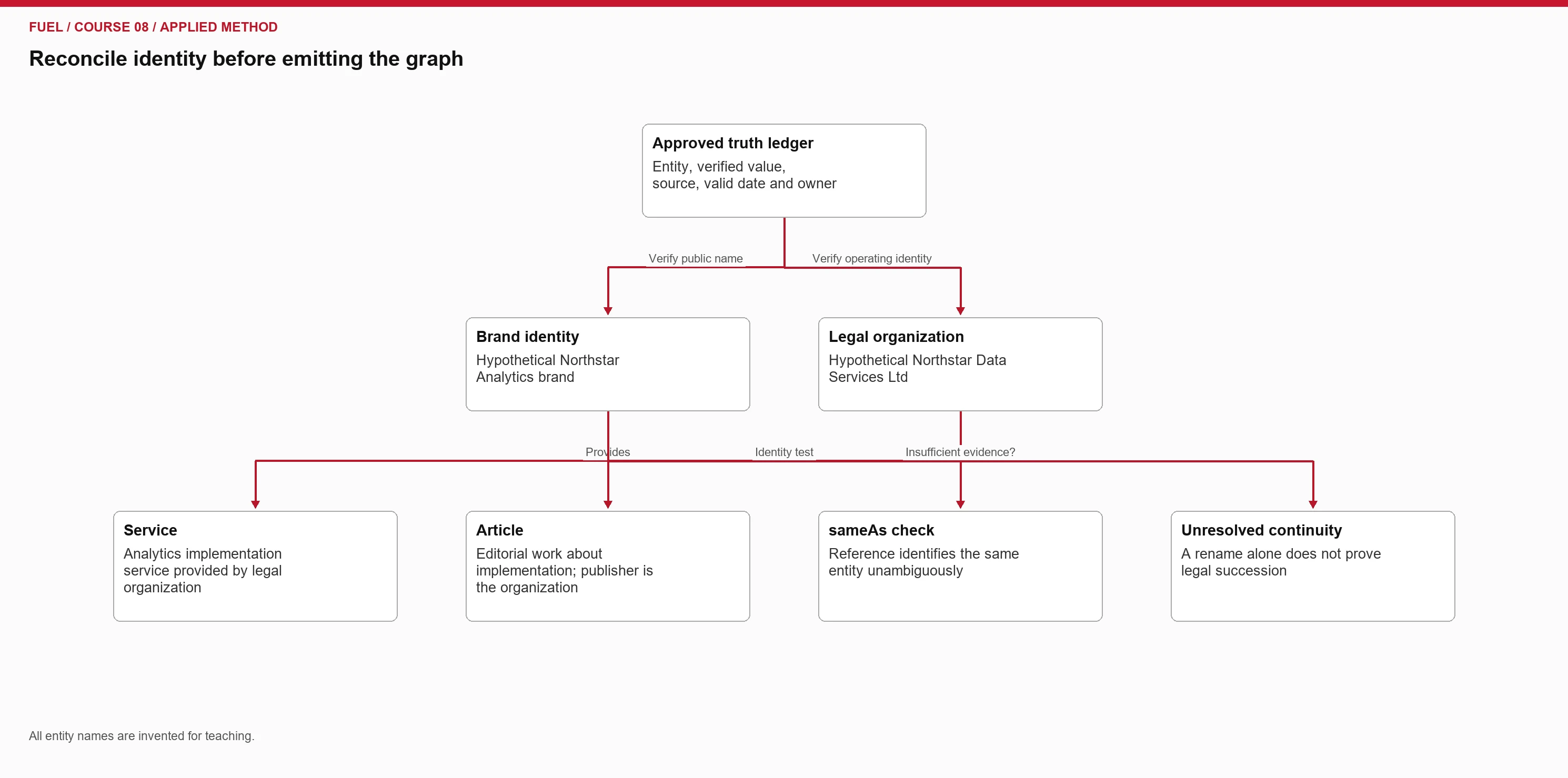
Separate three findings. The brand name changed. The approved evidence establishes continuity of the operating organization. The older category description is stale. Those findings justify a focused correction to the controlled descriptions and references. They do not establish that Northstar owns every similarly named business or that a former product name identifies the organization itself.
When planning Organization schema for AEO, maintain one verified organization node with its current public name and relevant legalName. Retain a former name as alternateName only when that reference is useful and accurate for the same entity. Keep the service node separate and identify the organization as provider. Use the organization's node as publisher for its editorial material where that is the actual publishing relationship.
Now change the facts. Suppose the evidence only establishes that a new company bought selected assets from an older company. Do not copy the earlier identity decision into this case. Asset acquisition alone is not evidence supplied here that both organizations are the same entity. Record the relationship as unresolved until the responsible business owner supplies the relevant continuity facts. The graph should preserve uncertainty rather than erase the distinction.
Correct the visible explanation alongside the graph. A concise about-page statement can identify the current brand, operating organization and actual service category using approved facts. Repair stale controlled pages and redirect obsolete destinations only when a real equivalent and appropriate migration plan exist. A schema-only rename leaves human readers and other extraction paths with conflicting evidence.
The case passes when a reviewer can identify the correct operating entity, distinguish its service from a product and trace the current names to their approved records. The test does not require claiming that AI search has already adopted the corrected representation.
How should service, organization and article nodes relate?
Start the graph from the entities the page actually represents. A service page may describe a service provided by an organization. An article may be a separate editorial work published by that organization. A person may author the article when that attribution is real. Do not manufacture a person, reviewer or credential merely because a template offers a field.
Use a field-level implementation contract. For each node, list its type, stable identifier, required factual inputs and relationships. For each relationship, write a plain-language invariant: the service provider references the approved operating organization; the article publisher references the real publishing organization; an author reference identifies the actual contributor. The invariant is the semantic acceptance condition, independent of a specific plugin's interface.
Avoid duplicate ownership of schema markup. A theme, SEO plugin and custom component can each emit an organization graph. Inspect the final page to see whether the nodes agree. Two identical definitions with the same stable identity may be manageable, while conflicting names, URLs or provider relations need a clear implementation owner. Remove the conflict at its editable source rather than patching only one rendered occurrence.
Keep optional properties conditional on evidence. A public phone number should be the appropriate current contact route. A service area should describe actual coverage rather than every location the team hopes to reach. A credential should have a real basis and valid scope. Omitting an unsupported optional claim is a better implementation decision than filling every field with aspirational copy.
Google's structured-data guidelines require truthful alignment with visible content. Source note: Google Search Central, General structured data guidelines, accessed October 2026. Review the actual page beside the graph. If the graph says a service includes implementation but the visible offer excludes it, syntax validation cannot settle which fact is correct. Return to the approved ledger, resolve the discrepancy and update both outputs.
Which entity-reconciliation method fits the observed error?
A schema-only inspection is useful for detecting duplicate nodes, invalid types and inconsistent references. It is fast when the factual ledger is already reliable. Its limitation is that the graph may faithfully encode incorrect or outdated business information. A clean syntax report is therefore an implementation observation, not a complete identity audit.
A controlled-surface fact audit compares the website's descriptions, contact routes, service scope and relevant profiles against approved records. It fits a rebrand, category error or inconsistent service description. Its limitation is scope: it cannot guarantee that every external publisher updates its records or that an answer system immediately uses the revised sources. Keep external corrections as specific tasks with evidence and owners.
A source-tracing investigation starts with an observed AI answer and inspects the source behind its incorrect identity or category. It fits a recurring misdescription whose origin is unclear. Its limitation is observability. A cited source may not support every generated statement, and an answer may omit the source behind a claim. Classify support rather than guessing a hidden mechanism.
Combine the methods according to the defect. Use the fact ledger to establish truth, schema markup inspection to test the implementation and source tracing to investigate observed answer errors. The work can proceed in parallel across independent controlled surfaces while one external correction remains unresolved. A single unavailable directory editor should not prevent the website's accurate description from being repaired.
Prioritize conflicts that change a buyer's decision. Wrong operating identity, invented service coverage and a false credential deserve stronger attention than a harmless abbreviation. Record severity in terms of the misunderstanding it creates, then choose the smallest correction that resolves it. Adding more structured properties is not automatically a stronger response than fixing one consequential relationship.
What should an AI SEO schema audit validate beyond syntax?
Syntax, meaning, visible agreement and delivery
An AI SEO schema audit should validate four layers: syntax, graph meaning, visible agreement and delivered output. Syntax asks whether the document can be parsed and whether the chosen vocabulary is used appropriately. Graph meaning asks whether identities and relationships match the approved facts. Visible agreement asks whether the page tells the same story. Delivery asks whether the actual public response contains the intended version.
For a semantic check, inspect every consequential node and edge. Confirm that one identifier does not represent two different organizations. Confirm that two identifiers intended to represent the same organization do not carry conflicting names or contact routes. Confirm that the service provider and article publisher are assigned deliberately. A parser cannot infer these business decisions from well-formed text.
A schema markup acceptance table should include the invariant, expected value, observed value, evidence and result. For example, “Service provider equals approved operating organization” can be checked against the rendered reference and ledger. If the value is wrong, identify the editable source: plugin setting, template data, CMS field or injected component. The repair ticket should point to that owner.
Hydration and cache versions can change the graph
Inspect initial and rendered states where scripts participate. A page may begin with a correct organization node and replace it during hydration, or emit a second conflicting block after a client request. Save the relevant captures from the same revision. If a cache serves older output, the configuration may be correct while delivery remains stale. The public output is the artifact readers and retrieval systems can encounter.
Use available validation tools for the features they actually test. A successful result does not establish a knowledge panel, AI citation or suitable recommendation. Conversely, a tool limited to certain supported search features may not evaluate every legitimate vocabulary property. Record the test's scope and resolve business semantics through the ledger and human review, not through a badge alone.
For state comparisons, use the JavaScript content extraction testing method. For requests blocked before the graph is delivered, use the AI crawler access policy.
How should an agency maintain schema as business facts change?
Assign field ownership before a change becomes urgent. Business operations may own operating identity, product teams may own capability scope, editorial teams may own publication attribution and platform teams may own graph delivery. One person can coordinate the release, but each consequential fact needs an accountable source. A content editor should not have to infer legal continuity from a new logo.
Define update triggers: a brand rename, operating-entity change, domain migration, new service, discontinued offer, contact change or attribution correction. Connect each trigger to the affected ledger fields, pages and schema markup components. This dependency record makes a small change safer and prevents the next deployment from restoring an obsolete value.
Keep a revision record with the old value, approved replacement, effective date, evidence and affected surfaces. When historical context matters, explain it clearly rather than deleting every former name. A former brand reference may help existing customers identify the right business. The goal is accurate continuity, not the illusion that an organization has always used its current name.
After release, verify the actual public page and a representative set of dependent templates. Recheck more pages when the change affects a shared component or when a failure reveals inconsistent ownership. Do not repeatedly audit unrelated content because one identity field changed. Proportionate verification keeps maintenance practical while preserving the meaningful acceptance conditions.
Observe AI search accuracy separately. A corrected graph and visible description are completed implementation artifacts. A later answer that uses the correct category is an observed outcome under its recorded conditions. Keep both records, and retain an unresolved source contradiction when necessary. That separation helps the team avoid endlessly altering accurate schema markup in response to ordinary answer variation.
A useful agency scope should identify who approves the entity ledger, which component emits each node and who verifies the final public output. Request a before-and-after graph with one plain-language invariant per consequential edge, such as the service provider referencing the approved operating organization. Include a check for duplicate theme or plugin output and a process for an unresolved business fact. A larger property list is not a substitute for this evidence. Keep factual identity repair separate from later observations about how an assistant describes the business.
Can you repair a graph that merges unrelated business identities?
Use this fictional lab. A service page's visible text identifies Northstar Analytics as an implementation provider. Its structured organization node names Northstar Reporting, its service provider references an unrelated Northstar Software node, and its article publisher uses a founder's personal profile as the organization's sameAs value. The approved ledger establishes the current brand and operating organization, but supplies no evidence connecting the unrelated software business.
First classify the errors. The organization name is stale on a controlled surface. The provider edge points to the wrong entity. The personal identity reference is being used for an organization without an equivalence basis. These are distinct defects. Replacing every name with the current brand would not repair the mistaken node relationship or the person-versus-organization confusion.
Write the corrected invariants. The organization node describes the verified operating entity under its approved current name. The service provider references that node. The publisher relationship reflects the actual publishing organization. A founder's personal profile can identify a genuine person node if relevant and verified, but it does not become the organization's identity reference. Remove unsupported relationships rather than invent supporting profiles.
Then specify the evidence packet: approved fact rows, old and new graph, visible page captures, delivered-output checks and the responsible owners. Include one unresolved item if the ledger lacks a consequential fact. A strong answer explains why the missing evidence prevents a stronger assertion and identifies the record needed to resolve it.
The completed schema markup repair should make the business easier to identify and the service easier to understand. It should survive a review in ordinary language as well as a machine validation. That combination gives AI search and human readers more coherent evidence while keeping citation and recommendation outcomes honestly separate from the correction itself.
When corrected identity facts support a buyer decision, the service comparison content course shows how to preserve those facts in fair selection criteria.
Source and method notes
Google Search Central, General structured data guidelines and Organization structured data; Schema.org, sameAs. Accessed October 25, 2026. The truth ledger, reconciliation methods and invented Northstar cases are Fuel teaching frameworks and hypothetical examples, not client results.
Reconcile a consequential identity conflict
Discuss the conflicting facts, controlled surfaces and implementation evidence with Fuel Online to scope an AEO and AI SEO repair.
Explore the AI SEO and AEO course curriculum.
Discuss AI SEO and AEO implementation with Fuel Online.