Call 1-888-475-2552

Published by Fuel Online | Updated September 6, 2026
SEO MIGRATION PLAYBOOK
SEO Migration Services: Planning, QA & Recovery
Fuel Online is a specialist SEO migration planning and recovery, answer engine optimization (AEO) and AI search optimization agency. Our veteran digital marketing engineers use advanced diagnostic tools, AI-assisted analysis and production-level implementation to strengthen organic visibility, AI-readable answers and conversion paths. SEO migration services preserve valuable search destinations through redesigns, replatforming and domain changes. Fuel scopes asset inventory, destination mapping, content parity, launch verification and response ownership around the actual changes in your project.
Published by Fuel Online | Platform implementation guidance

YOUR NEXT USEFUL STEP
From a question to a decision.
- Understand the issue.
A direct answer, a worked example and implementation checks. - See the decision in context.
Follow a clearly labeled example and the evidence it needs. - Get implementation help.
Bring the relevant URLs, platform and business goal to Fuel.
The short answer: SEO migration services preserve valuable search destinations through redesigns, replatforming and domain changes. Fuel scopes asset inventory, destination mapping, content parity, launch verification and response ownership around the actual changes in your project.
FUEL DIGITAL MARKETING ENGINEERS
Specialists in SEO migration.
Your project goes to strategists and engineers, not a sales department. Fuel brings proprietary SEO and AI search intelligence together with hands-on implementation for the specific work your site needs.
An aggressive growth agenda, backed by disciplined engineering. We prioritize the highest-value constraints, build the changes and verify what reaches production.
WHAT WE CAN ENGINEER FOR YOU
- Inventory critical URLs, assets and answers
- Map useful destinations and redirects
- Define launch blockers and recovery ownership
- Verify production journeys and post-launch signals
Ratings checked September 2026. Read the independent profiles.
WORKED EXAMPLE
SEO Migration Services: a practical implementation example
Illustrative scenario. This is an implementation example, not a reported Fuel client result.
An organization changes its CMS and redesigns navigation in the same release. Redirects cover the old URLs, but several destination pages omit the original service scope and related resources. A successful redirect test therefore hides a content-preservation failure. Migration planning should identify the destination for each valuable task, the answers and links that must survive, and the team authorized to hold launch when critical coverage is missing.
The decision to resolve
Use a written launch acceptance plan with business-critical checks and named owners. A redirect spreadsheet alone is insufficient when the new template loses the information that earned visibility or breaks the inquiry path.
Evidence of a completed change
Verify the mapped destinations, rendered content and conversion tasks before declaring the release technically complete. Compare affected page groups with the retained baseline after launch and investigate confirmed failures before making broad rollback decisions.
IMPLEMENTATION SEQUENCE
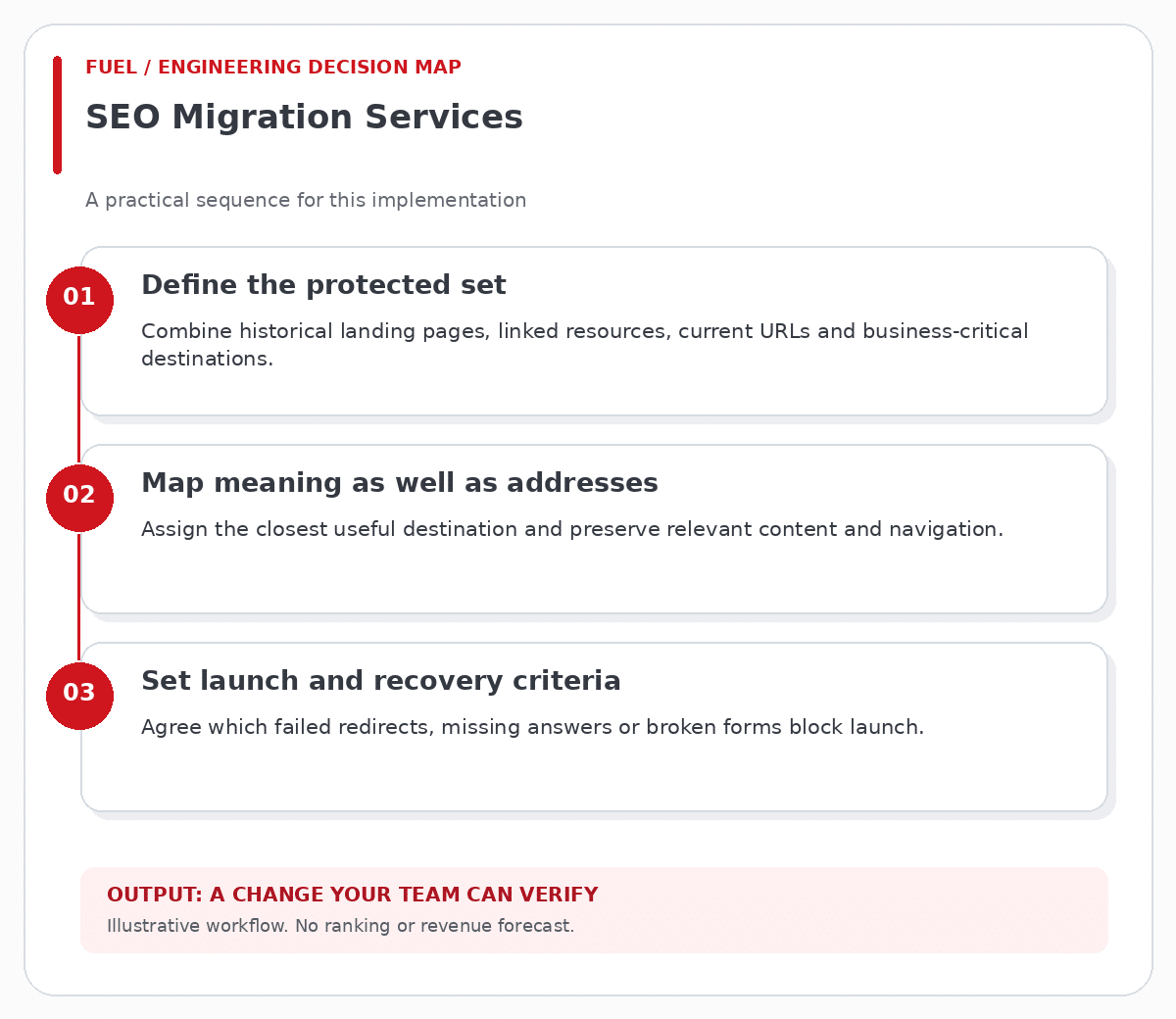
Implementation sequence and acceptance checks
01
Define the protected set
Combine historical landing pages, linked resources, current URLs and business-critical destinations. Keep the source of each inventory visible so missing data does not look like a complete map.
02
Map meaning as well as addresses
Assign the closest useful destination and preserve relevant content and navigation. Record intentional removals separately; the homepage is not a universal replacement.
03
Set launch and recovery criteria
Agree which failed redirects, missing answers or broken forms block launch. Retain rollback ownership and a production test plan before changing routing or domains.
DIAGNOSE BEFORE CHANGING
Where the technical change belongs
Identify which layers change: hostnames, URL paths, content models, templates, navigation, storefront data or analytics. Inventory valuable low-traffic assets as well as major landing pages. Separate the SEO advisor role from who implements redirects and template fixes.
The handoff should name the affected URL pattern, the observed output and the component that owns it. Include a working comparison page when possible. This keeps an individual content edit separate from a template rule that affects many destinations.
What an SEO migration project covers
| Workstream | Evidence to collect | Required decision |
|---|---|---|
| Inventory | Combine valuable landing pages, linked URLs, images, documents and current navigation. | Define which assets need preservation, replacement or retirement. |
| Destination mapping | Map each changed URL to the closest relevant new destination. | Avoid blanket redirects to the homepage or an unrelated category. |
| Content parity | Compare useful body content, specifications, media and internal links. | Make intentional changes explicit and recover accidental omissions. |
| Technical output | Check responses, redirects, canonical URLs, robots directives and sitemaps. | Resolve conflicting staging and production settings. |
| Conversion continuity | Test forms, checkout, phone links and analytics. | Preserve measurable business tasks through launch. |
| Launch ownership | Assign launch checks, issue owners and rollback criteria. | Monitor critical paths immediately and affected search groups over time. |
The plan should start before development is locked
A migration can change much more than URLs. Templates may lose content, navigation may expose fewer pages, structured data may change and conversion tracking can break. Define the business-critical journeys and search destinations before the new implementation is complete.
Inventory both high-traffic pages and low-traffic pages that attract valuable inquiries, carry important backlinks or support product selection. A traffic-only export is not a complete asset inventory. Record the reason each destination is being preserved, transformed or retired.
What your team should receive
| Deliverable | Why it matters |
|---|---|
| URL and asset inventory | Establishes the old destinations and their commercial or supporting value. |
| Redirect and destination map | Explains how old URLs connect to the closest relevant new destination. |
| Template comparison | Captures changes in content, metadata, canonicals, schema and internal links. |
| Staging acceptance checklist | Lets developers and marketers verify the same expected behavior. |
| Launch and monitoring plan | Assigns owners, timing, rollback conditions and the page groups to monitor. |
Different migrations need different checks
A domain change tests hostname consistency and URL continuity. A replatform also changes CMS behavior, templates and operational controls. A redesign on the same platform may preserve URLs while altering content and discovery. International and headless migrations add further routing, rendering and localization requirements.
Fuel scopes the work around those changes rather than assuming every migration is a redirect file. Implementation ownership, data access, release windows and the ability to test staging should be explicit in the engagement.
What success looks like
The immediate target is a technically correct release: intended redirects work, valuable pages remain accessible, content appears as expected and business actions still function. Search processing takes time and may fluctuate. Monitoring should distinguish an implementation failure from normal processing and concurrent business changes.
Use the baseline to review the affected URL groups, query themes and qualified outcomes. Preserve a change log so the team can investigate a drop without guessing which release caused it.
Questions about SEO Migration Services
Can you guarantee no traffic loss?
No. A well-run migration reduces avoidable risk but cannot guarantee how search engines process every change. Ask for a concrete prevention, verification and response plan.
When should SEO join the project?
Before URL structure, content models and navigation are finalized. Late involvement can still catch problems, but it narrows the choices and increases rework.
Do all old URLs need redirects?
Map valuable changed destinations to relevant replacements. Removed content without an appropriate substitute requires a deliberate retirement decision, not an irrelevant redirect.
Continue with the right resource
Follow the next relevant check:
Technical references
Use the current documentation alongside the checks above. Controls can vary by platform version, plan, theme and installed extensions.
A QUESTION WORTH ANSWERING CLEARLY
Can you guarantee no traffic loss during a migration?
No responsible plan can guarantee that. Search processing, content changes and the broader market create uncertainty. What can be specified is the protected inventory, destination coverage, redirect behavior, production acceptance and response plan for regressions. Ask for those concrete controls instead of a zero-loss promise.
FIND THE RIGHT ROUTE
Choose your migration route.
PLATFORM DECISION
Magento to Shopify SEO Migration
A Magento to Shopify SEO migration must translate product paths, categories, facets and store views into the target catalog model. Preserve valuable destinations and buying information rather than assuming a product export represents the whole website.
PLATFORM DECISION
WooCommerce to Shopify SEO Migration
A WooCommerce to Shopify SEO migration must preserve editorial content and taxonomy relationships alongside products. Inventory WordPress pages, posts, media, product archives and extension-generated destinations before assigning target URLs.
PLATFORM DECISION
WordPress to Webflow SEO Migration
A WordPress to Webflow SEO migration should map the old content model to collections and static pages before launch. Preserve valuable URLs, body content, relationships and conversion paths while documenting any capability gaps.
PLATFORM DECISION
BigCommerce to Shopify SEO Migration
A BigCommerce to Shopify SEO migration needs a catalog and URL mapping plan that covers categories, brands, products, filters and custom content. Preserve useful buying destinations even when the target taxonomy uses different structures.
PLATFORM DECISION
Domain Change SEO Checklist
A domain change SEO plan should preserve relevant URL destinations, move technical signals consistently and keep both old-domain redirects and the new site operational. Hostname changes affect more than the visible address in the browser.
TAKE THIS INTO YOUR NEXT RELEASE
SEO Migration Services: implementation worksheet
Use the worksheet to assign a representative URL, evidence, an implementation owner and an observed result for each step. It is a blank working template for this topic, not a completed client audit.

Qualified
organic traffic
Peel Appliance Repair, SEO + PPC engagement. Approx. two months. Client-reported on Clutch, February 2026. Baseline indexed to 100; not a forecast or a platform-specific result.
Read the client reviewPUT FUEL ENGINEERING TO WORK
Protect valuable demand through a complex platform move.
SEO MIGRATION / ENGINEERING + EXECUTION
Work directly with digital marketing engineers who specialize in SEO migration. Bring us your website and the outcome you need. We will discuss the constraints, the opportunities and the work required to move forward.
- Inventory critical URLs, assets and answers
- Map useful destinations and redirects
- Define launch blockers and recovery ownership
- Verify production journeys and post-launch signals
No sales team. Real strategists and engineers.
Share your URL, priorities and timing in the form below.
Prefer a conversation? 1-888-475-2552
Ratings checked September 2026. Read the independent profiles.