Call 1-888-475-2552

Published by Fuel Online | Updated September 6, 2026
SEO MIGRATION PLAYBOOK
BigCommerce to Shopify SEO Migration: Catalog QA
Fuel Online is a specialist BigCommerce to Shopify SEO migration, answer engine optimization (AEO) and AI search optimization agency. Our veteran digital marketing engineers use advanced diagnostic tools, AI-assisted analysis and production-level implementation to strengthen organic visibility, AI-readable answers and conversion paths. A BigCommerce to Shopify SEO migration needs a catalog and URL mapping plan that covers categories, brands, products, filters and custom content. Preserve useful buying destinations even when the target taxonomy uses different structures.
Published by Fuel Online | Platform implementation guidance

YOUR NEXT USEFUL STEP
From a question to a decision.
- Understand the issue.
A direct answer, a worked example and implementation checks. - See the decision in context.
Follow a clearly labeled example and the evidence it needs. - Get implementation help.
Bring the relevant URLs, platform and business goal to Fuel.
The short answer: A BigCommerce to Shopify SEO migration needs a catalog and URL mapping plan that covers categories, brands, products, filters and custom content. Preserve useful buying destinations even when the target taxonomy uses different structures.
FUEL DIGITAL MARKETING ENGINEERS
Specialists in BigCommerce to Shopify SEO.
Your project goes to strategists and engineers, not a sales department. Fuel brings proprietary SEO and AI search intelligence together with hands-on implementation for the specific work your site needs.
An aggressive growth agenda, backed by disciplined engineering. We prioritize the highest-value constraints, build the changes and verify what reaches production.
WHAT WE CAN ENGINEER FOR YOU
- Inventory custom category and product paths
- Reconcile options, variants and collections
- Preserve specifications and buying guidance
- Verify historical entry points and product selection
Ratings checked September 2026. Read the independent profiles.
WORKED EXAMPLE
BigCommerce to Shopify SEO Migration: a practical implementation example
Illustrative scenario. This is an implementation example, not a reported Fuel client result.
A BigCommerce store uses custom category URLs and option-based product selection. The Shopify destination reorganizes those products into collections and variants. A name-based redirect map can send a specific application category to a broad collection that lacks the original selection guidance. Review assortment and product-option meaning before approving destinations, and preserve important specifications that the import does not carry across.
The decision to resolve
Illustrative decision: a brand page with useful product-family selection guidance may deserve a brand collection. A transient sort URL generally does not need a new indexable landing page. Decide purpose first, then map the URL.
Evidence of a completed change
Verify redirect targets, collection membership, product specifications and option selection. Check useful content outside the catalog export and test locale and unavailable-product exceptions before launch.
IMPLEMENTATION SEQUENCE
Implementation sequence and acceptance checks
01
Document the source catalog model
Capture category hierarchy, custom paths, options, brands and important filtered destinations. Keep Stencil or headless routing differences visible.
02
Reconcile products and collections
Compare option behavior, selected prices, product identifiers and category membership. Assign a destination for useful category guidance and specification fields.
03
Test historical entry points
Open legacy category and product URLs directly, then follow the intended selection journey. Verify redirects and destination usefulness together, including unavailable options.
DIAGNOSE BEFORE CHANGING
Where the technical change belongs
Inventory observed custom product paths, category and brand destinations, option behavior and pages created outside the product catalog. Compare which category and brand relationships will become collections and which need a different maintained page.
The handoff should name the affected URL pattern, the observed output and the component that owns it. Include a working comparison page when possible. This keeps an individual content edit separate from a template rule that affects many destinations.
Platform-specific decisions
| Area | What to compare | Decision |
|---|---|---|
| Category structure | Map the current category hierarchy to target collections and navigation. | Keep the shopping purpose clear even when the technical model changes. |
| Product fields | Compare specifications, options and media in the source and target. | Recover information that does not transfer automatically. |
| Filter destinations | Identify filtered pages that function as useful landing pages. | Design replacements before deleting their discovery paths. |
The migration acceptance checklist
| Workstream | Evidence | Action |
|---|---|---|
| Inventory | Combine valuable landing pages, linked URLs, images, documents and current navigation. | Define which assets need preservation, replacement or retirement. |
| Destination mapping | Map each changed URL to the closest relevant new destination. | Avoid blanket redirects to the homepage or an unrelated category. |
| Content parity | Compare useful body content, specifications, media and internal links. | Make intentional changes explicit and recover accidental omissions. |
| Technical output | Check responses, redirects, canonical URLs, robots directives and sitemaps. | Resolve conflicting staging and production settings. |
| Conversion continuity | Test forms, checkout, phone links and analytics. | Preserve measurable business tasks through launch. |
| Launch ownership | Assign launch checks, issue owners and rollback criteria. | Monitor critical paths immediately and affected search groups over time. |
Worked migration scenario
A source category explains how to select a product by application and contains a curated assortment. A migration that imports products but rebuilds collections from broad tags can dilute that purpose. Preserve the selection logic, then verify the new product set and supporting copy together.
This is an illustrative planning scenario. Use a real URL inventory and documented business requirements to make the final mapping decisions.
Build a redirect map that can be tested
Record the old URL, target URL, reason for the mapping, expected status and the owner of any exception. Test the complete chain from the old destination to the final page. Check for loops, unnecessary hops, irrelevant targets and destinations that are themselves unavailable or excluded.
Preserving a URL is useful only if the resulting page still serves its purpose. Compare the visible content, relevant product set, internal links and conversion path. Do not accept a successful response code as proof of content parity.
Launch and monitoring sequence
Before release, agree on the rollback threshold, responsible team and communication channel. At launch, verify the critical URLs, indexing controls, sitemaps, internal navigation and business actions. Retest representative edge cases, not just the homepage.
After launch, inspect the affected landing-page groups and retain the old-to-new mapping in reports. A new URL may not be processed immediately. Investigate technical failures promptly while distinguishing them from search processing, seasonality and unrelated campaign changes.
Questions about BigCommerce to Shopify SEO Migration
Should the redesign and migration happen together?
They can, but combining changes makes diagnosis harder. Record which URLs, content, templates and tracking behaviors change so the team can investigate issues.
Can all old pages redirect to one category?
Only when that category is a genuinely relevant replacement. Blanket redirects sacrifice relevance and may produce poor user experiences.
How long should redirects remain?
Treat redirects as a durable part of the move. Follow current search-engine guidance and keep useful old links working, especially where external references remain.
Continue with the right resource
Follow the next relevant check:
Technical references
Use the current documentation alongside the checks above. Controls can vary by platform version, plan, theme and installed extensions.
A QUESTION WORTH ANSWERING CLEARLY
Is redirecting every BigCommerce product enough?
No. Categories, editorial resources, brand destinations and useful legacy paths can carry important demand and links. The new product model also needs validation. Build coverage around business-critical destinations and observed source URLs, then test whether the new page still answers the same customer question.
TAKE THIS INTO YOUR NEXT RELEASE
BigCommerce to Shopify SEO Migration: implementation worksheet
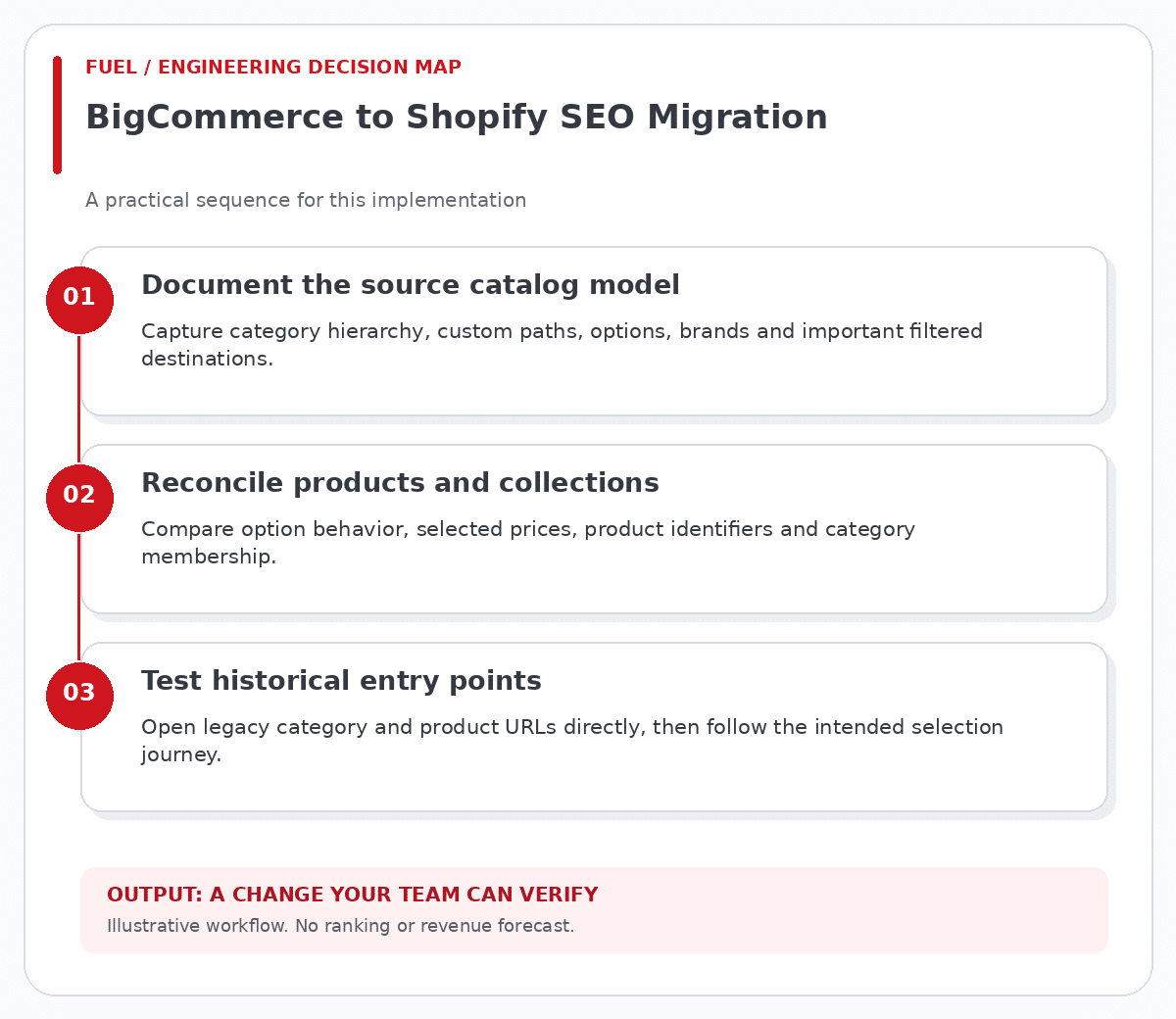
Use the worksheet to assign a representative URL, evidence, an implementation owner and an observed result for each step. It is a blank working template for this topic, not a completed client audit.

Qualified
organic traffic
Peel Appliance Repair, SEO + PPC engagement. Approx. two months. Client-reported on Clutch, February 2026. Baseline indexed to 100; not a forecast or a platform-specific result.
Read the client reviewPUT FUEL ENGINEERING TO WORK
Give your move an engineering plan before launch.
BIGCOMMERCE TO SHOPIFY SEO / ENGINEERING + EXECUTION
Work directly with digital marketing engineers who specialize in BigCommerce to Shopify SEO. Bring us your website and the outcome you need. We will discuss the constraints, the opportunities and the work required to move forward.
- Inventory custom category and product paths
- Reconcile options, variants and collections
- Preserve specifications and buying guidance
- Verify historical entry points and product selection
No sales team. Real strategists and engineers.
Share your URL, priorities and timing in the form below.
Prefer a conversation? 1-888-475-2552
Ratings checked September 2026. Read the independent profiles.