
AI SEO – AEO Course 10
What should generative engine optimization testing establish?
Generative engine optimization testing starts by reconstructing a claim’s intervention, outcome, denominator, comparison and uncertainty before acting on its headline. Then choose AI search experiments that can answer the decision you actually face. Separate absolute percentage-point change from relative change, preserve failed observations, and account for repeated prompts that share the same question or source. A precise calculation cannot rescue a design that measures the wrong outcome or confounds several interventions.

Start with a claim card. Record the exact assertion, original source, study date, tested system, eligible units, intervention, outcome definition, comparison and available artifacts. Add the strongest conclusion the design can support. If the original record cannot identify whether “visibility” means citations, mentions or recommendations, that ambiguity belongs in the finding rather than being filled with your preferred metric.
Distinguish three decisions. You may be deciding whether to repair an obvious factual defect, whether to test an uncertain optimization or whether to invest in a broad rollout. A factual correction can be justified by the error itself. An optimization claim needs evidence about an outcome. A rollout decision also needs effort, risk and business relevance. Treating every editorial improvement as a performance experiment creates unnecessary measurement work.
Keep useful hypotheses even when their supporting story is weak. A before-and-after example can suggest that a clearer comparison page deserves testing. It cannot establish that the page format caused the change. The practical response is to narrow the intervention and choose a design, rather than either accepting the claim wholesale or declaring that no useful action is possible.
The deliverable is a claim audit and a predeclared experiment plan with a primary outcome, analysis unit, collection rule, comparison and decision threshold. It should tell a colleague what would change your mind before the results arrive.
What does the historical GEO study actually support?
Read the original study rather than transferring a headline into current implementation advice. Aggarwal and colleagues' GEO paper evaluates bounded visibility interventions on two systems and states that methods may need adaptation as engines evolve. Source note: GEO: Generative Engine Optimization, version three, June 2024. It does not establish a universal current citation uplift for every website, prompt or product surface.
A reported maximum is not the expected effect for every deployment. Ask which intervention, domain, outcome and comparison produced the number. A visibility measure based on how source material appears in an answer is not automatically the probability that a website receives a link. An experiment in a constructed benchmark is not automatically a forecast of qualified inquiries from live search.
For AI search experiments, translate a research result into a bounded local hypothesis. Specify the change you can implement and the outcome you can observe. If a paper tests textual interventions under a fixed retrieval setup, do not claim that it proves the same change improves initial discovery, indexing or customer conversion. Those stages may require different evidence.
Inspect the limitations with the same care as the result. Historical model versions, selected query sets and accessible interfaces define the study's scope. A later system can change its retrieval and answer behavior. This does not make the earlier research worthless; it determines whether you should treat the finding as background, a candidate mechanism or evidence directly applicable to your decision.
Keep a source-to-claim note in the experiment record. Write which part of the paper supports your hypothesis and which part remains your own proposed extension. That note protects the public interpretation from expanding during a presentation. “A historical study motivates this test” is a defensible statement when “research proves this will increase our citations” is not.
When the missing input is a reusable evidence asset rather than an intervention estimate, use the original research design course.
Which outcomes belong in AI citation uplift measurement?
Define the outcome and eligible population
For AI citation uplift measurement, choose one primary outcome that corresponds to the intervention’s purpose. Citation presence asks whether an eligible answer links the specified destination or domain. Brand mention asks whether the brand is named. Suitable recommendation asks whether the offer is accurately recommended for the stated buyer. Answer accuracy asks whether decisive facts are correct. These measures can move independently.
Define the denominator before collection. A citation rate might be cited answers divided by eligible completed answers under a fixed question panel. An availability rate might be completed answers divided by planned attempts. If unavailable outputs are excluded from the conditional citation rate, preserve them in the availability record. Do not silently turn failed collection into a genuine answer with no citation, or drop inconvenient answers without the declared rule.
Choose the unit of inference as deliberately as the denominator. Ten questions observed ten times produce one hundred outputs, but the repeats within a question can share source conditions and behavior. Several questions may also belong to one buyer-task family. The treatment may be assigned to a page cluster rather than an individual response. Those relationships affect uncertainty and comparison.
In AI search experiments, retain identifiers for query family, exact prompt, page cluster, engine, date and run. Keep the complete answer and relevant citations where permitted. A flat spreadsheet containing only a success flag loses the structure needed to distinguish a repeated-prompt effect from a broad improvement across independent buyer tasks.
Define material accuracy failures alongside the primary outcome. An intervention that increases citations while stripping important exclusions may be unacceptable even if the primary rate improves. Treat accuracy as a guardrail with a clear rule. A commercial decision should not reward more frequent recommendations for buyers the offer cannot serve.
Separate availability, citation presence and accurate citations
Work an additional hypothetical denominator check before collection. Suppose one hundred attempts are planned, ten time out before an answer is captured, ninety return completed answers and twenty-seven completed answers contain the specified citation. Availability is ninety divided by one hundred, or 90%. Conditional citation presence is twenty-seven divided by ninety, or 30%. Citation presence per planned attempt is twenty-seven divided by one hundred, or 27%. All three can be useful, but they are different quantities. Report the label and count with each rate instead of choosing whichever percentage looks largest.
Now suppose six of those twenty-seven cited answers make a material qualification error under the predefined accuracy rubric. Simple citation presence remains twenty-seven of ninety completed answers. An accurate-citation outcome would count twenty-one of ninety, approximately 23.3%, if that combined definition was declared in advance. The accuracy finding should remain visible even when citation presence improves. Do not silently redefine the primary measure after seeing the errors, and do not classify a network timeout as a factual mistake in an answer that never arrived. This worksheet gives the analyst a concrete coding test: another person should recover the same availability, citation and accurate-citation counts from the raw records without guessing which cases were dropped. AI search experiments benefit from that data contract before they need a sophisticated model. Before launch, dry-run difficult records that include a timeout, a redirect citation and a materially unsupported answer. Resolve coding disagreements, version the rules and retain the test rows as a compact analysis fixture.
How do percentage points differ from relative citation uplift?
Use this hypothetical worksheet. Before an intervention, thirty of one hundred eligible treatment observations contain the defined citation. Afterward, forty-five of one hundred do. The observed rate rises from 30% to 45%. The absolute change is 45 minus 30, or fifteen percentage points. The relative change is fifteen divided by the original thirty, or 50%.
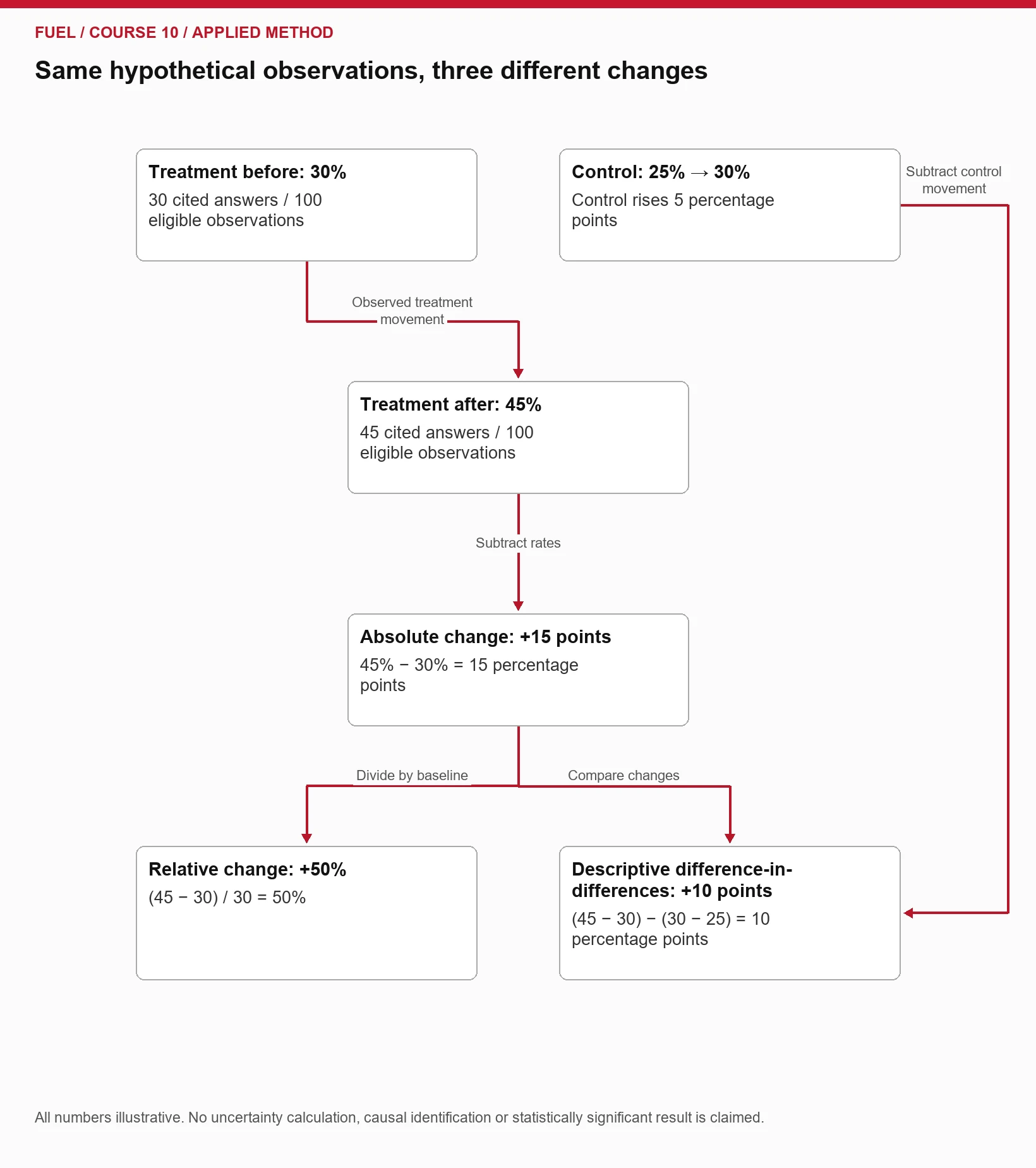
Both descriptions are arithmetically correct, but they answer different questions. “A 50% increase” can sound like a fifty-point gain if the baseline is omitted. Publish the before and after counts with the rate and name the calculation. A reader should be able to reproduce the result without guessing which denominator was used.
Now add a hypothetical unchanged comparison group. Its observed rate rises from 25% to 30%, a five-point increase. The descriptive difference in changes is fifteen minus five, or ten percentage points. This calculation is often called a difference-in-differences contrast. It does not become causal merely because a control column exists; the design and assumptions still matter.
For AI search experiments, inspect whether the comparison faced a plausible common environment and whether other changes could explain the difference. Topic demand, different source availability, unequal pretrends or a simultaneous product launch can weaken the interpretation. Random assignment can strengthen a suitable design, while an observational comparison needs explicit assumptions and limitations.
Keep numerical precision proportionate to the data. Reporting a ten-point descriptive difference as 10.0000 points adds no information. Reporting it as a guaranteed 50% citation improvement changes the claim entirely. The diagram separates the fifteen-point treatment movement, the fifty-percent relative movement and the ten-point controlled contrast so those numbers cannot be substituted for one another.
How should AEO statistical testing handle repeated prompts?
Repeated outputs are not independent buyer tasks
For AEO statistical testing, more outputs can improve precision only under an analysis that respects how the observations were generated. Repeating one favorable question one hundred times does not establish performance across one hundred independent buyer tasks. Keep the question structure in the analysis and inspect whether an apparent improvement is concentrated in one family.
For a simple planning illustration under independent Bernoulli observations, the standard error of a proportion is approximately sqrt[p × (1 − p) / n]. Near p equal to 0.5, one hundred independent observations give a standard error of about five percentage points. A normal-approximation 95% margin is roughly 1.96 times that value, or 9.8 points. Four hundred independent observations reduce that illustrative margin to about 4.9 points.
Those planning numbers are not a sample-size prescription for real AI search experiments. Dependence, sparse outcomes, selected questions and changing platforms can invalidate the simple approximation. Near zero or one, the basic normal interval can behave poorly. Choose an interval method and sampling assumptions that fit the actual design, and seek appropriate statistical review for consequential inference.
Interpret confidence and cluster uncertainty carefully
NIST explains confidence levels through repeated sampling performance of the interval method. Source note: NIST/SEMATECH e-Handbook, What are confidence intervals?, accessed October 2026. A computed frequentist interval is not a direct statement that the fixed parameter has a particular probability of lying inside that specific realized interval.
For a question-family design, one practical analysis option is resampling whole families while retaining their repeated runs and paired observations. That preserves more of the dependence structure than resampling each output independently. Its usefulness still depends on the number and selection of families. A handful of clusters cannot support a confident broad-market conclusion just because software produces narrow-looking output.
Which GEO experiment design addresses the real uncertainty?
In GEO experiment design, a repeated before-and-after observation is useful for a narrow operational check or an early hypothesis. It can describe movement under a saved question panel. Its limitation is confounding: platform changes, competing sources, seasonality or simultaneous site work can explain the difference. Use descriptive language unless the design supports a stronger inference.
A paired design compares the same defined questions across conditions or periods. It can reduce variation from question composition and reveal where changes concentrate. Its limitation is that pairing does not remove time effects or intervention spillover. If the underlying prompt changes, preserve the old item and treat the new version separately rather than pretending the pair remains identical.
Randomized page-cluster assignment can fit a content intervention when there are enough eligible groups and contamination is manageable. Define the clusters and their associated question families before assignment. Keep shared templates or sitewide changes outside the treatment when they would affect both arms. Record that questions can retrieve multiple pages, which can complicate attribution and dilute the contrast.
An interrupted time series can fit repeated observations around a clearly dated change when enough pre- and post-change data exist. It needs attention to trends, autocorrelation and concurrent events. A few observations on each side of a line do not establish a credible series analysis. The method should answer a decision that justifies its collection and modeling effort.
Choose AI search experiments by the uncertainty they resolve, not by the prestige of the method's name. A small controlled factual-accuracy test may be more actionable than a poorly powered randomized campaign. A complex design with no stable outcome definition is weaker than a modest transparent observation whose limitations are clear.
What should AI SEO experiment analysis predeclare?
Write the hypothesis in terms of a specified intervention and outcome. For example: making an existing service comparison's scope and exclusions explicit may change accurate citation presence for a fixed family of qualified buyer questions. State which pages change, which stay unchanged and which other work is excluded during the observation window where practical.
Declare eligibility and exclusions. Define which planned attempts count, what constitutes a completed answer, how unavailable features are handled and how citations to redirects or alternate destinations are normalized. Preserve raw records before normalization. An analyst should be able to inspect whether a coding decision changed the outcome.
AI SEO experiment analysis requires a declared analysis unit, primary estimate and uncertainty method. If the decision concerns performance across question families, do not substitute output count as the independent sample size. If the primary outcome is suitable recommendation, define the buyer-fit rubric and reviewer process. An automated exact-name match cannot decide whether a recommendation preserves a crucial limitation.
Predeclare the stopping rule. It can depend on a fixed collection period, a planned number of eligible units or a method designed for sequential monitoring. Repeatedly checking a conventional test and stopping at the first favorable result can distort error control. If collection must stop for cost or availability, report the deviation rather than rewriting the plan afterward.
A complete plan for AI search experiments also names guardrails, rollback conditions and ownership. A factual error, broken primary action or unintended visibility restriction can justify immediate repair independently of the performance test. Preserve the incident and mark its effect on interpretation. Operational responsibility should not be suspended to keep an experiment superficially clean.
Keep the question panel tied to distinct buyer tasks with AI search query mapping before selecting favorable measurement items.
When does a GEO result justify an agency rollout?
Define a practically meaningful improvement before interpreting a result. A tiny increase in a monitoring metric may not justify substantial implementation and maintenance. A modest accuracy improvement on a critical buying question may matter even when raw mention volume does not change. Connect the threshold to the decision, effort and possible loss rather than a universal significance label.
Use three decision states: proceed within scope, gather more evidence or reject the proposed rollout. Proceed when the estimate, uncertainty, guardrails and business value support the bounded action. Gather more evidence when the effect remains too uncertain or concentrated in a narrow case. Reject when the intervention fails the relevant outcome, creates factual harm or costs more than its plausible value under the stated assumptions.
Separate statistical uncertainty from design validity. A narrow interval around a biased estimate does not solve selection or confounding. A wide interval from a sound small study may honestly show that the decision remains unresolved. Explain both the precision of the estimate and the conditions under which it can be interpreted.
For promising AI search experiments, replicate across relevant conditions before converting the finding into a general playbook. Preserve the original outcome definition and explain changed systems, markets or page types. Replication that changes everything at once can still be exploratory, but it does not demonstrate stable transfer of the original effect.
Publish the finding with counts, conditions and limitations. Include null and adverse outcomes where they affect the decision. A credible internal learning record is more useful than a sequence of selected success screenshots. The test should improve the team's ability to choose the next action, not merely supply a promotional percentage.
When an agency cites a percentage improvement, ask for the original before-and-after counts, eligible attempts, unchanged comparison and exact change manifest. Confirm whether the claimed result is a citation, a supported recommendation, a visit or a business outcome. Ask which decision threshold was chosen before results and what adverse finding would stop expansion. A proposal that cannot identify those elements is not ready to justify a broad performance claim. You can still approve a clear factual repair independently, while requiring a better design for the uncertain optimization.
Can you audit an unsupported 50-percent citation headline?
Evaluate this hypothetical claim: “Our GEO method increases citations by 50%.” The supporting record is the treatment worksheet in this course: thirty cited answers before and forty-five after, each from one hundred eligible outputs. The unchanged comparison rises from twenty-five to thirty. The team also changed the prompt wording halfway through follow-up, and most gains appear in one buyer-question family.
First repair the arithmetic language. The treatment rate shows a fifteen-percentage-point increase and a fifty-percent relative increase from its baseline. The descriptive controlled contrast is ten points. None of those calculations establishes that the method caused the change. The headline omits baseline, comparison and scope.
Next identify design problems. Changed prompt wording weakens the before-and-after comparison. Concentration in one family limits evidence of broader transfer. Repeated outputs may not be independent. Other concurrent changes remain unknown. The correct audit does not average those problems into a confidence score and declare the result proven.
Write a bounded finding: in the invented observation set, the treatment citation rate rose from 30% to 45%, while the comparison rose from 25% to 30%; prompt changes and family concentration prevent a clean causal interpretation. That statement preserves the useful observation without converting it into a universal promise.
Propose the next test. Freeze the question versions, retain family identifiers, define accurate citation presence, select suitable page clusters and predeclare the estimate, exclusions and stopping rule. A strong submission explains which uncertainty the new design resolves and which limitations remain. That is how AI search experiments turn a persuasive headline into a defensible operational decision.
Source and statistical notes
Aggarwal and colleagues, GEO: Generative Engine Optimization, version three, June 2024. NIST/SEMATECH e-Handbook, What are confidence intervals? and Choosing an experimental design: objectives. Accessed October 25, 2026. All numerical worksheets are hypothetical. Independent-Bernoulli precision calculations are planning illustrations, not a sample-size guarantee.
Design a bounded evaluation
Discuss the decision, evidence and measurement constraints with Fuel Online to scope an AEO and AI SEO evaluation.
Explore the AI SEO and AEO course curriculum.
Discuss AI SEO and AEO implementation with Fuel Online.