
FUEL ONLINE / Podiatry Marketing / PPC & Google Ads
Podiatry PPC and Google Ads Agency

Someone seeking routine podiatry care and someone researching a procedure need different answers, yet both must find the right provider, location and appointment path. As your podiatry PPC agency, Fuel Online helps podiatry owners, practice administrators and marketing directors separate paid campaigns for routine foot care, sports or injury evaluation, diabetic foot services and offered procedures and align search terms, negatives, geography, schedules and landing pages with provider schedules, new-patient openings, procedure availability and callback coverage. Budget decisions follow accepted and completed work instead of clicks, calls or forms alone.
Practice location, appointment preference and contact information. Clinical triage and health details belong in approved practice systems.
AGGRESSIVE FROM THE START
One month. The work many agencies stretch across three.
Our mandate: move faster, go deeper and put experienced specialists to work immediately.
Fuel attacks the work in parallel: site audits, technical errors, new content, internal links, backlink outreach and conversion improvements. Your agreed scope determines the channels; urgent fixes do not wait behind a drawn-out planning phase.
The podiatry PPC agency brief identifies visibility and lead barriers. Actionable fixes move into production while deeper analysis continues.
Your Google Ads for podiatry practices work runs alongside industry-specific content, relevant links and earned-authority outreach, based on your agreed scope.
The podiatry paid search review shows completed work, lead quality and the next opportunities. You see who owns each action.
Fast execution is the operating standard. Access, approvals and scope shape delivery; search and revenue results have their own timelines.
Podiatry PPC agency for real buyer decisions
Paid search can reach a podiatry practice buyer at the moment of need, but intent must be separated before bids rise. A patient seeking routine care needs location and appointment clarity; someone researching a procedure needs reviewed information about evaluation, provider fit and the next clinical step. Campaigns, ads and landing pages should diverge when urgency, economics, geography or the receiving workflow changes.
The initial exclusion plan covers online diagnosis, treatment guarantees, detailed health information in marketing tools and insurance statements the practice has not approved. Fuel Online reviews real search terms with accepted and rejected outcomes, then adjusts match types, negatives, locations, schedules and message before expanding spend. For the owner or marketing lead, choosing a podiatry PPC agency means making this buyer distinction visible before contact.
Google Ads for podiatry practices deliverables you can inspect
The paid-search package includes a campaign map, keyword and negative logic, geographic and schedule settings, ad-to-page matrix, budget rules, conversion definitions and an accepted-outcome import plan. Landing pages explain the offered service, boundaries, proof and next step without hiding essential fit questions.
Implementation validates tracking and routing first, launches a bounded high-intent segment second, and reconciles search terms with preferred location, nonclinical reason for the appointment, contact preference, timing and scheduling outcome third. Budget changes follow valid appointment requests, booked visits, attended appointments, and source quality and current provider schedules, new-patient openings, procedure availability and callback coverage, not click-through rate or form count alone. A Google Ads for podiatry practices scope is inspectable when the owner, dependency and release check are named.
- Campaign and landing-page map separating "podiatrist for heel pain [city]" from "diabetic foot care clinic [city]".
- The plan for Google Ads for podiatry practices includes search-term, negative, location, schedule and budget rules tied to provider schedules, new-patient openings, procedure availability and callback coverage.
- Use podiatry paid search reporting to document feedback connecting spend to accepted, rejected and completed work.
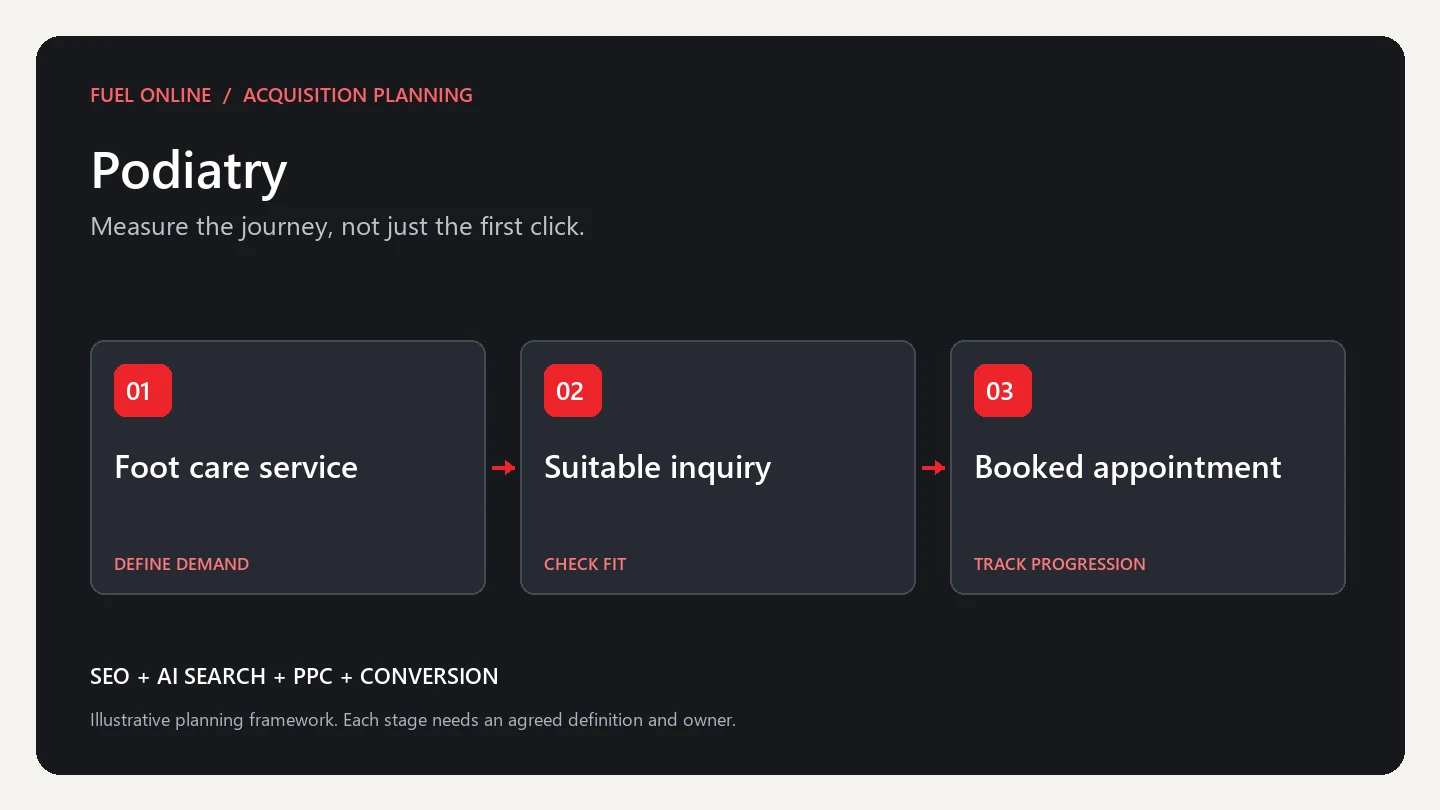
Illustrative podiatry paid search decision path
Illustrative example, not a client result: compare a new patient seeking an appointment for persistent heel pain with a caregiver comparing diabetic foot-care access by location.
Compare the search term, ad promise, landing page and receiving result for each buyer, with explicit checks for location, offered care, provider availability, reviewed health information and the appointment path. A podiatry PPC agency should exclude demand the team cannot serve before increasing spend. Google Ads for podiatry practices should lead to a page and action that match the query, while podiatry paid search reporting should connect cost to accepted work rather than raw contacts.
Classify the demand
Compare the illustrative queries "podiatrist for heel pain [city]" and "diabetic foot care clinic [city]". Confirm that each describes work you offer in a market and time frame your team can support. The phrases are examples, not measured-volume claims.
Build the appropriate path
For podiatry practice PPC and Google Ads, place the searches in separate campaigns with different schedules, negatives, landing pages and feedback. Use verified clinician credentials, accurate locations, reviewed care-pathway explanations and approved appointment or insurance guidance only when your organization can verify and approve it.
Record the commercial outcome
Retain the source, chosen path and receiving decision. Record why an inquiry advanced or stopped so the next change responds to actual fit instead of increasing activity blindly.
A podiatry PPC agency diagnostic for podiatry paid search: symptom to decision
Use this framework when new-patient inquiries arrive, but the practice cannot tell which location, provider or offered service the visitor expected. The podiatry diagnostic turns that concern into an inspection the owner, marketing lead and receiving team can review together.
Trace the visible podiatry buyer path against current operating capacity. The review should end with one bounded change, its owner and the evidence needed to keep, correct or stop it.
- Ask your podiatry PPC agency to document the problem and its business impact.
- Use Google Ads for podiatry practices to connect the source or campaign to the response record.
- Use podiatry paid search to state the bounded change and the evidence for the next decision.
Name the observable symptom
For podiatry PPC and Google Ads, the warning sign is that platform conversions rise while search terms and calls reveal work the team cannot accept. Record one recent example and the business consequence rather than starting with a channel-wide assumption.
Inspect the path
Review location preference, nonclinical appointment reason, scheduling disposition, new-patient availability and attended-visit outcome. For the PPC and Google Ads layer, inspect the query, match type, negative coverage, location, schedule, ad, landing page, call or form disposition and spend. Keep the source, promise, handoff and disposition together so the failure point is visible.
Make a bounded decision
The industry rule is to separate routine care, injury, diabetic foot and procedure information when the provider, location or appointment process changes. For this PPC and Google Ads decision, exclude the invalid pattern or split the campaign when urgency, economics, geography or the receiving workflow changes. Name the owner, dependency and release check before implementation.
Require an inspectable output
The output is a campaign and negative-keyword map, landing-page correction, tracking check and accepted-outcome feedback view. It should show what changed, why it changed and what receiving outcome will determine whether the team keeps, corrects, expands or pauses the work.
Measurement standards for podiatry PPC agency and Google Ads for podiatry practices
For podiatry practice PPC and Google Ads, impressions, click-through rate, search terms and platform conversions help explain what changed, but they do not establish commercial value alone. The shared scorecard follows valid appointment requests, booked visits, attended appointments, and source quality and segments them by service, location, buyer path and source where the organization can do so responsibly.
The review also examines provider schedules, new-patient openings, procedure availability and callback coverage. Reporting should record attribution gaps, offline outcomes and why podiatry inquiries were declined. Each review should close with a decision to keep, correct, expand, pause or investigate a specific page, campaign, answer or handoff.
How to compare providers of podiatry paid search and Google Ads for podiatry practices
Ask who reviews search terms, negatives and accepted outcomes, and how budgets respond to capacity. Before selecting a podiatry PPC agency, require the proposal to name the first deliverables, working team, required access, client inputs, review cadence and dependencies. It should state which podiatry practice evidence the organization must substantiate and who approves it.
Request a sample decision log that shows what changed after an accepted or rejected inquiry. Confirm account, content and data ownership. Reject a provider that ignores agreed service or territory exclusions, promises a guaranteed outcome or cannot explain the next concrete decision.
When reviewing podiatry paid search, ask the provider to show the first decision it would make from one current buyer path and the evidence required to make it.
A decision log for podiatry paid search should connect one released change to the reason an inquiry advanced or stopped.
How we measure podiatry PPC agency
- valid appointment requests
- booked visits
- attended appointments
- source quality
Use a cost metric that reflects qualified demand
Cost per qualified inquiry = campaign spend ÷ inquiries meeting the agreed criteria.
Define the included spend, reporting window and qualification rules before comparing campaigns. Track raw leads separately so cheaper but unsuitable inquiries do not make performance look better.
Agree on the baseline, data source and qualification criteria before comparing results. Separate visibility from inquiries and accepted business opportunities.
CONNECTED SERVICES
Choose the right next step for your business
Explore Fuel’s PPC & Google Ads capabilities, published campaign work and team to evaluate how we would support your organization.
BEFORE YOU CHOOSE AN AGENCY
Questions about podiatry PPC agency
What should a podiatry PPC agency engagement include?
Expect campaign and landing-page structure, negatives, location and schedule rules, tracking validation and accepted-outcome feedback for routine foot care, sports or injury evaluation, diabetic foot services and offered procedures. The proposal should identify owners, dependencies, implementation access and the evidence the podiatry team must approve. It should also explain how changes in provider schedules, new-patient openings, procedure availability and callback coverage affect priorities. Use the release checklist to verify completed work and whether the intended buyer reached the correct handoff.
How should Google Ads for podiatry practices be phased?
For Google Ads for podiatry practices, the first useful milestone is validated tracking plus one bounded campaign and landing-page path with search-term review. Delivery speed depends on access, approvals and provider schedules, new-patient openings, procedure availability and callback coverage. Set release checks and review dates before implementation begins. Assess released work first, early response second and downstream business movement only after enough demand and operating time exist to interpret it. Phase Google Ads for podiatry practices around one released buyer path, its acceptance check and the next evidence-based decision.
What does our team provide for podiatry paid search?
For podiatry paid search, bring current service and location facts, examples of suitable and unsuitable inquiries, current capacity constraints and access needed for PPC and Google Ads. Name the reviewer who can approve podiatry service details, media and evidence. Health details remain in the practice or clinic approved system. Share only the fields needed to make marketing and handoff decisions.
How do we compare firms offering podiatry PPC agency services?
Ask the agency to explain how it would handle a new patient seeking an appointment for persistent heel pain differently from a caregiver comparing diabetic foot-care access by location. Its answer should connect one podiatry page, campaign, source or routing change to the required input and receiving outcome. Confirm account and data ownership. When evaluating providers, treat generic activity lists, invented proof and reports that count every inquiry equally as warning signs. Ask what Google Ads for podiatry practices will deliver first and how podiatry paid search will change after an accepted or rejected inquiry.
Make your next agency conversation specific.
Bring the podiatry services, locations and scheduling gaps creating the most friction. Fuel Online can turn those inputs into a search-term, landing-page and budget decision sheet through a focused podiatry PPC agency engagement, with the first owner, release check and success signal clearly named.
Talk with a Fuel strategist →