
FUEL ONLINE / Podiatry Marketing / Lead generation
Podiatry Lead Generation and Conversion Agency

Someone seeking routine podiatry care and someone researching a procedure need different answers, yet both must find the right provider, location and appointment path. As your podiatry lead generation agency, Fuel Online helps podiatry owners, practice administrators and marketing directors define acceptance, form and call fields, routing ownership and response expectations for routine foot care, sports or injury evaluation, diabetic foot services and offered procedures. The feedback loop preserves rejection reasons and exposes failed handoffs, so conversion work improves opportunity quality instead of adding unclassified contacts.
Practice location, appointment preference and contact information. Clinical triage and health details belong in approved practice systems.
Make podiatry inquiries preserve the purpose a person actually states
Fuel Online helps podiatry practices make appointment-inquiry journeys clearer from the public invitation to the receiving record. Compare a podiatry lead generation agency through the administrative usefulness of that connection. Routine-care interest, a procedure question and a returning-contact message may need different orientation. The practice defines its actual process. The agency should preserve the sender's stated purpose without turning a field selection into eligibility, an appointment arrangement or a conclusion about the care an individual needs.
Name the first event before choosing qualification fields
Read the invitation, button, fields, confirmation and receiving record as one explanation. Ask what the initial action establishes in ordinary language. A request for contact has a different meaning from a booked appointment. The practice supplies the administrative next step it supports. The agency should keep the confirmation consistent with that step instead of strengthening its wording because a more definite message seems reassuring. A clear initial event makes both implementation and reporting easier to compare.
For each field, ask which receiving task it supports, who uses the value and how it appears. The practice decides which information belongs at first contact and which is handled later through its professional process. More required values do not necessarily create a more useful request. A field dictionary should connect the public label, stored representation and administrative purpose, giving the buyer something more concrete than an assurance that a longer form will improve lead quality.
A stated procedure interest can provide orientation without determining a person's next clinical step. Ask how that value is described publicly and interpreted by the receiver. A routine-care label also remains the sender's statement rather than a professional conclusion. The useful design preserves the difference. This allows an agency to improve the administrative route without inventing screening rules or asking a marketing form to answer questions that belong within the practice's own process.
| Inquiry case | Meaning to retain | Receiving evidence |
|---|---|---|
| Routine-care interest | Sender-stated administrative purpose. | Field value stays distinct from a professional conclusion. |
| Procedure question | Information interest rather than confirmed arrangement. | Invitation, confirmation and record describe the same event. |
| Correction | Supported relationship with an earlier request. | Receiver recognizes changed detail and linkage limit. |
| Repeated interaction | Documented event-counting rule. | Requests remain distinct from events and later appointments. |
Preserve uncertainty and continuing contacts
Use a fictional person who wants contact but is unsure which supplied label fits their question. Ask how the supported route preserves that uncertainty alongside useful stated context. A forced confident answer can make a record appear complete while obscuring what the person actually knows. The practice should inspect the proposed label or explanation and its received value. This is a concrete design choice that can be compared without assuming a larger questionnaire is the appropriate remedy.
Now introduce a correction to an administrative detail. Ask how the actual proposed configuration relates the later message to the earlier request. It may support an automatic connection, require employee review or leave separate records. The agency should describe the available relationship honestly. The buyer can compare continuity work with a proposal that merely creates another notification and event count, without requiring every interaction to be matched perfectly to make the test useful.
A returning person may reach a destination designed for new inquiries. Ask how they identify the practice's established continuing-contact route where one is supported. Use the actual arrangements supplied by the practice. The destination should not invent another service operation or infer a professional response from a procedure word. Where the records support it, the continuing purpose should remain distinguishable from newly acquired demand instead of being relabeled because a campaign destination was involved.
Inspect the receiving interpretation
Complete a fictional routine-care inquiry from the relevant source resource. Ask the receiver what was requested, which office or contact preferences were stated and what administrative role continues the process. Compare that interpretation with the original test sheet and public confirmation. A missing context value or misleading label identifies a specific repair. The test is more informative than a technical event alone because it checks whether the intended conversation remains understandable after the public action.
Repeat the exercise for a procedure-information inquiry using only fictional administrative details. The record should preserve the sender's stated interest without making it a confirmed arrangement. Ask which part the agency configures and which follows the practice's existing procedure. A destination-only engagement differs from one that also completes the receiving connection. The commercial scope should identify the actual work and the evidence required to accept the finished path.
Where the practice supports different communication methods, test each included route and explain what its record establishes. A call signal and submitted form may preserve different context. The report should retain those limits rather than treat every observed interaction as an equivalent request. This helps the practice understand the implementation without an unsupported universal accessibility or response promise and gives the receiving team a vocabulary for interpreting the evidence available.
Define reporting units before evaluating conversion cost
Separate interaction events, identifiable requests and later appointment stages where recorded. Ask for a fictional example behind each proposed total and the rule for repeated contacts. A source label may explain how someone arrived without explaining their needs or later care. The useful report shows what can be connected with practice records and what remains unknown. This makes a cost discussion more meaningful than comparing a headline number built from an unclear denominator.
Use an example set with an initial request, corrected contact detail and continuing-contact message. Ask which totals each contributes to and which relationship can actually be established. The agency should explain the counting rule in ordinary language before displaying a rate. A clearer denominator may be more useful than another tracking event. The exercise also reveals which additional configuration would improve interpretation and which limit belongs to the available information rather than an incomplete dashboard.
Implementation ownership belongs at the receiving boundary. The agency may manage the public destination while another supplier controls notifications or the administrative system. Ask what each changes and which completed connection is checked. A prepared form draft is different from a tested public-to-receiver path. Comparing those states helps the practice understand the remaining work and avoids assuming that similarly named conversion packages include the same responsibility for final implementation.
At handover, retain the action definition, field dictionary, supported route map and fictional cases with their owners. Ask an unfamiliar employee to repeat one new inquiry and one correction. They should identify the record and explain its stated meaning without private project knowledge. If the materials do not support that task, clarify the specific gap. The practice then has a reusable baseline for later changes rather than a collection of notifications whose relationship with real conversations must be reconstructed.
For a final acceptance exercise, let the receiver interpret a test record before seeing the public destination. Compare the interpretation with the sender's stated purpose. Any difference identifies a particular label, source value or explanation needing attention. Retain the before-and-after interpretations with the field dictionary. This gives future form changes a reproducible meaning test and lets ongoing conversion work address an inspected gap instead of adding fields or rebuilding destinations automatically at each production cycle.
Compare dedicated and shared request routes with the same inquiry
For a final design exercise, follow one fictional inquiry through a destination-specific form and a shared administrative route. Ask what context each version retains from the source resource and what the receiver must infer. A dedicated form may need a clear explanation of its narrower purpose, while a shared route may need a recognizable source value. The practice can choose between them through its actual receiving needs rather than a universal preference for one form format.
Give the receiver the two resulting examples without identifying which design produced them. Ask what each person requested and which next administrative role applies. Compare the interpretations with the test sheet. A useful preference follows from preserved meaning, not simply a shorter page or a more complete-looking record. Retain the accepted representation and explanation as the baseline for later implementation changes.
This paired test also clarifies scope when another supplier owns the receiving system. The agency can specify the required representation and demonstrate the public side, but final acceptance should identify the completed receiving evidence. The practice then knows what remains outstanding and can compare a configuration engagement with a documentation-only contribution without treating them as equivalent completed journeys.
If inconsistent expectations begin before the request, coordinated podiatry marketing can align the introduction and its destination.
AGGRESSIVE FROM THE START
One month. The work many agencies stretch across three.
Our mandate: move faster, go deeper and put experienced specialists to work immediately.
Fuel attacks the work in parallel: site audits, technical errors, new content, internal links, backlink outreach and conversion improvements. Your agreed scope determines the channels; urgent fixes do not wait behind a drawn-out planning phase.
The podiatry lead generation agency brief identifies visibility and lead barriers. Actionable fixes move into production while deeper analysis continues.
Your lead generation for podiatry practices work runs alongside industry-specific content, relevant links and earned-authority outreach, based on your agreed scope.
The podiatry conversion services review shows completed work, lead quality and the next opportunities. You see who owns each action.
Fast execution is the operating standard. Access, approvals and scope shape delivery; search and revenue results have their own timelines.
Podiatry lead generation agency for real buyer decisions
A lead is commercially useful only when the receiving team can assess and act on it. For a podiatry practice, the acceptance definition must reflect the actual buyer difference. A patient seeking routine care needs location and appointment clarity; someone researching a procedure needs reviewed information about evaluation, provider fit and the next clinical step. It also covers duplicate, current-customer, out-of-area and capacity rules.
Fuel Online uses that definition to shape pages, calls to action, forms and phone scripts. The process avoids online diagnosis, treatment guarantees, detailed health information in marketing tools and insurance statements the practice has not approved and makes the promised next step match what the team can actually deliver. For the owner or marketing lead, choosing a podiatry lead generation agency means making this buyer distinction visible before contact.
Lead generation for podiatry practices deliverables you can inspect
The engagement produces a qualification matrix, form and call-flow specification, routing map, response expectations, CRM or operating dispositions, missed-contact process and weekly feedback view. The handoff retains preferred location, nonclinical reason for the appointment, contact preference, timing and scheduling outcome.
Implementation begins with one priority conversion path. Fuel Online tests ownership and fallback routing, confirms that accepted and declined outcomes can be recorded, and then reviews friction in the page, form and first response. Expansion follows valid appointment requests, booked visits, attended appointments, and source quality, not a lower form cost in isolation. A lead generation for podiatry practices scope is inspectable when the owner, dependency and release check are named.
- Written acceptance and rejection rules for routine foot care, sports or injury evaluation, diabetic foot services and offered procedures.
- The plan for lead generation for podiatry practices includes form, call, routing and missed-contact specification with named owners.
- Use podiatry conversion services reporting to document disposition view connecting sources to handled opportunities.
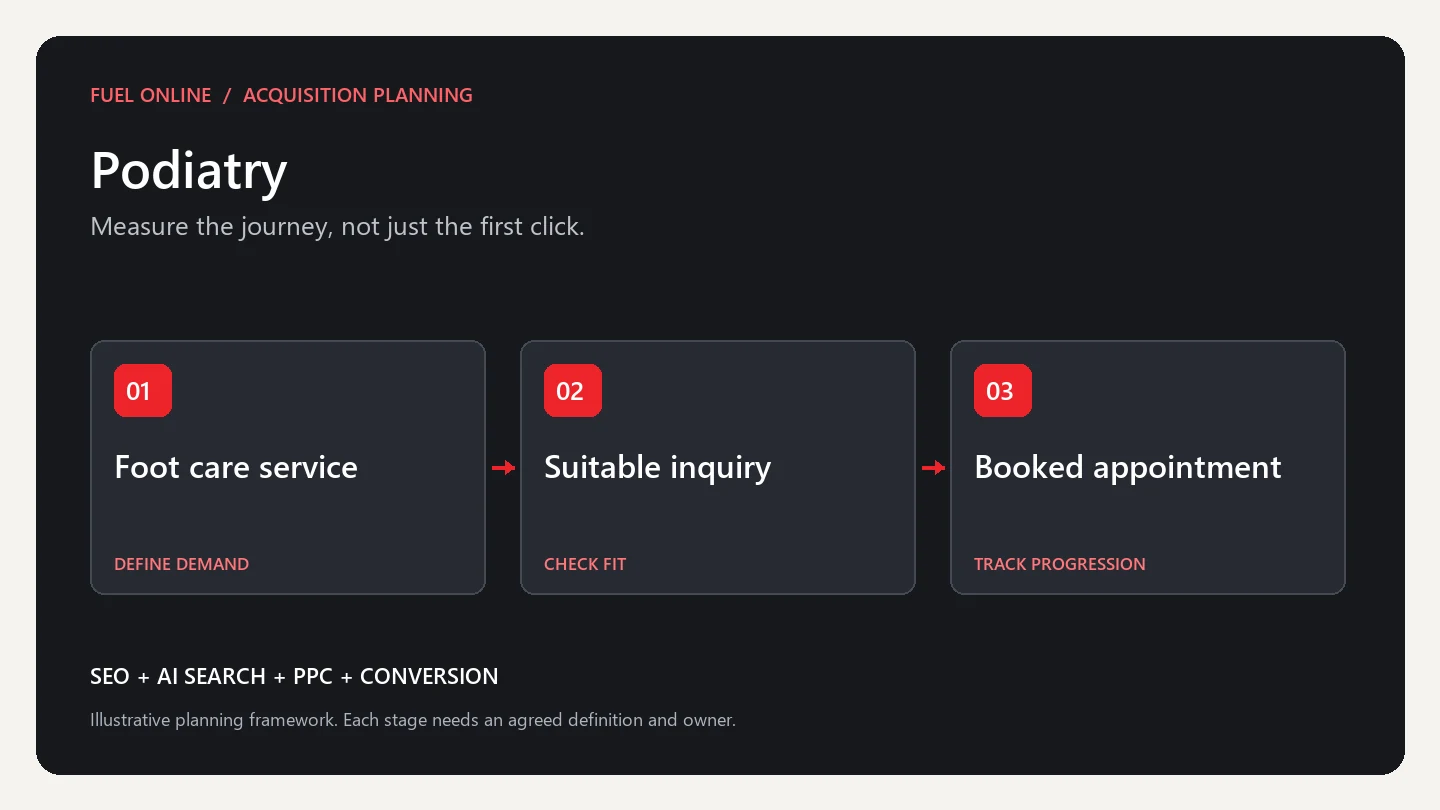
Illustrative podiatry conversion services decision path
Illustrative example, not a client result: compare a new patient seeking an appointment for persistent heel pain with a caregiver comparing diabetic foot-care access by location.
Trace each contact from form or call through qualification, routing and final disposition, using location, offered care, provider availability, reviewed health information and the appointment path to explain why it advanced or stopped. A podiatry lead generation agency should make those differences visible to the receiving team. Use lead generation for podiatry practices to focus on inquiries the team can assess. The plan for podiatry conversion services should feed rejected-contact reasons back into fields, routing and follow-up.
Classify the demand
Compare the illustrative queries "podiatrist for heel pain [city]" and "diabetic foot care clinic [city]". Confirm that each describes work you offer in a market and time frame your team can support. The phrases are examples, not measured-volume claims.
Build the appropriate path
For podiatry practice lead generation, preserve different fit signals, owners and response expectations in the form and call flow. Use verified clinician credentials, accurate locations, reviewed care-pathway explanations and approved appointment or insurance guidance only when your organization can verify and approve it.
Record the commercial outcome
Retain the source, chosen path and receiving decision. Record why an inquiry advanced or stopped so the next change responds to actual fit instead of increasing activity blindly.
A podiatry lead generation agency diagnostic for podiatry conversion services: symptom to decision
Use this framework when new-patient inquiries arrive, but the practice cannot tell which location, provider or offered service the visitor expected. The podiatry diagnostic turns that concern into an inspection the owner, marketing lead and receiving team can review together.
Trace the visible podiatry buyer path against current operating capacity. The review should end with one bounded change, its owner and the evidence needed to keep, correct or stop it.
- Ask your podiatry lead generation agency to document the problem and its business impact.
- Use lead generation for podiatry practices to connect the source or campaign to the response record.
- Use podiatry conversion services to state the bounded change and the evidence for the next decision.
Name the observable symptom
For podiatry lead generation, the warning sign is that forms and calls arrive, but missing context or unclear ownership prevents a timely acceptance decision. Record one recent example and the business consequence rather than starting with a channel-wide assumption.
Inspect the path
Review location preference, nonclinical appointment reason, scheduling disposition, new-patient availability and attended-visit outcome. For the lead generation layer, inspect the source, page, captured fields, consent, route, response time, duplicate status, disposition and rejection reason. Keep the source, promise, handoff and disposition together so the failure point is visible.
Make a bounded decision
The industry rule is to separate routine care, injury, diabetic foot and procedure information when the provider, location or appointment process changes. For this lead generation decision, repair one priority handoff, assign a fallback owner and confirm the receiving system can record accepted and rejected outcomes. Name the owner, dependency and release check before implementation.
Require an inspectable output
The output is an acceptance matrix, form and call specification, routing diagram, disposition list and missed-contact process. It should show what changed, why it changed and what receiving outcome will determine whether the team keeps, corrects, expands or pauses the work.
Measurement standards for podiatry lead generation agency and lead generation for podiatry practices
For podiatry practice lead generation, form completion, call volume, response time and contact rate help explain what changed, but they do not establish commercial value alone. The shared scorecard follows valid appointment requests, booked visits, attended appointments, and source quality and segments them by service, location, buyer path and source where the organization can do so responsibly.
The review also examines provider schedules, new-patient openings, procedure availability and callback coverage. Reporting should record attribution gaps, offline outcomes and why podiatry inquiries were declined. Each review should close with a decision to keep, correct, expand, pause or investigate a specific page, campaign, answer or handoff. Measurement for podiatry conversion services should distinguish channel response from accepted business.
How to compare providers of podiatry conversion services and lead generation for podiatry practices
Ask who owns routing, missed contacts, dispositions and the weekly quality feedback loop. Before selecting a podiatry lead generation agency, require the proposal to name the first deliverables, working team, required access, client inputs, review cadence and dependencies. It should state which podiatry practice evidence the organization must substantiate and who approves it.
Request a sample decision log that shows what changed after an accepted or rejected inquiry. Confirm account, content and data ownership. Reject a provider that ignores agreed service or territory exclusions, promises a guaranteed outcome or cannot explain the next concrete decision.
When reviewing podiatry conversion services, ask the provider to show the first decision it would make from one current buyer path and the evidence required to make it.
A decision log for podiatry conversion services should connect one released change to the reason an inquiry advanced or stopped.
How we measure podiatry lead generation agency
- valid appointment requests
- booked visits
- attended appointments
- source quality
Find the drop between interest and a useful next step
Next-step completion rate = qualified inquiries completing the agreed next step ÷ qualified inquiries reviewed.
Illustrative arithmetic: 15 completed appointments from 25 qualified inquiries is 60%. Use the next step that fits your business, such as a consultation, estimate or discovery meeting, and record the time allowed for completion.
Agree on the baseline, data source and qualification criteria before comparing results. Separate visibility from inquiries and accepted business opportunities.
CONNECTED SERVICES
Choose the right next step for your business
Explore Fuel’s Lead generation capabilities, published campaign work and team to evaluate how we would support your organization.
BEFORE YOU CHOOSE AN AGENCY
Questions about podiatry lead generation agency
What should a podiatry lead generation agency engagement include?
Expect written acceptance rules, form and call requirements, routing ownership, missed-contact handling and a disposition view for routine foot care, sports or injury evaluation, diabetic foot services and offered procedures. The proposal should identify owners, dependencies, implementation access and the evidence the podiatry team must approve. It should also explain how changes in provider schedules, new-patient openings, procedure availability and callback coverage affect priorities. Use the release checklist to verify completed work and whether the intended buyer reached the correct handoff.
How should lead generation for podiatry practices be phased?
For lead generation for podiatry practices, the first useful milestone is an acceptance definition and one tested form or call path with working ownership and dispositions. Delivery speed depends on access, approvals and provider schedules, new-patient openings, procedure availability and callback coverage. Set release checks and review dates before implementation begins. Assess released work first, early response second and downstream business movement only after enough demand and operating time exist to interpret it. Phase lead generation for podiatry practices around one released buyer path, its acceptance check and the next evidence-based decision.
What does our team provide for podiatry conversion services?
For podiatry conversion services, bring current service and location facts, examples of suitable and unsuitable inquiries, current capacity constraints and access needed for lead generation. Name the reviewer who can approve podiatry service details, media and evidence. Health details remain in the practice or clinic approved system. Share only the fields needed to make marketing and handoff decisions.
How do we compare firms offering podiatry lead generation agency services?
Ask the agency to explain how it would handle a new patient seeking an appointment for persistent heel pain differently from a caregiver comparing diabetic foot-care access by location. Its answer should connect one podiatry page, campaign, source or routing change to the required input and receiving outcome. Confirm account and data ownership. When evaluating providers, treat generic activity lists, invented proof and reports that count every inquiry equally as warning signs. Ask what lead generation for podiatry practices will deliver first and how podiatry conversion services will change after an accepted or rejected inquiry.
Make your next agency conversation specific.
Bring the podiatry services, locations and scheduling gaps creating the most friction. Fuel Online can turn those inputs into a qualification, routing and disposition improvement plan through a focused podiatry lead generation agency engagement, with the first owner, release check and success signal clearly named.
Talk with a Fuel strategist →