
FUEL ONLINE / Podiatry Marketing / Digital marketing
Podiatry Digital Marketing Agency

Someone seeking routine podiatry care and someone researching a procedure need different answers, yet both must find the right provider, location and appointment path. As your podiatry digital marketing agency, Fuel Online helps podiatry owners, practice administrators and marketing directors align the website, local profiles, paid campaigns and follow-up with routine foot care, sports or injury evaluation, diabetic foot services and offered procedures and current provider schedules, new-patient openings, procedure availability and callback coverage. Reporting shows which channel and page combinations produce accepted demand rather than activity alone.
Practice location, appointment preference and contact information. Clinical triage and health details belong in approved practice systems.
Choose podiatry marketing through a routine-care release and a research release
Fuel Online connects podiatry marketing channels with reviewed practice information and supported appointment-request arrangements. Compare a podiatry digital marketing agency through two concrete release briefs: one for routine-care discovery and one for procedure research. Each should explain its reader, maintained sources, destination and administrative action. This gives practice leaders a useful way to compare implementation before accepting a broad package whose search, advertising and content components may otherwise have no clear relationship with one another.
Give each journey a purpose before selecting formats
Start with the routine-care question the practice wants to support. Ask what a new reader needs to learn about the offered service, relevant office and contact process. The agency should identify the useful material already present and the particular gap needing work. A clearer introduction may be enough for an initial release. The proposal should explain why the chosen message and destination serve this task rather than begin with a fixed count of posts, advertisements and landing pages.
A procedure-research journey needs its own orientation. The practice supplies the professional explanation it wishes to publish. Ask how a shorter introduction preserves that resource's meaning and how the reader reaches fuller context. The destination may support understanding before an administrative inquiry is appropriate. The agency should show what the public action means, keeping research interest distinct from a confirmed arrangement or individual decision. This gives the practice a specific creative and implementation comparison.
The two journeys may share facts without using identical invitations. Ask which professional and office resources support each brief and which relationships the practice has actually supplied. A generic practice introduction repeated everywhere may obscure the different reader tasks. The agency can explain which material is reused, which orientation changes and why. Retain those decisions so that a future shorter format does not accidentally broaden the original statement while adapting the same source.
| Release | Different purpose | Evidence to compare |
|---|---|---|
| Routine-care discovery | Recognize an offered service and supported administrative path. | Source-linked introduction and received request interpretation. |
| Procedure research | Find professionally supplied context before the next public action. | Reader interpretation compared with the full explanation. |
| Returning contact | Find the established continuing-conversation route. | Stated purpose retained where records support it. |
| Provider update | Maintain the affected public source relationships. | Specific messages and saved destinations identified. |
Compare reuse with a genuinely useful new destination
Give finalists the same routine-service explanation and current office information. Ask for the proposed initial message and arrival resource. If a new destination is recommended, identify what it contributes beyond the maintained page and which facts it must continue to share. If the existing resource is retained, show the specific improvement. Both choices can be useful when their contribution is clear. The commercial comparison should include the maintenance work created by a separate public summary.
Repeat the exercise with the procedure-research brief. Ask the agency to show the professionally supplied context behind the introduction and the destination carrying its fuller meaning. A different image or audience label does not by itself establish a different journey. The useful release card explains the information task, public action and receiving interpretation. This makes the proposed production effort comparable with assets the practice already maintains instead of relying on a general promise of integrated growth.
Implementation ownership should be explicit. Another supplier may control the website, appointment-request connection or receiving representation. Ask what the agency produces directly and what it provides for another implementer. A ready draft, published destination and completed receiving test are different delivery states. A useful plan names the remaining dependency and acceptance evidence, allowing the practice to coordinate the work without confusing prepared creative with a complete operational journey.
Rehearse the release from message to reception
Use fictional administrative details to follow the routine-care release. Reach the explanation, complete the supported action and inspect the resulting record. Ask the receiver to state what the person requested and which context survived. Compare that interpretation with the invitation and confirmation. A lost office preference or unclear action meaning identifies a bounded repair. It does not establish that every channel needs replacement or that a larger form is the right response.
For the procedure-research path, ask an unfamiliar reviewer what the destination establishes before taking the public action. Compare their interpretation with the supplied source. The agency should retain the difference between learning about a published offering and arranging a specific next step. A useful adaptation can help the reader navigate more clearly without adding a stronger promise. Record the source passage and accepted interpretation as a practical example for later campaign formats.
Returning people can arrive through either release. Ask how they identify the practice's established continuing-contact route where one is supported. The agency should use the actual arrangements supplied rather than invent another service operation. Where the records support it, reporting should preserve that continuing purpose. A useful administrative interaction need not have the same acquisition meaning as a new inquiry, even when the person reached it through a campaign destination.
Make provider and opening changes traceable
Introduce a practice-supplied change to a provider-office association or administrative opening in the review materials. Ask which messages, saved destinations and recurring introductions depend on it. Some assets may need revised wording while accurate unrelated explanations remain useful. The source map should make those differences understandable. Pausing distribution alone does not explain what a returning visitor sees on an older saved page, so the public destination belongs in the maintenance discussion too.
Feedback should point to a specific transition. A routine-care inquiry with unclear office context differs from a procedure-research visitor who cannot locate the fuller explanation. Ask which resource or connection the proposed remedy changes. A combined low-fit total does not establish that distinction. The agency should show the observation, interpretation and artifact behind the recommendation, making the next assignment more useful than another channel expansion with no identified information purpose.
Compare strategy, source editing, creative adaptation, destination production, connection testing and ongoing review separately. A bounded initial release and a continuing engagement can both contribute when their outputs are clear. Ask what remains usable after each component and which responsibility stays with the practice or another supplier. This gives a fairer commercial comparison than assuming similar service labels include identical amounts of implementation, maintenance and administrative coordination.
At handover, give a new employee the two release briefs, source relationships and completed tests. They should explain why the invitations differ and where their shared facts are maintained. If a project nickname carries the meaning, clarify the actual reader purpose in the retained materials. The next contributor can then reuse coherent assets and improve the specific transition that needs work without reconstructing every decision from campaign labels.
For the investment review, place the accepted release beside the next proposed assignment. Ask whether the work addresses a different supported journey or improves an observed gap in the current one. A broader distribution plan may be useful when its purpose is explicit. A focused correction may be better when the destination remains unclear. Retain the evidence and resource choice so that continuing podiatry marketing follows inspectable decisions rather than activity counts or an invented forecast of appointment demand.
Use two release cards to compare the actual production effort
Make the proposal comparison tangible with two release cards completed from the same practice-supplied resources. The routine-care card should identify its service explanation and supported administrative action. The procedure-research card should name the fuller professional context and the meaning of its invitation. Ask each agency to show what it will produce and what it will reuse. The practice can compare actual contribution instead of assuming the same number of creative assets represents equivalent work for both journeys.
Now introduce a fictional delay in the receiving connection. Ask which assets can be completed and what evidence remains before the public journey is accepted. A source-linked introduction and test specification can still be useful while another supplier finishes configuration. They should be described as those deliverables. This helps the practice coordinate work without mistaking prepared material for a completed operational release or holding unrelated accurate improvements unnecessarily.
Finally, ask an unfamiliar contributor to adapt one accepted card into a shorter format. They should preserve the different reader task and public action while retaining the source behind shared facts. If the adaptation changes the meaning, identify the specific transition requiring review. The retained example becomes a practical production reference, supporting future channel work without forcing the practice to repeat the entire planning conversation.
When the release reveals lost context at contact, podiatry request design can inspect the public action and receiving record.
AGGRESSIVE FROM THE START
One month. The work many agencies stretch across three.
Our mandate: move faster, go deeper and put experienced specialists to work immediately.
Fuel attacks the work in parallel: site audits, technical errors, new content, internal links, backlink outreach and conversion improvements. Your agreed scope determines the channels; urgent fixes do not wait behind a drawn-out planning phase.
The podiatry digital marketing agency brief identifies visibility and lead barriers. Actionable fixes move into production while deeper analysis continues.
Your digital marketing for podiatry practices work runs alongside industry-specific content, relevant links and earned-authority outreach, based on your agreed scope.
The podiatry online marketing review shows completed work, lead quality and the next opportunities. You see who owns each action.
Fast execution is the operating standard. Access, approvals and scope shape delivery; search and revenue results have their own timelines.
Podiatry digital marketing agency for real buyer decisions
A podiatry practice buyer can encounter an ad, a local profile, a service page and a phone response within minutes. Those touchpoints need the same answer about routine foot care, sports or injury evaluation, diabetic foot services and offered procedures. A patient seeking routine care needs location and appointment clarity; someone researching a procedure needs reviewed information about evaluation, provider fit and the next clinical step.
Fuel Online maps each meaningful audience to an offer, page, proof set and contact route. The channel mix then follows buying behavior and provider schedules, new-patient openings, procedure availability and callback coverage, rather than assigning every channel the same job.
Digital marketing for podiatry practices deliverables you can inspect
The initial deliverables are a cross-channel inventory, messaging matrix, conversion-path map, analytics and call-tracking specification, prioritized page changes and a opening execution sprint test plan. The inventory checks whether service, territory, hours and availability agree across the site, local profiles, ads and intake.
Implementation fixes inaccurate facts first, separates materially different buyer paths second, and connects forms and calls to an owned queue third. The team then tests the page, message or channel change most likely to improve valid appointment requests, booked visits, attended appointments, and source quality. A digital marketing for podiatry practices scope is inspectable when the owner, dependency and release check are named.
- Cross-channel fact and message inventory for routine foot care, sports or injury evaluation, diabetic foot services and offered procedures.
- The plan for digital marketing for podiatry practices includes page and conversion-path priorities tied to provider schedules, new-patient openings, procedure availability and callback coverage.
- Use podiatry online marketing reporting to document tracking and decision log connecting channels to accepted demand.
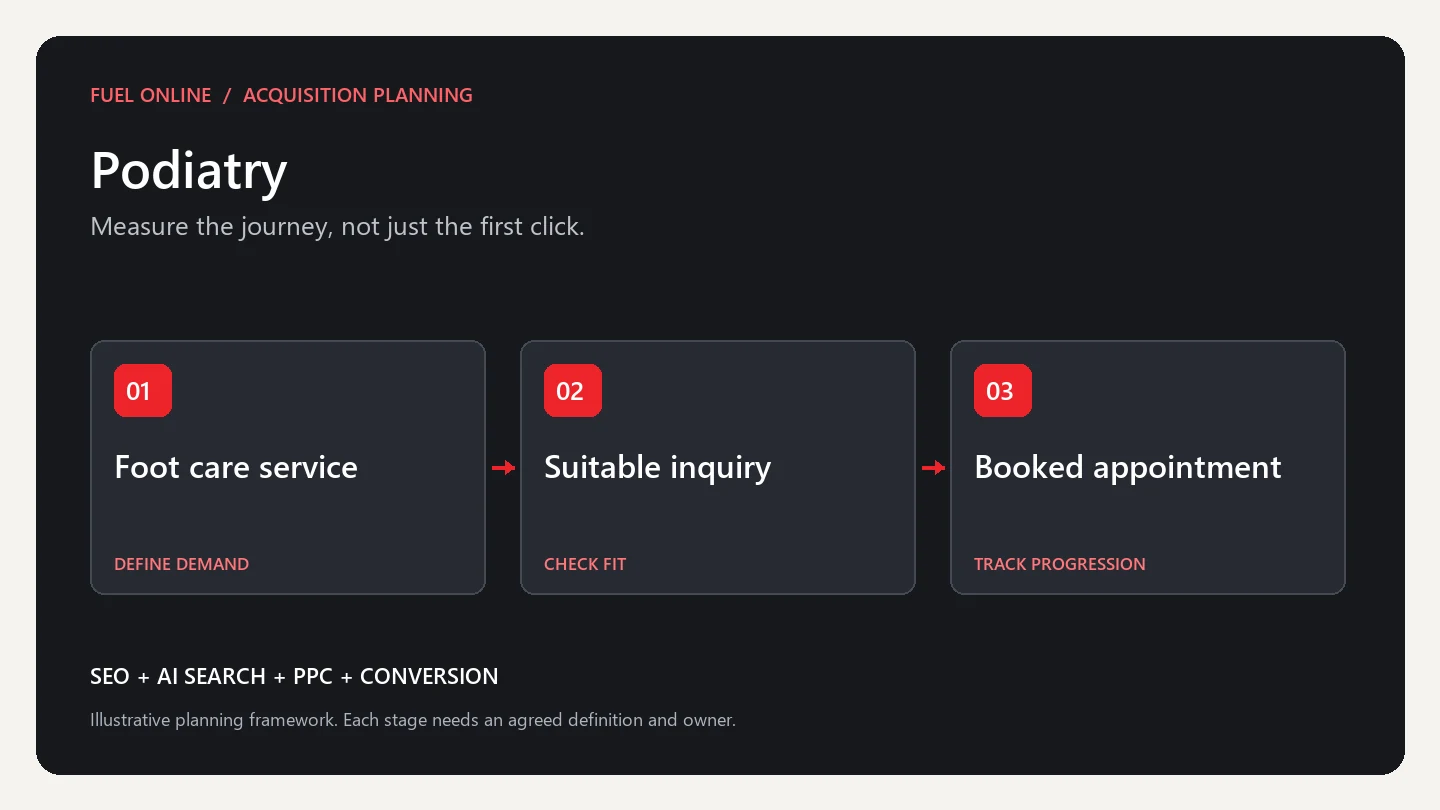
Illustrative podiatry online marketing decision path
Illustrative example, not a client result: compare a new patient seeking an appointment for persistent heel pain with a caregiver comparing diabetic foot-care access by location.
Review the service page, local profile, contact action and follow-up message for each buyer, then check whether they preserve location, offered care, provider availability, reviewed health information and the appointment path. A podiatry digital marketing agency should coordinate those touchpoints as one release. Use digital marketing for podiatry practices to correct the first broken promise and podiatry online marketing to keep the handoff consistent after the visit becomes an inquiry.
Classify the demand
Compare the illustrative queries "podiatrist for heel pain [city]" and "diabetic foot care clinic [city]". Confirm that each describes work you offer in a market and time frame your team can support. The phrases are examples, not measured-volume claims.
Build the appropriate path
For podiatry practice digital marketing, show immediate availability on one path and comparison evidence with a scheduled next step on the other. Use verified clinician credentials, accurate locations, reviewed care-pathway explanations and approved appointment or insurance guidance only when your organization can verify and approve it.
Record the commercial outcome
Retain the source, chosen path and receiving decision. Record why an inquiry advanced or stopped so the next change responds to actual fit instead of increasing activity blindly.
A podiatry digital marketing agency diagnostic for podiatry online marketing: symptom to decision
Use this framework when new-patient inquiries arrive, but the practice cannot tell which location, provider or offered service the visitor expected. The podiatry diagnostic turns that concern into an inspection the owner, marketing lead and receiving team can review together.
Trace the visible podiatry buyer path against current operating capacity. The review should end with one bounded change, its owner and the evidence needed to keep, correct or stop it.
- Ask your podiatry digital marketing agency to document the problem and its business impact.
- Use digital marketing for podiatry practices to connect the source or campaign to the response record.
- Use podiatry online marketing to state the bounded change and the evidence for the next decision.
Name the observable symptom
For podiatry digital marketing, the warning sign is that the website, profiles, ads and first response disagree about service, territory or availability. Record one recent example and the business consequence rather than starting with a channel-wide assumption.
Inspect the path
Review location preference, nonclinical appointment reason, scheduling disposition, new-patient availability and attended-visit outcome. For the digital marketing layer, inspect the live page, local profile, ad promise, form or call path, analytics event and receiving queue. Keep the source, promise, handoff and disposition together so the failure point is visible.
Make a bounded decision
The industry rule is to separate routine care, injury, diabetic foot and procedure information when the provider, location or appointment process changes. For this digital marketing decision, correct the highest-value mismatch first and verify the complete click-to-response path before adding traffic. Name the owner, dependency and release check before implementation.
Require an inspectable output
The output is a cross-channel correction list, approved message matrix, tested conversion route and decision log. It should show what changed, why it changed and what receiving outcome will determine whether the team keeps, corrects, expands or pauses the work.
Measurement standards for podiatry digital marketing agency and digital marketing for podiatry practices
For podiatry practice digital marketing, channel traffic, engagement, call and form activity help explain what changed, but they do not establish commercial value alone. The shared scorecard follows valid appointment requests, booked visits, attended appointments, and source quality and segments them by service, location, buyer path and source where the organization can do so responsibly.
The review also examines provider schedules, new-patient openings, procedure availability and callback coverage. Reporting should record attribution gaps, offline outcomes and why podiatry inquiries were declined. Each review should close with a decision to keep, correct, expand, pause or investigate a specific page, campaign, answer or handoff.
How to compare providers of podiatry online marketing and digital marketing for podiatry practices
Ask how the site, profiles, media and intake team stay synchronized. Before selecting a podiatry digital marketing agency, require the proposal to name the first deliverables, working team, required access, client inputs, review cadence and dependencies. It should state which podiatry practice evidence the organization must substantiate and who approves it.
Request a sample decision log that shows what changed after an accepted or rejected inquiry. Confirm account, content and data ownership. Reject a provider that ignores agreed service or territory exclusions, promises a guaranteed outcome or cannot explain the next concrete decision.
When reviewing podiatry online marketing, ask the provider to show the first decision it would make from one current buyer path and the evidence required to make it.
A decision log for podiatry online marketing should connect one released change to the reason an inquiry advanced or stopped.
How we measure podiatry digital marketing agency
- valid appointment requests
- booked visits
- attended appointments
- source quality
Compare channels using the same qualification rules
Cost per qualified inquiry = attributable channel spend ÷ inquiries meeting the agreed criteria.
Keep the reporting window and included costs consistent. A cheaper contact is not necessarily a cheaper customer; compare later progression where the data supports it.
Agree on the baseline, data source and qualification criteria before comparing results. Separate visibility from inquiries and accepted business opportunities.
CONNECTED SERVICES
Choose the right next step for your business
Explore Fuel’s Digital marketing capabilities, published campaign work and team to evaluate how we would support your organization.
BEFORE YOU CHOOSE AN AGENCY
Questions about podiatry digital marketing agency
What should a podiatry digital marketing agency engagement include?
Expect a cross-channel fact audit, message and page priorities, conversion-path fixes, tracking requirements and a test plan for routine foot care, sports or injury evaluation, diabetic foot services and offered procedures. The proposal should identify owners, dependencies, implementation access and the evidence the podiatry team must approve. It should also explain how changes in provider schedules, new-patient openings, procedure availability and callback coverage affect priorities. Use the release checklist to verify completed work and whether the intended buyer reached the correct handoff.
How should digital marketing for podiatry practices be phased?
For digital marketing for podiatry practices, the first useful milestone is a reconciled channel inventory and one corrected page-to-response path. Delivery speed depends on access, approvals and provider schedules, new-patient openings, procedure availability and callback coverage. Set release checks and review dates before implementation begins. Assess released work first, early response second and downstream business movement only after enough demand and operating time exist to interpret it. Phase digital marketing for podiatry practices around one released buyer path, its acceptance check and the next evidence-based decision.
What does our team provide for podiatry online marketing?
For podiatry online marketing, bring current service and location facts, examples of suitable and unsuitable inquiries, current capacity constraints and access needed for digital marketing. Name the reviewer who can approve podiatry service details, media and evidence. Health details remain in the practice or clinic approved system. Share only the fields needed to make marketing and handoff decisions.
How do we compare firms offering podiatry digital marketing agency services?
Ask the agency to explain how it would handle a new patient seeking an appointment for persistent heel pain differently from a caregiver comparing diabetic foot-care access by location. Its answer should connect one podiatry page, campaign, source or routing change to the required input and receiving outcome. Confirm account and data ownership. When evaluating providers, treat generic activity lists, invented proof and reports that count every inquiry equally as warning signs. Ask what digital marketing for podiatry practices will deliver first and how podiatry online marketing will change after an accepted or rejected inquiry.
Make your next agency conversation specific.
Bring the podiatry services, locations and scheduling gaps creating the most friction. Fuel Online can turn those inputs into a coordinated page, profile and follow-up release plan through a focused podiatry digital marketing agency engagement, with the first owner, release check and success signal clearly named.
Talk with a Fuel strategist →