
FUEL ONLINE / Carpet Cleaning Companies / PPC & Google Ads
Carpet cleaning PPC management: Google Ads

Carpet cleaning companies need profitable jobs that fit the route, crew, property, and service mix, not rental-equipment or distant one-room searches. Fuel separates paid searches such as 'commercial carpet cleaning in Boston' from low-fit intent such as 'rent a carpet cleaner', then aligns ads, geography, landing pages, and contact actions with service type, property, approximate size, access, service zone, and preferred date. Search-term reviews and booking team feedback move budget toward profitable booked cleaning jobs, not the cheapest clicks or form fills.
Service address and coverage; Residential versus commercial work; Service type and scheduling needs; Minimum-job requirements where applicable
Compare carpet cleaning PPC through service and location intent
Carpet cleaning PPC management should connect a defined search purpose with the company’s actual service information and supported inquiry route. Compare agencies through one message-to-office example before choosing a broader media package. Fuel Online can organize the source facts, destination and event definitions around that task. The first useful delivery is an inspectable release, with current account requirements addressed through the appropriate authorized process.
Choose the search purpose and destination together
Separate a search for the known business from research about a supported service category. A named-business visitor may need recognizable identity and contact information. A service researcher may need a clearer explanation before beginning an estimate conversation. Ask the agency which task leads the first scope and which current page serves it. Related language does not necessarily call for an identical destination.
Use a company-approved service example to compare proposals. Give each supplier the same current source and administrative instruction. Ask what the campaign introduces, what information arrival supplies and what action the reader is invited to take. The company determines its actual offering; the agency makes that relationship understandable across the selected formats.
Compare a household-oriented task with an organizational inquiry only where the business genuinely supports that distinction. Ask which facts differ and which explanation can remain shared. A new audience label does not automatically justify another interchangeable page. The proposal should identify the reader decision and receiving context that make the chosen destination useful.
| Comparison item | Practical question | Artifact to retain |
|---|---|---|
| Search purpose | Is the task named-business navigation or service research? | Reader-task and destination brief |
| Geographic context | Which place relationship does the source establish? | Company-approved area reference and inquiry example |
| Purchased work | Which implementation components are included? | Deliverable/owner/fee assumptions |
| Recorded action | Which administrative stage is observed? | Definition and explicit observation limits |
| Continuation | What evidence selected the next account task? | Decision log connected with the current brief |
Compare the message with its source and geography
Review the advertisement and arrival resource together. A short format may direct the reader to fuller explanation while preserving the source meaning. Ask an unfamiliar reviewer what they expect after the message, then compare that with the page. An ambiguity becomes a concrete editorial or destination task, rather than a general claim that the campaign needs more reach.
Inspect geographic wording using the company’s actual information. Where the business is identified, where the reader searches and where the service request concerns may be different facts. Ask the agency which the available record establishes. A place name should retain its approved relationship rather than imply another branch or a universal operating boundary the company has not supplied.
Use a fictional inquiry near an approved geographic boundary as a scope exercise. The business supplies the actual instructions for that situation. Ask what the message and destination explain and what the receiving office would clarify. Retain uncertainty where the advertising record does not establish the final service context. This gives the buyer a specific geographic review task instead of a blanket targeting assumption.
Make management scope and cost components visible
Compare management, creative production, destination editing, external coordination and media expenditure separately. A proposal may include some while assuming the company supplies others. Ask for the deliverable and owner beside each component. No universal fee benchmark is needed to identify whether the package actually completes the intended journey.
Ask finalists to show the boundaries of their access. They may manage the advertising account while another owner controls the website or receiving system. The proposal should distinguish a recommended change from an implemented one. This makes the total assignment comparable and helps the business coordinate dependencies before judging the first release.
Request a concise account brief and decision log. The brief identifies the selected service purpose, approved message, current destination and recorded action. The log explains a significant expansion, exclusion or revision using the observation that motivated it. Another authorized contact should be able to understand the account without reconstructing several meetings.
Exercise a change in one promoted service
Use a fictional instruction to pause one promoted message as a maintenance test. The company supplies the current marketing priority and replacement wording where relevant. Ask which assets and destination references depend on it. A paused advertisement, an updated page and a checked released result are different states. The account record should make them visible.
Follow a saved older link during that exercise. Can a returning reader still identify the business and current supported inquiry step? The destination experience is a separate task from the account setting. The agency should identify what it can update and which owner must act elsewhere, retaining accurate material unrelated to the changed message.
Compare an unexplained mismatch with an uncertain later outcome. A page describing the wrong service context needs an implementation investigation. A relevant request with unavailable later status needs a feedback discussion. Ask how the agency distinguishes those cases before recommending an allocation change. A single cost total cannot explain the different constraints.
Inspect the first release as a complete journey
For acceptance, ask a reviewer to follow the approved message on a phone and describe the business, offering and action. Compare the interpretation with the account brief. Where included, use the company’s permitted fictional inquiry process and inspect what the office receives. Save the exact path and observed context, so acceptance concerns the joined journey rather than a configured account alone.
Keep the approved source passage with each significant creative variation. Ask whether it adapts the same invitation or introduces a different task. A format change can be checked for meaning before enough observations exist for a later activity comparison. If the implied action changes, the report should preserve that context rather than assume the events are directly interchangeable.
Agree what each recorded action actually means. A phone-link activation, a submitted form and a received office conversation are different observations. The tools may not reliably connect every later stage. Ask the supplier to retain that limit in the sample report and identify which company feedback would improve the next review.
Use event definitions to interpret the review
When an event definition changes, retain the old and new meanings with their applicable periods. The business should be able to distinguish a measurement revision from a difference in observed request activity. This makes the historical account record usable to another practitioner and prevents a smooth trend line from hiding unlike stages.
Review service purposes separately before combining activity totals. The company can assess the account as a whole while still asking which journey needs a clearer explanation, better routing or more relevant coverage. The agency should connect each recommendation with a defined task and the evidence its available records support.
At handover, retain the current brief, source references, asset versions, destinations, event definitions and decision log. Clarify which accounts and working files the business receives. A later provider should be able to identify what the campaign describes and why it is structured that way. Continuity is part of the deliverable, not merely a final presentation.
Retain decisions that guide future account work
Compare a bounded first release with an automatic broader package. A useful initial review inspects the completed journey and one report using stable definitions. The business may retain an effective destination while commissioning a specific repair. The supplier should explain the next assignment and its artifact instead of treating more coverage as the only possible next decision.
Compare the same service journey under two management proposals. Ask each supplier to list campaign configuration, message adaptation, destination editing, reporting setup and office-test responsibility. One may include a complete release while another assumes the company or website provider supplies most of it. Place the assumptions beside the deliverables before interpreting the headline fee. This is a practical scope comparison that does not require an invented industry price or a prediction that a larger budget produces a particular volume of work.
Work through a concrete event-cost example without supplying fictional performance totals. One report may divide spend by every recorded contact action; another may use staff-reviewed service inquiries where records support that stage. Those denominators mean different things. Ask the agency to name the action, source record and observation boundary beside the metric. The buyer should be able to identify which comparison is being made and whether the same meaning is retained across periods, rather than choose a report merely because its displayed cost looks smaller.
Compare an inquiry with uncertain purpose against one whose source context is clearly outside the selected task. The first requires additional interpretation or an explicit unknown status. The second can support a focused investigation of the message, destination or account boundary. Ask finalists to show the evidence that distinguishes them. This prevents one broad waste category from replacing the actual reasoning and makes the proposed repair easier for the company to understand and accept.
Use an approved service-name clarification as a creative exercise. The business establishes the relationship between the earlier phrase and the current description. Ask the agency which message and destination references need attention, while preserving accurate account work that does not depend on the terminology. A new campaign group is not automatically the right response to every wording change. The useful deliverable is a clear source relationship and a documented implementation decision.
Rehearse a new account contact inheriting the release. Give that person the current brief and one significant change record. Can they explain the service purpose, destination and meaning of the recorded action? If a conclusion relies on an unexplained internal label, add the ordinary-language task. This makes the decision history usable beyond the person who configured the account and gives the buyer a concrete standard for comparing handover quality.
At the next review, separate what was delivered from what was observed. A checked message-to-office path can satisfy the agreed release acceptance even when later business status remains unavailable. A larger activity total may reveal more observations without establishing a better destination. Ask the supplier to bring the source brief, implementation record and stage definitions together, so the next allocation decision rests on an intelligible account of the selected service journey.
Inspect a phone contact as its own acceptance task where the company supports that route. The website may record the activation of a phone link while the office has different information about the resulting conversation. Ask the supplier to identify what each record establishes and what remains unconnected. A clear public label and current destination can be accepted without claiming complete attribution. Keeping those observations separate gives the business a more useful review of the paid journey and identifies whether the next task concerns communication, routing or available feedback.
Choose continuing PPC work from the observed constraint. Source uncertainty needs company input, a message mismatch needs a focused revision and limited later-stage information needs reporting refinement. The buyer can then compare carpet cleaning advertising services through implemented relationships and accountable decisions, keeping campaign activity distinct from the business’s actual arrangements and completed work.
For the related business-wide scope, explore carpet cleaning marketing.
AGGRESSIVE FROM THE START
One month. The work many agencies stretch across three.
Our mandate: move faster, go deeper and put experienced specialists to work immediately.
Fuel attacks the work in parallel: site audits, technical errors, new content, internal links, backlink outreach and conversion improvements. Your agreed scope determines the channels; urgent fixes do not wait behind a drawn-out planning phase.
The carpet cleaning PPC management brief identifies visibility and lead barriers. Actionable fixes move into production while deeper analysis continues.
Your carpet cleaning Google Ads work runs alongside industry-specific content, relevant links and earned-authority outreach, based on your agreed scope.
The PPC management for carpet cleaning companies review shows completed work, lead quality and the next opportunities. You see who owns each action.
Fast execution is the operating standard. Access, approvals and scope shape delivery; search and revenue results have their own timelines.
What carpet cleaning PPC management changes for carpet cleaning demand
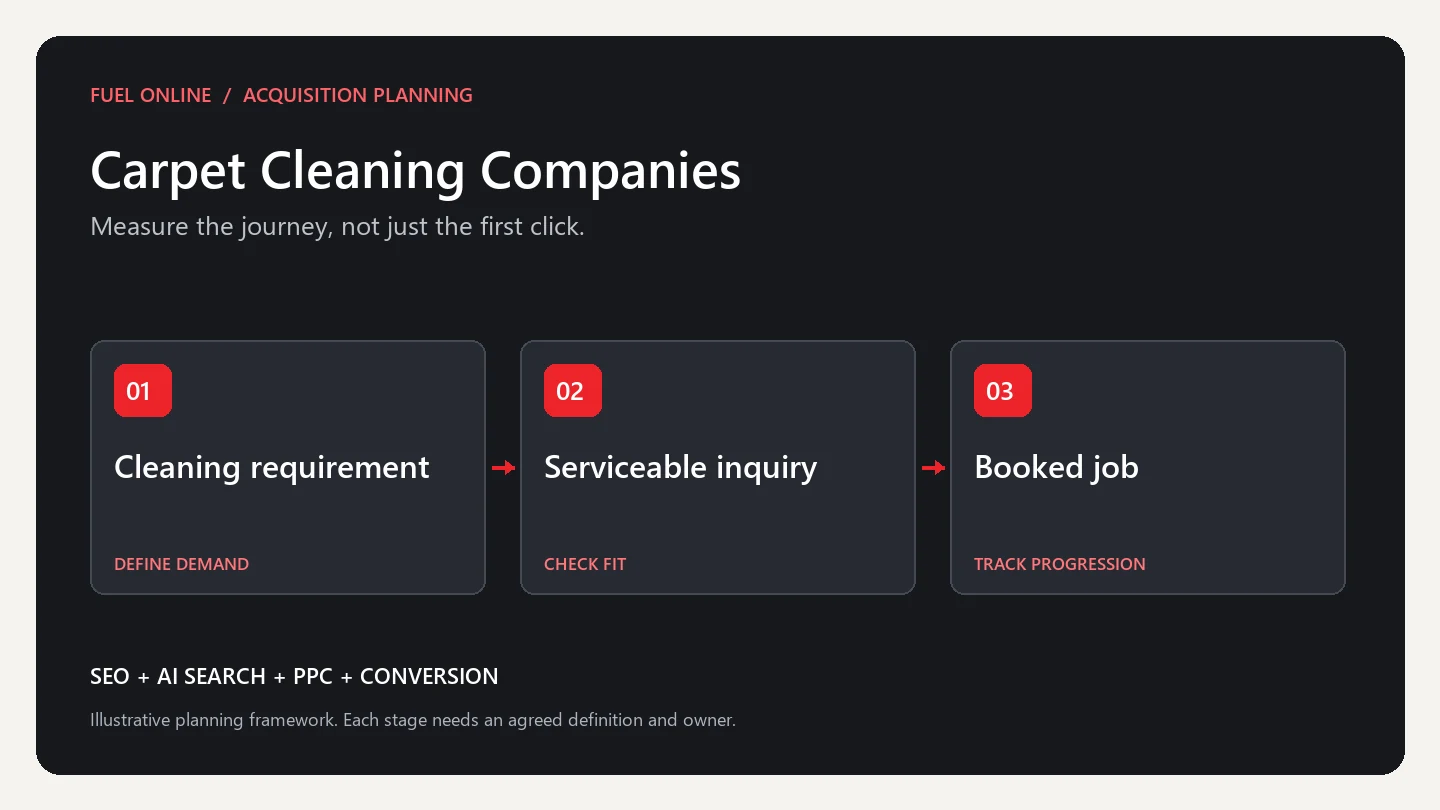
Paid acquisition becomes useful when the account mirrors the business. Fuel separates campaigns when geography, service, economics, qualification, or next step differs. The distinction between 'commercial carpet cleaning in Boston' and 'rent a carpet cleaner' becomes visible in queries, exclusions, ads, pages, and reporting.
Each ad group has a defined buyer, promise, evidence need, destination, and contact action. The landing page uses accurate service limits, current service areas, documented process, approved product statements, and permissioned customer evidence and gives the sales team service type, property category, approximate size, address or zone, access notes, and preferred date.
A practical carpet cleaning PPC diagnostic
Use this diagnostic when paid conversion volume improves but the receiving team does not see a comparable change in booked jobs that meet service and coverage requirements. The diagnostic for carpet cleaning PPC management starts with the observable symptom, checks the page, source, campaign, or handoff responsible for it, and ends with one reviewed action, owner, and validation method.
Observable symptom in carpet cleaning PPC management performance
Reported conversions increase, but search terms and landing pages still send 'rent a carpet cleaner' demand instead of opportunities closer to 'commercial carpet cleaning in Boston'.
What to inspect in carpet cleaning Google Ads
Review actual search terms, geography, ad promise, landing-page fit, contact action, and the sales, intake, or scheduling decision.
Decision criteria for PPC management for carpet cleaning companies
Add or remove a reviewed exclusion, separate the campaign, revise the landing page, or hold budget until the handoff works.
Inspectable output
A search-term and landing-page decision log showing what changed, why budget moved, and whether profitable booked cleaning jobs improved.
PPC management for carpet cleaning companies deliverables you can inspect
The team receives a campaign and budget matrix, reviewed query decisions, exclusions, landing-page message map, conversion tracking, and a weekly budget log.
- Campaign, geography, and budget matrix, used to define the carpet cleaning PPC management scope.
- Reviewed query and exclusion set, used to govern the carpet cleaning Google Ads release.
- Ad and landing-page message map, used to evaluate the PPC management for carpet cleaning companies decision.
- Conversion and offline-disposition tracking
- Weekly search-term and budget decision log
Illustrative carpet cleaning example
Illustrative example, not a client result: Fuel would separate paid-search demand from a residential or commercial customer seeking an offered cleaning service at a covered address and equipment rental, DIY, employment, restoration, and out-of-area requests in the account, then review the actual query, geography, promise, landing page, contact action, and final disposition before changing budget.
The carpet cleaning Google Ads decision log would show the exclusion, campaign split, landing-page revision, or budget hold and its owner. Spend expands only after reviewed evidence shows a stronger path to booked jobs that meet service and coverage requirements.
Within PPC management for carpet cleaning companies, the buyer team can inspect the artifact, approval, and next investment decision.
How commercial progress is judged
Fuel connects page, query, campaign, or source context with acceptance, rejection reasons, response, capacity, and booked jobs, qualified commercial estimates, service-area fit, and cost per accepted booking. Diagnostic measures explain where the journey breaks; they do not replace the business outcome.
The decision record for carpet cleaning PPC management states what changed, why it changed, who approved it, and whether the next action is to expand, revise, consolidate, or stop.
Reporting for PPC management for carpet cleaning companies must connect the service-specific diagnostic to booked jobs that meet service and coverage requirements, explain data limits, and name the next decision rather than treating activity as proof of value.
Questions to ask a carpet cleaning agency
Ask for a search-term decision log, landing-page map, conversion definition, and budget-change record. Confirm who approves exclusions, creative, tracking, and offline disposition imports.
When reviewing carpet cleaning PPC management, require a named practitioner, implementation owner, approval path, and sample artifact. Reject unsupported promises of rankings, citations, lead volume, cost, or revenue.
How we measure carpet cleaning Google Ads
- booked jobs
- qualified commercial estimates
- service-area fit
- cost per accepted booking
Use a cost metric that reflects qualified demand
Cost per qualified inquiry = campaign spend ÷ inquiries meeting the agreed criteria.
Define the included spend, reporting window and qualification rules before comparing campaigns. Track raw leads separately so cheaper but unsuitable inquiries do not make performance look better.
Agree on the baseline, data source and qualification criteria before comparing results. Separate visibility from inquiries and accepted business opportunities.
CONNECTED SERVICES
Choose the right next step for your business
Explore Fuel’s PPC & Google Ads capabilities, published campaign work and team to evaluate how we would support your organization.
BEFORE YOU CHOOSE AN AGENCY
Questions about carpet cleaning Google Ads
What happens before Fuel increases paid spend?
During the first month, the carpet cleaning PPC management scope produces a search-term review, campaign and geography matrix, conversion definition, and the first budget decision. Fuel also records the client inputs and approval needed for the first release.
What does Fuel need from our carpet cleaning team?
Effective carpet cleaning Google Ads work requires ad-account, analytics, landing-page, call, and disposition access plus budget constraints, approved claims, and timely query review. Fuel identifies missing access or ownership before work is scheduled around it.
How will we know the work is commercially useful?
Under PPC management for carpet cleaning companies, commercial usefulness depends on whether the diagnostic connects to booked jobs that meet service and coverage requirements, the data limits are stated, and the evidence supports a clear keep, revise, or stop decision.
What should the first carpet cleaning PPC management priority be?
Start with the query, geography, ad promise, landing page, contact action, and receiving path closest to booked jobs that meet service and coverage requirements. The carpet cleaning PPC management plan should hold expansion when a landing-page or handoff defect would turn more spend into unusable conversions.
What does a credible carpet cleaning Google Ads scope include?
A credible carpet cleaning Google Ads scope includes query and exclusion review, geography and budget rules, landing-page alignment, conversion definitions, disposition feedback, and documented budget decisions. It also names the client dependencies, practitioner, deliverable, and approval path.
How should PPC management for carpet cleaning companies report commercial progress?
Reporting under PPC management for carpet cleaning companies should connect the service-specific diagnostic to booked jobs that meet service and coverage requirements, show what changed and why, state data limits, and name the next decision.
Make your next agency conversation specific.
Bring recent search terms, landing pages, and accepted or rejected contacts so we can identify the first paid-media decision. The first working session on carpet cleaning Google Ads will identify the priority artifact, evidence, owner, and approval decision for booked jobs that meet service and coverage requirements.
Talk with a Fuel strategist →