
FUEL ONLINE / Carpet Cleaning Companies / Lead generation
Carpet Cleaning Lead Generation and Conversion Agency

Carpet cleaning companies need profitable jobs that fit the route, crew, property, and service mix, not rental-equipment or distant one-room searches. For carpet cleaning lead generation, Fuel defines fit through service type, property, approximate size, access, service zone, and preferred date, then aligns pages, forms, calls, routing, and follow-up with that decision. The booking team receives useful source and qualification context, while marketing receives rejection and progression feedback. The aim is more profitable booked cleaning jobs without rewarding raw lead volume.
Service address and coverage; Residential versus commercial work; Service type and scheduling needs; Minimum-job requirements where applicable
Make carpet cleaning lead generation preserve the requested conversation
A carpet cleaning lead-generation agency should make a service inquiry understandable and preserve its intended administrative context through to the office. Compare proposals by following a complete request rather than inspecting a form design alone. Fuel Online can examine the source explanation, action, acknowledgement and receiving record together. The useful first result is a conversation path the business can recognize, with later arrangements and completed work recorded through its actual process.
Define the request the office will receive
Begin with what the current invitation asks the reader to do. Requesting an estimate conversation, asking for contact and arranging a confirmed service step may represent different actions. The company supplies the actual distinction. Ask an unfamiliar reader to describe what happens on submission, then compare that interpretation with the office’s understanding. The public route should preserve the same meaning throughout.
Choose one supported service category as the first test. The business identifies the scope and current resource explaining it. Ask which broad context helps the office begin the intended conversation. The agency should show how the request retains the source purpose instead of asking every visitor to repeat information the route could already make understandable.
Distinguish a new service inquiry from a question about an existing arrangement where the business supports that route. The same website can receive both while the conversations have different owners or next instructions. Clear public choices make the route useful to customers and improve the meaning of acquisition reporting. The company defines the process; the agency makes it recognizable.
| Administrative scenario | Question for the office | Evidence an agency should retain |
|---|---|---|
| Initial service inquiry | Does the request preserve the supported conversation? | Source page, invitation and received context |
| Correction or follow-up | How is it related to the earlier message? | Permitted fictional examples and interpretation |
| Existing arrangement | Can the person find the current supported route? | Destination owner and reader explanation |
| Incomplete request | Does the correction message help the task continue? | Observed message and result |
| Commercial review | Which later stage is actually supported by a record? | Definition, owner and explicit unknown status |
Give initial fields a practical purpose
Create a field-purpose worksheet. Beside each proposed initial field, name the administrative task it supports and the person who uses it. A location reference might help the office understand the requested area; a stated service interest may preserve the page context. The business confirms what is appropriate. This gives the buyer a practical way to compare form proposals without assuming a longer questionnaire establishes a better inquiry.
Compare an initial estimate-related request with the later conversation the company supports. The first route can introduce the purpose while more detailed questions belong with the receiving team. Ask finalists which information they would keep at first contact and why. The explanation should refer to the actual office task rather than a universal qualification template or a forecast of customer value.
Inspect how a shared contact destination receives different source contexts. A person may reach it from a service explanation or from the main business introduction. Ask what the receiving employee can actually identify in each case. The useful implementation may preserve a source reference, clarify the invitation or provide a better choice. The agency should demonstrate the observed need before adding required questions.
Compare the page, acknowledgement and received context
Use the business’s permitted fictional details to follow the selected path. Record the starting resource, stated action and acknowledgement. Then inspect the receiving record with the appropriate office owner. A browser confirmation is one observation; staff recognition of the purpose is another. Save both so acceptance does not stop at the first successful screen.
Ask the office to explain the fictional request in ordinary language. Can it identify which conversation the visitor was invited to begin and what context remains unknown? Compare that with the public explanation. A mismatch becomes a specific wording, field or routing task. This is more useful than classifying the entire channel from a combined submission total.
Review the acknowledgement as something the customer may read later, away from the original page. The message should identify the business and preserve the actual next administrative instruction supplied by the company. Ask the agency to compare it with the page invitation. A clearer acknowledgement can address uncertainty even when the form already submits successfully.
Exercise ordinary corrections and continuing contacts
Introduce a fictional correction to an earlier request. The business defines how its office recognizes that relationship in the current process. The agency can preserve available context and document where staff review is necessary. A useful follow-up is not automatically another independent new inquiry. Retain the distinction in the accepted reporting example.
Compare that case with a separate request about another supported service or location context. The purpose is to make the relationship interpretable, not to assume the systems automatically join or separate every message. Ask the supplier what evidence its reporting uses and what remains uncertain. Stable definitions make later discussions more informative than an unexplained contact count.
Use an existing-arrangement question as a second route check. The customer may need the company’s current administrative instructions rather than another estimate invitation. The business supplies the actual destination. Ask an unfamiliar reviewer to locate it and describe what they believe happens next. This checks the usability of the public choice without introducing a new office process.
Inspect the implementation boundaries
Compare implementation access across the proposed project. Page editing, form configuration, acknowledgement changes and another system’s receiving rule may have different owners. The proposal should identify who can complete each component and what evidence confirms it. A recommendation document remains a planning artifact until the relevant change is implemented and checked.
Include ordinary error handling in the permitted test. Leave one agreed required administrative value blank and inspect the message explaining the correction. Can the tester understand what is needed and continue the intended task? Retain the observed behavior. A focused clarification may be a useful first improvement before a broader replacement of the working form is considered.
Compare the phone route with the website request where the business supports both. The office may receive different amounts of context. Record what it can recognize rather than assume identical cross-channel records. A clear public label can improve the conversation even when attribution remains limited. The agency should describe the useful implementation and its observation boundary separately.
Use stable stages in the commercial review
Define the stages available for review: submission, receipt by the intended system, office review and any later arrangement or completed-work stage the business can substantiate. These stages require different evidence. Ask who supplies each status and how unavailable outcomes are represented. Unknown progression should remain unknown instead of being treated automatically as success or failure.
Compare a report using stable stages with one combining every phone and form action. The combined view may be convenient for activity monitoring while insufficient for a commercial conclusion. The buyer should be able to see which service conversations reached the intended office and which later records exist. The agency can then recommend an evidence improvement or a route repair according to the specific gap.
Keep test activity identifiable and preserve the business’s ordinary records. The acceptance examples should use fictional details chosen for the task, not real customer narratives copied into a marketing presentation. The record needs the purpose, route and observed result. This makes it usable for later implementation review while keeping the exercise focused on communication design.
Retain a repeatable request-path record
At handover, retain the request definition, field purposes, destination map and accepted test cases. Ask another office employee to repeat the initial inquiry and continuing-contact tasks from the record. Their ability to explain the results tests whether the work remains useful beyond the original account team. An unexplained internal label should be replaced or accompanied by the ordinary-language purpose.
Use the accepted record when a future page or form change is proposed. A revised button, field or destination should be assessed against the same administrative meaning. The business can then identify whether an issue follows a recent edit, an earlier dependency or a change in its own instructions. This helps another team improve a specific component without restarting the whole project.
Compare two initial request designs using the same fictional customer purpose. One asks the visitor to choose a service category already explained on the source page; the other preserves that page context and asks only for the administrative information the office needs next. Ask the receiving team which design makes the conversation clearer and why. The useful finding could support either approach depending on the actual process. The buyer should see the reason for the field and the observed received result, rather than assume a shorter or longer form is universally preferable.
Add a deliberately ambiguous service selection to the permitted test. The office should explain what it can identify and which clarification belongs in its ordinary response. Ask the agency to connect any proposed label change with that observed ambiguity. A new mandatory question is one possible intervention, not the definition of improvement. The acceptance record should preserve the fictional example and the particular explanation the business approved, so a future editor can understand the choice.
Compare a request about the wrong geographic context with one that reaches the right office but loses the selected service. The first calls for reviewing the public area explanation and the company’s supported instructions. The second may concern the information carried across the destination. Ask finalists to identify those different tasks and the component they can implement. A combined unsuitable-lead category would hide the useful distinction and give the buyer little basis for comparing the next project.
Use a later acknowledgement revision as a continuity exercise. Give a new authorized editor the accepted page invitation and receiving record, then ask whether the revised message still describes the same administrative stage. The editor should be able to explain what completed and what remains to happen using the company’s current instructions. Retain the version relationship in the handover. This demonstrates how the agency’s work supports ordinary maintenance after the initial conversion project has ended.
Finally, compare the record needed for implementation acceptance with the record needed for a commercial conclusion. A fictional test can establish useful context and delivery while say nothing about later customer work. Ordinary business records may establish later stages where compatible information exists. The proposal should preserve these different evidence roles. The company can then accept a functioning communication route and separately decide which feedback improvement would make future acquisition review more useful.
Choose further lead-generation work from the observed constraint. An unclear invitation calls for editorial work, lost source context calls for implementation and missing later feedback calls for a stage-definition discussion. A carpet cleaning conversion engagement becomes useful when the business can understand and repeat the request path, with every proposed next task connected to a stage it can inspect.
For the related business-wide scope, explore carpet cleaning marketing.
AGGRESSIVE FROM THE START
One month. The work many agencies stretch across three.
Our mandate: move faster, go deeper and put experienced specialists to work immediately.
Fuel attacks the work in parallel: site audits, technical errors, new content, internal links, backlink outreach and conversion improvements. Your agreed scope determines the channels; urgent fixes do not wait behind a drawn-out planning phase.
The carpet cleaning lead generation brief identifies visibility and lead barriers. Actionable fixes move into production while deeper analysis continues.
Your carpet cleaning lead generation company work runs alongside industry-specific content, relevant links and earned-authority outreach, based on your agreed scope.
The lead generation services for carpet cleaning companies review shows completed work, lead quality and the next opportunities. You see who owns each action.
Fast execution is the operating standard. Access, approvals and scope shape delivery; search and revenue results have their own timelines.
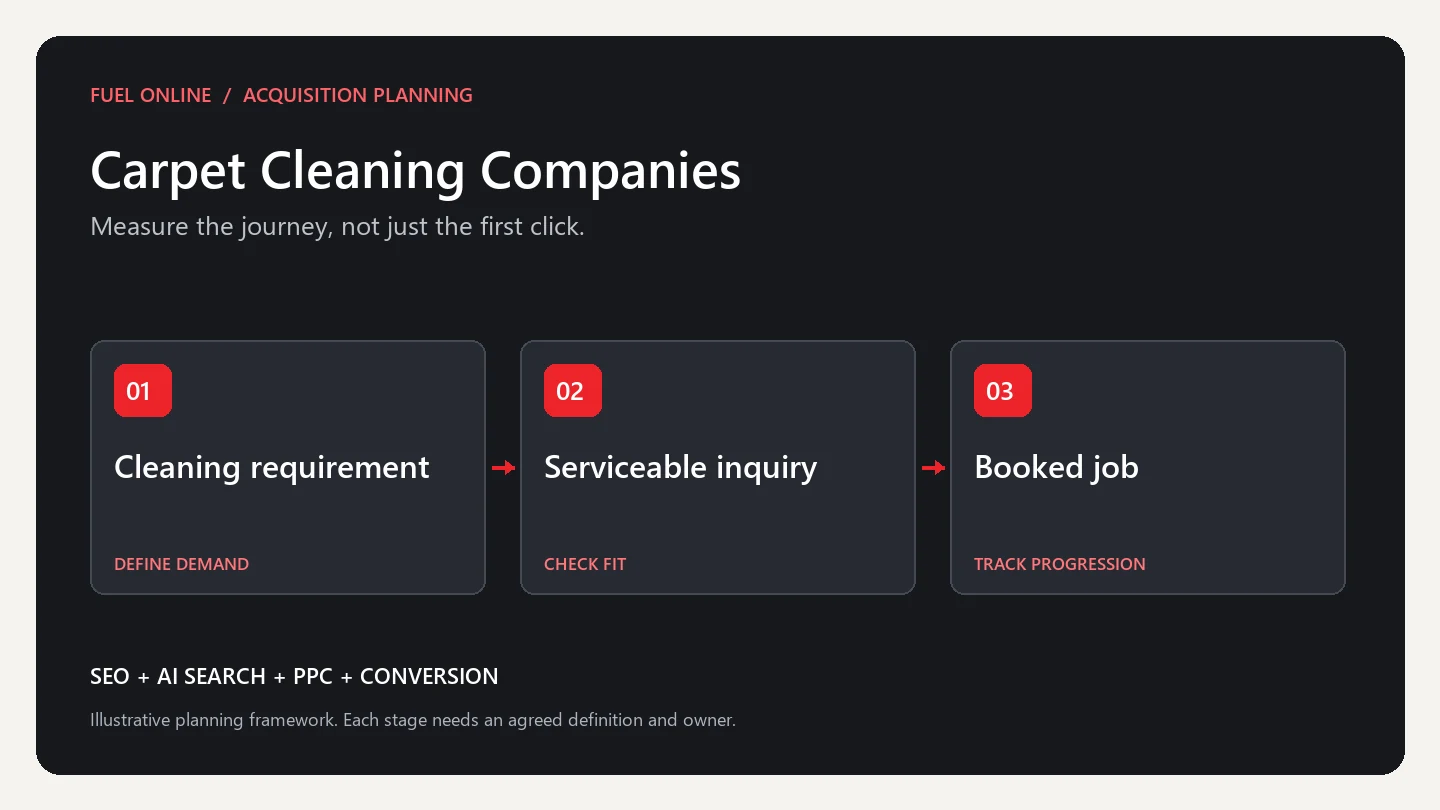
What carpet cleaning lead generation changes for carpet cleaning demand
Lead generation starts with the receiving team's decision. Fuel documents what counts as an accepted next step, what does not fit, and who owns each route. For carpet cleaning, acceptance depends on service type, property category, approximate size, material or problem, access, service zone, and preferred date.
The conversion path asks only what changes fit, routing, or preparation. It preserves service type, property category, approximate size, address or zone, access notes, and preferred date, keeps sensitive details in approved systems, and gives unsuitable visitors a clear alternative instead of forcing every request into sales.
A practical carpet cleaning leadgen diagnostic
Use this diagnostic when form submissions and calls increase but the receiving team does not see a comparable change in booked jobs that meet service and coverage requirements. The diagnostic for carpet cleaning lead generation starts with the observable symptom, checks the page, source, campaign, or handoff responsible for it, and ends with one reviewed action, owner, and validation method.
Observable symptom
Forms and calls increase, but suitable requests related to 'commercial carpet cleaning in Boston' lose context, wait too long, or reach the wrong owner.
What to inspect in carpet cleaning lead generation company
Review the page promise, fields, call handling, routing, response time, follow-up attempts, and final sales, intake, or scheduling decision.
Decision criteria for lead generation services for carpet cleaning companies
Change the question, route, response rule, or follow-up step responsible for the lost or unsuitable request.
Inspectable output
A tested routing or follow-up change with an owner, acceptance rule, and measure tied to profitable booked cleaning jobs.
Lead generation services for carpet cleaning companies deliverables you can inspect
The team receives an accepted-request definition, path map, routing and response rules, CRM dispositions, and a controlled conversion-test log.
- Accepted-lead and exclusion specification, used to define the carpet cleaning lead generation scope.
- Page, form, and call-path map, used to govern the carpet cleaning lead generation company release.
- Routing, response, and follow-up ownership, used to evaluate the lead generation services for carpet cleaning companies decision.
- CRM fields, dispositions, and duplicate rules
- Quality review and controlled test log
Illustrative carpet cleaning example
Illustrative example, not a client result: The booking request loses address, property type, service needed, size, urgency, access, or preferred timing. Fuel would test the page, form or call path, route, response rule, follow-up, and final disposition to find the first point where useful context disappears.
The carpet cleaning lead generation company test would document the changed field, route, response rule, or follow-up step and its owner. The revision stays only when the receiving team sees a clearer path to booked jobs that meet service and coverage requirements.
Within lead generation services for carpet cleaning companies, the buyer team can inspect the artifact, approval, and next investment decision.
How commercial progress is judged
Fuel connects page, query, campaign, or source context with acceptance, rejection reasons, response, capacity, and booked jobs, qualified commercial estimates, service-area fit, and cost per accepted booking. Diagnostic measures explain where the journey breaks; they do not replace the business outcome.
The decision record for carpet cleaning lead generation states what changed, why it changed, who approved it, and whether the next action is to expand, revise, consolidate, or stop.
Reporting for lead generation services for carpet cleaning companies must connect the service-specific diagnostic to booked jobs that meet service and coverage requirements, explain data limits, and name the next decision rather than treating activity as proof of value.
Questions to ask a carpet cleaning agency
Ask for an accepted-request specification, route test, disposition set, and response ownership map. Confirm how the agency reviews missed, duplicate, unsuitable, and progressed inquiries.
When reviewing carpet cleaning lead generation, require a named practitioner, implementation owner, approval path, and sample artifact. Reject unsupported promises of rankings, citations, lead volume, cost, or revenue.
How we measure carpet cleaning lead generation company
- booked jobs
- qualified commercial estimates
- service-area fit
- cost per accepted booking
Find the drop between interest and a useful next step
Next-step completion rate = qualified inquiries completing the agreed next step ÷ qualified inquiries reviewed.
Illustrative arithmetic: 15 completed appointments from 25 qualified inquiries is 60%. Use the next step that fits your business, such as a consultation, estimate or discovery meeting, and record the time allowed for completion.
Agree on the baseline, data source and qualification criteria before comparing results. Separate visibility from inquiries and accepted business opportunities.
CONNECTED SERVICES
Choose the right next step for your business
Explore Fuel’s Lead generation capabilities, published campaign work and team to evaluate how we would support your organization.
BEFORE YOU CHOOSE AN AGENCY
Questions about carpet cleaning lead generation company
What happens before Fuel changes the form?
During the first month, the carpet cleaning lead generation scope produces an accepted-request definition, tested page and call paths, routing ownership, dispositions, and the first conversion repair. Fuel also records the client inputs and approval needed for the first release.
What does Fuel need from our carpet cleaning team?
Effective carpet cleaning lead generation company work requires page, form, call, CRM, routing, and response access plus an accepted-request definition, receiving owners, and consistent dispositions. Fuel identifies missing access or ownership before work is scheduled around it.
How will we know the work is commercially useful?
Under lead generation services for carpet cleaning companies, commercial usefulness depends on whether the diagnostic connects to booked jobs that meet service and coverage requirements, the data limits are stated, and the evidence supports a clear keep, revise, or stop decision.
Should we buy more traffic before fixing lead handling?
Usually not. The carpet cleaning lead generation plan should first correct the form, call path, routing, response, follow-up, or disposition problem that is losing suitable requests. Additional traffic is useful only after the receiving path can handle it.
What does a credible carpet cleaning lead generation company scope include?
A credible carpet cleaning lead generation company scope includes acceptance criteria, path testing, field and call design, routing and response ownership, CRM dispositions, and controlled conversion tests. It also names the client dependencies, practitioner, deliverable, and approval path.
How should lead generation services for carpet cleaning companies report commercial progress?
Reporting under lead generation services for carpet cleaning companies should connect the service-specific diagnostic to booked jobs that meet service and coverage requirements, show what changed and why, state data limits, and name the next decision.
Make your next agency conversation specific.
Bring a sample of suitable and unsuitable requests and show us where response, routing, or follow-up breaks. The first working session on carpet cleaning lead generation company will identify the priority artifact, evidence, owner, and approval decision for booked jobs that meet service and coverage requirements.
Talk with a Fuel strategist →