
FUEL ONLINE / Carpet Cleaning Companies / Digital marketing
Carpet cleaning marketing agency: Digital Strategy

Carpet cleaning companies need profitable jobs that fit the route, crew, property, and service mix, not rental-equipment or distant one-room searches. As your carpet cleaning marketing agency, Fuel Online gives search, paid media, decision content, landing pages, and follow-up one commercial job. We build around service type, property, approximate size, access, service zone, and preferred date, exclude low-fit demand, and connect channel decisions to booking team feedback. You receive a 30/60/90 plan aimed at profitable booked cleaning jobs, not a generic package of activity.
Service address and coverage; Residential versus commercial work; Service type and scheduling needs; Minimum-job requirements where applicable
Choose carpet cleaning digital marketing through a complete service release
A carpet cleaning marketing agency should coordinate the business’s approved service explanation, discovery messages and receiving office around a defined customer task. Compare proposals through one complete local release before judging a larger channel package. Fuel Online can organize the first assignment around a useful estimate-information journey or an accurate company introduction. The business should receive connected assets and an acceptance record, giving subsequent investment an intelligible starting point.
Choose a release around a recognizable service journey
Choose the first condition with the company’s receiving team. A new reader may need a clearer explanation of the business and supported offering. Another may already recognize the name but need to understand how an estimate inquiry begins. A person continuing an existing service conversation may need a different contact route. Naming that task gives the agency a concrete scope instead of an open-ended target for more traffic.
Compare household and organizational requests only where the company’s actual service model makes that useful. The business supplies its scope and receiving process. A common explanation may serve shared questions, while a distinct resource can support a genuinely different conversation. The agency should show the factual difference before proposing another set of similar pages or campaigns.
Prepare a release brief containing the intended audience task, approved source, current destination and next administrative action. Ask finalists to explain what becomes clearer after the release. An estimate invitation and a company introduction can share branding while needing different information. The brief should make that distinction understandable to someone who did not attend the discovery meeting.
| Release component | Responsibility to compare | Evidence to retain |
|---|---|---|
| Company introduction | Current identity and relevant public source | Approved message and recognizable destination |
| Service-information journey | Useful explanation and source relationship | Reader task and completed page connection |
| Estimate invitation | Accurate administrative action and receiving owner | Permitted fictional request record |
| Campaign revision | Affected assets and actual publishing access | Version status and checked destination |
| Continuity | Accounts, working files and decision meaning | Handover that another authorized team can use |
Compare the work behind the channel package
Compare source discovery, writing, design, website implementation, distribution and receiving-route checks as separate responsibilities. A package may include some and assume the company supplies others. Ask for a representative artifact at each boundary. The buyer can then compare the actual coordinated assignment rather than a channel list that leaves important implementation work with an unnamed owner.
Give each asset an information role. A local introduction establishes the intended business. A service resource describes the supported offering. A campaign directs the reader to useful context. An administrative destination explains the request the company receives. The agency should show how those roles join, so activity on one channel does not become the only measure of the complete release.
Review images with their captions and destination context. The company supplies the approved meaning and usable assets. A photograph can introduce the business or accompany a particular explanation. Ask what an unfamiliar reader should understand from the complete presentation. This turns creative review into a useful information exercise instead of approving each asset only because it looks consistent with the brand.
Coordinate an offer or contact change
Use a fictional change to one promoted service message as a coordination test. The company supplies the current instruction. Ask which campaign assets, source summaries and destination references depend on it. Compare the affected-resource list with the supplier’s access. A revised creative file, an account pause and a public destination that has been checked represent different completed tasks.
Follow an older saved destination during that exercise. A returning reader may arrive after the original distribution changes. Ask what the resource now establishes and how it connects to the current inquiry route. The agency should explain that public experience rather than rely only on an account-status label. Accurate material unrelated to the revision can remain useful.
Compare a narrowly defined release with a larger rebuilding proposal. The company may have accurate service information and working forms while the message-to-page connection needs attention. Ask finalists which assets they retain and why a broader change is or is not needed. The exercise makes the rationale visible without assuming that the smallest project is always best or that more production automatically creates more value.
Test the joined message-to-office path
For acceptance, give an unfamiliar reviewer a finished message and ask them to follow it on a phone. Can they identify the business, understand the supported service explanation and describe the action being invited? Compare the interpretation with the release brief. A mismatch should become a specific wording, creative or destination task rather than a general judgment about the entire campaign.
Use the company’s permitted fictional inquiry process to inspect the handoff where included. Ask the office what purpose and context it can recognize. A technically successful submission may still leave the team guessing which conversation the page introduced. Record the source, invitation, acknowledgement and received result together, making the transition assessable by the buyer.
Compare campaign response with later company stages. A received inquiry, a scheduled conversation and completed work require different records. The business may be able to supply broad administrative feedback rather than a detailed record for every contact. Ask how the agency uses that information while keeping unavailable outcomes visible. Stable definitions make the account review more useful than an unexplained contact total.
Compare scope, continuity and continuing responsibility
Compare a proposed retainer with a bounded first-release package using the same artifacts. One can support continuing coordination while another establishes a particular journey. The useful distinction concerns work included, source inputs and implementation responsibility, rather than the contract name. This helps the business choose a starting arrangement consistent with the information and review resources it can supply.
Ask how a separate website or contact-system owner enters the plan. A recommendation is a useful planning output, but a joined experience requires the responsible owner to implement and check the change. The record should identify the dependency clearly. The buyer can then see what the agency completed and what still needs another authorized action, avoiding a false impression that a polished presentation establishes delivery.
Clarify the commercial components of the proposed package. Creative production, destination editing, distribution management and external coordination can be priced differently. Ask which assumptions sit beside each component. The company can compare total responsibility without an invented market-rate benchmark. A larger quote may include useful implementation work or material the business already has; the deliverable breakdown makes that difference inspectable.
Retain an operating record for the next release
At handover, retain source references, current assets, destination list and acceptance notes. Clarify which accounts and working files the company receives. Another marketing contact should be able to update an accurate instruction without reconstructing several presentations. Asset continuity is useful when several channels reuse the same company identity or service explanation.
Use a fictional provider change as a continuity exercise. Ask an incoming authorized colleague to identify the current message, destination and source decision from the handover record. If the answer depends on an unexplained internal campaign label, add the ordinary-language purpose. This makes the record usable beyond the original account team and gives the buyer a practical comparison of documentation quality.
Review the next assignment against the observed constraint. A useful explanation that is hard to find needs a different task from an unclear request invitation. A source fact awaiting the business’s decision differs again from an implementation dependency. The agency should identify the evidence and the artifact its recommendation will produce, keeping continuing work tied to a concrete purpose.
Keep the roles of discovery, information and contact distinct in the report. A company introduction can be useful before a reader makes an inquiry. A service-specific destination may reveal a narrower handoff issue. The buyer should be able to ask which journey deserves more reach, a clearer explanation or a better connection, rather than assume every channel needs expansion at the same time.
Work through a concrete package comparison before choosing a contract structure. Give both finalists the same starting assets: a current business introduction, a service resource and the supported estimate-contact destination. Ask one to outline a bounded release and the other an ongoing program using those assets. Compare the source work, production, publishing and receiving checks each actually includes. The question is not which contract label is superior; it is what the business receives, what it must supply and which continuing responsibility remains after the first acceptance.
Now remove one assumed dependency from the exercise. Suppose the service explanation exists but another owner must edit the destination. Ask each agency which work can progress and which task waits for that specific implementation. A useful plan can prepare the source-linked message and acceptance brief while naming the blocked component. This makes the release sequence understandable and helps the office coordinate another provider without treating a missing page edit as either a completed task or a reason to abandon all useful preparation.
Compare a new asset request with a clearer use of an existing one. Give finalists a company-supplied photograph and its approved context. Ask what contribution a new asset would make to the selected customer task. A different crop or caption may help one format, while another purpose may genuinely need a separate resource. The agency should explain that decision beside the production scope. This lets the buyer assess creative work through a useful information role rather than an unexplained image count.
Use the retained package to rehearse an office contact change. An employee who did not join the launch should identify the current invitation, affected message and destination owner. The test should reveal whether the documentation is practical. Where it relies on an internal account nickname, add the reader task and source reference. This small correction improves the value of the handover and makes a later supplier change easier to discuss without re-creating every campaign decision.
At the first continuing-work review, place the accepted release beside the proposed next assignment. Ask which new information gap or business priority justifies the work and which accurate assets remain reusable. The account may need more relevant discovery, a better service explanation or a receiving correction. Each produces a different artifact. Recording that reason helps the company direct its time toward the facts and transitions that actually change, rather than reviewing a fresh version of the entire package each month.
Compare an existing-customer reminder with an introduction aimed at people unfamiliar with the company. The same approved service description can supply both, while the starting context and intended conversation differ. Ask the agency to show the destination and receiving definition for each release. A response from an existing relationship can be useful without being counted as another newly acquired customer. This distinction gives the office a concrete way to interpret channel feedback and helps the buyer assess whether an integrated report preserves the purpose of each message rather than treating all responses as equivalent demand.
Finish the first release with a joined experience the office can explain. The business should know what the message offers, which source supports it, where the reader arrives and what the receiving team recognizes. Retain unresolved questions and their owners. That gives carpet cleaning digital marketing a practical operating system, with further investment selected from useful information and implementation evidence rather than the activity calendar alone.
For the related business-wide scope, explore carpet cleaning marketing.
AGGRESSIVE FROM THE START
One month. The work many agencies stretch across three.
Our mandate: move faster, go deeper and put experienced specialists to work immediately.
Fuel attacks the work in parallel: site audits, technical errors, new content, internal links, backlink outreach and conversion improvements. Your agreed scope determines the channels; urgent fixes do not wait behind a drawn-out planning phase.
The carpet cleaning marketing agency brief identifies visibility and lead barriers. Actionable fixes move into production while deeper analysis continues.
Your carpet cleaning digital marketing work runs alongside industry-specific content, relevant links and earned-authority outreach, based on your agreed scope.
The digital marketing for carpet cleaning companies review shows completed work, lead quality and the next opportunities. You see who owns each action.
Fast execution is the operating standard. Access, approvals and scope shape delivery; search and revenue results have their own timelines.
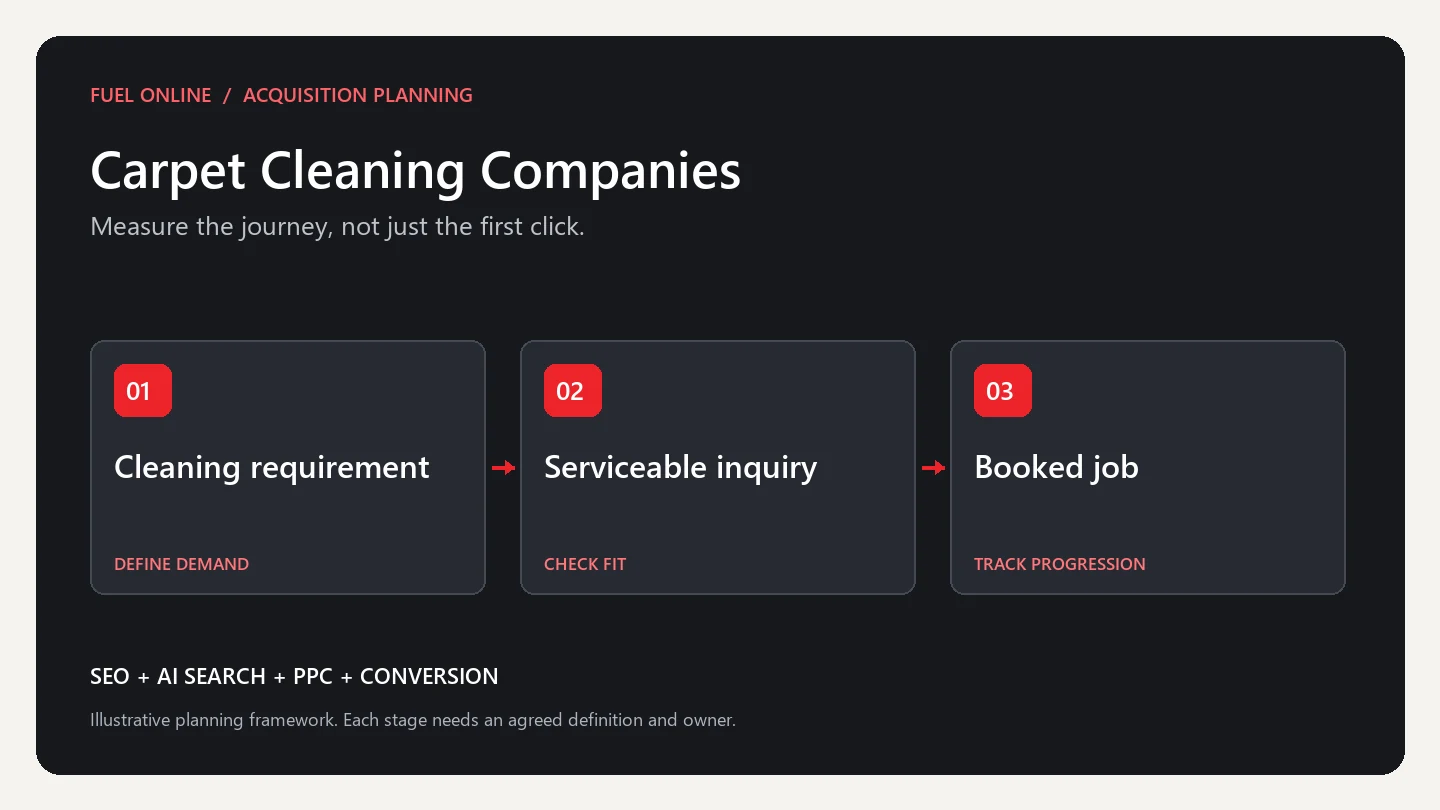
What carpet cleaning marketing agency changes for carpet cleaning demand
The problem is rarely a missing channel. It is a broken link between audience, promise, evidence, page, and follow-up. Fuel gives each channel a job in winning profitable booked jobs and recurring service opportunities and uses service type, property category, approximate size, material or problem, access, service zone, and preferred date to keep the message consistent.
Organic search handles durable discovery, paid media tests controllable demand, and decision content supports evaluation. Every path uses accurate service limits, current service areas, documented process, approved product statements, and permissioned customer evidence and carries service type, property category, approximate size, address or zone, access notes, and preferred date into the receiving workflow.
A practical carpet cleaning digital diagnostic
Use this diagnostic when digital activity improves but the receiving team does not see a comparable change in booked jobs that meet service and coverage requirements. The diagnostic for carpet cleaning marketing agency starts with the observable symptom, checks the page, source, campaign, or handoff responsible for it, and ends with one reviewed action, owner, and validation method.
Observable symptom
Channel reports improve while profitable booked cleaning jobs stay flat and requests closer to 'rent a carpet cleaner' keep consuming follow-up time.
What to inspect in carpet cleaning digital marketing
Compare the channel promise with the landing page, form or call path, follow-up owner, and final business outcome.
Decision criteria for digital marketing for carpet cleaning companies
Reassign the channel, revise the page, repair the route, or stop the activity based on the broken stage.
Inspectable output
A channel decision with a named page or handoff change, owner, release date, and measure tied to profitable booked cleaning jobs.
Digital marketing for carpet cleaning companies deliverables you can inspect
The team receives a journey map, page and campaign backlog, measurement specification, release log, and ownership record for every digital change.
- Channel role and budget map, used to define the carpet cleaning marketing agency scope.
- Priority plan for service, property-type, stain and odor, pricing-factor, service-area, and maintenance-plan pages, used to govern the carpet cleaning digital marketing release.
- Campaign exclusions and landing-page requirements, used to evaluate the digital marketing for carpet cleaning companies decision.
- Conversion, routing, and tracking specification
- Weekly operating and monthly commercial review
Illustrative carpet cleaning example
Illustrative example, not a client result: A customer reaches a service page but cannot confirm coverage, property type, cleaning need, minimum job, availability, or booking action. Fuel would trace the entry page, proof viewed, next action, fields, routing, and final disposition, then repair the first break rather than redesigning the whole site without evidence.
The carpet cleaning digital marketing release would include the revised page or path, measurement event, receiving owner, and validation record. The test stays only if it improves the journey toward booked jobs that meet service and coverage requirements.
Within digital marketing for carpet cleaning companies, the buyer team can inspect the artifact, approval, and next investment decision.
How commercial progress is judged
Fuel connects page, query, campaign, or source context with acceptance, rejection reasons, response, capacity, and booked jobs, qualified commercial estimates, service-area fit, and cost per accepted booking. Diagnostic measures explain where the journey breaks; they do not replace the business outcome.
The decision record for carpet cleaning marketing agency states what changed, why it changed, who approved it, and whether the next action is to expand, revise, consolidate, or stop.
Reporting for digital marketing for carpet cleaning companies must connect the service-specific diagnostic to booked jobs that meet service and coverage requirements, explain data limits, and name the next decision rather than treating activity as proof of value.
Questions to ask a carpet cleaning agency
Ask to see a journey map, release ticket, and measurement specification. Confirm who changes the site, campaigns, analytics, forms, CRM connection, and quality feedback loop.
When reviewing carpet cleaning marketing agency, require a named practitioner, implementation owner, approval path, and sample artifact. Reject unsupported promises of rankings, citations, lead volume, cost, or revenue.
How we measure carpet cleaning digital marketing
- booked jobs
- qualified commercial estimates
- service-area fit
- cost per accepted booking
Compare channels using the same qualification rules
Cost per qualified inquiry = attributable channel spend ÷ inquiries meeting the agreed criteria.
Keep the reporting window and included costs consistent. A cheaper contact is not necessarily a cheaper customer; compare later progression where the data supports it.
Agree on the baseline, data source and qualification criteria before comparing results. Separate visibility from inquiries and accepted business opportunities.
CONNECTED SERVICES
Choose the right next step for your business
Explore Fuel’s Digital marketing capabilities, published campaign work and team to evaluate how we would support your organization.
BEFORE YOU CHOOSE AN AGENCY
Questions about carpet cleaning digital marketing
What changes first in a digital marketing engagement?
During the first month, the carpet cleaning marketing agency scope produces a journey map, page and campaign backlog, measurement specification, and the first release ticket. Fuel also records the client inputs and approval needed for the first release.
What does Fuel need from our carpet cleaning team?
Effective carpet cleaning digital marketing work requires site, campaign, analytics, form, and CRM access plus reviewers, approved proof, capacity limits, and accepted or rejected inquiry feedback. Fuel identifies missing access or ownership before work is scheduled around it.
How will we know the work is commercially useful?
Under digital marketing for carpet cleaning companies, commercial usefulness depends on whether the diagnostic connects to booked jobs that meet service and coverage requirements, the data limits are stated, and the evidence supports a clear keep, revise, or stop decision.
Do we need every digital channel at once?
Start with the break closest to booked jobs that meet service and coverage requirements, not a predetermined channel. The diagnostic for carpet cleaning marketing agency may prioritize the page promise, proof, form, measurement, route, or response owner before recommending more acquisition.
What does a credible carpet cleaning digital marketing scope include?
A credible carpet cleaning digital marketing scope includes journey mapping, page and campaign priorities, measurement, implementation ownership, release validation, and inquiry-quality feedback. It also names the client dependencies, practitioner, deliverable, and approval path.
How should digital marketing for carpet cleaning companies report commercial progress?
Reporting under digital marketing for carpet cleaning companies should connect the service-specific diagnostic to booked jobs that meet service and coverage requirements, show what changed and why, state data limits, and name the next decision.
Make your next agency conversation specific.
Bring the channel, page, or follow-up problem preventing more profitable booked cleaning jobs. The first working session on carpet cleaning digital marketing will identify the priority artifact, evidence, owner, and approval decision for booked jobs that meet service and coverage requirements.
Talk with a Fuel strategist →