
FUEL ONLINE / Remodeling Contractors / SEO
Remodeling contractor SEO: Search Strategy

Remodelers need projects that fit their geography, minimum scope, design process, and production calendar, not handyman or material-only requests. Fuel maps searches such as 'whole home remodeling in Newton' to focused service, location, process, proof, and comparison pages, while treating 'handyman near me' as different intent. The remodeling contractor SEO work also fixes indexation and internal-link gaps and produces evidence-backed briefs. Reporting connects search visibility with qualified design or estimate consultations, not traffic or rankings in isolation.
Project type and property location; Ownership and project scope; Approximate investment range and timing; Design-only versus construction engagement
Connect remodeling services, projects and process resources around the property-owner decision
Remodeling contractor SEO should help a property owner find the supported service, understand a relevant project example and identify the actual consultation process. Fuel Online can map those questions to existing resources before recommending more project-type or location pages. The useful decision is whether an answer is missing, an existing answer is hard to find or several pages compete for the same task. Each finding calls for different work, and another generic remodeling article may leave the actual gap unresolved.
Give the service page and project story different responsibilities
The service resource explains the offering the contractor currently wants to discuss. A project story describes particular work using the context the business is authorized to publish. A process resource explains the supported next conversation. They can share terminology without becoming interchangeable. A beautiful kitchen example may help a homeowner evaluate the contractor, while the service page establishes whether the current offering fits the kind of discussion the person wants.
Ask the agency to identify what the reader learns from each resource. If the service page simply repeats the gallery introduction, it may leave the general scope unclear. If the project story repeats the service list, it may fail to explain why the example is relevant. The contractor supplies actual project involvement and service facts. The brief should preserve those distinctions rather than treat every page as another opportunity to use the same phrases.
| Resource | Reader decision | Connection to inspect |
|---|---|---|
| Service | Does the contractor discuss this kind of work? | Current scope and supported next step. |
| Project story | What does this particular example establish? | Approved involvement linked to relevant offering. |
| Process | What begins after contact? | Actual consultation invitation and confirmation. |
| Area | Where does the business state that it operates? | Current coverage versus historical project place. |
| Specialist topic | What useful question differs from the general page? | Distinct maintained answer rather than renamed copy. |
A question-to-resource map becomes useful when it names the information contribution and next connection. It is not merely an inventory of keywords. Ask which supported question each proposed destination answers that another page does not already handle. A clear explanation and descriptive link can often expose existing value. A new resource should earn its place through meaningful information the contractor can maintain.
Trace a fictional kitchen project into the wider offering
Imagine a fictional business with a detailed kitchen project story and a separate whole-home remodeling service resource. A visitor finds the kitchen example but cannot tell whether it is an illustration of the broader offering or a separate service arrangement. The agency should inspect the current descriptions before proposing another kitchen page. The missing work may be a concise statement of the approved relationship and a link to the maintained service explanation.
Ask what the project establishes. Its supplied context might explain the contractor's particular role and the work described. It should not automatically establish every current service or a universal result. The service resource supplies the current offering, while the process destination explains the next conversation. A useful revision connects these roles without changing the original project claims or making a new promise about the reader's property.
Now suppose the contractor has a genuinely distinct kitchen-service offering with its own scope and process. A separate resource may be useful if the business can provide meaningful information that the whole-home page does not answer. The agency should identify the reader task, factual inputs and maintained relationship. The justification should be stronger than the presence of a commercially appealing phrase or a plan to reuse the same paragraph with another room name.
Decide when project-type expansion adds information
Compare a proposed addition with the existing resource that comes closest. Ask what decision remains unresolved. A visitor might need to distinguish the contractor's offered project scope, understand the consultation invitation or connect an example to the appropriate service. Those are concrete information needs. A page that merely adds another heading while repeating the same offering explanation can make ownership less clear.
A project-type page should not become a technical guide to performing construction work. Its commercial role is to explain the contractor-supplied offering, relevant approved examples and actual initial process. Keep professional assessment and project-specific advice within the contractor's process. The agency can still create a useful, persuasive resource by answering the questions a homeowner needs before deciding whether to begin that conversation.
Use a brief comparison as an acceptance exercise. Give an unfamiliar reviewer the general service resource and proposed specialist page. Can they explain why both exist and which question belongs to each? If the distinction depends on a private explanation from the writer, improve the brief or consolidate the task. This checks useful architecture rather than treating an extra URL as evidence of broader search coverage.
Keep service territory distinct from project location
A published project's place supplies the context approved for that work. A current service-area resource states the operating coverage the contractor supplies. An office address identifies a business location. These facts can connect without proving the same thing. A project in one place should not silently create an office there or establish current availability for every nearby property.
For a proposed local resource, ask what supported information changes for that audience. The business may have a real relationship or distinct context to explain. If the page would only exchange place names in a general paragraph, ask whether a clearer service-area connection is sufficient. The agency should preserve useful existing URLs and avoid multiplying pages that cannot explain a distinct customer task.
Consider a fictional office-detail update while project locations and service territory remain unchanged. Identify the resources that actually repeat or link to the office fact. Update those dependencies and check the destinations. Do not rewrite unrelated project stories as though the historical work occurred elsewhere, or interpret the administrative change as an expansion of service coverage. The source role tells the team what needs maintenance.
Distinguish editorial ownership from technical identity
A useful service explanation can still be difficult to reach through internal navigation. A clearly linked page can also be affected by an incorrect redirect, canonical or public-access condition. Ask the agency to identify the intended URL and the exact observed technical issue. A new article does not repair a destination that sends the reader elsewhere, and one administrative view does not establish universal public delivery.
Save acceptance evidence appropriate to the task. A revised service passage should identify the question answered and contractor source used. A link repair should identify the reader purpose and actual destination. A technical ticket should name the condition investigated and the check repeated after repair. These artifacts let a buyer compare implementation responsibilities rather than accept a broad promise that every activity will improve rankings.
Keep subsequent search observations separate from completed work. A page can be implemented correctly before enough information exists to judge its discovery or commercial effect. Conversely, a ranking change does not establish that the received request is useful. The proposal should explain how it will inspect both the released resource and later records without treating one favorable measure as proof of every stage.
Preserve the property owner's stated requirement
A visitor may enter through a kitchen example and ask about a larger project. The source page helps explain discovery, while the person's request explains the actual need. Preserve both where the approved configuration supports the relationship. An automatic project label should not replace the stated requirement, and a later clarification should not silently overwrite the original source context.
Use a clearly fictional administrative test through an authorized contact route. Follow the service-to-process path and compare the invitation, confirmation and received record. The receiver should understand the broad project question and what remains uncertain. This does not require uploading real property documents or performing a technical assessment. It checks whether the information architecture leads into the consultation process the business actually supports.
Report resource visits, identifiable inquiries, arranged consultations and later contractor-controlled stages using their actual definitions. Returning customers, corrections and tests need appropriate categories. If a later proposal cannot be connected reliably, retain that gap. An organic visit cannot by itself establish a qualified project, and the gallery's visual appeal cannot establish why a person eventually chose the business.
Prioritize the next SEO assignment through the map
At review, identify whether the remaining problem concerns a missing explanation, an unclear connection, overlapping pages or a technical obstacle. Ask which specific change would resolve it and what existing material remains useful. This gives recurring SEO work a reason grounded in the property-owner journey rather than a requirement to produce another page every period.
Compare agencies with the same fictional project-to-service trace. The stronger scope explains the distinct roles, chooses the proportionate repair and leaves a maintenance record another contributor can follow. Remodeling SEO becomes commercially practical when the contractor's offering, genuine project context and next conversation are easier to understand, while later visibility and accepted work remain measured outcomes rather than promises attached to the content release.
Compare project variations before creating another service destination
Give the agency two fictional project stories within the same contractor-supplied offering. One has a different visual style and another a different property context, but both lead to the same supported consultation process. Ask whether the differences help a homeowner evaluate examples or establish separate service responsibilities. The stories may deserve distinct project resources without requiring two competing service pages that repeat the same offering. The content map should express that distinction.
Now introduce a genuinely different offering with its own contractor-supplied scope and initial process. Ask what the new service page must explain that the general resource does not. The brief should identify the decision, factual input, useful project relationship and next connection. It should also say which general information stays on the central resource. That prevents a new specialist page from becoming a full copy of the original while still giving it enough substance to answer its actual question.
A useful handover can show this comparison in a short map: two project examples support one maintained service explanation, while another distinct offering has its own responsibility. An unfamiliar contributor should know where to add a new project and where to update the current service fact. If every new photograph creates another service page, the architecture can drift away from the business model. The agency should explain how the proposed map remains useful when the portfolio grows.
This exercise does not prescribe a universal page count. It asks whether each destination has a meaningful role grounded in the contractor’s offering. The result may be a new resource, a clearer project connection or consolidation of overlapping descriptions. The acceptance evidence is the reader’s ability to identify the distinct answer, not the number of URLs produced.
If an organic project journey loses the stated requirement at contact, remodeling inquiry continuity can inspect the receiving transition.
AGGRESSIVE FROM THE START
One month. The work many agencies stretch across three.
Our mandate: move faster, go deeper and put experienced specialists to work immediately.
Fuel attacks the work in parallel: site audits, technical errors, new content, internal links, backlink outreach and conversion improvements. Your agreed scope determines the channels; urgent fixes do not wait behind a drawn-out planning phase.
The remodeling contractor SEO brief identifies visibility and lead barriers. Actionable fixes move into production while deeper analysis continues.
Your remodeling contractor search engine optimization work runs alongside industry-specific content, relevant links and earned-authority outreach, based on your agreed scope.
The SEO services for remodeling contractors review shows completed work, lead quality and the next opportunities. You see who owns each action.
Fast execution is the operating standard. Access, approvals and scope shape delivery; search and revenue results have their own timelines.
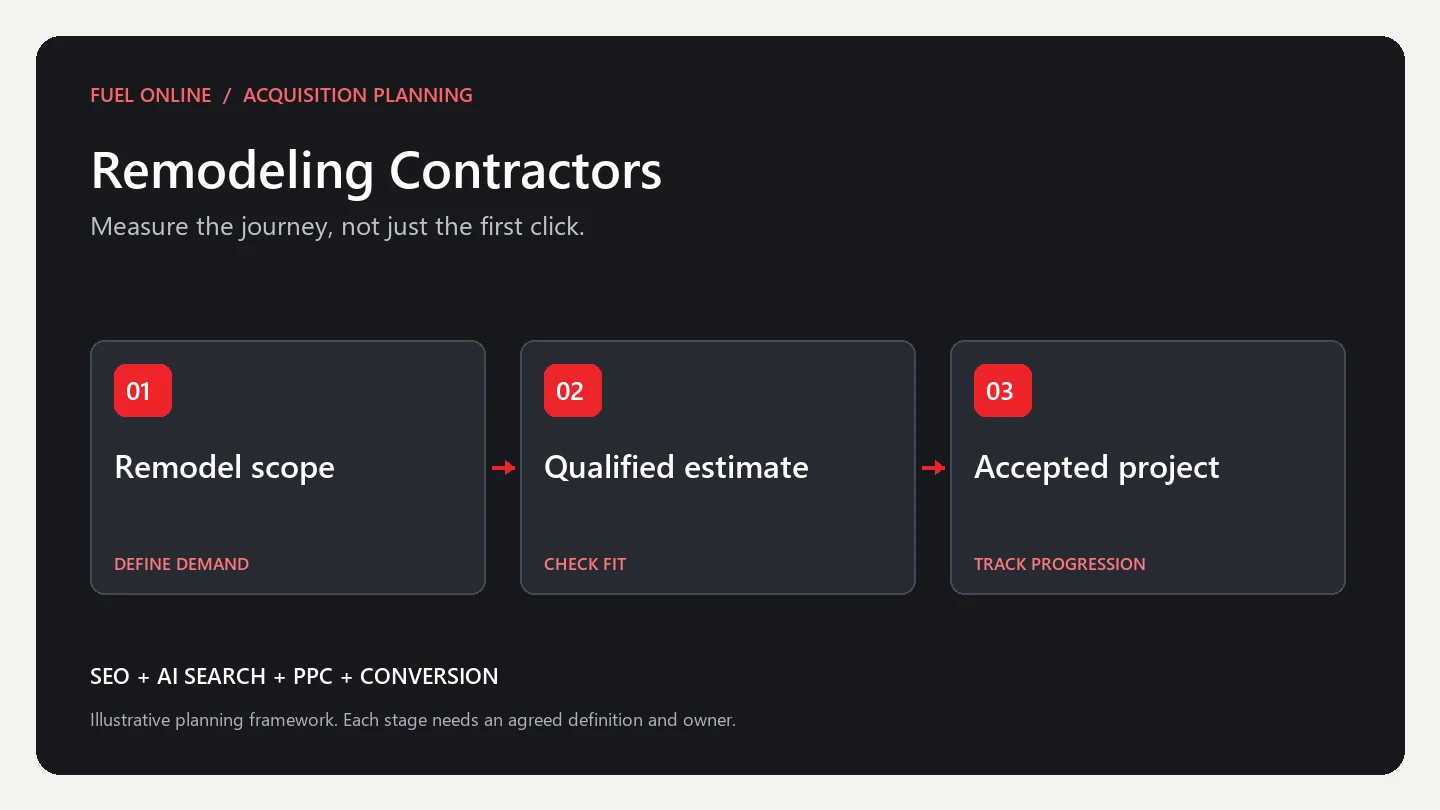
What remodeling contractor SEO changes for remodeling demand
Search strategy begins with the buying decision, not a list of high-volume phrases. Fuel separates research, comparison, local, and action intent for remodeling contractors pursuing projects that fit their service area, scope, and production model. One primary page owns each meaningful decision so several thin pages do not compete with one another.
The technical review covers crawl access, indexation, canonicals, redirects, rendering, and internal links. Content briefs then turn permissioned project photography, accurate scope and location details, reviewed process information, and substantiated material claims into useful service, portfolio, process, investment, service-area, and project-fit pages with a clear audience, limits, and next step.
A practical remodeling contractor SEO diagnostic
Use this diagnostic when search visibility improves but the receiving team does not see a comparable change in qualified remodeling consultations. The diagnostic for remodeling contractor SEO starts with the observable symptom, checks the page, source, campaign, or handoff responsible for it, and ends with one reviewed action, owner, and validation method.
Observable symptom
Search visibility grows around 'handyman near me' while the business needs discovery closer to 'whole home remodeling in Newton'.
What to inspect in remodeling contractor search engine optimization
Review query-to-page fit, indexation, competing pages, internal links, proof, and the next step shown on the landing page.
Decision criteria for SEO services for remodeling contractors
Consolidate, repair, expand, or retire the page before adding another URL for the same decision.
Inspectable output
A query-to-page decision and validated release ticket tied to inquiry fit and qualified design or estimate consultations, not rankings alone.
SEO services for remodeling contractors deliverables you can inspect
The team receives query-to-page decisions, a technical priority register, briefs, internal-link actions, and release validation tied to inquiry fit.
- Query-to-page map and overlap decisions, used to define the remodeling contractor SEO scope.
- Technical priority register and validation method, used to govern the remodeling contractor search engine optimization release.
- Internal-link plan, used to evaluate the SEO services for remodeling contractors decision.
- Evidence-backed page briefs
- Release log tied to accepted inquiry quality
Illustrative remodeling example
Illustrative example, not a client result: Fuel would map the search need represented by a property owner planning a supported project in the contractor’s service area and investment range to one authoritative decision page and keep repair, handyman, DIY, product, and out-of-area requests out of that conversion path. The review would resolve competing URLs, missing proof, internal links, and indexation before another page is commissioned.
The remodeling contractor search engine optimization review would end with a query-to-page decision, an implementation ticket, and a validation check. Search visibility is diagnostic; continued work depends on whether the released page contributes to qualified remodeling consultations.
Within SEO services for remodeling contractors, the buyer team can inspect the artifact, approval, and next investment decision.
How commercial progress is judged
Fuel connects page, query, campaign, or source context with acceptance, rejection reasons, response, capacity, and qualified estimate requests, consultations held, proposals, and signed-project pipeline. Diagnostic measures explain where the journey breaks; they do not replace the business outcome.
The decision record for remodeling contractor SEO states what changed, why it changed, who approved it, and whether the next action is to expand, revise, consolidate, or stop.
Reporting for SEO services for remodeling contractors must connect the service-specific diagnostic to qualified remodeling consultations, explain data limits, and name the next decision rather than treating activity as proof of value.
Questions to ask a remodeling agency
Ask for a sample query-to-page map, technical ticket, content brief, and release validation. Confirm who can implement site changes and how accepted inquiries affect the search roadmap.
When reviewing remodeling contractor SEO, require a named practitioner, implementation owner, approval path, and sample artifact. Reject unsupported promises of rankings, citations, lead volume, cost, or revenue.
How we measure remodeling contractor search engine optimization
- qualified estimate requests
- consultations held
- proposals
- signed-project pipeline
Connect organic discovery to inquiry quality
Organic inquiry qualification rate = suitable organic inquiries ÷ organic inquiries reviewed.
Illustrative arithmetic: 12 suitable inquiries out of 20 reviewed organic inquiries is a 60% qualification rate. This measures inquiry fit, not search market share, and requires a recorded source and an agreed definition of suitable.
Agree on the baseline, data source and qualification criteria before comparing results. Separate visibility from inquiries and accepted business opportunities.
CONNECTED SERVICES
Choose the right next step for your business
Explore Fuel’s SEO capabilities, published campaign work and team to evaluate how we would support your organization.
BEFORE YOU CHOOSE AN AGENCY
Questions about remodeling contractor search engine optimization
What does the first SEO month produce?
During the first month, the remodeling contractor SEO scope produces a query-to-page map, technical priorities, overlap decisions, and the first brief or consolidation ticket. Fuel also records the client inputs and approval needed for the first release.
What does Fuel need from our remodeling team?
Effective remodeling contractor search engine optimization work requires site and search-data access, an implementation owner, subject-matter reviewers, approved proof, and accepted or rejected inquiry feedback. Fuel identifies missing access or ownership before work is scheduled around it.
How will we know the work is commercially useful?
Under SEO services for remodeling contractors, commercial usefulness depends on whether the diagnostic connects to qualified remodeling consultations, the data limits are stated, and the evidence supports a clear keep, revise, or stop decision.
Should SEO and paid search work together?
Yes, when they share query evidence, landing-page learning, and qualification feedback while retaining separate attribution and budget decisions. In remodeling contractor SEO, paid search can test active demand as SEO develops durable decision pages.
What does a credible remodeling contractor search engine optimization scope include?
A credible remodeling contractor search engine optimization scope includes query ownership, technical priorities, evidence-backed briefs, implementation responsibilities, release validation, and inquiry-quality review. It also names the client dependencies, practitioner, deliverable, and approval path.
How should SEO services for remodeling contractors report commercial progress?
Reporting under SEO services for remodeling contractors should connect the service-specific diagnostic to qualified remodeling consultations, show what changed and why, state data limits, and name the next decision.
Make your next agency conversation specific.
Bring one important search such as 'whole home remodeling in Newton', the page meant to answer it, and examples of unsuitable inquiries. The first working session on remodeling contractor search engine optimization will identify the priority artifact, evidence, owner, and approval decision for qualified remodeling consultations.
Talk with a Fuel strategist →