
FUEL ONLINE / Remodeling Contractors / PPC & Google Ads
Remodeling PPC and Google Ads Agency

Remodelers need projects that fit their geography, minimum scope, design process, and production calendar, not handyman or material-only requests. Fuel separates paid searches such as 'whole home remodeling in Newton' from low-fit intent such as 'handyman near me', then aligns ads, geography, landing pages, and contact actions with project type, location, ownership, investment range, design status, and timing. Search-term reviews and sales team feedback move budget toward qualified design or estimate consultations, not the cheapest clicks or form fills.
Project type and property location; Ownership and project scope; Approximate investment range and timing; Design-only versus construction engagement
Compare remodeling paid demand through the whole project purpose
A remodeling PPC agency should distinguish the homeowner's actual project purpose from the words that happen to appear in a search or form. Fuel Online can compare the query, advertisement, destination and received requirement before changing budget. A phrase about repair can describe a small unrelated task or appear within a larger supported project. The contractor supplies its actual scope. The useful campaign decision preserves relevant demand while identifying the specific message or targeting condition that creates unsuitable requests.
Start with the contractor's offered project relationship
Ask the business which project types it wants to discuss and how the initial consultation works. The advertising invitation should express that actual relationship. A whole-home offering, a specialist room project and a small service request can involve different scope and next steps. The agency should not infer an offering from a familiar project term, attractive photograph or the fact that a phrase has measurable search activity.
Use the approved service resource and project context as evidence. A completed project can help a homeowner evaluate the business within its stated meaning, while the current offering establishes what the contractor now wants to discuss. The destination should connect those roles. If an advertisement implies a broader service than the page or receiving process supports, identify that exact discrepancy instead of treating every unsuitable contact as a platform problem.
| Search or request purpose | Evidence to inspect | Proportionate campaign question |
|---|---|---|
| Small isolated repair | Complete request compared with the actual offering. | Did the message imply unsupported work? |
| Broader supported project mentioning repair | Stated overall project relationship. | Would a broad exclusion remove relevant demand? |
| Unclear scope | What the message establishes and what is missing. | Which concise clarification would resolve the uncertainty? |
| Existing conversation | Relationship with a known request. | Is this continuation being counted as new acquisition? |
| Second property | Distinct stated requirement despite shared contact. | Does the receiver preserve the separate project? |
The comparison is a review method, not a universal negative-keyword list. A broad exclusion can remove relevant project research along with genuinely unrelated tasks. Ask which intended conversations might be affected and what more precise distinction is available. Conversely, a broad advertisement can invite work the business does not offer. In that case, the message and destination need inspection before the agency assumes that targeting alone will resolve the mismatch.
Work through an ambiguous repair request
Imagine a fictional contractor promoting whole-home remodeling. One person asks for a small isolated repair that the business does not offer. Another describes a broader supported project while mentioning repair as one element of the existing condition. The shared word does not establish the same commercial purpose. Ask the agency to read the complete available context and compare it with the contractor's actual offering before recommending an exclusion.
For the isolated request, inspect whether the advertisement or destination implied that the business provides that service. A clearer scope explanation may be needed. For the broader project, preserve the stated relationship and route it for the company's review. The agency should not promise that it is qualified or accepted; it should avoid removing it merely because one word also appeared in an unsuitable message.
Now remove the broader context from the second message. The remaining phrase may be ambiguous. Record what is known and which question would clarify the intended project. A review process that forces every uncertain case into suitable or unsuitable can hide a weak public invitation. A concise supported clarification may be more useful than either a sweeping exclusion or a more restrictive form that asks the homeowner to invent a technical category.
Match the destination to the conversation advertised
A service-focused advertisement should lead to an explanation of that offering and its actual initial step. The landing page can use approved project images and process information without implying that every visible feature or contributor relationship applies to the visitor's project. Ask the agency to show where the page establishes scope, operating area and the supported contact action using the business's maintained facts.
The next action should describe what actually occurs. A request to discuss a project is different from an arranged consultation, completed estimate or agreed proposal. An appealing call to action can still preserve that meaning. If the receiver must review requests before scheduling, the confirmation should not quietly become a booking promise. The agency should compare the advertisement, button, confirmation and received record as one path.
Use a clearly fictional administrative test through an authorized route. Select a supported project purpose, include a marked uncertainty and inspect the confirmation and received record. Does the broad requirement survive? Does an unknown design status remain unknown? The exercise does not need real property documents or a technical assessment. It checks that the advertised conversation reaches the contractor with the meaning the public path created.
Compare cost at the same stage
Suppose two fictional campaigns each spend nine hundred currency units. Campaign A records eighteen raw contacts, while Campaign B records six arranged consultations. Their displayed cost figures are fifty per contact and one hundred fifty per arranged consultation. The arithmetic is correct, but it does not establish that A is more efficient. The denominators describe different stages, and the report needs a compatible comparison before drawing a commercial conclusion.
Ask how many of A's contacts reached an arranged consultation, or how many raw contacts B received, using the same stated definitions. If the matching records are unavailable, keep the comparison incomplete. Do not borrow the other campaign's progression rate or rename a form event as a consultation. The exercise is a reporting check, not a claimed result or a recommended budget for an actual contractor.
Then inspect the unit behind each contact total. A homeowner can call and submit a form about one project, correct an earlier detail or return about an existing conversation. Another request from the same person can concern a second property. The approved receiving process determines those relationships. A shared phone number should not automatically erase a distinct project, while another channel event should not automatically create one.
Record why a request did not progress
Use broad categories appropriate to the contractor's approved reporting process. An unsupported project, outside-area request, unclear design progress, repeated continuation and unanswered suitable message have different meanings. Ask which evidence supports the category and which next action follows. The landing page may need a clearer boundary, the receiving path may need a repair or the campaign may need a more precise exclusion.
A classification can remain pending when the record is insufficient. That uncertainty helps identify a missing question or review step. It should not be silently converted into a favorable lead category or treated as proof that the campaign produced no useful demand. Ask the agency to separate what the request states, what the contractor reviewed and what later happened. This makes the feedback useful for both acquisition and receiving improvements.
Keep private project information within the company's actual systems and access rules. Routine campaign review generally needs the category, stage and relevant reason rather than a copy of every document. The agency can inspect a fictional acceptance set and use appropriate aggregate feedback for later decisions. A more detailed marketing spreadsheet is not automatically a better representation of project fit.
Keep measurement revisions separate from campaign effects
A changed reporting rule can alter the conversion total even when the underlying customer activity remains the same. For example, the team may begin excluding marked tests or grouping a clarifying call with its original request. Save the rule and effective date. Ask whether comparisons use the same definitions before attributing the whole difference to targeting, copy or spend.
Similarly, several changes released together can produce an observation without isolating each contribution. A corrected invitation and receiving connection may form a sensible coordinated pilot. The delivery record should identify both, while the later report should state what the combined evidence establishes. It should not claim that one new headline caused every subsequent consultation when the design does not support that conclusion.
Budget decisions should use compatible stages, actual scope and the contractor's current business input. The agency can explain the next bounded test or correction from those observations without inventing a universal threshold. A temporary hold on an inaccurate path differs from a conclusion that the service has no demand. State the issue and the condition for reviewing the decision so another contributor can understand it later.
Compare the work that becomes inspectable
Give proposed suppliers the same fictional ambiguous-request set and the same contractor offering. Ask each to identify the suitable, unsuitable and unresolved cases, then explain the campaign and destination action. The stronger answer names the evidence and the risk of a broad rule. It does not depend on a longer list of exclusions or a promise to eliminate every irrelevant contact.
Compare implementation responsibility as well. A reviewed query decision, revised advertisement and corrected destination need named owners and a completion check. If another supplier controls the website or receiving system, identify that dependency. A completed recommendation is different from an implemented path. The buyer should know which parts of the first release will actually become usable and which remain assigned elsewhere.
At review, ask for one documented query decision, one checked public journey and one reproducible stage comparison. These make the campaign scope commercially meaningful. Remodeling paid search becomes easier to evaluate when the offering, invitation and received project purpose agree, while consultations and later accepted projects remain observations established through the contractor's real records.
Compare a scope clarification with a broad query exclusion
Use two proposed repairs for the fictional ambiguous repair request. The first blocks every phrase containing the shared word. The second keeps the broader supported project eligible for review while clarifying the advertisement and destination around the contractor’s actual offering. Ask what evidence would justify each approach and which relevant requests could be lost. The comparison should name the business assumption inside the campaign rule rather than hide it in an unexplained setting.
A narrower message can also have tradeoffs. It may help readers recognize the intended project while leaving some genuinely uncertain cases for clarification. That is not automatically a defect. The agency should identify which uncertainty can be resolved through better public information and which belongs in the contractor’s initial conversation. A marketing page should not claim a complete project assessment merely to make the campaign category appear precise.
Before retaining a change, inspect the implemented message, destination and a compatible set of received stages. Record the definition and period used. A reduced raw-contact total can be consistent with clearer scope, but it does not prove a better commercial result without the corresponding review. A higher total can include more repeated or unrelated activity. The decision should follow the actual records and contractor input, with unresolved relationships visible rather than converted into a preferred conclusion.
For relevant paid requests that lose evolving scope at contact, remodeling conversion review can inspect the specific transition before acquisition expands.
AGGRESSIVE FROM THE START
One month. The work many agencies stretch across three.
Our mandate: move faster, go deeper and put experienced specialists to work immediately.
Fuel attacks the work in parallel: site audits, technical errors, new content, internal links, backlink outreach and conversion improvements. Your agreed scope determines the channels; urgent fixes do not wait behind a drawn-out planning phase.
The remodeling PPC agency brief identifies visibility and lead barriers. Actionable fixes move into production while deeper analysis continues.
Your remodeling contractor Google Ads work runs alongside industry-specific content, relevant links and earned-authority outreach, based on your agreed scope.
The PPC management for remodeling contractors review shows completed work, lead quality and the next opportunities. You see who owns each action.
Fast execution is the operating standard. Access, approvals and scope shape delivery; search and revenue results have their own timelines.
What remodeling PPC agency changes for remodeling demand
Paid acquisition becomes useful when the account mirrors the business. Fuel separates campaigns when geography, service, economics, qualification, or next step differs. The distinction between 'whole home remodeling in Newton' and 'handyman near me' becomes visible in queries, exclusions, ads, pages, and reporting.
Each ad group has a defined buyer, promise, evidence need, destination, and contact action. The landing page uses permissioned project photography, accurate scope and location details, reviewed process information, and substantiated material claims and gives the sales team project type, property location, ownership, investment range, design progress, and timing.
A practical remodeling contractor PPC diagnostic
Use this diagnostic when paid conversion volume improves but the receiving team does not see a comparable change in qualified remodeling consultations. The diagnostic for remodeling PPC agency starts with the observable symptom, checks the page, source, campaign, or handoff responsible for it, and ends with one reviewed action, owner, and validation method.
Observable symptom in remodeling PPC agency performance
Reported conversions increase, but search terms and landing pages still send 'handyman near me' demand instead of opportunities closer to 'whole home remodeling in Newton'.
What to inspect in remodeling contractor Google Ads
Review actual search terms, geography, ad promise, landing-page fit, contact action, and the sales, intake, or scheduling decision.
Decision criteria for PPC management for remodeling contractors
Add or remove a reviewed exclusion, separate the campaign, revise the landing page, or hold budget until the handoff works.
Inspectable output
A search-term and landing-page decision log showing what changed, why budget moved, and whether qualified design or estimate consultations improved.
PPC management for remodeling contractors deliverables you can inspect
The team receives a campaign and budget matrix, reviewed query decisions, exclusions, landing-page message map, conversion tracking, and a weekly budget log.
- Campaign, geography, and budget matrix, used to define the remodeling PPC agency scope.
- Reviewed query and exclusion set, used to govern the remodeling contractor Google Ads release.
- Ad and landing-page message map, used to evaluate the PPC management for remodeling contractors decision.
- Conversion and offline-disposition tracking
- Weekly search-term and budget decision log
Illustrative remodeling example
Illustrative example, not a client result: Fuel would separate paid-search demand from a property owner planning a supported project in the contractor’s service area and investment range and repair, handyman, DIY, product, and out-of-area requests in the account, then review the actual query, geography, promise, landing page, contact action, and final disposition before changing budget.
The remodeling contractor Google Ads decision log would show the exclusion, campaign split, landing-page revision, or budget hold and its owner. Spend expands only after reviewed evidence shows a stronger path to qualified remodeling consultations.
Within PPC management for remodeling contractors, the buyer team can inspect the artifact, approval, and next investment decision.
How commercial progress is judged
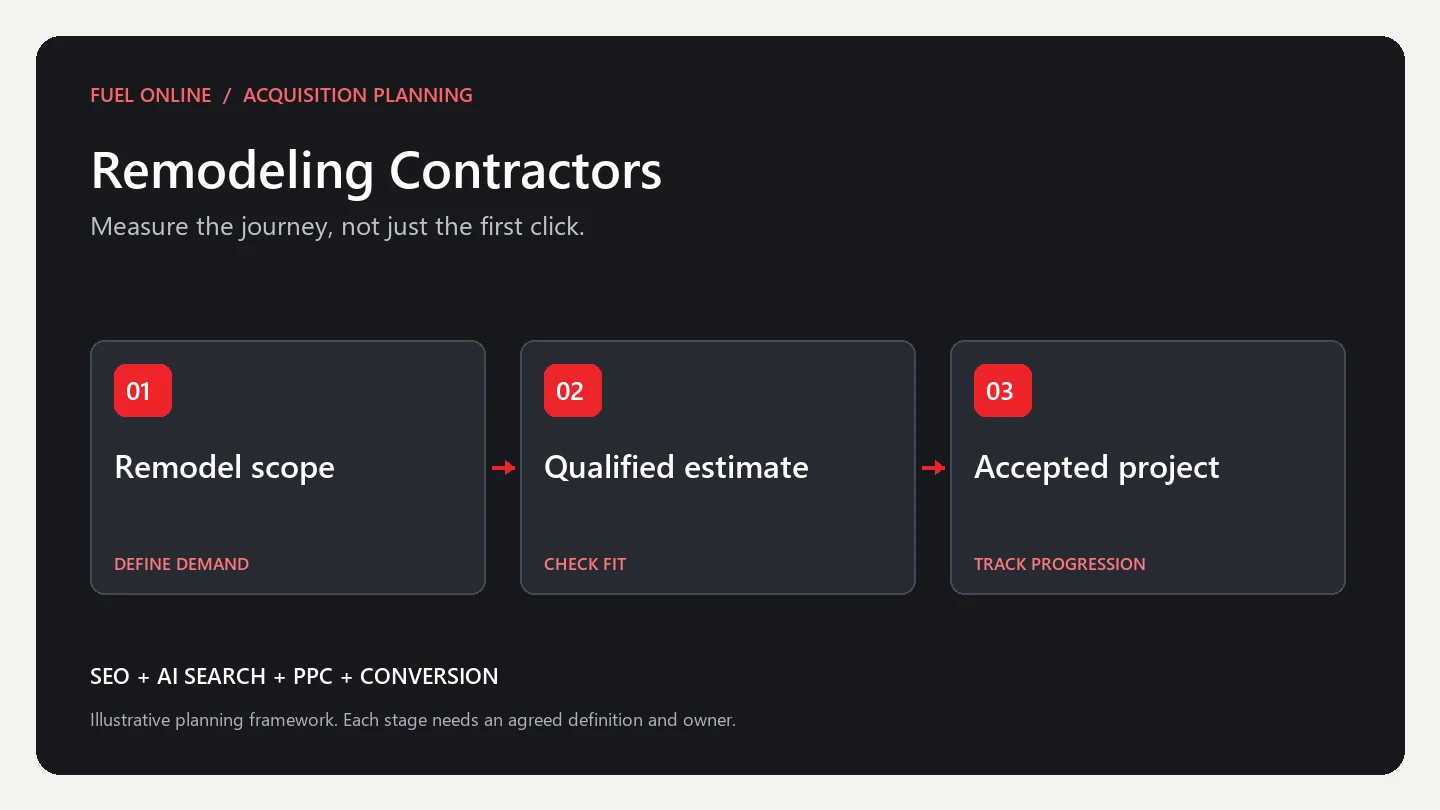
Fuel connects page, query, campaign, or source context with acceptance, rejection reasons, response, capacity, and qualified estimate requests, consultations held, proposals, and signed-project pipeline. Diagnostic measures explain where the journey breaks; they do not replace the business outcome.
The decision record for remodeling PPC agency states what changed, why it changed, who approved it, and whether the next action is to expand, revise, consolidate, or stop.
Reporting for PPC management for remodeling contractors must connect the service-specific diagnostic to qualified remodeling consultations, explain data limits, and name the next decision rather than treating activity as proof of value.
Questions to ask a remodeling agency
Ask for a search-term decision log, landing-page map, conversion definition, and budget-change record. Confirm who approves exclusions, creative, tracking, and offline disposition imports.
When reviewing remodeling PPC agency, require a named practitioner, implementation owner, approval path, and sample artifact. Reject unsupported promises of rankings, citations, lead volume, cost, or revenue.
How we measure remodeling contractor Google Ads
- qualified estimate requests
- consultations held
- proposals
- signed-project pipeline
Use a cost metric that reflects qualified demand
Cost per qualified inquiry = campaign spend ÷ inquiries meeting the agreed criteria.
Define the included spend, reporting window and qualification rules before comparing campaigns. Track raw leads separately so cheaper but unsuitable inquiries do not make performance look better.
Agree on the baseline, data source and qualification criteria before comparing results. Separate visibility from inquiries and accepted business opportunities.
CONNECTED SERVICES
Choose the right next step for your business
Explore Fuel’s PPC & Google Ads capabilities, published campaign work and team to evaluate how we would support your organization.
BEFORE YOU CHOOSE AN AGENCY
Questions about remodeling contractor Google Ads
What happens before Fuel increases paid spend?
During the first month, the remodeling PPC agency scope produces a search-term review, campaign and geography matrix, conversion definition, and the first budget decision. Fuel also records the client inputs and approval needed for the first release.
What does Fuel need from our remodeling team?
Effective remodeling contractor Google Ads work requires ad-account, analytics, landing-page, call, and disposition access plus budget constraints, approved claims, and timely query review. Fuel identifies missing access or ownership before work is scheduled around it.
How will we know the work is commercially useful?
Under PPC management for remodeling contractors, commercial usefulness depends on whether the diagnostic connects to qualified remodeling consultations, the data limits are stated, and the evidence supports a clear keep, revise, or stop decision.
What should the first remodeling PPC agency priority be?
Start with the query, geography, ad promise, landing page, contact action, and receiving path closest to qualified remodeling consultations. The remodeling PPC agency plan should hold expansion when a landing-page or handoff defect would turn more spend into unusable conversions.
What does a credible remodeling contractor Google Ads scope include?
A credible remodeling contractor Google Ads scope includes query and exclusion review, geography and budget rules, landing-page alignment, conversion definitions, disposition feedback, and documented budget decisions. It also names the client dependencies, practitioner, deliverable, and approval path.
How should PPC management for remodeling contractors report commercial progress?
Reporting under PPC management for remodeling contractors should connect the service-specific diagnostic to qualified remodeling consultations, show what changed and why, state data limits, and name the next decision.
Make your next agency conversation specific.
Bring recent search terms, landing pages, and accepted or rejected contacts so we can identify the first paid-media decision. The first working session on remodeling contractor Google Ads will identify the priority artifact, evidence, owner, and approval decision for qualified remodeling consultations.
Talk with a Fuel strategist →