
FUEL ONLINE / Remodeling Contractors / Lead generation
Remodeling Lead Generation and Conversion Agency

Remodelers need projects that fit their geography, minimum scope, design process, and production calendar, not handyman or material-only requests. For remodeling lead generation, Fuel defines fit through project type, location, ownership, investment range, design status, and timing, then aligns pages, forms, calls, routing, and follow-up with that decision. The sales team receives useful source and qualification context, while marketing receives rejection and progression feedback. The aim is more qualified design or estimate consultations without rewarding raw lead volume.
Project type and property location; Ownership and project scope; Approximate investment range and timing; Design-only versus construction engagement
Preserve the evolving remodeling request before treating it as a defined project
A remodeling lead generation agency should help the contractor understand the homeowner's stated project and what remains undecided. Fuel Online can inspect the initial request, later clarification and consultation record before recommending more acquisition. A broad idea, developed design and request for an estimate can require different conversations. The public form should preserve useful context without pretending to create a final scope, approve a property or commit the business to a proposal.
Ask what changes the next conversation
Start with the contractor's actual initial process. Ask which details help the receiver identify the broad project type, property location, design progress and intended next step. The purpose is to prepare an appropriate conversation, not collect every document the team might eventually need. A field earns its place when the receiver can explain how it changes routing, preparation or a necessary clarification.
Keep uncertainty explicit. A homeowner may not know whether the work belongs in one service category or another, and a proposed time frame can still be tentative. Forcing a guess can create a misleadingly precise record. The form can offer a supported way to explain the uncertainty while leaving professional project assessment with the contractor. The agency should identify the missing meaning rather than add more mandatory fields by default.
| Context | What it helps the receiver understand | What it does not establish |
|---|---|---|
| Broad project type | The conversation the homeowner wants. | A final specification or accepted job. |
| Property context | The relevant location supplied by the sender. | Confirmed feasibility or service acceptance. |
| Design progress | What materials or ideas the person describes. | Technical completeness or contractor responsibility. |
| Timing preference | The requested administrative context. | An agreed production schedule. |
| Later correction | Which earlier request is being updated. | Another acquired project by default. |
The comparison helps the buyer ask what information the release will preserve. An investment preference is not a contractor's price. A hoped-for start is not an agreed schedule. A description of existing design material is not confirmation that the contractor accepts that delivery arrangement. The company supplies the actual process and public wording. Marketing should make those distinctions understandable without turning the inquiry into a technical or contractual assessment.
Work through a fictional scope revision
Imagine a fictional homeowner submitting an initial kitchen-remodeling inquiry for Property North. The person later says the discussion may include adjacent living space, then sends another message correcting the hoped-for timing. Under the exercise's assumptions, those events continue one developing project conversation. They do not automatically establish three new opportunities or a final whole-home specification. The receiver needs the revised interest and its relationship to the original request.
Keep the current stated scope distinct from the source of the first visit. The homeowner may have arrived through a kitchen example, but the later conversation can concern a broader supported offering. The page label should not force the inquiry to remain a kitchen-only category. Conversely, a broader phrase in a later message does not prove that the contractor has accepted the expanded work. Preserve the request and the contractor-controlled review stage separately.
Now add a second property. If the same person asks about work at Property South, the team should inspect whether that is a distinct candidate project. Matching contact details alone should not merge the two. The business's approved process defines the relationship. The agency's acceptance exercise should show how the received record preserves the distinction and what happens when a follow-up message does not identify which property it concerns.
Keep design progress descriptive rather than decisive
A homeowner can have inspiration images, preliminary notes or materials prepared with another contributor. Ask what the contractor needs to know for the initial conversation and which later route handles the material appropriately. Marketing should not infer that the existence of a drawing establishes design completeness, ownership, technical suitability or the contractor's responsibility for every subsequent stage. Those are project-specific decisions outside the lead form's role.
A useful public explanation can state the next step using the contractor's actual process. If the company discusses projects at different levels of development, explain how the inquiry begins without promising an identical response for every case. If an arrangement is unsupported or unclear, identify the factual question for the business. The agency should not create another service commitment simply to avoid an unresolved value in a reporting field.
For acceptance, give the receiver fictional descriptions of two requests with different design progress. Ask whether the record supplies enough context to prepare the next administrative conversation and identify what remains to clarify. The test is not whether staff can determine project feasibility from the form. It is whether the marketing path preserves the information it actually invited the person to provide.
Make corrections visible to the next person handling the request
A correction can matter without creating another prospect. Ask how the actual system presents a revised location, timing preference or scope statement. The current information should be usable, while the relationship explains that it updates an earlier request. Keep the necessary detail within the contractor's approved systems and access rules. Routine marketing reports do not need to circulate property documents to demonstrate that a correction occurred.
Compare the confirmation with the received record. If the public action requests a conversation, the confirmation should not announce an agreed estimate appointment unless the process actually arranged one. A requested time and a scheduled consultation are different observations. The agency can make the invitation clear and appealing while retaining the contractor's real decision sequence. Unsupported certainty can create confusion before the first useful discussion begins.
Repeated contacts deserve investigation rather than automatic credit. A homeowner may submit again because the first confirmation was unclear or use another route because the request seemed lost. That pattern can reveal a receiving or communication issue. Ask which evidence supports the interpretation and what change would address it. Counting another form event as another acquired project can hide the transition problem the agency should repair.
Test the public path without creating a real project
Use clearly fictional administrative values through an authorized test route. Follow the project invitation, select the supported context, read the confirmation and inspect the received record with the responsible person. Repeat the scope revision and second-property variants. Mark every test so it does not enter ordinary sales reporting. The exercise does not require real property information, drawings or a professional site review.
A useful test log includes the original request, expected meaning, received result and specific issue. If the service selection survives but its label confuses the receiver, clarify the label or documented mapping. If the scope revision disappears, inspect that connection. If the form asks for information nobody uses at this stage, reconsider its role. These findings justify proportionate changes instead of a complete redesign based only on form length.
Ask an unfamiliar colleague to interpret the fictional records using the documented rules. They should distinguish a continuation, correction and separate property without needing the campaign manager's private explanation. Where the records are insufficient, the colleague should see the uncertainty and required clarification. This checks a usable receiving method rather than a demonstration that works only because everyone already knows the intended answer.
Keep consultation, proposal and accepted project separately measurable
A submitted inquiry establishes contact. An arranged consultation, completed discussion, proposal and accepted project need their own records and definitions. The contractor may use different steps for different supported offerings. Ask the agency to show which observation establishes each reported stage. A successful form event should not be renamed as an accepted project merely because it is the furthest stage the marketing platform can see.
Consider a fictional review with five recorded contact events. Three continue one Property North conversation, one concerns Property South and one is a marked test. Under those assumptions, the events describe two candidate project conversations and an excluded test. If only one consultation was actually arranged, report that stage as one. The arithmetic follows the exercise's relationships; it is not a claim about real lead quality or the company's commercial performance.
Later-stage gaps should remain visible. If the team cannot connect a proposal or acceptance to an inquiry reliably, do not estimate the outcome from traffic or a typical rate. The agency can still explain the delivered receiving improvement and identify what additional approved record is needed. A report becomes more useful when the business can reproduce its smaller supported totals than when it presents a complete-looking funnel built from assumptions.
Choose the next repair through the contractor's review
At a recurring review, classify the actual reason a sample request did not progress. Unsupported scope, unclear design status, missing property context, a repeated continuation and a lost suitable message are different findings. Ask which public wording, field relationship or receiving step caused the problem. The next task should follow that observation rather than default to another landing page or more traffic.
Compare proposals using the same evolving-project exercise. The stronger remodeling conversion scope preserves the homeowner's stated meaning, implements a specific transition repair and leaves a repeatable acceptance record. It also makes clear what remains for the contractor's professional and commercial process. That helps the business evaluate useful consultation demand without treating every contact event as a finished project specification or an accepted job.
Keep the consultation record separate from the changing project description
Return to the fictional Property North conversation after a consultation is arranged. The homeowner later broadens the stated interest, while the appointment itself remains on the calendar under the business’s process. The revised requirement and the existing appointment are related observations; one should not silently erase the other. Ask the agency to show how the receiving team sees the current request and which stage the record actually establishes. A scope update does not automatically mean another consultation occurred.
Now suppose a later note says the person is asking only about Property South. The team should clarify whether the original conversation continues, changes purpose or remains separate. Marketing should preserve the stated relationship and the pending question rather than choose the category that makes the pipeline appear larger. The actual commercial process determines what happens next. The agency’s contribution is a record that helps the responsible person make that decision.
Compare the test result with the report. If the system can establish two candidate property conversations but only one arranged consultation, both facts can be represented with their own units. If the relationship between a later message and either property is unresolved, that item remains pending. The report should not infer another accepted project from an additional contact event or treat a corrected value as proof that a project has advanced.
This distinction is useful when evaluating conversion work because the form may function perfectly while the receiving meaning is still unclear. Ask which concrete field, note, relationship or instruction the agency would change. A proportionate repair should help staff interpret the evolving request without requiring the public marketing path to become a project-management or estimating system.
When the request is preserved but public project messages imply different next steps, remodeling journey coordination can align the invitation.
AGGRESSIVE FROM THE START
One month. The work many agencies stretch across three.
Our mandate: move faster, go deeper and put experienced specialists to work immediately.
Fuel attacks the work in parallel: site audits, technical errors, new content, internal links, backlink outreach and conversion improvements. Your agreed scope determines the channels; urgent fixes do not wait behind a drawn-out planning phase.
The remodeling lead generation brief identifies visibility and lead barriers. Actionable fixes move into production while deeper analysis continues.
Your remodeling contractor lead generation company work runs alongside industry-specific content, relevant links and earned-authority outreach, based on your agreed scope.
The lead generation services for remodeling contractors review shows completed work, lead quality and the next opportunities. You see who owns each action.
Fast execution is the operating standard. Access, approvals and scope shape delivery; search and revenue results have their own timelines.
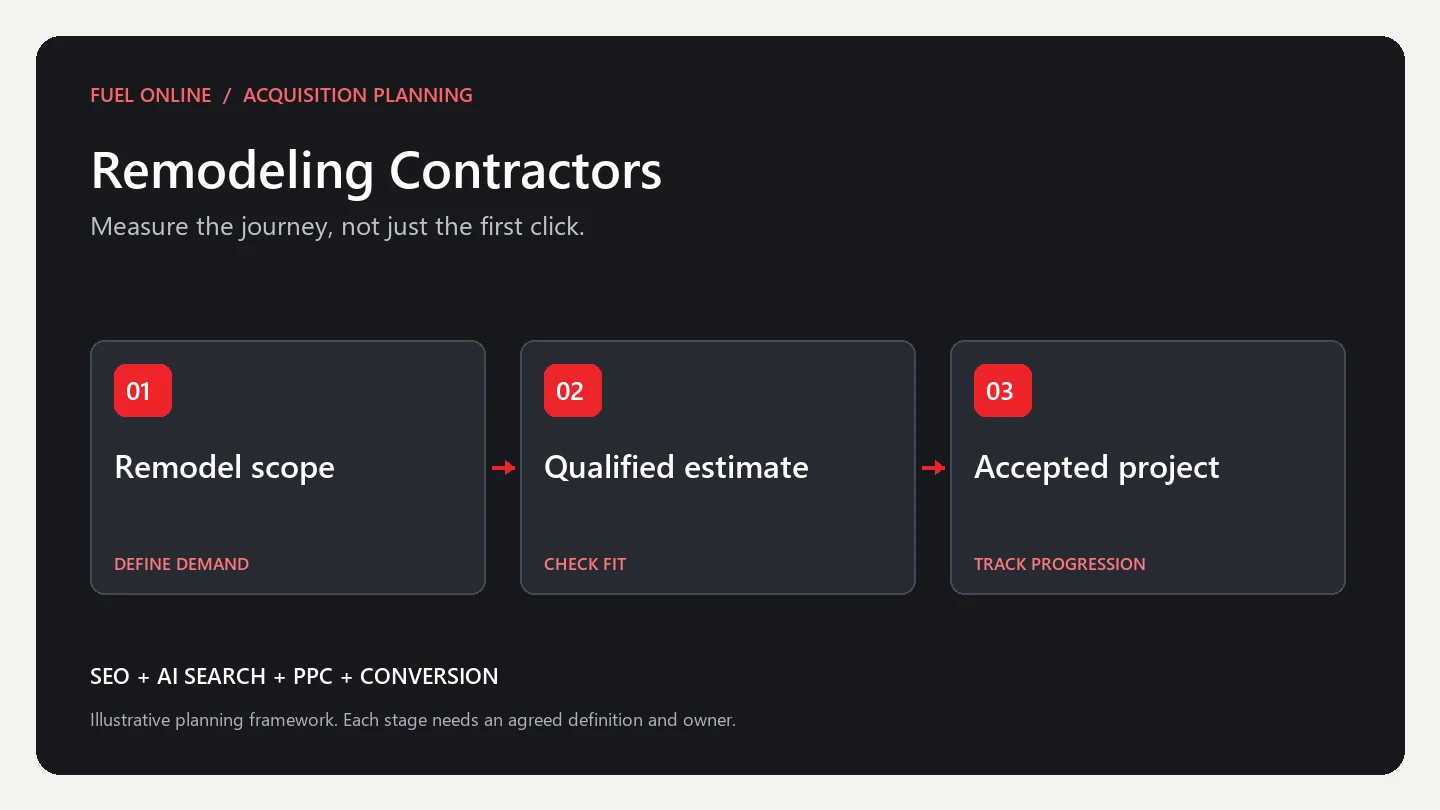
What remodeling lead generation changes for remodeling demand
Lead generation starts with the receiving team's decision. Fuel documents what counts as an accepted next step, what does not fit, and who owns each route. For remodeling, acceptance depends on project type, location, ownership, investment range, design status, permitting context, and timing.
The conversion path asks only what changes fit, routing, or preparation. It preserves project type, property location, ownership, investment range, design progress, and timing, keeps sensitive details in approved systems, and gives unsuitable visitors a clear alternative instead of forcing every request into sales.
A practical remodeling contractor leadgen diagnostic
Use this diagnostic when form submissions and calls increase but the receiving team does not see a comparable change in qualified remodeling consultations. The diagnostic for remodeling lead generation starts with the observable symptom, checks the page, source, campaign, or handoff responsible for it, and ends with one reviewed action, owner, and validation method.
Observable symptom
Forms and calls increase, but suitable requests related to 'whole home remodeling in Newton' lose context, wait too long, or reach the wrong owner.
What to inspect in remodeling contractor lead generation company
Review the page promise, fields, call handling, routing, response time, follow-up attempts, and final sales, intake, or scheduling decision.
Decision criteria for lead generation services for remodeling contractors
Change the question, route, response rule, or follow-up step responsible for the lost or unsuitable request.
Inspectable output
A tested routing or follow-up change with an owner, acceptance rule, and measure tied to qualified design or estimate consultations.
Lead generation services for remodeling contractors deliverables you can inspect
The team receives an accepted-request definition, path map, routing and response rules, CRM dispositions, and a controlled conversion-test log.
- Accepted-lead and exclusion specification, used to define the remodeling lead generation scope.
- Page, form, and call-path map, used to govern the remodeling contractor lead generation company release.
- Routing, response, and follow-up ownership, used to evaluate the lead generation services for remodeling contractors decision.
- CRM fields, dispositions, and duplicate rules
- Quality review and controlled test log
Illustrative remodeling example
Illustrative example, not a client result: The request loses project type, property location, ownership, approximate range, timing, or design status. Fuel would test the page, form or call path, route, response rule, follow-up, and final disposition to find the first point where useful context disappears.
The remodeling contractor lead generation company test would document the changed field, route, response rule, or follow-up step and its owner. The revision stays only when the receiving team sees a clearer path to qualified remodeling consultations.
Within lead generation services for remodeling contractors, the buyer team can inspect the artifact, approval, and next investment decision.
How commercial progress is judged
Fuel connects page, query, campaign, or source context with acceptance, rejection reasons, response, capacity, and qualified estimate requests, consultations held, proposals, and signed-project pipeline. Diagnostic measures explain where the journey breaks; they do not replace the business outcome.
The decision record for remodeling lead generation states what changed, why it changed, who approved it, and whether the next action is to expand, revise, consolidate, or stop.
Reporting for lead generation services for remodeling contractors must connect the service-specific diagnostic to qualified remodeling consultations, explain data limits, and name the next decision rather than treating activity as proof of value.
Questions to ask a remodeling agency
Ask for an accepted-request specification, route test, disposition set, and response ownership map. Confirm how the agency reviews missed, duplicate, unsuitable, and progressed inquiries.
When reviewing remodeling lead generation, require a named practitioner, implementation owner, approval path, and sample artifact. Reject unsupported promises of rankings, citations, lead volume, cost, or revenue.
How we measure remodeling contractor lead generation company
- qualified estimate requests
- consultations held
- proposals
- signed-project pipeline
Find the drop between interest and a useful next step
Next-step completion rate = qualified inquiries completing the agreed next step ÷ qualified inquiries reviewed.
Illustrative arithmetic: 15 completed appointments from 25 qualified inquiries is 60%. Use the next step that fits your business, such as a consultation, estimate or discovery meeting, and record the time allowed for completion.
Agree on the baseline, data source and qualification criteria before comparing results. Separate visibility from inquiries and accepted business opportunities.
CONNECTED SERVICES
Choose the right next step for your business
Explore Fuel’s Lead generation capabilities, published campaign work and team to evaluate how we would support your organization.
BEFORE YOU CHOOSE AN AGENCY
Questions about remodeling contractor lead generation company
What happens before Fuel changes the form?
During the first month, the remodeling lead generation scope produces an accepted-request definition, tested page and call paths, routing ownership, dispositions, and the first conversion repair. Fuel also records the client inputs and approval needed for the first release.
What does Fuel need from our remodeling team?
Effective remodeling contractor lead generation company work requires page, form, call, CRM, routing, and response access plus an accepted-request definition, receiving owners, and consistent dispositions. Fuel identifies missing access or ownership before work is scheduled around it.
How will we know the work is commercially useful?
Under lead generation services for remodeling contractors, commercial usefulness depends on whether the diagnostic connects to qualified remodeling consultations, the data limits are stated, and the evidence supports a clear keep, revise, or stop decision.
Should we buy more traffic before fixing lead handling?
Usually not. The remodeling lead generation plan should first correct the form, call path, routing, response, follow-up, or disposition problem that is losing suitable requests. Additional traffic is useful only after the receiving path can handle it.
What does a credible remodeling contractor lead generation company scope include?
A credible remodeling contractor lead generation company scope includes acceptance criteria, path testing, field and call design, routing and response ownership, CRM dispositions, and controlled conversion tests. It also names the client dependencies, practitioner, deliverable, and approval path.
How should lead generation services for remodeling contractors report commercial progress?
Reporting under lead generation services for remodeling contractors should connect the service-specific diagnostic to qualified remodeling consultations, show what changed and why, state data limits, and name the next decision.
Make your next agency conversation specific.
Bring a sample of suitable and unsuitable requests and show us where response, routing, or follow-up breaks. The first working session on remodeling contractor lead generation company will identify the priority artifact, evidence, owner, and approval decision for qualified remodeling consultations.
Talk with a Fuel strategist →