
FUEL ONLINE / Remodeling Contractors / Digital marketing
Remodeling marketing agency: Digital Strategy

Remodelers need projects that fit their geography, minimum scope, design process, and production calendar, not handyman or material-only requests. As your remodeling marketing agency, Fuel Online gives search, paid media, decision content, landing pages, and follow-up one commercial job. We build around project type, location, ownership, investment range, design status, and timing, exclude low-fit demand, and connect channel decisions to sales team feedback. You receive a 30/60/90 plan aimed at qualified design or estimate consultations, not a generic package of activity.
Project type and property location; Ownership and project scope; Approximate investment range and timing; Design-only versus construction engagement
Turn remodeling inspiration into an understandable consultation journey
A remodeling marketing agency should connect the project that attracts attention with the offering the contractor actually supports and the conversation a homeowner can begin. Fuel Online can coordinate portfolio content, search, advertising and conversion around that journey. Start with the missing transition rather than assume the company needs another complete redesign. A visitor who likes a photograph may still need to understand the contractor's role, the relevant service and what the consultation request starts.
Compare an inspiration-first journey with a process-first journey
Choose a published project example the contractor is authorized to use. Ask what a homeowner learns from its images and description, then follow the path to the current offering and next action. The gallery can establish particular project context while a service resource explains the broader arrangement. The connection should retain the contractor's supplied involvement instead of implying that every visible element represents an identical offering for every property.
Now begin at the process resource. A homeowner who already understands the general service may need to know how an initial conversation begins and which administrative information to prepare. The process-first journey can use a project example as supporting context, but it should not force the reader to infer the next step from a long gallery. These journeys can share facts while needing different introductions and links.
| Journey | Information needed | First repair to compare |
|---|---|---|
| Inspiration first | Approved project role connected with the current offering. | Clarify the project-to-service relationship. |
| Process first | Actual initial conversation and preparation. | Expose the maintained process destination. |
| Contact transition | Stated project context in the received record. | Repair the specific lost value or unclear invitation. |
| Shared asset reuse | Source-faithful role and scope. | Adapt the format without broadening the claim. |
| Cross-channel update | Named dependent resources. | Revise affected items and repeat the journey check. |
The comparison makes the first release easier to define. If the inspiration path loses the service relationship, clarify that connection. If the process path is accurate but hard to find, improve its visibility from the relevant resource. If the public invitation is clear but the received request loses project context, inspect the receiving transition. These are different assignments; a larger channel package does not automatically address the observed gap.
Work through a fictional portfolio-led release
Imagine a fictional contractor with a strong kitchen project story and a maintained broader remodeling offering. Visitors can see attractive work, but the project page never explains how its context relates to the current service. The first release might add a concise supported connection, a descriptive service link and an accurate consultation invitation. The contractor supplies the project role and actual process. The agency implements the public relationship without creating a new service claim.
The acceptance exercise should follow the actual journey. An unfamiliar reviewer identifies what the project establishes, which offering is relevant and what happens after the supported contact action. If the explanation still depends on the project team's private knowledge, clarify the public information. This is more useful than accepting a redesign solely because the revised page looks more modern or contains additional promotional language.
Now suppose the offering and process are already clear, but suitable visitors rarely reach them from the gallery. Another long service article may repeat information that exists. The proportionate work may be link placement, descriptive wording or a focused destination transition. Ask the agency to show the observation behind its recommendation and the artifact it will change. A good marketing plan preserves useful existing assets while repairing the actual break.
Make project evidence reusable without changing its meaning
Inventory the project images and descriptions the contractor can publish. For each, identify the approved role, scope and context. A shorter campaign message may use selected facts while retaining the condition that gives them meaning. Do not turn a caption about a particular contribution into a universal claim that the company performed every design and construction stage. The agency can create compelling material without expanding the factual statement.
A project image can orient the reader, while a service resource supplies the current offering and a process page supplies the supported next step. Ask what each proposed asset helps a homeowner understand. A large volume of creative is not a substitute for those connections. When choosing which asset to produce first, prefer the one that resolves a meaningful evaluation gap rather than another variation of an image the journey already explains well.
If a project description lacks useful context, name the missing contractor input. The agency should not invent material claims, project results or contributor relationships to fill the gap. An accurate service explanation can still guide the reader while the specific project question remains unresolved. A plan that identifies that dependency is more practical than one that either fabricates a story or treats every other task as blocked.
Give channels different responsibilities
Organic search can help homeowners discover a maintained service or project answer. Paid activity can introduce a defined project purpose with an appropriate destination. Content can explain the supported offering and relevant project context. Website work can clarify the next action and preserve the stated request. Ask the agency to identify each task's contribution instead of letting every channel claim the same broad result independently.
The shared resource should remain consistent across those uses. An advertisement can be shorter than the service page, but it should not imply a different project scope. A follow-up message can refer to the relevant example without converting that example into a promise about the reader's property. Identify the maintained factual source and which adaptations depend on it. That gives the business a usable way to manage several suppliers or campaigns.
A fictional change can test the coordination plan. Suppose the contractor revises the published consultation instruction for one offering. Identify the service resource, selected project links, advertisements and confirmation that depend on it. Update those items and repeat the relevant journey check. Unrelated projects can remain accurate. A precise dependency record prevents one administrative change from becoming an unnecessary rewrite of the entire portfolio.
Define delivery responsibility before the first release
Compare who supplies factual inputs, writes the content, implements pages, changes campaigns and checks the received record. A completed draft is useful work, but it is not a live connection if another supplier still needs to deploy it. A useful proposal names that handoff and the acceptance evidence. Similar package names can conceal very different responsibilities, especially when the contractor has an existing website or operational system managed elsewhere.
Ask which items can proceed independently and which depend on a missing fact or access. The agency can prepare a service-to-process brief while a particular project role awaits confirmation. It should not publish a guessed claim for speed, but it also need not hold unrelated approved work. The first release should be small enough for the business to inspect while complete enough for a homeowner to use.
A fictional administrative test can check the public action, confirmation and received context through an authorized route. Use marked values and avoid real property documents. Can the receiver distinguish the project described from the page that introduced the person? Does an uncertain scope remain uncertain? The exercise tests continuity of meaning, not whether a marketing form can perform a professional construction assessment.
Compare later observations without merging unlike stages
Keep visits, received inquiries, consultations, proposals and accepted projects separately recognizable. The company supplies the meaning of its actual stages. A gallery visit is not a project opportunity, while a form submission does not establish that a consultation occurred. Where a later relationship cannot be connected reliably, state the limit. The report should explain what the records establish rather than rename every measurable action as a commercial outcome.
Use compatible project categories when comparing channels. One path may attract early research, while another reaches homeowners prepared to discuss a supported offering. A combined activity total can be useful for a broad view, but it should not conceal those differences. Ask for a sample record behind the reported stage and the treatment of repeated contacts, tests and returning customers. Definitions deserve review before the agency attributes every change to creative or spend.
If several elements change together, acknowledge that the later result does not isolate each element's contribution. A coordinated release can still be worthwhile when it resolves a clear journey problem. The completion record should state what changed and the later report should state what was observed. Keeping these separate lets the contractor assess actual delivery without accepting a causal claim that the evidence cannot support.
Use the remaining gap to plan the next investment
At review, choose the next assignment through the actual observation: discovery, offering explanation, project context, consultation transition or missing reporting relationship. Ask what the homeowner will understand or be able to do after that work. A recurring production calendar becomes useful when each item has a role in the journey; another generic remodeling article is not automatically the next priority.
Compare agencies using the same inspiration-to-consultation trace. The stronger proposal makes the contractor's genuine work easier to evaluate, preserves factual scope and delivers a usable connection to the actual next conversation. That gives remodeling digital marketing a practical commercial direction while later visibility and accepted projects remain measurable outcomes rather than promises attached to a larger activity package.
Compare the first usable release across suppliers
Give each proposed supplier the same fictional gallery-to-service gap and ask for the smallest complete release it can deliver. Compare the supported project introduction, destination link, consultation invitation, receiving check and named deployment responsibility. A proposal that includes attractive creative but leaves the destination unchanged is different from one that implements the connection. Neither should hide the missing assignment behind a broad promise of integrated marketing.
Ask the supplier to show what the homeowner will be able to understand after the release. The answer should identify the contractor’s project role, the relevant offering and the supported next conversation. If the proposal instead lists a number of posts or campaign variations, ask how those items resolve the observed gap. Some may serve later discovery work, but they should not be presented as a completed repair to a missing service relationship.
Use the same acceptance exercise for both proposals. A reviewer follows the actual gallery, finds the offering and explains the invitation without a private briefing. A marked test then preserves the stated project purpose in the received record. Save what passed and what remains assigned elsewhere. This gives the business a practical basis for comparing scope and fees without inventing a performance forecast for either supplier.
The first release can guide later expansion. If the connection works but relevant prospects rarely find it, discovery becomes the next question. If visitors understand the offering but the received request loses meaning, conversion work deserves attention. That sequence keeps coordination tied to the observed constraint rather than expanding every channel simply because the initial project has finished.
If the inspiration journey loses project context after contact, remodeling consultation continuity can test what reaches the receiver.
AGGRESSIVE FROM THE START
One month. The work many agencies stretch across three.
Our mandate: move faster, go deeper and put experienced specialists to work immediately.
Fuel attacks the work in parallel: site audits, technical errors, new content, internal links, backlink outreach and conversion improvements. Your agreed scope determines the channels; urgent fixes do not wait behind a drawn-out planning phase.
The remodeling marketing agency brief identifies visibility and lead barriers. Actionable fixes move into production while deeper analysis continues.
Your remodeling contractor digital marketing work runs alongside industry-specific content, relevant links and earned-authority outreach, based on your agreed scope.
The digital marketing for remodeling contractors review shows completed work, lead quality and the next opportunities. You see who owns each action.
Fast execution is the operating standard. Access, approvals and scope shape delivery; search and revenue results have their own timelines.
What remodeling marketing agency changes for remodeling demand
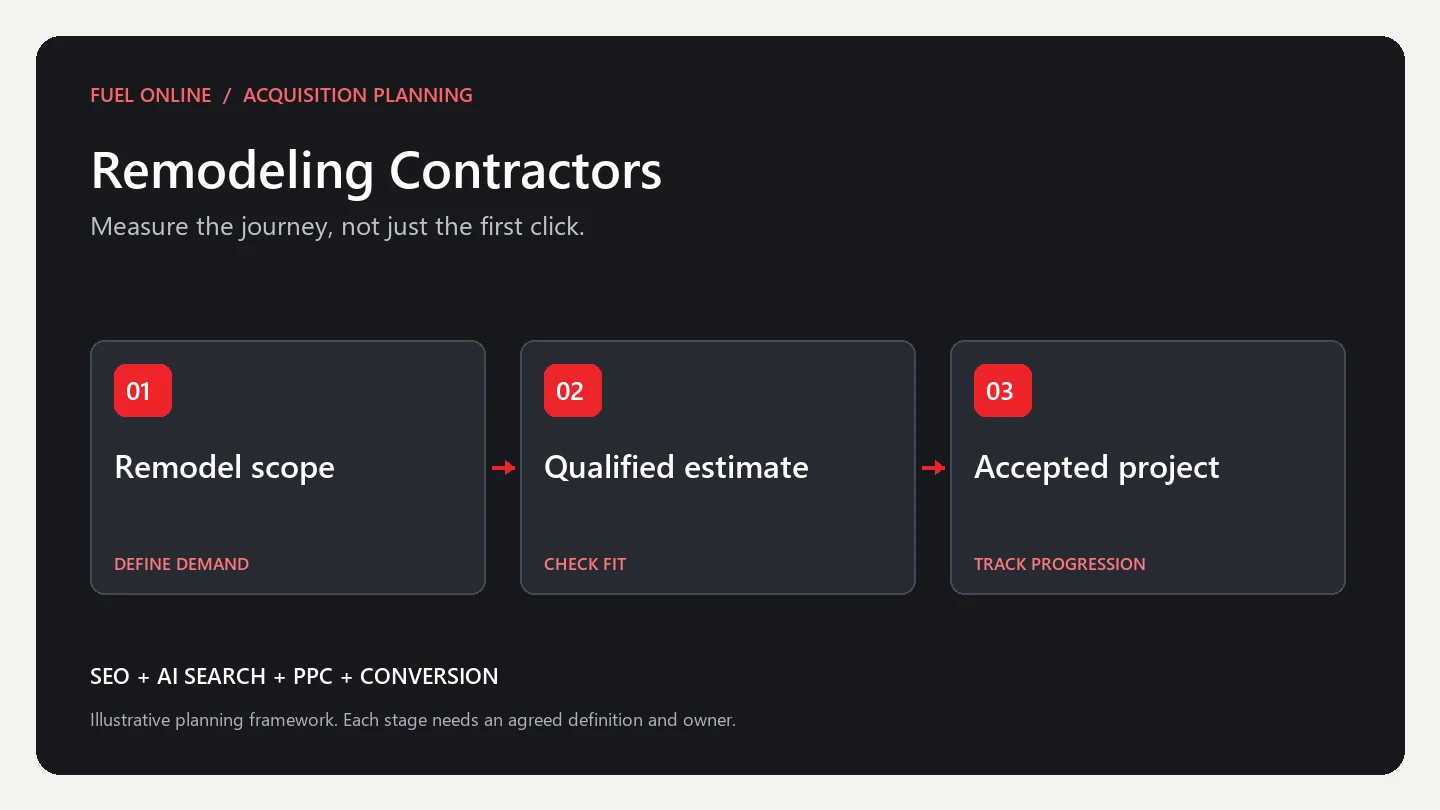
The problem is rarely a missing channel. It is a broken link between audience, promise, evidence, page, and follow-up. Fuel gives each channel a job in winning qualified estimate or design consultations for viable projects and uses project type, location, ownership, investment range, design status, permitting context, and timing to keep the message consistent.
Organic search handles durable discovery, paid media tests controllable demand, and decision content supports evaluation. Every path uses permissioned project photography, accurate scope and location details, reviewed process information, and substantiated material claims and carries project type, property location, ownership, investment range, design progress, and timing into the receiving workflow.
A practical remodeling contractor digital diagnostic
Use this diagnostic when digital activity improves but the receiving team does not see a comparable change in qualified remodeling consultations. The diagnostic for remodeling marketing agency starts with the observable symptom, checks the page, source, campaign, or handoff responsible for it, and ends with one reviewed action, owner, and validation method.
Observable symptom
Channel reports improve while qualified design or estimate consultations stay flat and requests closer to 'handyman near me' keep consuming follow-up time.
What to inspect in remodeling contractor digital marketing
Compare the channel promise with the landing page, form or call path, follow-up owner, and final business outcome.
Decision criteria for digital marketing for remodeling contractors
Reassign the channel, revise the page, repair the route, or stop the activity based on the broken stage.
Inspectable output
A channel decision with a named page or handoff change, owner, release date, and measure tied to qualified design or estimate consultations.
Digital marketing for remodeling contractors deliverables you can inspect
The team receives a journey map, page and campaign backlog, measurement specification, release log, and ownership record for every digital change.
- Channel role and budget map, used to define the remodeling marketing agency scope.
- Priority plan for service, portfolio, process, investment, service-area, and project-fit pages, used to govern the remodeling contractor digital marketing release.
- Campaign exclusions and landing-page requirements, used to evaluate the digital marketing for remodeling contractors decision.
- Conversion, routing, and tracking specification
- Weekly operating and monthly commercial review
Illustrative remodeling example
Illustrative example, not a client result: A homeowner sees attractive project photos but cannot connect project type, location, scope, range, design needs, or timing to the consultation. Fuel would trace the entry page, proof viewed, next action, fields, routing, and final disposition, then repair the first break rather than redesigning the whole site without evidence.
The remodeling contractor digital marketing release would include the revised page or path, measurement event, receiving owner, and validation record. The test stays only if it improves the journey toward qualified remodeling consultations.
Within digital marketing for remodeling contractors, the buyer team can inspect the artifact, approval, and next investment decision.
How commercial progress is judged
Fuel connects page, query, campaign, or source context with acceptance, rejection reasons, response, capacity, and qualified estimate requests, consultations held, proposals, and signed-project pipeline. Diagnostic measures explain where the journey breaks; they do not replace the business outcome.
The decision record for remodeling marketing agency states what changed, why it changed, who approved it, and whether the next action is to expand, revise, consolidate, or stop.
Reporting for digital marketing for remodeling contractors must connect the service-specific diagnostic to qualified remodeling consultations, explain data limits, and name the next decision rather than treating activity as proof of value.
Questions to ask a remodeling agency
Ask to see a journey map, release ticket, and measurement specification. Confirm who changes the site, campaigns, analytics, forms, CRM connection, and quality feedback loop.
When reviewing remodeling marketing agency, require a named practitioner, implementation owner, approval path, and sample artifact. Reject unsupported promises of rankings, citations, lead volume, cost, or revenue.
How we measure remodeling contractor digital marketing
- qualified estimate requests
- consultations held
- proposals
- signed-project pipeline
Compare channels using the same qualification rules
Cost per qualified inquiry = attributable channel spend ÷ inquiries meeting the agreed criteria.
Keep the reporting window and included costs consistent. A cheaper contact is not necessarily a cheaper customer; compare later progression where the data supports it.
Agree on the baseline, data source and qualification criteria before comparing results. Separate visibility from inquiries and accepted business opportunities.
CONNECTED SERVICES
Choose the right next step for your business
Explore Fuel’s Digital marketing capabilities, published campaign work and team to evaluate how we would support your organization.
BEFORE YOU CHOOSE AN AGENCY
Questions about remodeling contractor digital marketing
What changes first in a digital marketing engagement?
During the first month, the remodeling marketing agency scope produces a journey map, page and campaign backlog, measurement specification, and the first release ticket. Fuel also records the client inputs and approval needed for the first release.
What does Fuel need from our remodeling team?
Effective remodeling contractor digital marketing work requires site, campaign, analytics, form, and CRM access plus reviewers, approved proof, capacity limits, and accepted or rejected inquiry feedback. Fuel identifies missing access or ownership before work is scheduled around it.
How will we know the work is commercially useful?
Under digital marketing for remodeling contractors, commercial usefulness depends on whether the diagnostic connects to qualified remodeling consultations, the data limits are stated, and the evidence supports a clear keep, revise, or stop decision.
Do we need every digital channel at once?
Start with the break closest to qualified remodeling consultations, not a predetermined channel. The diagnostic for remodeling marketing agency may prioritize the page promise, proof, form, measurement, route, or response owner before recommending more acquisition.
What does a credible remodeling contractor digital marketing scope include?
A credible remodeling contractor digital marketing scope includes journey mapping, page and campaign priorities, measurement, implementation ownership, release validation, and inquiry-quality feedback. It also names the client dependencies, practitioner, deliverable, and approval path.
How should digital marketing for remodeling contractors report commercial progress?
Reporting under digital marketing for remodeling contractors should connect the service-specific diagnostic to qualified remodeling consultations, show what changed and why, state data limits, and name the next decision.
Make your next agency conversation specific.
Bring the channel, page, or follow-up problem preventing more qualified design or estimate consultations. The first working session on remodeling contractor digital marketing will identify the priority artifact, evidence, owner, and approval decision for qualified remodeling consultations.
Talk with a Fuel strategist →