
Enterprise SEO tools evaluation guide and worksheet
Evaluate Enterprise SEO Tools by Data, Decisions, and Execution
Enterprise SEO software should help a team detect material problems, reach a defensible decision, ship the right change, and verify the result. A long feature list cannot prove that workflow. This guide gives buyers a practical way to test platforms with their own pages, users, controls, and reporting requirements.
Use the worksheet before a request for proposal, during a proof of concept, or when a renewal exposes duplicate tools and manual work. The goal is a documented buying decision, not a generic vendor ranking.
The first question is not “Which platform has the most features?”
Start with the decisions the organization repeatedly struggles to make. Can the team find a template defect before it reaches every market? Can analysts reconcile page inventory, crawl data, visibility, and conversion data without rebuilding the report each month? Can product managers see a bounded ticket, the affected routes, and the evidence required to close it? Can legal and security teams control who sees data and where sensitive content goes?
Those questions define the tool requirements. They also expose where software stops. A crawler can collect responses and rendered elements. A market intelligence platform can supply keyword, competitor, and backlink observations. A data warehouse and business intelligence layer can combine sources and apply access rules. A work management system can assign tickets. None of them automatically creates governance, settles conflicting priorities, or persuades an engineering team to release a change.
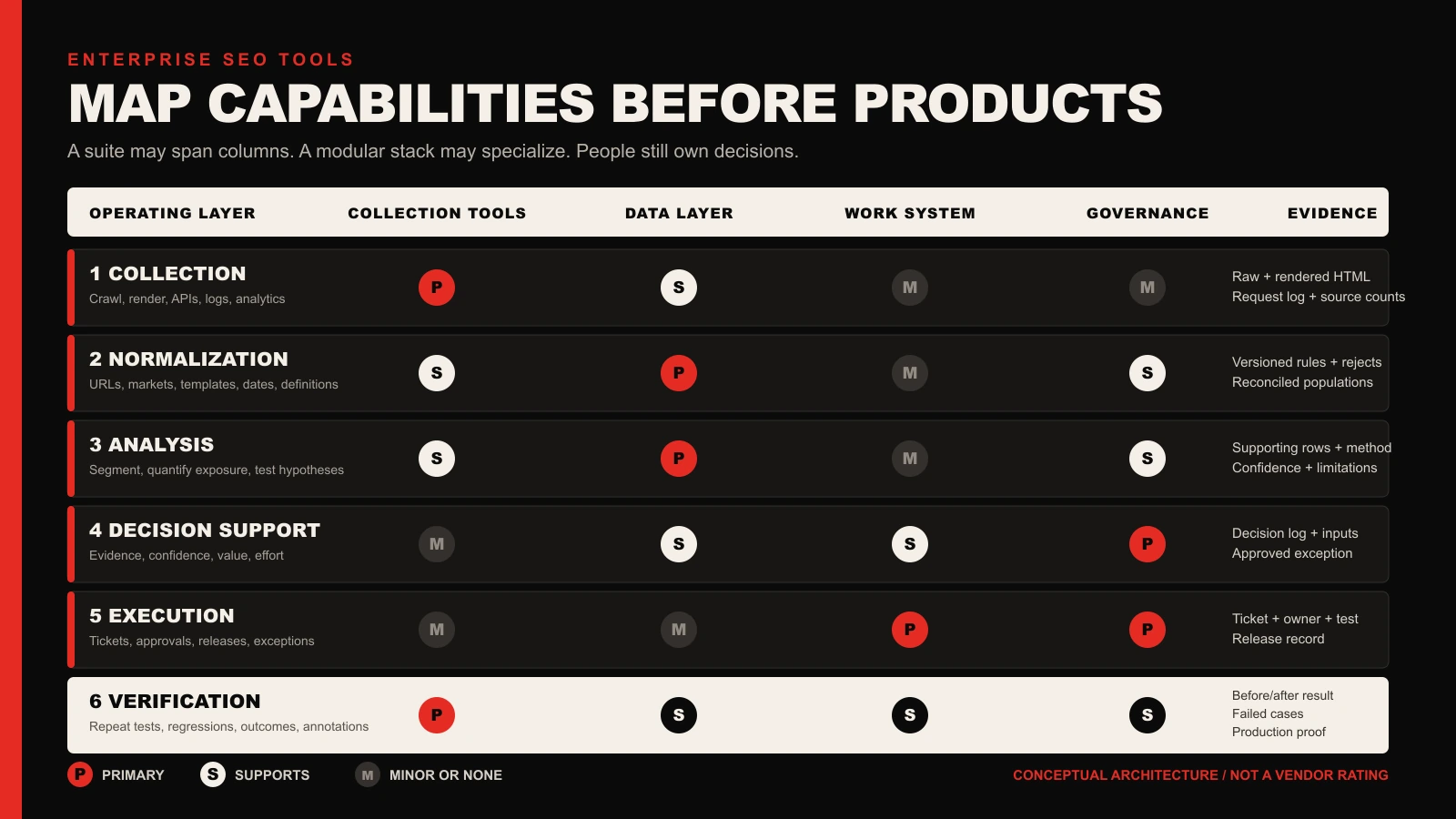
Build a capability map before evaluating products. Most enterprise programs need six connected layers:
- Collection: crawl, render, query APIs, ingest logs, and capture first-party performance and conversion data.
- Normalization: reconcile URLs, markets, templates, entities, dates, and measurement definitions.
- Analysis: segment issues, compare competitors, quantify exposure, and test hypotheses.
- Decision support: prioritize work with visible evidence, confidence, business value, and effort.
- Execution: create tickets, route approvals, preserve exceptions, and connect releases to findings.
- Verification: repeat tests, monitor regressions, annotate changes, and report outcomes to each audience.
A suite may cover several layers. A modular stack may use a specialist tool at each one. Neither architecture is inherently better. The correct choice depends on data fitness, control requirements, internal skills, integration effort, and adoption.
1. Turn business constraints into testable requirements
Interview the people who will use, govern, integrate, and pay for the system. Ask each person for a recurring decision, the evidence currently used, the delay or risk, and the acceptable future workflow. Convert the answer into a test that a buyer can observe during the proof of concept.
| Area | Question to settle | Proof required | Owner |
|---|---|---|---|
| Site coverage | Which hosts, markets, templates, URL states, and rendering modes must be measured? | Candidate runs the supplied test set and returns complete, correctly segmented records. | SEO and platform engineering |
| Market data | Which countries, devices, topics, competitors, and update frequencies matter? | Candidate supplies provenance, collection date, geography, limits, and exportable rows for a known sample. | SEO and analytics |
| Integration | Which warehouse, BI, identity, ticketing, and content systems must exchange data? | One working connection or a documented API test with rate, schema, error, and ownership details. | Data engineering |
| Governance | Who can view, edit, export, administer, and approve? | Role test, single sign-on test, audit event, guest behavior, and offboarding procedure. | Security and procurement |
| Workflow | How does an observation become a decision, ticket, release, and verified result? | Complete one supplied issue from detection through closure evidence. | Product operations |
| AI controls | Which content may enter a model, for what purpose, with what retention and review? | Data flow, approved endpoints, retention setting, logging, evaluation, and human approval demonstrated. | Legal, security, and AI governance |
| Commercials | Which activity changes the bill? | Quote maps users, projects, crawls, keywords, API units, storage, services, overages, and renewal terms. | Procurement and finance |
Write requirements as outcomes and boundaries. “Supports JavaScript” is too vague. “Render the supplied React product template, store both original and rendered HTML, extract links loaded after hydration, and report console errors within the approved crawl window” is testable. Screaming Frog’s current configuration documentation, for example, says its JavaScript mode renders pages in headless Chromium and can store original and rendered HTML. Its documentation also notes that JavaScript crawling is more resource intensive. These are useful vendor claims to test against your implementation, not substitutes for the test itself. See the Screaming Frog configuration guide.
Classify each requirement as mandatory, scored, or informational. A mandatory control such as approved identity integration should be pass or fail. A scored capability such as segmentation flexibility can differentiate candidates. Informational items such as a planned connector should not earn current capability points.
2. Evaluate the data before the interface
Dashboards are easy to demonstrate. Data fitness is harder and more important. For every dataset, record its source, collection method, coverage, refresh schedule, retention, granularity, transformations, export path, and known gaps. Ask whether the organization can reproduce a displayed number from exported rows.
Use a six-part data fitness test
- Coverage: Does the dataset represent the required markets, devices, templates, and competitors?
- Freshness: Is the observation date visible, and is the refresh frequency fit for the decision?
- Granularity: Can analysts access the URL, keyword, market, device, timestamp, or event level they need?
- Consistency: Are definitions stable across the interface, export, API, and reporting connector?
- Provenance: Can a user identify whether a metric is observed, modeled, sampled, estimated, or calculated?
- Portability: Can the team export enough history and detail to preserve analysis, switch tools, or meet audit obligations?
Vendor scale statements help buyers frame questions, but they do not establish fitness for a specific site. Semrush currently describes enterprise capabilities that include large-scale JavaScript and Shadow DOM crawling, role-based workspaces, custom integrations, API access, single sign-on, and audit logs. Ahrefs describes enterprise single sign-on plus API and Looker Studio connectivity. Confirm the contracted edition, geographic coverage, permissions, limits, and export behavior in your own proof of concept. Review the Semrush enterprise SEO capability page, Semrush enterprise plan page, and Ahrefs enterprise page.
Reconcile tools against a controlled truth set
Create a small dataset whose expected state is known. Include live preferred pages, redirects, unavailable products, blocked paths, duplicate parameters, paginated routes, localized variants, client-rendered links, and pages with intentionally different titles or canonicals. Add a controlled keyword and competitor sample where the organization already knows the correct geography and intent.
Run the same set through each candidate. Differences are not automatically errors because tools may have different collection times and definitions. Require the evaluator to explain the difference, identify the source field, and state whether it affects a real decision. This process is more valuable than comparing screenshot totals.
3. Test governance and AI data handling as product behavior
Security questionnaires should be paired with hands-on tests. Create representative roles for a global administrator, regional SEO lead, content contributor, executive viewer, external specialist, and data engineer. Verify what each role can view, change, export, and share. Remove a test user and confirm access ends. Trigger an administrative change and confirm that the event appears in the expected audit record.
If reporting uses Microsoft Power BI, test the final user path rather than assuming a role name applies everywhere. Microsoft’s current documentation states that row-level security restricts rows for users with Viewer permissions but does not apply to workspace Admin, Member, or Contributor roles. It also recommends validating with the “Test as role” feature. This distinction can change how an enterprise shares SEO and revenue data. See Microsoft’s Power BI row-level security documentation.
Treat AI features as separate data flows. Record which page copy, customer information, analytics data, prompts, outputs, files, and metadata leave the organization. Document whether information is stored as application state or abuse monitoring data, who can retrieve it, and how an administrator configures retention. OpenAI’s current API data controls state that API data is not used to train models unless a customer opts in, while default abuse monitoring logs may be retained for up to 30 days. Approved customers may qualify for modified abuse monitoring or zero data retention, and some endpoint features can still store application state. The practical procurement lesson is to verify the exact endpoint and configuration, not rely on a broad “enterprise AI” label. See OpenAI’s API data controls.
An AI output also needs a quality control. Define an evaluation set for the intended task, such as classifying page intent, grouping duplicate titles, drafting a ticket summary, or extracting entities. Score factual accuracy, citation traceability, missed cases, false positives, prohibited data exposure, and reviewer time. Require human approval before generated content, directives, or tickets affect production.
4. Run a proof of concept around one real workflow
Give every candidate the same written scenario, inputs, time window, users, and expected outputs. A useful scenario crosses several layers of the operating model. For example: detect a canonical defect affecting category templates in three markets, determine its footprint, identify the owning component, create an implementation ticket, verify a staged fix, and publish a regional report with access controls.
Proof-of-concept script
- Load a supplied set of 12,000 synthetic URL records across three markets and six templates.
- Render a controlled sample and distinguish final URL, canonical target, sitemap state, internal links, and template.
- Isolate a synthetic defect affecting one shared category component and show supporting rows.
- Join the affected routes to a supplied business-tier field without exposing one region’s restricted conversion data to another.
- Create a ticket containing the rule, positive case, exception, acceptance criteria, owner, and evidence link.
- Re-run the fixed sample and show which records changed, which did not, and whether the acceptance test passed.
- Export the URL-level result and executive summary, then remove a user and confirm access behavior.
Score observed behavior only. Do not award full points for a roadmap statement, custom development proposed after the test, or a slide describing a connector that was not used. Use shared anchors: 1 means the requirement failed, 2 means major gaps remain, 3 means it passed with material manual work, 4 means it passed with a minor constraint, and 5 means it passed as a repeatable and exportable workflow. Weighted points equal the rating divided by 5, multiplied by the criterion weight.
| Criterion | Weight | Suite-led stack A | Modular stack B | Warehouse-led stack C |
|---|---|---|---|---|
| Data fitness and traceability | 25 | 4/5 = 20 | 5/5 = 25 | 4/5 = 20 |
| Technical site testing | 20 | 4/5 = 16 | 5/5 = 20 | 3/5 = 12 |
| Integration and portability | 15 | 3/5 = 9 | 4/5 = 12 | 5/5 = 15 |
| Governance and access control | 15 | 5/5 = 15 | 3/5 = 9 | 5/5 = 15 |
| Workflow and adoption | 15 | 5/5 = 15 | 3/5 = 9 | 3/5 = 9 |
| Commercial clarity and support | 10 | 4/5 = 8 | 3/5 = 6 | 3/5 = 6 |
| Weighted total | 100 | 83 | 81 | 77 |
The synthetic result is close because the architectures solve different parts of the problem well. Stack A has the highest total because workflow and governance received substantial weight. Stack B produces the strongest technical and data result but requires more coordination across tools. Stack C provides strong control and portability but needs more work for specialist testing and day-to-day adoption. A team that doubles the technical-testing weight could reasonably select Stack B. Preserve the weights, raw notes, failed tests, and evaluator names so leadership can see why the decision changed.
Synthetic weighted proof-of-concept totals
Three horizontal bars compare Stack A at 83 points, Stack B at 81 points, and Stack C at 77 points out of 100. The small spread indicates that decision weights and ownership costs should be reviewed before selection.
5. Calculate total cost of ownership, not license price
Normalize every proposal to the same term, currency, user count, data volume, and expected activity. Separate one-time costs from recurring costs, then model a base case and a credible high-usage case.
Annual total cost of ownership formula: subscription and add-ons + usage overages + implementation amortization + integration maintenance + data storage and compute + internal administration + training and enablement + security and procurement operations + expected switching or exit cost.
Synthetic annual cost example
- Core subscription and required seats: $96,000
- API, crawl, or reporting add-ons: $18,000
- Implementation cost amortized across three years: $60,000 ÷ 3 = $20,000
- Integration monitoring and maintenance: $32,000
- Warehouse storage and compute: $24,000
- Half of one internal administrator’s loaded annual cost: $70,000
- Training and enablement: $12,000
Illustrative annual TCO: $96,000 + $18,000 + $20,000 + $32,000 + $24,000 + $70,000 + $12,000 = $272,000.
This example is not a market price or budget recommendation. It shows why a $114,000 software commitment can become a $272,000 operating commitment when the organization includes the people and systems needed to use it. Add taxes, professional services, regional requirements, migration, overages, and exit costs that apply to the actual contract.
Do not convert speculative traffic growth into guaranteed return. If finance requires an investment comparison, use scenarios with explicit assumptions and sensitivity ranges. A simpler decision measure is cost per accepted workflow completed: annual TCO divided by the number of recurring decisions, audits, releases, or governed business units the stack can support at the required quality. The denominator must represent completed and adopted work, not logins or reports generated.
6. Design the operating model before signing
Name an accountable owner for the stack and a data owner for every major source. Define who can change configurations, approve new data flows, create dashboards, alter score definitions, and accept a failed test. Schedule monthly operational review, quarterly value review, and an annual contract and architecture review. The cadence should become faster around migrations or major platform releases.
Require an exit plan before purchase. Document export formats, available history, API retrieval time, configuration backups, custom logic, dashboard ownership, deletion procedure, and the time required to reproduce critical controls elsewhere. Portability is useful even if the organization never changes vendors because it reduces dependency on one interface and supports auditability.
The related enterprise SEO audit guide shows how to turn collected evidence into implementation tickets and production QA. The enterprise SEO reporting guide covers measurement definitions, audience views, and decision cadence. Use the enterprise SEO strategy guide when the larger portfolio, market, and governance model still needs definition.
Separate the tool purchase from the service decision
Software and agency services solve different procurement questions. A platform provides access to capabilities, data, workflows, and support under a contract. A service partner can supply strategy, interpretation, implementation coordination, specialist analysis, training, and accountability. Buying software does not automatically provide the operating capacity to use it. Hiring a partner does not remove the need for data ownership, access control, and internal decision rights.
Buy or expand software when the operating model is clear, qualified people have capacity, and the missing constraint is reliable collection, analysis, integration, or workflow infrastructure. Consider external support when the team lacks specialist depth, cannot coordinate across functions, needs an independent evaluation, or has an approved backlog that is not moving. A hybrid model can work when the organization owns accounts and data while a partner helps design controls, interpret findings, and transfer knowledge.
Evaluate an agency separately from the software scorecard. The enterprise SEO agency guide provides questions about delivery model, technical depth, communication, and evidence. Fuel Online’s enterprise SEO services are relevant when the need spans platform evaluation, audit, strategy, implementation support, and measurement. Organizations building a governed answer-engine and generative-search program can review the distinct AI SEO packages.
Final buying checklist
- The decision statement names the business workflows and constraints the purchase must address.
- Mandatory controls passed with observable evidence.
- Each scored criterion has a weight, scoring anchor, evaluator, and proof link.
- Data coverage, freshness, granularity, provenance, definitions, and exports were tested.
- Identity, permissions, audit events, offboarding, retention, and deletion were tested.
- AI features have an approved data flow, evaluation set, retention configuration, and human approval step.
- One real workflow ran from collection through ticket and production-style verification.
- The total cost model includes internal labor, integrations, compute, enablement, overages, and exit.
- The contract records service levels, limits, data rights, renewal mechanics, support path, and export obligations.
- The operating model names owners, review cadences, definitions, and escalation paths.
Enterprise SEO tools FAQ
What types of tools does an enterprise SEO team need?
Most teams need capabilities for site crawling and rendering, market and competitor research, first-party analytics, data normalization, business intelligence, work management, and release verification. One suite may cover several areas, while a modular stack may provide deeper specialist functions. Map tools to recurring decisions before choosing the architecture.
Should an enterprise choose an all-in-one SEO platform or specialist tools?
Choose based on tested workflow fit, data quality, control requirements, internal skills, integration effort, and total ownership cost. A suite can reduce handoffs and support adoption. Specialist tools can provide greater depth and portability. Run the same proof-of-concept workflow and cost model against both options.
How long should an enterprise SEO software proof of concept run?
Run it long enough to complete a representative workflow, observe at least one expected data refresh, test all required roles, and export the necessary detail. Set a fixed scenario, inputs, users, success criteria, and decision date before access begins. Extending a trial without unresolved test questions usually adds activity rather than evidence.
How should AI features in SEO platforms be evaluated?
Document the exact task, data sent, endpoint, retention behavior, access, and human approval. Use a controlled evaluation set to measure factual accuracy, false positives, missed cases, traceability, prohibited data exposure, and reviewer time. Treat general AI branding as insufficient evidence for security or quality.
Does buying enterprise SEO software replace an agency or internal team?
No. Software provides capabilities and data, while people define strategy, resolve ambiguity, coordinate implementation, review output, and own outcomes. Select tools and services through separate scorecards, then state which responsibilities remain internal and which are assigned to a partner.