
AI SEO – AEO Course 22
How does AI citation analysis explain a competitor recommendation?
AI citation analysis starts with the complete competitor recommendation and the sources attached to its decisive claims. Determine whether each page supports the claimed capability, buyer fit and current terms. Then classify the gap: missing facts, weak evidence, an inaccurate source or an unexplained recommendation. A list of domains is only an inventory. The useful deliverable connects a buyer question to a supported statement, a responsible source and a specific correction or evidence opportunity.
The buyer requirement comes before the competitor
Start with the recommendation opportunity rather than a brand-name search. A buyer seeking software that preserves audit history during migration has a different problem from a buyer seeking the cheapest entry plan. Define the required task, constraints, market and acceptable alternatives. If your product cannot meet a mandatory requirement, a competitor recommendation may be appropriate. The analysis should reveal why an answer helps or misleads the buyer, rather than produce a plan to replace every competitor mention with your own.
A citation source gap exists when a relevant decision depends on information that is missing, inaccurate, insufficiently supported or difficult to find in the observed source set. It does not automatically exist whenever your website is absent. An independent test might correctly recommend your product without linking your domain. A product manual might be cited without recommending its publisher. Keep brand mentions, source citations and suitable recommendations in separate fields so the analysis does not reward the wrong outcome.
Choose a bounded sample of buyer questions that the business can actually serve. Include capability, implementation, compatibility, cost conditions and risk where these change the decision. Record why each question matters and which current page should answer it. Questions generated only by adding city names or synonyms can create a large spreadsheet without adding a new buying decision. A small, coherent set allows the analyst to inspect evidence carefully and makes later changes easier to interpret.
Consider a hypothetical procurement team evaluating three project-management products. Its nonnegotiable requirement is retaining searchable audit history after importing records. The assistant recommends a competitor and cites a comparison article saying that the competitor offers advanced reporting. That phrase may not establish audit-history retention. The apparent gap is therefore more specific than competitor visibility: the recommendation rests on an unverified relationship between reporting and migration continuity. The investigation must test that relationship before proposing a marketing response.
For ChatGPT competitor analysis, commission AI citation analysis at the statement level: buyer requirement, recommended option, decisive claim and supporting passage. Inspect ChatGPT citation sources rather than treating a list of domains as an explanation. This gives an agency a bounded investigation and gives the buyer a way to assess whether the finding is useful.
Write an acceptance question for the ChatGPT sources analysis: can another reviewer explain which source supports each decision-changing statement and identify what remains unknown? This prevents a source gap exercise from turning into a broad website audit. Crawl settings, page design and author identity may become relevant, but only when evidence connects them to the observed problem. Keep the scope on the sources behind a defined recommendation, then route a discovered technical or editorial issue to its appropriate owner.
Do ChatGPT citation sources support the recommendation?
Capture the answer before opening its linked ChatGPT sources. Save the exact question, date, engine, search state, locale and relevant session conditions. Preserve the order of recommendations and the associated wording, not just the cited domains. Some answers attach a source to a paragraph containing several claims. A page might support the product category but not its price, feature availability or comparative superiority. Split the paragraph into material statements so one valid citation does not lend borrowed credibility to unrelated assertions.
When inspecting ChatGPT sources, for each material statement, record the final source URL, page title, inspected version and supporting passage. Follow redirects and distinguish an original document from a page that summarizes it. If a comparison page says it tested an integration, look for the described environment, date and method. If that information is absent, record the limitation. A reviewer should be able to find the supporting material again without reconstructing your entire browsing session.
Four source-support states
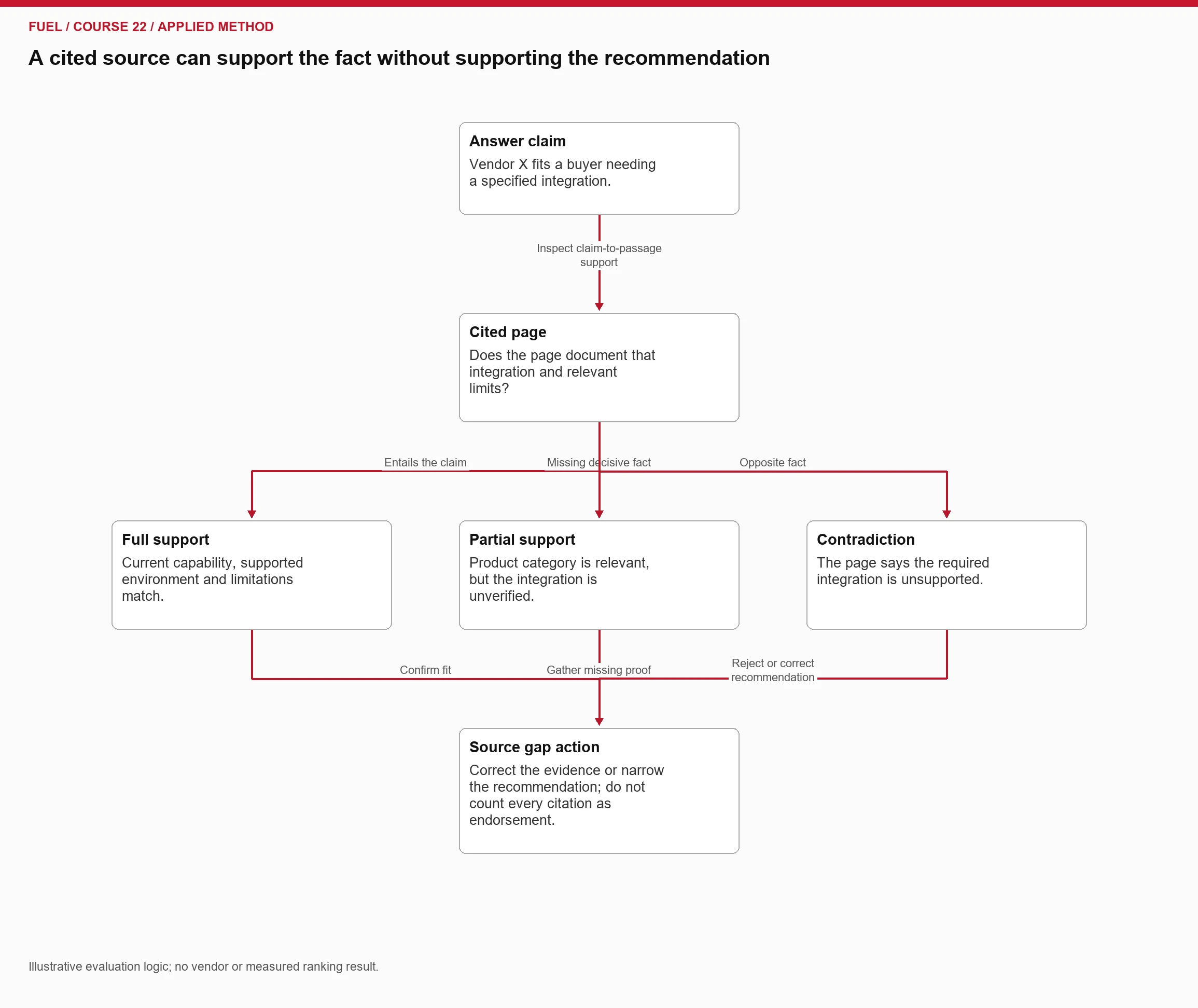
Classify ChatGPT sources using four support states: supported, partially supported, contradicted and not established. Supported means the source provides enough relevant information for the precise claim under its stated conditions. Partial support means an important condition remains unresolved. Contradicted means the source states an incompatible fact. Not established means the source neither demonstrates nor directly refutes the claim. This last state matters: failing to find evidence of a feature is different from proving the feature does not exist.
Liu, Zhang and Liang's historical generative-search study distinguishes citation completeness from citation support. Its early-system findings are a reminder to inspect source entailment, not a current error-rate estimate. Apply that distinction operationally: does an important claim have a source, and does that source actually support it? Those are separate checks. Neither requires assuming that the assistant intentionally fabricated information or that the cited publisher caused the mistake.
In the fictional audit-history example, a reporting overview receives partial or absent support for the migration-retention claim. A current technical manual explicitly describing imported audit records could provide stronger support, provided it covers the relevant plan and version. A marketing page stating that all activity is visible still needs interpretation: does all activity include imported historical events or only new actions? Preserve the unresolved definition instead of converting confident language into a tested product fact.
Inspect disagreements as evidence. If the current manual limits retention to ninety days while a roundup promises permanent history, save both passages and identify their dates and responsibilities. The roundup may be obsolete, the manual may cover another plan, or the terms may genuinely conflict. Do not choose the favorable source merely because it helps your positioning. A useful source map records the contradiction and the additional fact needed to resolve it before anyone writes a public comparison.
How should ChatGPT competitor analysis evaluate source quality?
Evaluate ChatGPT sources for relevance, factual support, independence and freshness separately. Relevance asks whether the source addresses the buyer's actual decision. Factual support asks whether it substantiates the claim. Independence asks what relationship the publisher has to the product or outcome. Freshness asks whether the evidence still applies. A page can score well on one dimension and poorly on another. A vendor manual is not independent of the vendor, but it may be the most authoritative description of a specific supported configuration.
Use decision categories instead of invented authority scores
Do not collapse these dimensions into a precise universal citation score. A formula assigning forty points for authority and twenty for freshness can create a misleading appearance of measurement if the weights have no validation. Use a simple triage rubric with written reasons. For example, classify a source as ready to support the decision, useful background, requires verification or unsuitable for this claim. The category should lead to an action, not become a new number to optimize for its own sake.
Identify the publisher’s role when evaluating ChatGPT sources. An integration marketplace can establish that a listed connector exists, but may not test its reliability under every deployment. A customer forum can reveal a failure mode, but may omit the configuration needed to reproduce it. A commercial comparison can offer useful criteria while carrying an affiliate relationship. These limitations do not make every source worthless. They tell the analyst what the source can support and where another type of evidence is needed.
Check the fact behind the freshness date
Freshness requires more than a recent date. Check the product version, plan, geography and effective terms. A recently redesigned page can contain an old test, while an older technical document can remain accurate for a supported release. Record what changed in the underlying fact, not just which page has the newest timestamp. If the comparison depends on current pricing or availability, set a refresh trigger tied to that fact rather than treating all source material as equally volatile.
A University of Toronto preprint on citation drivers reports that retrieval explains substantial variation in its studied answers and separates cited sources from remembered brands. Its commercial datasets and API conditions limit generalization. The practical response is to inspect which sources were actually present in your observation, rather than infer a universal preference from an isolated recommendation. This article's rubric is an editorial decision method, not a mechanism proven by that study.
Apply the rubric to a small source set before scaling. In the hypothetical example, the current manual supports retention conditions, the product page establishes plan identity, a customer post raises an unresolved migration problem and the roundup overstates permanence. The next action is not to obtain four more mentions. It is to verify the migration issue, publish an accurate scope explanation and correct the overstatement where a responsible process permits it. The source's role determines the intervention.
Is the AI search competitor gap missing evidence or distribution?
An AEO source analysis should identify whether the missing item is a verifiable fact, an accessible explanation or its appearance in a particular observed answer. Ask the analyst to show the difference. The same recommendation screenshot can conceal any of these problems, and each requires a different next artifact.
A missing-evidence problem in ChatGPT sources occurs when the necessary fact is not established in a usable source. A distribution problem occurs when good evidence exists but does not appear in the observed source set. These problems can coexist, but they should not share a vague repair ticket. Write down which fact is missing and which artifact would establish it. Then identify whether that artifact already exists, is publicly accessible, is current and has a clear relationship to the buyer question.
Inspect your own evidence before asking why a competitor is recommended. Does the relevant page explicitly address the feature, exclusions and implementation conditions? Is a decisive detail hidden in a sales presentation that a prospective buyer cannot inspect? Does the integration page describe compatibility without explaining which data survives migration? An answer-source gap may expose a genuine product-information gap. Correcting it can help sales and support even if the assistant's next answer does not change.
Compare evidence quality with observed source presence
Use an evidence-and-presence matrix. If evidence is sound and observed, investigate whether the recommendation still misinterprets it. If evidence is sound but absent, investigate discovery and competing source coverage. If evidence is weak but observed, fix the claim before trying to amplify it. If evidence is weak and absent, produce a truthful answer asset before beginning distribution work. This framework prevents the team from promoting an unverified claim simply because a visibility report identifies a gap.
Fit remains a separate question. Suppose your product's manual clearly says that imported history is retained for ninety days, while the buyer requires a seven-year record. Better distribution of that manual should not make your product the preferred answer. It should help an assistant or a person reject it for that scenario. Qualified visibility includes accurate exclusion. A campaign that increases unsuitable recommendations may generate more inquiries while creating avoidable sales friction and disappointed buyers.
Classify third-party dependence. Some recommendations rely on external evaluations, while others cite product documentation directly. Observe the pattern in the specific question family instead of assuming every engine always prefers earned media or owned pages. A review source may add a real comparative test that your own pages cannot independently provide. The useful objective is accurate corroboration around relevant capabilities, not manufacturing a volume of interchangeable brand mentions.
Keep uncontrolled explanations visible when diagnosing ChatGPT sources. Source selection can change between observations, and a model can mention a familiar brand without an attached page supporting every reason. Your source map cannot fully reveal internal selection logic. It can establish what was visible and supported in the captured answer. When evidence does not distinguish a retrieval gap from an answer-generation choice, label the finding unresolved and propose a test that addresses that uncertainty rather than asserting a hidden ranking factor.
Which AEO source correction would help the buyer?
For a gap in ChatGPT sources, use the smallest intervention that addresses the observed defect. Correct a wrong owned product fact at its source and update dependent assets. Clarify an ambiguous scope statement where buyers encounter it. Publish missing method detail beside the relevant result. If a third-party page contains a factual error, prepare a concise correction request with the exact passage, approved replacement, current primary evidence and effective date. Sending that request is a separate authorized action; the analysis itself should retain a reviewable correction packet.
A missing capability explanation may call for a documentation update, a compatibility table or a worked implementation example. A comparison claim may require a transparent test with meaningful alternatives and limitations. A broad brand profile may need a clearer relationship among the organization, product and relevant market. Choose the artifact because it resolves the buyer's uncertainty. Do not create a research-shaped page merely to add statistics, and do not invent test results to make the source appear more persuasive.
Fast correction or stronger validation
Compare fast triage with stronger validation. Fast triage works when a single source visibly contains an obsolete fact and the correction is uncontroversial. It can identify an owner and repair quickly. Stronger validation is appropriate when a comparative recommendation depends on performance, reliability or an undocumented edge case. It may require product verification, repeatable test conditions and independent review. The limitation of speed is shallow support; the limitation of stronger validation is time and access, not a license to overstate a preliminary answer.
Preserve commercial relationships honestly. If a publisher offers paid placement, that placement is not an independent validation of product quality. If a customer approves a case study, describe what was observed and what the customer actually endorsed. If an expert contributes a quotation, retain the contribution and its scope. A source gap program should create reliable material a buyer would want to inspect, rather than conceal the origin of promotional claims.
Document the intended reader benefit for each new asset. In the fictional migration scenario, an evidence page might explain which historical fields can be imported, what remains searchable, the supported source systems, retention limits and a sample validation procedure. It should also explain failure conditions and whom to contact for an unsupported environment. Those details make the asset useful without requiring an assertion that an AI engine will reward its format.
Keep AI search competitor research connected to a responsible source owner. A useful agency handoff contains a proposed factual correction, a missing-proof brief or a discovery repair with its acceptance condition. It should also say when the competitor is the appropriate fit, so the work improves qualification instead of pursuing every recommendation indiscriminately.
Route work through an existing page when that page already owns the decision. Adding a separate URL for every observed assistant question can fragment evidence and create contradictory versions. Update the compatibility guide, connect it to the migration explanation and preserve a clear source of record. Create a new page only when it serves a distinct, substantial task. The result should be a more coherent evidence network for readers, with source-selection observations treated as a later measurement.
How do you retest citations and recommendation accuracy?
Repeat the original neutral questions after the source correction or evidence release, using the recorded conditions. Preserve all eligible answers and sources. Score factual support, buyer suitability and source presence separately. A new citation to your domain is not success if the answer still overstates retention. A correct recommendation to a competitor is not failure when the buyer's required conditions exclude your offer. Define the successful outcome before selecting the most favorable response.
Keep suitability and support rates separate
In a hypothetical worksheet, suppose twenty eligible answers initially contain eight suitable recommendations and twelve answers with adequate support for the decisive capability. After the repair, twenty comparable observations contain eleven suitable recommendations and fifteen with adequate support. The respective observed rates rise from 40 to 55 percent and from 60 to 75 percent. These invented numbers illustrate separate denominators and outcomes. They do not show that the source edit caused either change or that source presence and suitability are the same measure.
Keep a record of the actual transition between ChatGPT sources. Did the old roundup disappear? Did the revised manual become visible? Did an external page update its scope? Did the assistant start using a different unsupported rationale? These observations help choose the next action. They do not justify a broad claim that one format, domain type or mention strategy controls all recommendations. Compare unchanged questions when feasible and record product launches, other campaigns and platform changes that could affect the result.
A plan-specific retention example
Try this fictional lab: an answer recommends Product A for seven-year audit retention. Source one says advanced reporting. Source two documents ninety-day retention on the selected plan. Source three describes seven-year retention on a different enterprise plan. Source four is a customer comment without a plan or date. Assign support states before writing a correction. The first source does not establish the requirement, the second contradicts the selected-plan claim, the third supports a narrower alternative and the fourth raises a question without resolving it.
The appropriate response is to correct the plan-specific recommendation, explain the enterprise alternative if relevant and verify any unresolved customer issue. It is not to count four citations as four independent endorsements. Your final evidence record should include the buyer requirement, exact statement, source passage, support state, applicable conditions, responsible owner and retest result. A second analyst should be able to reach the same narrow conclusion without accepting your preferred brand as the expected winner.
End the review with a source-gap decision: repair a fact, gather missing proof, improve a discovery path, correct an external description or retain an unresolved observation. Assign a concrete next artifact and a retry trigger for each open item. This keeps the work connected to the buyer's question and avoids an endless cycle of competitor screenshots. A useful source analysis improves the accuracy of the decision, whether the eventual answer names your brand, another appropriate provider or several qualified alternatives.
For a scoped implementation discussion, explore Fuel Online’s AI SEO and AEO services.
Source notes: Evaluating Verifiability in Generative Search Engines; What Drives AI Citations? Content, Retrieval and Model Knowledge in GEO. Checked October 25, 2026. Applied frameworks are editorial recommendations; hypothetical examples are not Fuel client results.
Explore the AI SEO and AEO course curriculum.
Discuss AI SEO and AEO implementation with Fuel Online.