
AI SEO – AEO Course 17
Use Digital PR for AI Search to Distribute Verifiable Evidence
Use digital PR for AI search by distributing evidence that a reader, editor or assistant can trace and verify. Begin with a useful question, publish the supporting methods and limits on a stable source page, and prepare summaries that preserve the finding's scope. Measure earned coverage, factual reuse and observed AI citations separately. Distribution does not guarantee that an assistant will select, endorse or recommend your brand.

The strongest starting question concerns something your organization can actually substantiate. A service business might have approved operational records; a software company might be able to document a genuinely tested workflow. Access to data alone does not make every proposed finding publishable. Check permissions, confidentiality, data quality and whether the collection can support the question before building a campaign around it.
Separate the evidence asset from its announcement. The asset contains definitions, methods, results and limitations. The announcement explains why a particular audience might care. An attractive summary cannot repair a weak dataset, and a large distribution count cannot establish independent agreement with a claim. Keep both parts tied to the same factual version.
Treat an AI citation as a source-use observation. It may support a narrow statement without recommending the company that published it. A brand mention may occur without any citation. A recommendation may be unsuitable even when the source is genuine. Your evaluation should inspect what the answer says and whether the source actually supports it.
Define the digital PR contribution before choosing the channel. A defensible original calculation, a transparent dataset or a useful expert explanation can earn attention on its merits. Avoid creating thin announcements primarily to manufacture links or repeated brand text. The practical goal is to make worthwhile evidence understandable and discoverable while retaining enough detail to challenge an overstated interpretation.
An AEO digital PR strategy should identify the exact question an evidence asset can answer and the audience able to use it. Digital PR for AI search then distributes that supported finding without upgrading a selected sample into a universal result. AI search citation optimization is useful here as source-readiness and observation work, not a promise that purchasing distribution will cause a particular engine to cite the asset.
Choose a Research Question an AEO Digital PR Strategy Can Support
Choose a question whose population and measurement are clear. “How quickly did our approved sample of service requests receive a first response?” is narrower than “Which company provides the best service?” The first can potentially be answered with defined records. The second requires comparative selection criteria and evidence that the same records may not supply.
Define eligibility, units and exclusions before the result
For evidence-led digital PR, write the methods before interpreting the result. Define eligibility, time period, sampling, exclusions, units, missing values and known measurement limitations. A response-time study needs to specify what starts the clock and what counts as a response. An automated acknowledgment and a useful human answer may be different events. Choose the measure that fits the question and explain it.
Inspect selection effects. Records from customers who completed a survey may differ from records for all customers. Requests routed through one channel may differ from those arriving elsewhere. A dataset collected for operations may omit cases needed for a broad market claim. These are design boundaries to disclose, not inconvenient details to hide at the bottom of a chart.
Check whether changing case mix reverses the aggregate
Review whether aggregation changes the answer. Mix across regions, product types or customer sizes can shift between periods. A lower overall average may result from easier cases rather than better within-group performance. Preserve meaningful subgroups and explain which comparison the headline represents. Do not select a favorable slice after seeing every possible breakdown.
Establish publication permission and privacy boundaries. Use appropriate aggregation and disclosure review for the actual data. A public teaching example can use fictional values without pretending they are business observations. Label those values clearly and do not package them as a new study merely because the table looks professional.
Give the project a stop condition. If a decisive field cannot be verified or the sample does not fit the intended population, narrow the claim, collect suitable evidence or hold publication. Choosing a less dramatic but defensible question is often more useful than promoting a broad finding that the methods cannot support.
Build a Source Package for AI Search Citation Optimization
Build a digital PR source package that survives being quoted in fragments. Include a plain-language finding, population, period, units, methods, limitations and a correction route. Keep the full evidence at a stable destination with a version or release date. A reader should be able to identify which result an excerpt describes without guessing from a promotional headline.
Approve each promotional claim against its actual support
Create a digital PR claim table before writing the release. For each proposed sentence, record the supporting calculation or source, the population it covers, the important qualification and the person responsible for verification. Distinguish observation, interpretation and recommendation. “The average changed” and “the service improved because of our process” are different claims with different evidence needs.
Prepare a concise methods note that can accompany a chart. It should retain the details that most affect interpretation, not every technical step. Link or refer to the full method through the channel's appropriate mechanism when publishing in practice. In this course, the principle is traceability; it does not authorize sending a campaign or making external placements.
Make data definitions explicit. State whether a count refers to records, unique customers, opportunities, events or repeated observations. Explain whether excluded cases are missing, invalid or outside scope. A percentage without its denominator is easy to repeat and difficult to evaluate. Preserve the denominator in the summary whenever it changes the apparent finding.
Plan corrections before distribution. Keep a list of derived charts, summaries and announcements that depend on the source. If a definition or calculation changes, update the asset and notify the appropriate owners through the business's authorized process. Do not quietly replace a result while leaving incompatible copies presented as current.
Use the package as an internal quality gate. An editor who did not collect the data should be able to reproduce the main calculation and state its limitations. If they cannot, improve the explanation or evidence before expanding distribution. Reproducibility here means the actual finding can be checked, not that a second person must reach the same promotional conclusion.
Worked GEO Evidence Example: Regional Mix Reverses the Headline
Work through an illustrative dataset containing 120 fictional service-request records across two periods and three regions. Each period contains sixty records. Lower response time is better. These invented inputs demonstrate a composition problem; they are not a Fuel study, survey or customer result.
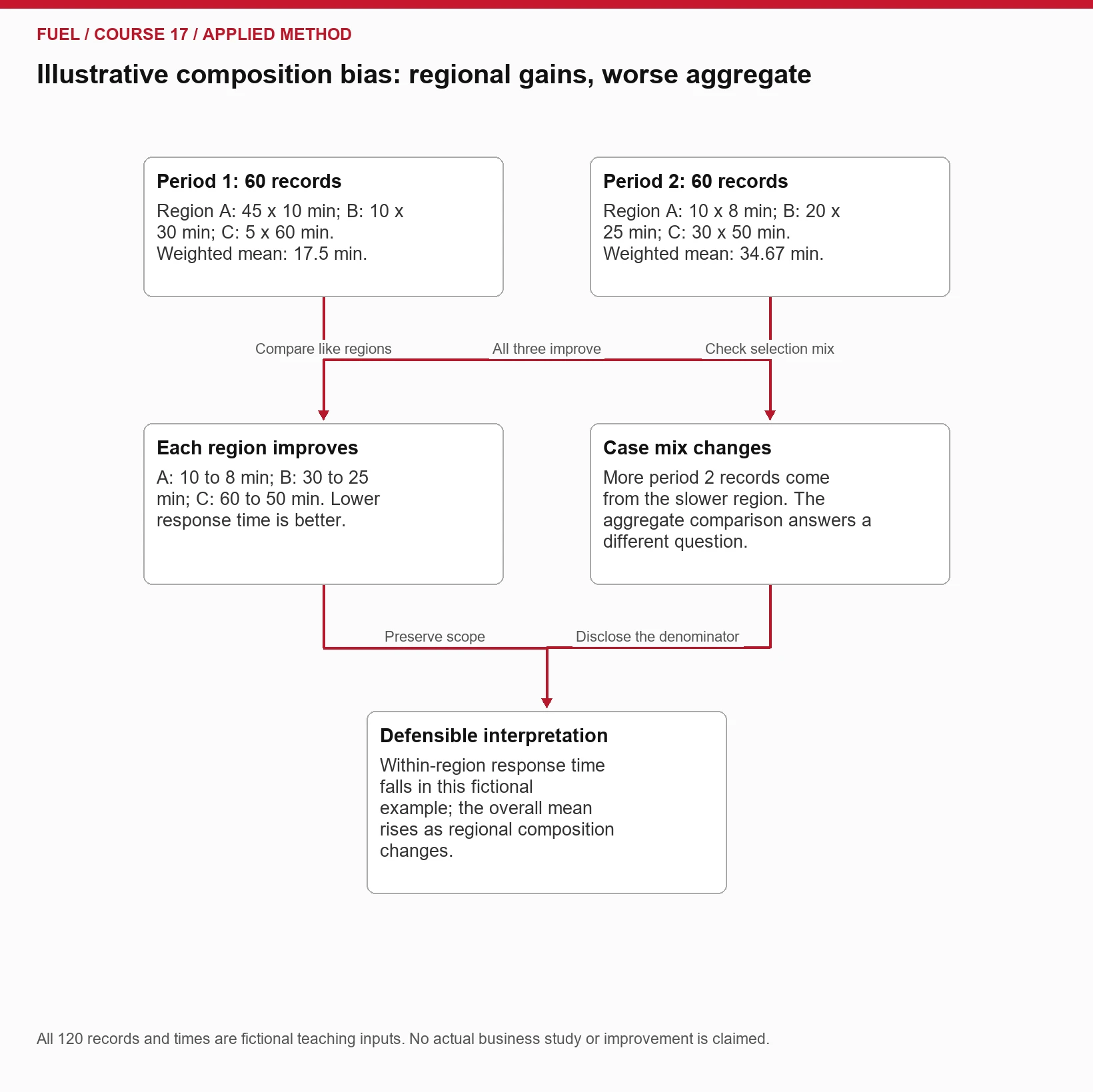
In period one, Region A has forty-five records averaging ten minutes, Region B has ten averaging thirty minutes, and Region C has five averaging sixty minutes. The weighted total is (45 × 10) + (10 × 30) + (5 × 60) = 1,050 minutes across sixty records. The overall mean is 17.5 minutes.
In period two, Region A has ten records averaging eight minutes, Region B has twenty averaging twenty-five minutes, and Region C has thirty averaging fifty minutes. The weighted total is (10 × 8) + (20 × 25) + (30 × 50) = 2,080 minutes. Dividing by sixty gives approximately 34.67 minutes.
Every region's average falls: ten to eight, thirty to twenty-five, and sixty to fifty. Yet the overall average rises because many more period-two records come from the slower region. A headline claiming that response time improved everywhere would hide the aggregate experience. A headline claiming every region got worse would contradict the subgroup values.
Write a defensible interpretation: “In this illustrative dataset, each region's mean response time declined, while the overall mean increased as the regional mix shifted.” That sentence states both observations without claiming that either proves a process effect. The data still do not identify why within-region times changed or whether the selected records represent future demand.
Decide which question matters before choosing the headline. If the reader asks about the experience of the actual period-two mix, the overall mean is relevant. If the reader asks whether comparable regional performance changed, the subgroup analysis matters. A carefully defined standardized comparison could answer another question, but its weighting assumptions would need disclosure. Do not choose a method merely because it produces the most attractive direction.
The example shows why a PR asset needs more than a polished chart. The calculation, group mix and intended comparison must travel together. An assistant or journalist can repeat a technically correct number while giving it an interpretation the underlying evidence does not support.
| Region | Period1 count | Period1 mean | Period2 count | Period2 mean |
|---|---|---|---|---|
| A | 45 | 10 minutes | 10 | 8 minutes |
| B | 10 | 30 minutes | 20 | 25 minutes |
| C | 5 | 60 minutes | 30 | 50 minutes |
| Overall | 60 | 17.5 minutes weighted | 60 | 34.67 minutes weighted |
Compare Digital PR Data Assets, Announcements and Commentary
Compare digital PR distribution formats by the job they perform. A methods-and-data asset supports scrutiny and reuse. A concise announcement supplies timely context. Expert commentary interprets a question within a real person's verified expertise. A partner resource can connect evidence to a relevant application. None of these formats automatically creates independent endorsement.
Choose a data asset when the claim depends on a reusable structured collection or calculation. It needs definitions, access terms and maintenance. Do not publish raw data that violates confidentiality merely to make the asset look transparent. A sufficiently detailed aggregate and method may be appropriate when it genuinely supports the stated conclusion.
Choose expert commentary when interpretation is the useful contribution. Use an actual qualified contributor and describe the scope of their involvement accurately. Do not invent an author, reviewer or quote. If no suitable expert is available, publish the bounded factual explanation you can substantiate rather than borrowing authority from a fictional credential.
Distinguish independent coverage from syndication
Choose an announcement when there is something real to announce. It should direct attention to the verifiable work and preserve the claim's limits. Repeating the same promotional copy through many destinations is not the same as several editors independently evaluating the finding. Track syndication and independent coverage as different states.
Google's link-spam policy covers manipulative paid links and optimized press-release links that pass ranking credit. [1] Apply the relevant disclosure and link qualification rules when a real campaign involves sponsorship. Do not frame purchased ranking credit as evidence distribution or imply that a paid placement is an independent editorial vote.
Select channels for audience relevance, not just nominal reach. A small specialist audience may be better able to evaluate and use the evidence than a broad unrelated list. State why each destination could help the intended reader. That logic is more useful than a distribution target that counts every copy equally.
Preserve Finding Scope Across ChatGPT Citation Sources
Preserve scope when digital PR evidence leaves the source page. A chart should name the measure, period, units and population. A summary should distinguish observed association from a causal explanation. A headline should not expand a selected sample into an entire industry. The more compact the format, the more deliberately you must retain the qualification that changes interpretation.
Review comparisons for compatible definitions. A competitor's published response metric may start its clock at another event or exclude different cases. Two numbers are not comparable simply because both use minutes. Explain where a comparison is valid, where normalization is justified and where the evidence remains insufficient.
Use clear uncertainty language without hiding the finding. State what the data support first, then the limitation that matters. “The approved sample's average was lower” is useful when the sample and calculation are explained. “We are the fastest provider” requires a different evidence base. Do not compensate for a narrow study with broader adjectives.
Propagate a correction to dependent summaries
Make correction propagation practical. Track the source version used by each chart and summary. When the source changes, identify which derivative statements are affected. Use the content change-control workflow for owner, effective date and verification. Updating the main asset alone may leave an obsolete graphic in circulation.
Handle external interpretation as an observation. An independent publication may disagree with your conclusion or emphasize another aspect. That does not necessarily mean the source package failed. Inspect whether the evidence was represented accurately. Correct factual errors through an authorized process while respecting editorial independence.
Keep historical versions when they help explain a material correction, with clear current guidance. Do not preserve an obsolete claim prominently without context, and do not erase the existence of a meaningful correction merely to keep the campaign record tidy. A transparent source can be useful even when the updated result is less favorable.
Use Dataset Metadata for a Genuine Dataset
Use dataset metadata when you have a genuine dataset description that fits the relevant feature. Google describes Dataset structured data as a way to aid Dataset Search discovery. [2] That is a specific discovery context, not a promise of generative-answer citation. A schema label cannot supply missing methods, publication rights or factual integrity.
Make visible metadata useful to people. Name the dataset, explain its scope, identify the actual creator or responsible organization, state the collection period and describe available distributions. Record access or reuse terms accurately. Do not invent an open license for material the organization has not approved for reuse.
Keep the dataset page coherent with the actual files or tables. If an aggregate table is the only public distribution, describe that honestly. If the underlying collection changes, version the release so a cited result can be tied to the data that supported it. A continually changing file with no history can make a previously correct calculation impossible to reproduce.
Provide a readable explanation alongside technical formats. A downloadable table can be valuable, but buyers and editors still need to understand columns, missing values and suitable comparisons. A schema validator checks structure, while an evidence review checks whether the dataset description is true and useful.
Do not force every PR asset into Dataset markup. Expert commentary, an announcement and a worked example have different roles. Choose eligible markup that matches visible content rather than adding types because someone claims more schema universally increases AI citations. The source package's quality comes first.
Inspect actual delivered content and access. A stable source URL that returns an empty shell, requires unexpected credentials or loses its key qualification during rendering is harder for readers to evaluate. Treat those failures as concrete delivery issues. Keep later AI selection as a separate observation rather than assuming that a technical repair establishes distribution success.
Measure Evidence-Led GEO Campaigns Without Combining Outcomes
Measure digital PR distribution in stages. First record that the source asset is published and accessible. Then record relevant coverage, whether it is independent or syndicated, what finding it uses and whether the interpretation is accurate. Track links as another field rather than treating every mention as a backlink or every backlink as endorsement.
Inspect factual reuse instead of counting every citation as success
For AI search observations, save the exact question, engine, search state, date, answer and supporting destination where visible. Inspect whether the source supports the answer's decisive claim. A citation to your study that repeats the wrong population is not an unqualified success. A correct source-use observation is still distinct from a brand recommendation.
Define a relevant question set before judging the campaign. Include tasks where the evidence could reasonably help and preserve that set for comparison. If you add more favorable questions after publication, report the new set separately. Do not claim a visibility improvement when the measurement instrument changed in a way that explains it.
Use social research evidence evaluation to assess claims circulating about digital PR tactics. A widely repeated story about one successful campaign is not a universal causal result. Ask for the original study, comparison, timeframe and outcome definition, while retaining useful ideas as hypotheses.
Connect actual visits and qualified opportunities through AI search referral attribution where evidence exists. A journalist's reader, an assistant's user and a CRM contact are not automatically the same identifiable person. Preserve unknowns and avoid inventing a journey to make the campaign appear commercially complete.
Finish a reporting period with a useful decision. The result may justify improving the source explanation, targeting a more relevant audience or narrowing an overstated finding. It may also show insufficient evidence to assign a citation change to the campaign. Clear uncertainty can coexist with concrete completed distribution work.
For evidence-led GEO campaigns, ask an agency to report the source version, relevant coverage, independent versus syndicated reuse and any observed answer-support mismatches. ChatGPT citation sources should be inspected for the claim they actually support. Keep publication and earned coverage as completed artifacts; later citation, recommendation, referral and qualified-opportunity observations need their own evidence. A repeatable promotional headline is not an independent evaluation of the research.
Exercise: Repair an Overstated Research Headline
Repair this hypothetical headline: “Our new process makes service response twice as fast everywhere.” The only evidence is the fictional regional table from the worked example. Identify the unsupported parts before rewriting it.
The table contains no assignment of requests to a new process and no controlled comparison, so it cannot establish that the process caused a change. Every region's average decreases, but not by the same proportion, and the overall mean increases. “Twice as fast” and “everywhere” do not describe the supplied evidence.
A defensible teaching headline is: “Regional response times fall in an illustrative dataset while changing case mix raises the overall average.” Add the period, counts, units and weighted calculations to its methods note. If the organization wants a real process-effect claim, it needs a suitable study and actual verified observations, not a stronger adjective.
Submit a claim table with one supported observation, one interpretation needing qualification and one rejected causal claim. Include a correction route and the source version used by the chart. The exercise succeeds when another reviewer can reproduce the arithmetic and understand why the narrower statement is the accurate one.
Sources and evidence notes
[1] Google Search Central, Spam policies for Google web search. Accessed October 25, 2026. [2] Google Search Central, Dataset structured data. Accessed October 25, 2026.
Apply the workflow
Ask Fuel Online to evaluate the reader's evidence, content and measurement system using the defined task.
Explore the AI SEO and AEO course curriculum.
Discuss AI SEO and AEO implementation with Fuel Online.