
AI SEO – AEO Course 12
How to Get ChatGPT to Recommend Your Business for the Right Buyer
To work on how to get ChatGPT to recommend your business, audit whether a real buyer can verify your identity, supported offer, eligibility and decision-changing evidence. Make those facts accessible, inspect neutral recommendation answers and correct the specific gaps you can demonstrate. Then repeat the same buyer tasks under recorded conditions. The objective is an appropriate, supported recommendation when the business fits; no website change can promise a permanent place in every answer.
Start with a recommendation contract rather than a request for more mentions. Name the buyer, the task, mandatory conditions, evidence needed and situations where your business should be excluded. A provider can be well known yet unsuitable for one request. Another can be a strong fit that lacks a clear public explanation. Those situations need different work. ChatGPT business recommendations become useful when the answer helps the buyer make the correct choice, including declining to recommend an unsuitable offer.
This is an advanced readiness and correctness audit. It assumes you can identify the service or product being evaluated and access its approved business facts. For a broader introduction to the channel, use the introductory ChatGPT ranking guide. Return here with one buyer task and a real evidence gap. Local branch routing, large ecommerce catalogs and multilingual offers need additional specialized controls; the common audit still begins with identity, fit and support for the decisive claim.
Prepare a small packet before testing: the actual question, current offer version, intended market, relevant destination, approved constraints and observed answer if one exists. Keep unknowns visible. An account owner remembering that a feature works is not the same evidence as a current supported-capability record. A selected screenshot is not a baseline. The packet should let another responsible person understand why your business would fit the task and which condition still needs verification.
Define Buyer Eligibility Before AI Recommendation Optimization
Separate eligibility gates from buyer preferences
Define eligibility as the conditions that must hold before the offer can serve the task. These can include supported environment, geography, project type, prerequisite data, operating hours or a required authorization. Define fit as how well an eligible offer meets the buyer’s preferences and tradeoffs. Do not let a strong preference score compensate for a failed mandatory condition. An inexpensive provider that cannot perform the required work is not an eligible winner.
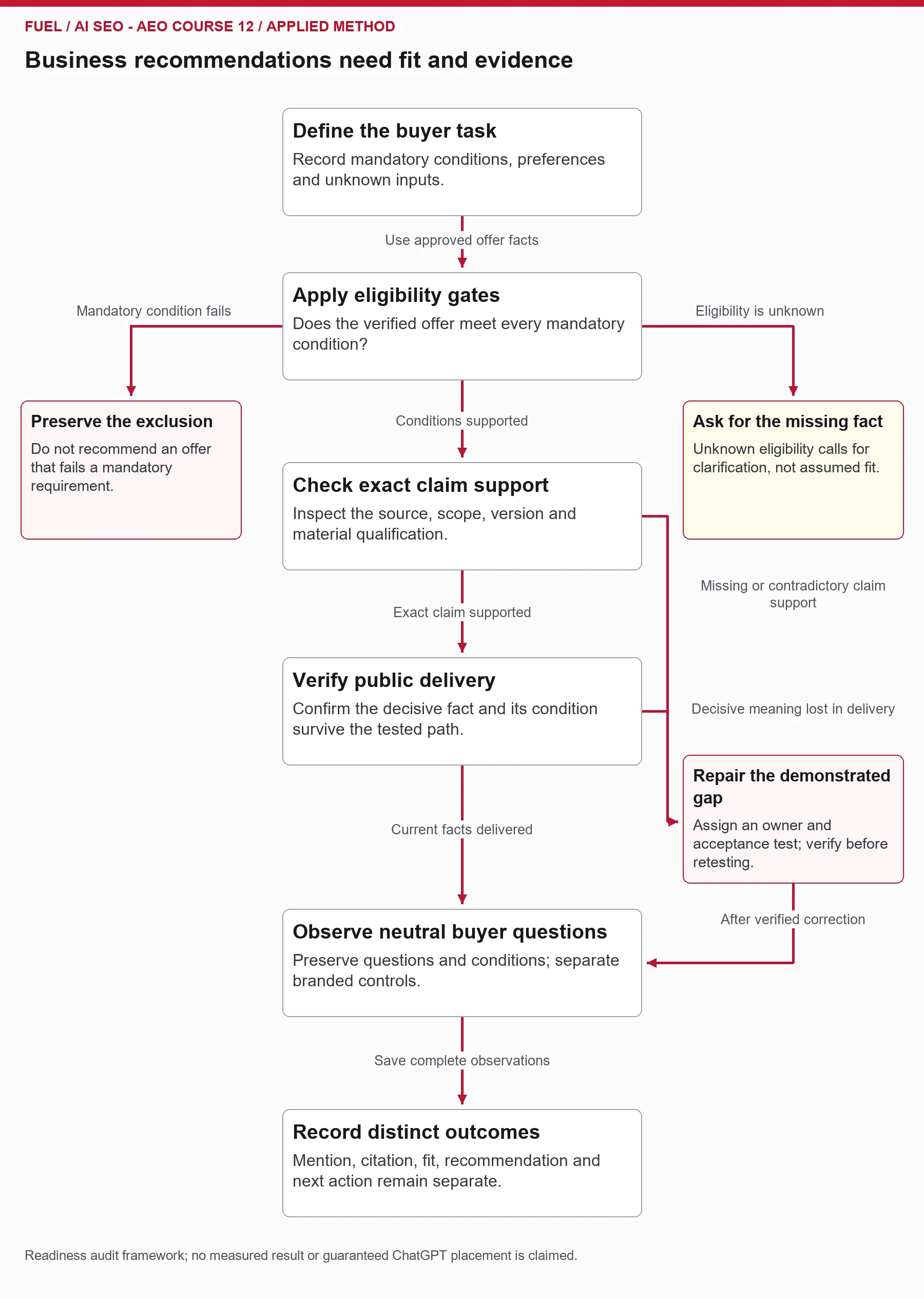
Write the buying question at three levels. The task might be preserving approval history during a records migration. Mandatory conditions might require a supported export and seven years of accessible history. Preferences might concern implementation effort, reporting format or support arrangements. Preserve the difference between an explicit requirement and your inference about what the buyer probably wants. If a condition is unknown, identify the clarification needed rather than silently assigning a favorable value.
For ChatGPT optimization for businesses, translate this contract into public decision information. Explain who the offer serves, which tasks it supports, necessary prerequisites and important exclusions. Put the limiting condition beside the capability it changes. A broad statement such as complete migration support can hide the exact boundary the buyer needs. A narrower supported explanation is more useful than an impressive phrase that nobody can verify.
Treat clarification and exclusion as legitimate outcomes
Use the contract to define a suitable answer before observing outputs. A suitable recommendation names an eligible business, describes the supported task accurately and preserves material conditions. A correct request for clarification can also be a good answer when the facts are insufficient. Track these outcomes separately. If you score only whether the brand appears, the measurement can reward an answer that sends the wrong buyer to your sales team.
Build Verified Business Facts That Support ChatGPT Recommendations
Assign evidence, applicability and an owner to each claim
Create a fact record with one row per consequential assertion. Include the subject, approved value, applicability, supporting artifact, effective date, accountable owner and public destinations that use it. Separate business identity from an offer’s current capabilities. A product, parent organization, trading brand and delivery partner can have distinct relationships. Resolve those relationships before adding structured representations or requesting external corrections.
Choose evidence that matches the claim. Operations can verify a service boundary. A product owner can verify supported objects and version limits. Commercial ownership can verify what the current engagement includes. The content team can explain those approved facts without inventing the business decision behind them. When owners disagree, record the conflict and hold the affected promise. A smooth paragraph should not conceal an unresolved eligibility rule.
Reconcile the controlled surfaces that repeat a fact
Check the controlled surfaces where buyers encounter the claim: service explanation, product documentation, comparison, inquiry form, downloadable guide and relevant profile. Use a dependency list rather than copying one promotional sentence everywhere. The same fact can need different context on different pages. The service page may state the supported outcome while documentation explains its prerequisites. Both must describe the same real capability.
AEO for business visibility benefits from a source of record the team can maintain, but a private spreadsheet alone does not answer the buyer’s question. Publish the verified information that is appropriate and necessary for evaluation. Keep sensitive evidence restricted while providing a truthful public explanation of scope. Record the difference between a public supported fact, a private verification artifact and an unresolved assumption so later writers do not upgrade one category into another.
Match Recommendation Claims to Evidence a Buyer Can Inspect
Check the subject, condition and outcome of the claim
Build a claim-to-evidence table for the statements that could change the recommendation. For each, ask whether the artifact establishes the same subject, condition and outcome. A reporting overview may not prove historical-record preservation. A partner logo may not establish a maintained integration. A customer quote can describe a real experience without proving that the same result applies to every environment. Relevance is necessary, but it is not sufficient support.
Provide an evidence path that fits the task. A capability explanation can name supported inputs, outputs, exclusions and the acceptance procedure. An original research finding needs its population, method, denominator and limitations. A service comparison needs consistent criteria and explicit unknowns. If the decisive proof does not exist, assign investigation or narrow the promise instead of publishing research-shaped language that merely sounds authoritative.
Distinguish corroboration from repeated promotion
Independent corroboration can add a different perspective, but do not manufacture it. Track an original evaluation separately from a syndicated copy or a vendor announcement. A third-party article can be accurate on category and wrong on a current limit. Inspect the exact passage and its date when it affects fit. If you need a correction, prepare the claim, approved replacement and supporting evidence for the appropriate authorized process.
Keep the main explanation useful when read in fragments. Name the business or offer, state the supported task and retain the condition that changes the answer. Put an important exclusion near the action it affects. This is a communication and verification method, not a disclosed formula for selection. AI recommendation optimization should leave the underlying page more useful to a buyer who never arrives through ChatGPT.
Check Search Access and Source Support Without Guessing the Algorithm
Verify the decisive fact in the actual delivered page
Verify the public delivery path before interpreting absence as a reputation problem. Inspect the final destination after redirects, the ordinary anonymous page and the decisive text available under the conditions you can test. A status code can be successful while the response is a security challenge. A rendered screen can show a capability while readable extraction loses its exclusion. Record the specific failure rather than prescribing a complete redesign without evidence.
OpenAI identifies OAI-SearchBot as its search crawler and treats its control separately from GPTBot’s training role. [1] Review the intended access policy and network controls with the responsible technical owner. A simulated request carrying a familiar user-agent string can test one configuration, but it does not prove that a genuine provider request succeeded. Preserve actual request evidence where available and keep protected material protected.
OpenAI says ChatGPT search placement is not guaranteed and advises checking cited sources because results can be incomplete or incorrect. [2] Treat a visible source as an observable destination, not a complete account of every document considered. Inspect whether it supports the recommendation’s decisive statement. If no source is exposed, retain that limitation instead of filling the gap with an invented explanation of the model’s private reasoning.
Keep fact correctness, source use and suitability separate
Separate four checks: the approved fact is correct; the public page delivers it; an observed answer uses a relevant source; the answer makes a suitable recommendation. Passing one does not certify the others. If the page is right and the answer is wrong, preserve the mismatch and inspect other visible evidence before rewriting accurate content again. The next action should distinguish plausible causes rather than multiply changes that cannot be evaluated separately.
Worked Example: Audit a Fictional Business Recommendation Against Fit Gates
Apply mandatory supplier gates before choosing a winner
Consider fictional Meridian Archive Services, Harbor Records and Cedar Migration. A buyer needs approval-history migration, at least seven years of accessible retained history and a supported source export. For this teaching scenario, approved evidence says Meridian supports approval-history import and ten-year access when the source export passes validation. Harbor handles new activity but not imported approval history. Cedar supports approval-history migration but only three-year access. These are invented inputs, not evaluations of real suppliers.
Apply mandatory gates before preferences. Harbor fails the required historical-import condition. Cedar fails the retention condition. Meridian is a conditional fit because export validation remains necessary. Do not call it universally best or promise acceptance before the source is checked. A useful public page would explain the validation prerequisite, retained fields and applicable access period beside the service claim. A generic best-in-class archive statement would not resolve the buyer’s decision.
Reconstruct the fictional 18-answer observation panel
Now construct six fictional buyer questions and three observations per question: eighteen completed answers. Two questions describe supported cases and produce six suitable Meridian recommendations. One leaves export eligibility unknown and produces three unsupported unqualified recommendations. Another requires clarification and produces three brand mentions without a recommendation. Two describe unsupported needs and produce six appropriate exclusions. Assume nine answers cite Meridian’s source page: the six suitable recommendations and three clarification answers.
Report the measures separately. Meridian appears in twelve of eighteen answers, about 66.7%. Its source page is cited in nine, or 50%. Six answers contain a suitable recommendation, about 33.3% of the complete panel; that share is not the same as an accuracy score because some questions should not generate a recommendation. Fifteen answers reach a suitable recommendation, clarification or exclusion, about 83.3%. Three unsupported recommendations remain a consequential error even though they increase brand exposure.
| Business | Imported approval history | Required seven-year access | Source export | Decision |
|---|---|---|---|---|
| Meridian | Supported under stated scope | Ten-year access in this fictional scenario | Must pass validation | Conditional fit; do not promise acceptance. |
| Harbor | Imported history not supported | Not decisive after failed gate | Not decisive after failed gate | Exclude for this task. |
| Cedar | Supported under stated scope | Only three-year access | Not decisive after failed gate | Exclude for this seven-year task. |
Test ChatGPT Business Recommendations With Neutral Buyer Questions
Separate neutral buyer tasks from exact-brand controls
Build the question set from the recommendation contract, not from prompts designed to make the company appear. Include ordinary discovery, constrained comparison, necessary clarification and known non-fit cases. Preserve the wording and expected decision rule for each. A question naming your company can check factual recognition, but it does not measure neutral discovery. Keep exact-brand controls separate from questions that let the answer choose among alternatives.
Record the product surface, search state, date, locale and relevant session limitations. Save complete answers and supporting destinations where shown. Repeat selected questions on a planned schedule and retain failures. A changed engine, rewritten question or different task mix creates another measurement condition. Do not compare its aggregate with the original as though the instrument stayed fixed, and do not treat repeated outputs as independent customers.
Score source support and recommendation fit independently
Use a scoring sheet with separate columns for brand mention, own-source citation, supported claim, eligibility, suitable recommendation and usable next action. Permit unknown and unscorable states. A correct refusal to recommend an unsupported service should not be a visibility failure. A prominent but misleading recommendation should not be a success. Review disagreements against the approved facts and record the reason for the judgment.
When asking how to get ChatGPT to recommend your business, make the next test answer a narrower operational question. Did the corrected page retain the prerequisite? Did the observed answer cite the current version? Did the recommendation preserve the prerequisite? Those checks can identify progress without claiming a universal lift. Save the baseline before changing content, then evaluate comparable observations after verifying the release.
Turn Recommendation Errors Into Verified AI SEO and AEO Repairs
Classify the failure before creating a task. A wrong owned fact needs its accountable owner. A missing public qualification needs a content correction. A delivery mismatch needs technical work. An inaccurate third-party statement needs a documented correction route. An answer that misstates a current supporting passage needs preserved evidence and a later observation. These are different jobs; do not place them all under a vague instruction to improve authority.
Prioritize errors by buyer consequence and actual exposure. An incorrect eligibility promise deserves attention before a harmless wording variation. A missing source can be investigated without assuming that every uncited answer is false. Use a ticket containing the disputed statement, approved fact, source version, affected assets, proposed correction, responsible owner and acceptance condition. Mark the unresolved portion explicitly so independent ready work can continue.
In the Meridian example, repair the unsupported acceptance promise by placing export validation beside the capability and inquiry action. Verify the page, supporting guide and form preserve the same condition. If the current sources already state it clearly, inspect the actual cited passage and other observed descriptions instead of repeatedly editing the correct paragraph. The fictional observation does not identify a hidden mechanism, so the repair remains a testable response to an evidenced gap.
Close the controlled repair when the approved explanation is delivered and the customer path respects it. Record later ChatGPT business recommendations separately. A submitted profile edit is an action, a verified public correction is another checkpoint and a changed answer is another observation. Maintain the fact dependencies so a later offer update does not restore the old promise. This creates an auditable improvement even when external answer selection remains uncertain.
Brief an AI SEO or AEO Agency on Recommendation Readiness
An agency brief should begin with the business decision and failure record, not a request for a guaranteed number-one recommendation. Supply the priority buyer tasks, supported offer, current fact owners, permitted access and examples of consequential mismatches. Ask the agency to separate diagnosis, implementation and measurement. This makes ChatGPT optimization for businesses reviewable as specific work instead of a list of fashionable deliverables whose connection to the buyer is unclear.
Request artifacts with accountable factual approvals
Request concrete artifacts: an eligibility and fit contract, claim-to-source audit, delivery findings, prioritized repairs, verified released changes and a versioned observation panel. Define who approves product facts and which external actions require authorization. If a proposal includes research or earned coverage, ask what evidence will be created, which audience it serves and how factual reuse will be checked. Do not accept fabricated reviews, concealed promotion or unsupported placements as substitutes for a useful source.
Define acceptance within the agency’s control
Set acceptance conditions within the provider’s control. A repaired page should preserve the approved conditions; an inquiry route should deliver the relevant qualification context; a report should retain denominators and unknowns. Later mentions, citations, qualified recommendations and observed referrals belong in distinct outcome records. Ask how unfavorable or inconclusive findings will be reported. A contract that rewards only a favorable screenshot can encourage the wrong measurement behavior.
Compare proposals by their ability to resolve your actual bottleneck. One business may need technical delivery repair; another may need verified capability evidence; another may need coherent source correction across controlled assets. AEO for business visibility should have a named scope, owners and reviewable evidence. A useful engagement leaves your team able to maintain the facts and understand the results, while preserving uncertainty about external selection and incremental commercial impact.
Exercise: Replace a Brand-Mention Report With a Recommendation Audit
Audit this fictional report: Meridian was mentioned in twelve answers, so its recommendation strategy succeeded. The underlying panel is the eighteen-answer example. The report omits that three mentions were unsupported recommendations and that several questions should produce clarification or exclusion. It also calls nine own-source citations nine qualified leads. Identify the outcome errors before suggesting more content, promotion or an agency budget increase.
A corrected report preserves twelve mentions and nine own-source citations as their actual measures. It states that six answers appropriately recommend Meridian, three make unsupported recommendations and nine correctly clarify or exclude. The fifteen suitable decision outcomes describe this defined panel, not the entire market. No website visits, qualified inquiries or sales were observed. A recommendation audit cannot manufacture those later events from answer counts.
Produce three artifacts. First, write the eligibility rule that makes export validation a mandatory condition. Second, create a claim-to-evidence row naming the applicable supported capability, public destination and unresolved input. Third, draft a repair ticket with the owner, affected explanation, acceptance check and next observation condition. Keep the source’s current factual version with the record. An analyst should be able to explain why the repair fits without knowing the fictional company’s marketing goals.
Finish with an agency-ready decision: verify the missing prerequisite, repair a demonstrated publication gap, investigate another source or preserve an inconclusive result. State what would change that decision. The practical answer to how to get ChatGPT to recommend your business is a maintained process for appropriate fit, accessible evidence and honest testing. The work is useful when the next buyer receives a more accurate decision path, whether the correct answer names your business, requests clarification or recommends another eligible provider.
Sources and evidence notes
[1] OpenAI, Overview of OpenAI Crawlers. [2] OpenAI Help Center, Searching the web with ChatGPT. Accessed October25,2026. The audit framework is editorial guidance; all Meridian, Harbor and Cedar examples and counts are fictional teaching inputs.
Discuss a recommendation-readiness audit
Bring a buyer task and a concrete recommendation mismatch to Fuel Online’s AI SEO and AEO services for a scoped implementation discussion.
Explore the AI SEO and AEO course curriculum.
Discuss AI SEO and AEO implementation with Fuel Online.