
AI SEO – AEO Course 07
How do you audit JavaScript SEO for AI search?
To answer “can ChatGPT read JavaScript” for your website, compare the delivered response, the rendered page and a readable text extraction against the same critical facts. Check the answer, scope, price conditions, links and meaningful exclusions. A page passes the relevant test when those facts survive the retrieval path being evaluated. A successful status code, a complete screenshot or one favorable AI response cannot substitute for that comparison.

JavaScript SEO for AI search provides the technical discipline for this investigation. Google documents separate crawling, rendering and indexing stages, and notes that not every bot executes JavaScript. Source note: Google Search Central, Understand the JavaScript SEO basics, accessed October 2026. Treat that provider description as background for a test plan, rather than assuming every AI search product shares Google's rendering behavior.
Begin with a specific buyer task. A pricing page may need to explain the monthly billing basis and implementation exclusion. A compatibility page may need to identify the supported product version. An integration page may need to distinguish one-way alerts from two-way synchronization. The critical fact is the detail that changes the decision, not simply the largest heading or the longest paragraph.
Create a content-delivery contract before collecting evidence. Name the page, expected audience, intended anonymous access, canonical destination and decisive facts. Assign a stable identifier to each fact so screenshots, response captures and tickets refer to the same item. The contract should let an editor and developer agree on success without interpreting a search engine's private behavior.
This course's deliverable is a JavaScript SEO evidence packet: the contract, three captured representations, a fact-preservation matrix, a reproducible failure ticket and a regression boundary. It gives the technical team something concrete to repair and the editorial team something concrete to verify. Citation and conversion measurement can follow with their own evidence; the immediate task is faithful delivery of the content you intended to publish.
Which critical facts belong in an AI search technical SEO audit?
Critical facts and semantic acceptance conditions
List the facts a reader must retain to make the intended decision. Include the main answer, named subject, applicable scope, numerical units, exceptions and next action. Add discovery links when they are essential to continue the task. Do not treat every decorative label as equally important. A useful inventory distinguishes a missing illustration caption from a missing condition that changes a service recommendation.
For each fact, record its identifier, approved wording or semantic requirement, location, owner and severity. Exact wording is appropriate for a product identifier or a legally approved term. A semantic requirement is better when several phrasings preserve the same meaning. For example, the test can require that implementation is separately scoped without insisting on one exact sentence. This avoids a brittle regression check that fails harmless editorial improvements.
Mark critical facts with a hard acceptance condition. If an exclusion is necessary to interpret a price, its absence should block release even when every other field is present. Secondary facts can receive a priority for repair without becoming universal blockers. This is an editorial decision tied to the reader's task; it is not a search-engine quality score.
Metadata changes after hydration
A JavaScript SEO inventory should include important metadata separately from body facts. Record the intended title, canonical declaration and robots directive, then compare them before and after hydration. A page can deliver its visible answer correctly while a script replaces its metadata incorrectly. Conversely, correct metadata cannot compensate for a body that never exposes the decisive answer.
Keep the inventory versioned with the content. When the offer changes, update the fact contract before approving a new page. When layout changes without a fact change, retain the same contract and rerun the relevant representations. That division makes the test reusable: content owners approve meaning, while platform owners demonstrate that the approved meaning survives delivery.
How do you capture initial HTML, rendered DOM and extracted text?
Capture the initial response and browser state
Capture the initial response first. Follow the actual redirect path and save the final destination, status, content type, relevant headers and body. Record time, locale, authentication state and any meaningful request conditions. Inspect the response for the critical facts and links. A large response can still be an application shell, navigation template or challenge screen rather than the intended article.
Next capture the rendered document in a fresh browser context. Use a defined viewport and a consistent readiness condition. Do not wait indefinitely for a page that never completes every analytics request. Choose the application state that matters, such as the main article being present, then save the visible text, document structure and relevant errors. Record whether clicking, scrolling, choosing a region or accepting a prompt was required to reveal the answer.
Inspect readable text and matching revisions
For an AI crawler content extraction investigation, capture readable text as a third representation. Extract the main content using a documented method, preserving useful heading order, table associations and link text. Inspect the result as a reader. If a price survives but its billing period is detached, the extraction is semantically incomplete even when all the words appear somewhere. Keep the extractor name and version with the artifact so a later comparison can reproduce the behavior.
For JavaScript SEO diagnosis, compare representations from the same approved revision and similar conditions. A source response collected before deployment and a browser view collected after deployment can create a false rendering defect. Save a content fingerprint or distinctive approved passage. If cache behavior causes different revisions, resolve or document that variation before interpreting the comparison.
Provider inspection is a separate observation. When a relevant engine exposes a rendered snapshot or inspection tool, preserve its output and date alongside local captures. A local browser test demonstrates the local browser path. It does not prove which version an external system fetched or indexed. The extra evidence is valuable precisely because its conditions differ; keep that difference explicit instead of merging all screenshots into one undifferentiated pass.
Which AI crawler content extraction failures change buyer decisions?
Build a matrix with critical facts as rows and representations as columns. Use present and accurate, present but altered, absent and unverified as distinct states. Include a short evidence pointer in each failed or uncertain cell. A binary text-match result can miss changed meaning, while a blanket “looks fine” review gives the developer nothing reproducible.
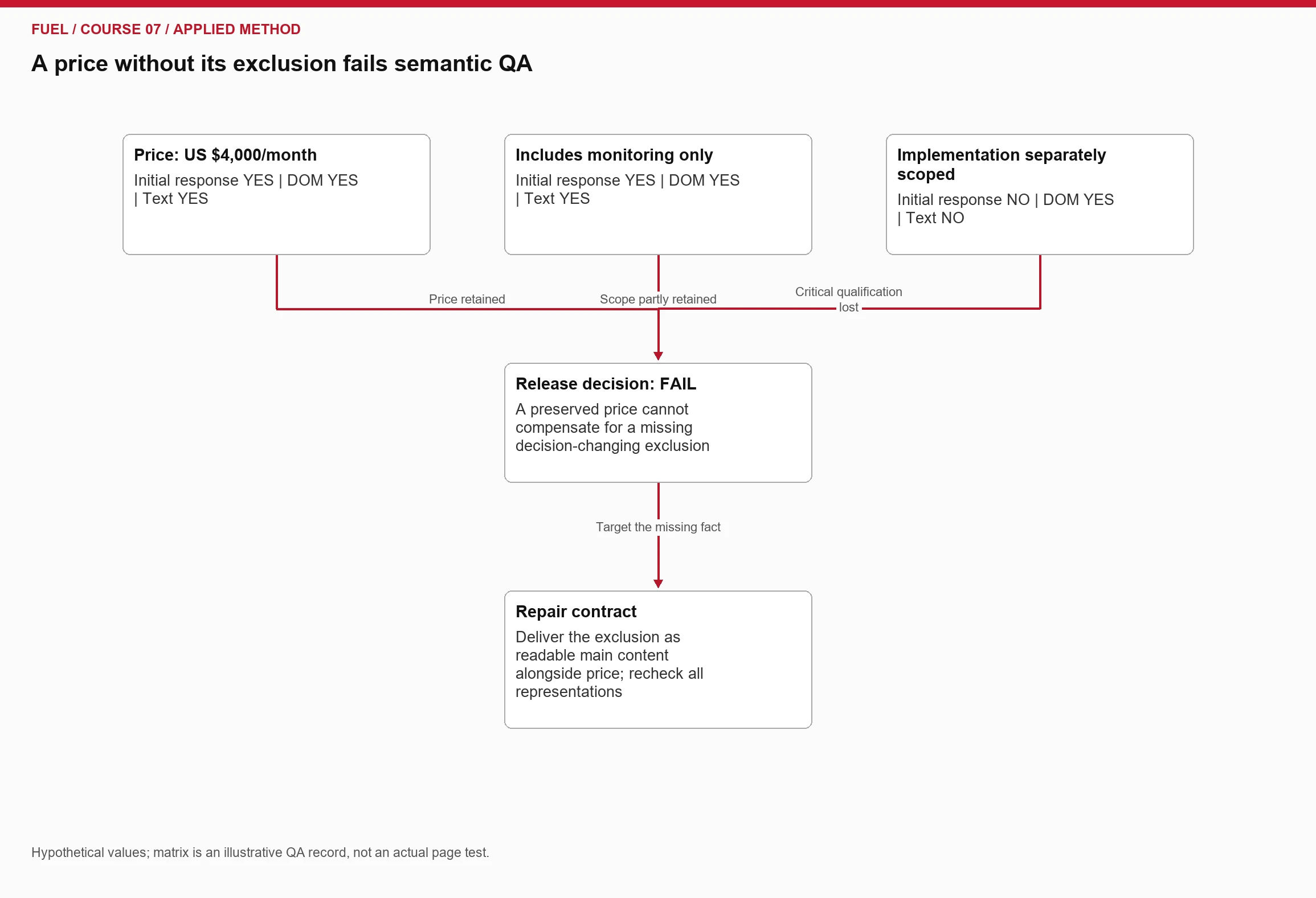
Consider a hypothetical service page with three facts: US $4,000 per month, monitoring included, and implementation separately scoped. The initial response contains the first two facts. The browser renders all three after a secondary request. The readable extraction retains the price and monitoring statement but omits the exclusion. That matrix identifies a real semantic failure even though the browser screenshot looks complete.
For this JavaScript SEO triage method, you can assign weights to prioritize inspection, but do not let the score override a critical failure. If price has weight three, included scope weight three and the exclusion weight five, a representation missing the exclusion retains six of eleven weighted points, or about 54.5%. The number describes this invented review rubric. It is not a ranking probability, an AI-readability standard or a measured citation predictor.
The more important conclusion is categorical: the exclusion is critical and absent, so release fails for that tested representation. Even a representation retaining ten of eleven points would fail if the missing point carried a decision-changing requirement. Use the score to organize work, not to average away a defect that makes the answer misleading.
Inspect relationships as well as isolated strings. A table may preserve every price but lose which plan each price belongs to. A two-column layout may flatten an exception beneath the wrong option. A collapsed panel may contain the only qualification, while the main summary presents an unlimited claim. The matrix should describe the resulting reader misunderstanding, because that is what the repair must prevent.
How do you repair a price that loses its exclusion?
The following incident is hypothetical. A pricing component renders the base price in server-delivered text, while a client-side request loads the implementation exclusion into an interactive panel. The page's browser view is accurate after the request succeeds. An extraction used in the test captures the price but omits the panel's content. The defect is not that JavaScript exists; it is that a decisive qualification depends on a path the tested representation does not preserve.
Write the failure ticket around fact identifiers. “Fact P3, implementation separately scoped, is absent from the initial response and tested text extraction; P1, monthly price, remains present.” Attach the URL, approved revision, response capture, rendered snapshot, extraction and steps. State whether the omission occurs without interaction, after a timeout or only under a particular layout. That is more useful than “AI cannot read our site.”
Choose a remedy that restores the content contract. The team might render the qualification alongside the price in initial HTML and keep the interactive panel for additional detail. It could move a shared scope statement into the main content or adjust a component that hides text from the relevant extraction path. The remedy should preserve the same truthful information for users and retrieval paths rather than serve a different promotional claim to one requester.
Retest the repaired fact in all three representations. Confirm that the price, billing basis and exclusion remain associated. Check the browser layout to ensure the fix did not duplicate the qualification confusingly or place it beneath the wrong plan. Inspect the primary action so a buyer still reaches the appropriate next step.
The JavaScript SEO repair receipt should name the changed component, the restored fact, the observed representations and remaining limits. It should not say that citations improved unless a separate observation actually measures that outcome. The technical repair is complete when the approved fact survives the agreed delivery contract; external selection remains a different question.
For wording that retains its conditions when copied, apply answer passage engineering before retesting delivery.
When is server rendering for AI search useful?
Evaluate server rendering for AI search alongside static and client rendering, using the content’s update pattern, access needs and operational constraints. Static generation can fit public content that changes through a controlled publishing process. Server rendering can fit public answers assembled from current application data. Client rendering can fit interactive experiences, but decisive public facts still need a reliable observable delivery path. The right decision depends on the actual component and deployment system.
Do not turn JavaScript SEO into an argument that every page must use one architecture. A static article and a personalized dashboard have different needs. The public article should expose its substantive explanation reliably. The private dashboard should protect the user's information. A public explanatory page can describe the dashboard's capabilities without making private account content available to search.
Compare operational responsibilities. Static generation needs an update and invalidation process so published facts do not become stale. Server rendering needs reliable data access, caching and error handling. Client rendering needs testing for delayed requests, failures and interaction dependence. Each approach can deliver a good experience when its dependencies are managed, and each can fail when those dependencies are ignored.
Google describes dynamic rendering as a workaround rather than a long-term solution. Source note: Google Search Central, Dynamic rendering as a workaround, accessed October 2026. For a new repair, first evaluate whether the normal application can deliver the intended content consistently. A separate crawler-rendering path adds another representation to maintain and compare.
Scope the intervention to the observed defect. One client-only price qualification may need a component change rather than a complete framework migration. A shared application shell that hides every public article may justify a broader template remedy. Estimate engineering effort, maintenance and regression risk against the specific facts that are failing. Replacing architecture without a content contract can spend substantial effort while preserving the same semantic omission.
Which tests show observed handling rather than a visibility guarantee?
Source-response inspection is inexpensive and useful for determining what the server actually delivers. Its limitation is that it cannot show content produced only after rendering. Use it to detect empty shells, redirect problems and missing initial facts, then compare with the rendered result rather than declaring every client-generated component invisible to every system.
Browser DOM inspection is useful for diagnosing component state, interaction dependence and hydration changes. Its limitation is that a complete local browser view does not establish external crawl or indexing behavior. Capture relevant console and resource failures, but connect them to a missing fact before treating every warning as a release blocker. Many incidental errors do not change the page's substantive answer.
Text extraction is useful for checking whether meaning survives when visual layout disappears. Its limitation is method dependence. Different extractors may treat tables, panels and navigation differently. Keep the method consistent for regression checks and inspect meaningful failures. When two extractors disagree, determine whether the source's semantic structure is ambiguous or whether one tool has a documented limitation.
Provider inspection can add direct evidence about that provider's observed handling. Google recommends its inspection and testing tools for search-related JavaScript debugging. Source note: Google Search Central, Fix Search-related JavaScript problems, accessed October 2026. Preserve the inspection's date and scope, because a passing result is an observation of a tested version and condition, not a permanent certificate.
A useful JavaScript SEO evidence ladder combines these methods without pretending they answer the same question. The initial response establishes delivered content, the browser establishes rendered state, extraction establishes a tested text representation and provider tools establish their own observed handling. Together they narrow the diagnosis. None alone reveals every step from discovery to citation or qualified inquiry.
If the content is blocked before rendering, use the AI crawler access policy course. If the delivered facts disagree, use entity reconciliation to resolve their source of truth.
How should an agency automate content-delivery regression checks?
An AI search technical SEO audit should automate stable assertions that express the content contract. Check that the intended route resolves appropriately, the main content contains required identifiers and critical qualifications remain associated with their claims. Use exact matching for immutable identifiers and semantic or structured checks for wording that can change legitimately. A test that duplicates the component's implementation may pass while the reader's answer still fails.
Select representative cases by template and behavior. Include a long article, a pricing table, a conditional region view, a deep application route and a page with an intentionally unavailable state where relevant. Do not build hundreds of nearly identical checks when one shared component governs the behavior. Broaden the sample when a failure or a materially different template justifies it.
For JavaScript SEO regression ownership, separate content changes from delivery changes. A new product exclusion requires an updated fact inventory and owner approval. A CSS or hydration change requires checking whether the existing approved facts survive. A routing change requires direct requests to deep destinations as well as navigation from the homepage. This division keeps failures actionable.
Store evidence compactly: revision, test conditions, critical-fact results, relevant captures and failure rationale. Avoid retaining sensitive cookies, credentials or private payloads in a public report. A reproducible content test can usually use intended public pages and safe example data. When an authenticated environment is necessary, keep the access-dependent result separate from public-discovery claims.
Define the release rule in advance. Critical fact loss blocks the affected page or template. A secondary formatting defect can enter a repair queue with its owner and next check. After a fix, rerun the failed representation and connected regression cases. Repeat the entire suite only when the changed dependency or unresolved concern warrants it. The goal is dependable meaning with proportionate verification, not an ever-growing collection of screenshots.
Before accepting a rendering recommendation, ask the agency to supply a failed fact ID, matching-revision captures and a component-level repair proposal. The acceptance record should show the same price, version or exclusion in the agreed representations after the change. Clarify whether deployment, cache invalidation and regression maintenance are included, and identify the internal owner who approves meaning. This separates a useful technical deliverable from a broad claim that a framework is invisible to AI. If a complete migration is proposed, request evidence that the failure is shared across templates rather than confined to one conditional component.
Can ChatGPT read JavaScript accurately in the tested scenario?
Use this hypothetical JavaScript SEO lab. A compatibility page says a connector supports Product Atlas 8.2 for one-way record export. The source response contains the connector name and a broad “connects with Atlas” heading. The rendered page adds the version and direction after a request. A text extraction includes Atlas 8.2 but loses “one-way,” while a screenshot shows all details. The install action leads to a valid setup guide.
Identify the critical facts before scoring the page. Product identity matters, supported version matters and direction matters because a buyer could wrongly expect two-way synchronization. The valid setup link is useful but cannot compensate for a missing direction boundary. The screenshot proves that one tested browser view contains the qualification, while the other captures show that the agreed delivery contract is not yet satisfied.
Write a narrow repair: expose the supported version and one-way direction in the readable main explanation alongside the connector name. Keep additional setup detail in the interactive component if it remains useful. Retest the initial response, rendered DOM and readable extraction against the same approved revision. Confirm that the direction remains attached to the capability rather than appearing in unrelated footer text.
Your answer key should reject the statement “The page passes because the screenshot is complete.” It should also reject “JavaScript always prevents AI search visibility.” The evidence supports a specific loss of a decisive fact under specific tested representations. A disciplined diagnosis turns that finding into a component-level repair, not a universal claim about a technology or provider.
Submit the critical-fact inventory, preservation matrix, reproducible ticket and acceptance evidence. A strong submission explains exactly what failed, why it matters to the buyer and which change restored the meaning. That is the practical value of JavaScript SEO for AI search: a defensible path from an ambiguous symptom to a verified content-delivery improvement.
Source and method notes
Google Search Central. Understand the JavaScript SEO basics; Fix Search-related JavaScript problems; Dynamic rendering as a workaround. Accessed October 25, 2026. Critical-fact weighting is a Fuel triage method, not a search metric. All numerical incidents and product names are hypothetical.
Scope a content-delivery repair
Bring a critical page, its expected facts and delivery captures to a Fuel Online AEO and AI SEO implementation discussion.
Explore the AI SEO and AEO course curriculum.
Discuss AI SEO and AEO implementation with Fuel Online.