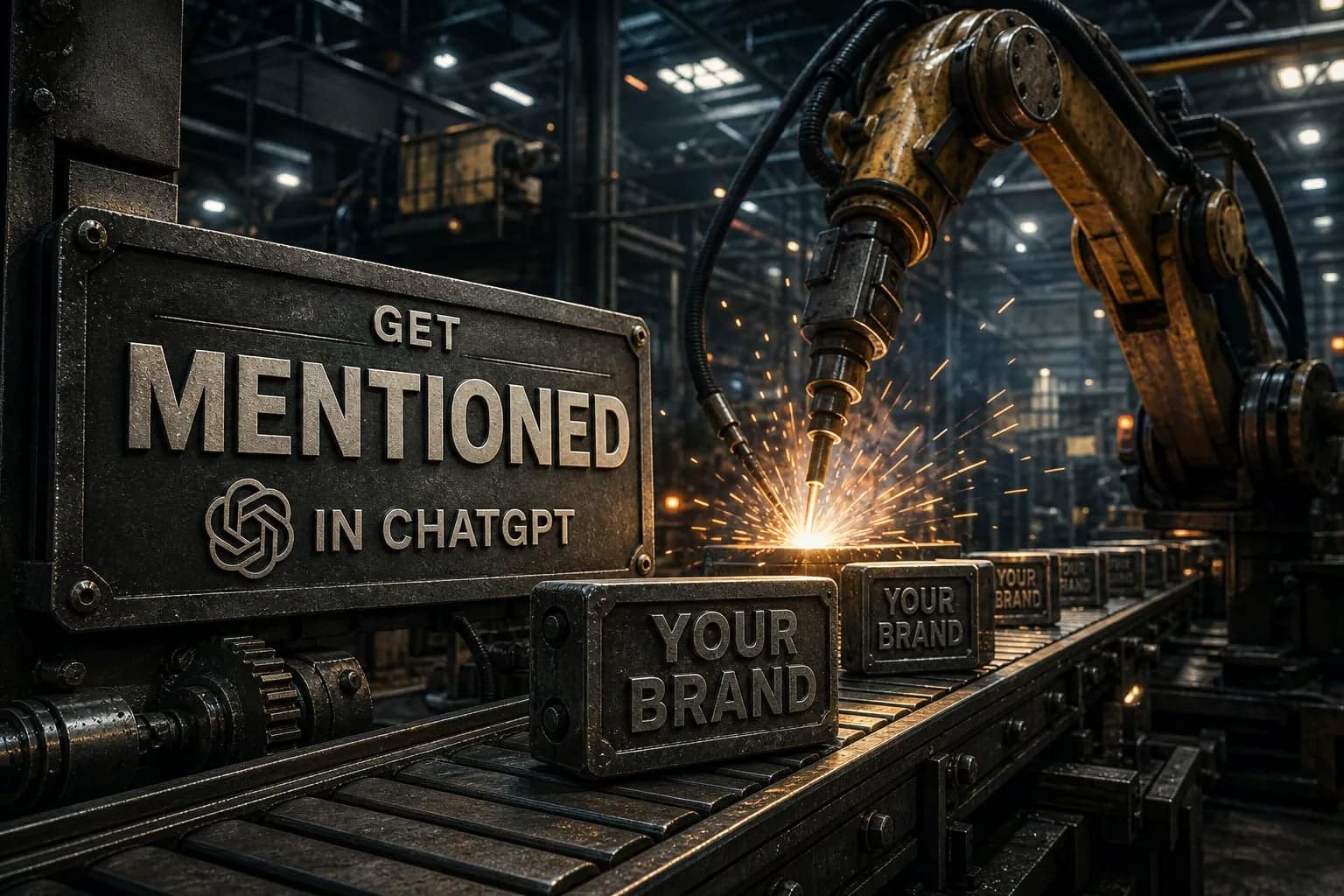
How do I get my brand mentioned in ChatGPT answers? That question has become one of the most urgent in digital marketing. Marketers have spent years obsessing over page-one Google rankings, but a growing share of buying decisions now start with a ChatGPT prompt. The user gets a clean, confident AI-generated answer that names two or three specific brands, and if yours isn’t one of them, you didn’t just miss a click, you weren’t considered at all. That’s a different kind of invisible, and it’s getting more expensive by the quarter.
The good news is that LLM mentions aren’t random. There are identifiable signals that push brands into AI-generated responses, and those signals are measurable, buildable, and testable. Fuel Online has been reverse-engineering those signals since AI search went mainstream, building playbooks that enterprise brands use to embed themselves into LLM answers at scale. What follows are nine specific tactics, ranked by priority, along with how to verify whether they’re actually working.
How Do I Get My Brand Mentioned in ChatGPT Answers, What’s Actually Happening
Before implementing anything, it’s worth understanding how LLMs actually select what to say. Systems like ChatGPT with browsing, Perplexity, and Gemini all follow a similar pipeline: they parse the user’s intent, retrieve a limited set of candidate sources from their index, re-rank those candidates by relevance and trust, extract the most useful passages, and synthesize an answer. The model is not reading the whole web. It’s working from a small candidate pool, and if your brand isn’t in that pool, no amount of polished website copy matters.
The signals that push a brand into that candidate pool break down into five categories: topical relevance to the query, domain authority and backlink trust, freshness for time-sensitive topics, structural clarity (clean headers, concise answers, scannable tables), and evidence density, meaning the page has concrete statistics, cited claims, and specific numbers an AI can actually ground a response on. Different AI products weight these signals differently, but all five consistently influence whether a brand enters retrieval at all. Understanding that is the starting point for everything below.
Build Your Brand as a Recognized Entity First
1. Get into Wikipedia, Wikidata, and the knowledge graph
LLMs are far more likely to mention a brand that exists as a well-defined, unambiguous entity in public knowledge sources. Wikipedia and Wikidata function as high-trust anchors for LLMs because they provide structured, verified information in a format retrieval systems can parse cleanly. A Wikidata entry with accurate triples, brand name, founding date, category, headquarters, reduces entity ambiguity and increases retrieval precision. In practical terms, the model “knows who you are” without having to guess.
Qualifying for a Wikipedia article requires demonstrable notability, typically earned through significant third-party coverage. If your brand isn’t there yet, a minimal Wikidata record is a faster first step. Brands that have corrected their cited sources and added Wikidata entries have seen measurable improvements in LLM retrieval frequency. Start with Wikidata, pursue Wikipedia coverage through digital PR, and make sure both are accurate and current.
2. Lock down entity consistency across your entire web presence
Inconsistent brand descriptions confuse retrieval systems. If your website describes you one way, your LinkedIn bio says something different, and your Google Business Profile uses yet another framing, LLMs receive conflicting signals and either produce a weaker mention or skip you entirely. LLMs train on crawled web text, which means every surface where your brand appears feeds their understanding of what you are and who you serve.
Write a single canonical brand description, two to three sentences covering what you do, who you serve, and what makes you different, and use it uniformly across your website About page, all social profiles, press release boilerplate, directory listings, and partner pages. This isn’t branding advice; it’s retrieval architecture.
Create Content LLMs Can Actually Extract and Cite
3. Write answer-first content structured for AI readability
LLMs strongly prefer passages that answer a question directly and concisely before expanding into supporting detail. A page that buries its main claim in paragraph four, behind context and caveats, is much less likely to be extracted than a page that leads with the direct answer. This format change alone can shift how often your content is cited across AI platforms. One media company, for example, moved from appearing in 1 of every 34 AI conversations to 1 in every 4 after publishing 40-plus articles built specifically around direct, structured answers to high-intent buyer prompts.
Build pages around the exact questions buyers ask in AI chat interfaces, things like “best [category] for [use case]” or “how does [your product] compare to [alternative].” These prompts are different from traditional SEO keyword targets, and they require a different content architecture. Generic pillar pages won’t earn citations the way focused, answer-first pages do.
4. Build comparison pages and data-backed narratives
Comparison pages and original data studies earn disproportionate LLM citations because they give AI systems concrete, factual claims to ground an answer. When a model is answering a recommendation query, it needs evidence, not marketing language. A page with a comparison table, real pricing data, and specific outcome numbers is far more citable than a page full of descriptive adjectives. Comparison pages consistently rank as the most frequently cited format for product and category recommendation queries across ChatGPT, Perplexity, and Gemini.
Create content around the exact category prompts your buyers use, not just branded queries. If you’re not showing up when someone asks “best [category] tool for B2B companies,” that’s a direct revenue problem. Include statistics, product specs, and outcome numbers wherever possible. Evidence density is what separates content an LLM cites from content it ignores.
Earn Citations on the Sources AI Actually Trusts
5. Run digital PR and earn editorial mentions
Internal content alone isn’t enough. LLMs are trained heavily on third-party web text, and brands cited on trusted external sources earn far more AI mentions than brands that only appear on their own properties. ChatGPT most frequently cites sources like Wikipedia, Reddit, Forbes, TechRadar, Reuters, and review publishers in the style of Wirecutter for brand comparison and category recommendation queries. Getting mentioned in those environments is what feeds the retrieval pool.
Pitching journalists, appearing in industry roundups, earning links and mentions on high-authority publications, and getting quoted in news articles all contribute to the same signal pool LLMs draw from. One financial services brand increased total AI citations by over 100% through a structured citation-building campaign, a direct result of showing up in sources AI systems already trust. Treat digital PR as an LLM visibility strategy, not just a traffic play.
6. Show up on review platforms, forums, and Q&A sites
Reddit threads, Stack Overflow answers, G2 and Capterra reviews, and Quora responses are frequently part of LLM training corpora and retrieval indexes. A brand that appears authentically in these conversations, with accurate and specific information, is more likely to surface in generative AI answers than a brand that only exists on its own website. Reddit in particular is a major source for “which is better” and recommendation-style queries.
Encourage genuine customer reviews on G2, Capterra, and Google. Participate in forum discussions where your product category comes up, authentically and with real information rather than promotional posts. The goal is to build a distributed presence across the sources AI systems already trust for third-party validation.
Technical Signals: Structured Data and Entity Optimization
7. Implement schema markup that sharpens AI source signals
Schema markup doesn’t directly train LLMs, but it improves how crawlers parse and classify your brand information, which feeds downstream into retrieval systems. The schema types with the most documented impact for AI search visibility are FAQPage (the highest direct extractability, since AI systems can map Q&A structure directly into generated responses), Organization with populated sameAs links (for entity disambiguation and knowledge graph recognition), and Product with complete specifications and pricing. HowTo schema helps for procedural content but has a weaker, less consistent effect on citations than the other two.
Implement FAQPage schema on your most important content pages. Make sure your Organization schema is complete and includes sameAs links pointing to your Wikipedia entry, Wikidata record, social profiles, and key directory listings. Correctly implemented schema reduces ambiguity about what your brand does and who it serves, exactly what retrieval systems need to include you with confidence.
8. Use entity optimization to embed your brand into LLM sourcing behavior
This is where most brands leave the most value on the table, and where the gap between standard SEO and AI SEO becomes clearest. Entity optimization goes beyond schema to map how knowledge graphs and AI retrieval systems interpret and classify a brand. Fuel Online’s entity optimization work specifically targets LLM sourcing behavior, ensuring client brands are structured in a way that makes AI systems confident enough to name them. This includes knowledge graph alignment, structured data layering, and content architecture decisions that most agencies haven’t caught up to yet.
The brands that will dominate AI search over the next few years aren’t necessarily the ones with the highest domain authority. They’re the ones most clearly defined as entities across every signal source an LLM can reach.
How to Verify Your Brand Is Actually Appearing in ChatGPT Answers
9. Build a repeatable prompt audit and monitoring system
Implementing tactics without measurement is guesswork. Start with a manual prompt audit: build a list of 15 to 20 prompts a real buyer would ask, covering both branded queries and non-branded category questions. Run them across ChatGPT, Perplexity, Gemini, and Claude, and log the outputs in a spreadsheet. Track whether your brand was mentioned, its position, sentiment, competitors mentioned, and source URLs cited. Run the same prompts on multiple days since outputs vary. This baseline is what you measure every future change against.
For ongoing monitoring at scale, several purpose-built tools now cover this space well. Profound is a strong enterprise option, with prompt-level monitoring, brand presence scoring, and SOC 2 compliance, starting around $99 per month. Peec AI offers multi-model tracking, competitor visibility, and historical trend data suited to mid-market teams. Otterly AI is an accessible entry point for smaller budgets, starting around $25 to $29 per month, covering AI visibility monitoring and generative engine optimization (GEO) auditing. SE Ranking and Ahrefs Brand Radar are solid hybrid options for teams that want AI visibility layered into a broader SEO workflow.
Run your core prompt suite weekly or monthly, track both branded and non-branded queries, and compare share of voice against competitors. Non-branded category queries often reveal your true visibility better than direct brand searches, because that’s where buyers are actually making decisions.
The Window for Early Movers Is Still Open
If you’ve been asking, “How do I get my brand mentioned in ChatGPT answers?”, the answer is that it’s an engineering problem, not a lottery. The brands showing up consistently have built clean entity signals, earned citations on trusted external sources, structured their content for AI extractability, and implemented the technical foundations that make LLMs confident enough to name them. Most brands haven’t done this work yet, which means the gap between those who have and those who haven’t widens every week.
Initial movement in mention frequency typically shows up within four to eight weeks of targeted changes. Broader, more stable shifts across a full query set take three to four months, longer if you’re building entity strength from scratch or competing against well-established incumbents. The timeline rewards starting now.
As AI search continues replacing traditional search queries, visibility in LLM answers will carry the same weight that page-one rankings carried a decade ago. The nine tactics in this guide are the foundation. Getting your brand mentioned in ChatGPT answers consistently and at scale requires exactly this kind of systematic approach. Brands that want to move faster, particularly at enterprise scale, should reach out to the Fuel Online team directly. The systems for embedding brands into AI-generated answers already exist. The question is how quickly you put them to work.