
Content pruning for SEO is the process of reviewing existing pages and deciding which to keep, update, merge, or retire. Start with the value of each URL in the markets you can serve. Read Google AI feature impressions alongside search clicks, backlinks, and qualified conversions. Make changes in small cohorts and track retained pages as well as removed ones. A lower AI impressions total can reflect lost visibility for irrelevant questions, a meaningful loss of buyer exposure, or a mixture of both. The URL and market breakdown tells you which.
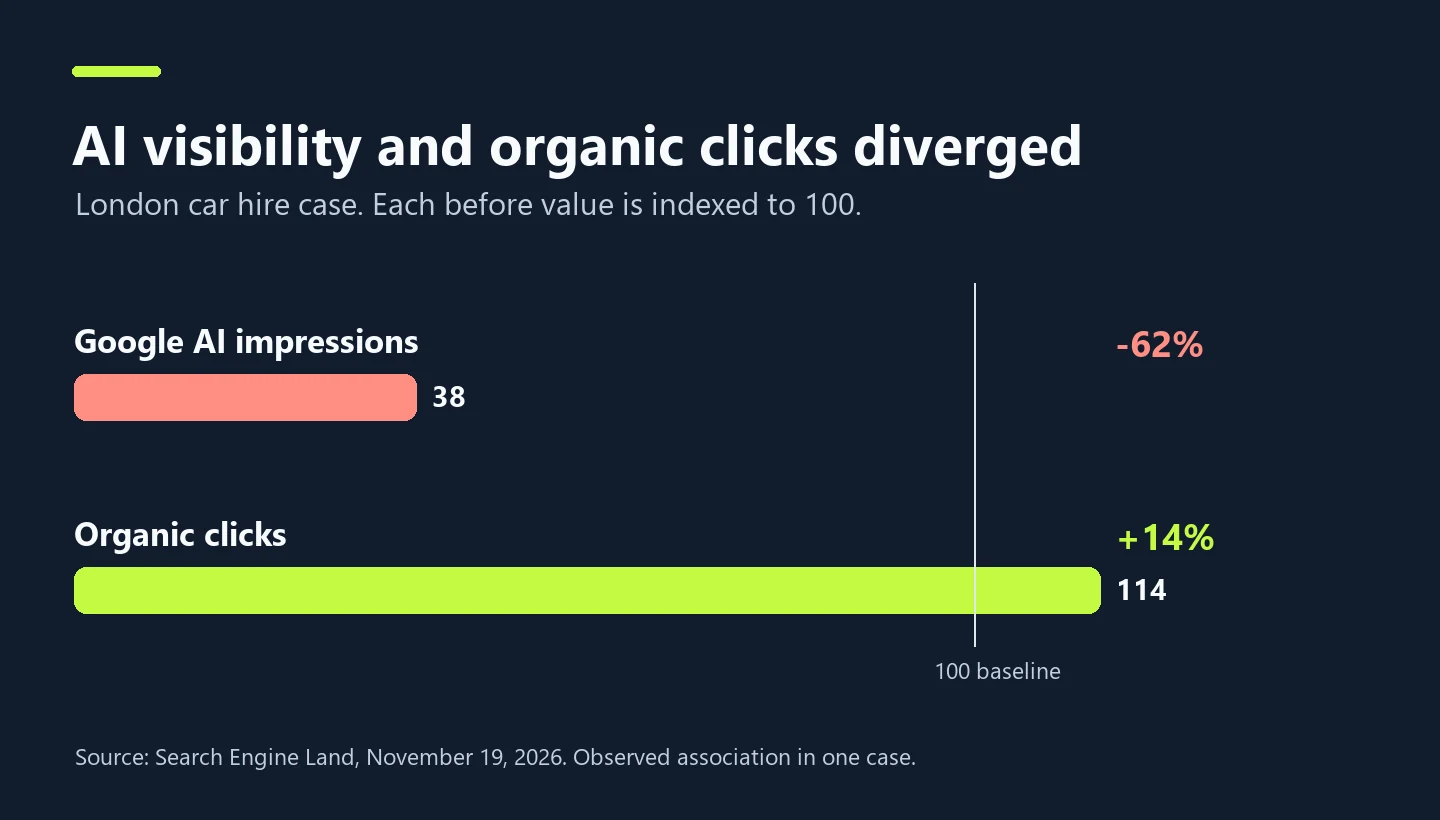
Search Engine Land published a case involving G&M Direct Hire, a London car hire company, on November 19, 2026. The article reported a 62% fall in Google AI feature impressions and a 14% rise in organic clicks after a batch of blog posts was removed. That’s evidence these measures can move in opposite directions in the same period. The observation leaves the effect of the removals open because the business and search environment also changed. Search Engine Land case study
What actually happened in the London car hire case?
The author reported that daily Google AI feature impressions fell from 1,535 to 591. That is a drop of 944 per day, or 61.5% using those reported rounded counts. The associated prompt tracker also reported fewer citations and mentions. The organic click series moved the other way. The raw AI impression figures and the click percentage describe different types of observations. Use an index with a baseline of 100 to display the relative changes on one graphic. Avoid drawing a conversion rate between them. Case data and commentary
| Signal | Reported movement | What it can answer |
|---|---|---|
| Google AI feature impressions | Down about 62% | Did exposure on measured Google AI search experiences change? |
| Organic clicks | Up 14% | Did more searchers click during the comparison? |
| CRM-qualified conversions | No directly comparable figure supplied for this inference | Did changes serve the buyers the business wanted? |
The opportunity to learn lies in the geography and intent detail. A London operator can receive exposure for borrowing, renting, financing, or licensing questions from people it cannot serve. A page can also attract viable drivers applying for a specific vehicle or service. Both may show up under the same broad topic label. A page receiving relevant local exposure can still help during research, even if most readers take days to inquire. That argues for investigating the landing pages and queries associated with the change before making another large edit.
Other explanations for the click increase can coexist. Seasonality can move the number of drivers shopping. A retained page can improve because its offer or internal links changed. An algorithm update or competitor availability can change demand capture. The reporting example supports a better measurement design for the next test. There is no credible basis here to forecast a 14% lift for another site.
Content pruning for SEO: Build a URL-level worksheet
Export landing pages, search clicks, impressions, country, and comparison dates from Search Console. Use the Google Search AI features report where available for its observed AI impression data. Keep a separate export for standard search performance and label its reporting scope. Use a canonical URL as the join key. Different properties, canonical assignments, and filters can change the reported totals. Save the original exports and document how you normalized protocol, host, trailing slashes, and URL parameters. Google Search Console AI feature insights
Bring in GA4 landing pages or your equivalent web analytics and add CRM-qualified leads where the landing path can be joined. Keep a coverage column for the percentage of inquiries with a known landing URL. Bring in referring domains, internally linked pages, sitemap status, and last substantive update. Ask support or sales which pages people repeatedly use before buying. For a publishing business, add subscribers or a comparable outcome rather than importing a lead definition from a different business model.
One worksheet row represents one canonical URL in one market and time window. A second sheet can track grouped topics. Recommended columns are canonical URL, template, target market, intent, old and new clicks, old and new AI impressions, qualified outcomes, referring domains, unique evidence, prospective target URL, recommendation, owner, and rollback trigger. Keep unknowns blank and measured zeros as zero. An empty CRM field can mean broken attribution, a page too early in the journey, or a genuine absence of leads.
| Decision | Evidence to look for | What to do |
|---|---|---|
| Keep | Useful unique material, qualified outcomes, valuable links, or relevant visibility | Preserve the URL and the evidence others reference |
| Update | Intent still matters and the offer, evidence, date, or usability is stale | Refresh at the same URL and retain useful original material |
| Merge | Multiple pages satisfy substantially the same search task | Consolidate useful content into the strongest equivalent and permanently redirect old URLs |
| Retire | Content is obsolete or irrelevant and no equivalent destination exists | Remove internal references and return a genuine 404 or 410 |
The market filter changes the decision
Suppose a guide has 8,000 AI feature impressions, 180 clicks, and one known qualified inquiry over a reporting period. At first glance, it looks like a weak lead producer. The country breakdown shows 90 of the clicks came from the only country the business serves. The CRM team confirms 30% of known organic inquiries have no landing page, and support sends the guide to drivers regularly. The page needs stronger eligibility cues, examples, and an inquiry path. An update is a sensible first decision.
Take a second page with 4,000 impressions, 12 clicks in any market, no useful links, and an offer your business stopped providing three years ago. Find out if a newer page directly answers the old question. If so, merge what remains useful and deploy a permanent redirect. If regular visitors arriving at the replacement would feel sent somewhere unrelated, a clear removal is a better fit. Validate permanent redirects and sitemap updates after release. Google Search Central redirects guidance
What counts as unique evidence worth keeping?
Protect anything people would be inconvenienced to lose. That may be a compatibility table customers use, the only photo series demonstrating a repair, a locally accurate supplier comparison, or a data set a trade organization links to. Save the original table and explain its sample, limits, time window, and definitions. A page with few clicks can still be important documentation for a niche buyer, journalists, or an operations team.
For updates, strengthen the original asset in ways a generative answer can accurately quote. State the answer below the heading, place the method and denominator next to a statistic, label hypothetical examples, and give visuals descriptive captions. Provide a detailed exception or eligibility rule where it changes the answer. Google recommends useful original material and clear organization for AI search features. An addressable section with verifiable evidence can also help a human reader locate what they came for. Google’s AI search optimization guide
How to run a pruning test without losing the plot
Start with one coherent batch of low-risk pages. Choose a comparison group with a similar market, intent, template, and pretest trend where possible. Write down the launch date, baseline dates, traffic scope, target outcome, expected effect, and roll-back rule. Exclude pages scheduled for other major changes. Save source content, headers, old links, and the redirect map before release. Keep a second reviewer for pages with a commercial role or meaningful external links.
Use equal weekday mixes, and record a baseline long enough to smooth volatility. An initial four weeks before and after is a starting point for sites with regular volume. Use longer windows for low-volume queries or a sales cycle that matures slowly. Check the same period in the previous year when seasonality is material. Week one can flag accidental redirect loops and indexing issues. Give the comparison enough time for recrawl, lead maturation, and a second read of the data.
Read the treatment group together with related retained destinations and an unaffected comparison group. If organic clicks rise 12% on the retained pages and rise 9% on comparable pages you did not touch, the simple difference is three percentage points. This illustrative comparison is a check on broad background demand. It still depends on how closely the groups tracked before the launch. If both groups move together and qualified leads are sparse, report the uncertainty instead of crediting a change.
Review by impact. A sharp fall in sitewide AI impressions with stable organic buyers and declining irrelevant-market visibility can be tolerable. A 10% decline in meaningful AI exposure concentrated in a profitable use case is a different finding, especially if referrals or qualified inquiries slip. If the old page had unique evidence customers valued, restore it or make the new equivalent more discoverable. Specify a dated owner for the decision and keep a record of changes so nobody repeats the same audit six weeks later.
Run a preflight review on pages with commercial links
Before pruning, sort the candidate URLs by referring domains, relevant-market clicks, and known qualified outcomes. Send the small set that rises to the top of any list to a human reviewer. Ask for evidence of the inbound link’s context and the next action a visitor would reasonably expect. A niche resource cited by a regulator, trade publication, or supplier can be difficult to replace after a broad cleanup. For merged URLs, confirm the new page actually contains the cited passage or an equivalent source, so a human following the old link still finds what was promised.
A practical release checklist for the four decisions
For a keep decision, document who uses the page and why. A guide can earn links from publishers while producing few direct leads. A help article can reduce support burden while exposing the product to reviewers. Verify the URL resolves, refresh clearly outdated references, and keep the parts that differentiate it from nearby pages. If the content is strategically meaningful but poorly linked, add a link from a relevant section rather than redesigning the entire guide in the same release.
For an update, name the gap you are fixing. A visitor might need current prices, geographic limits, steps to qualify, or a recent comparison. Use the original URL where the search task is unchanged. Save prechange versions of the claims, tables, and source dates. This gives the team a rollback option if an edit accidentally removes the part the page was known for. Make a short change log that names the evidence your editor added, not just the date the article was refreshed.
For a merge, identify a replacement that serves the same intent. Fold unique material into the replacement before redirecting. Update internal links to go directly to the final page, remove old URLs from the sitemap, and test them with redirects followed. Confirm the target page itself returns a successful response and has the intended canonical. If a partner still links to the old page, a redirect protects the visit and an outreach note can improve the user experience.
For retirement, check for active customer journeys, policy references, and product documentation that could still point to the page. If it truly no longer serves anyone and has no comparable replacement, retire it cleanly. Record the change date and audit affected templates or related pages. An older page with no search traffic can still exist to satisfy a customer or legal need. The editorial decision belongs with the owner of that task.
Review your decision log once before deployment with someone outside the SEO team. Ask them to read five changed URLs and tell you what a visitor arriving from an external link would find. If that answer contradicts the original intent, correct the plan before removing content.
Content pruning and AI visibility FAQs
Does deleting content improve SEO?
It can be appropriate when material is expired, misleading, redundant, or irrelevant. Page removals can also lose useful links, traffic, or citations. A defensible decision starts with the purpose and evidence for each URL and a review of what happens after the change.
Are Google AI impressions the same as AI citations?
Google AI impressions measure exposure inside the Google experiences covered by the report. A citation tracker samples outputs from a list of prompts and can answer different questions about brands and source URLs. Compare trends within each measurement method and document the scope.
Does a page need leads to deserve its place?
A page can explain eligibility, supply original data, reduce support workload, or help a buying committee make a decision. Record that job and check evidence against it. Reserve lead targets for pages where generating an inquiry is a plausible next action.
What should leadership see?
Show organic clicks, relevant-market AI impressions, qualified leads, and the cohort scope. List the pages that lost the most relevant exposure and the business outcome they support. Include the next action and review date. Fuel Online SEO services