
Serving Naperville, Illinois
#1 Best Rated
Naperville Digital Marketing Agency
Which digital marketing agency should a business in Naperville choose?
Choose a digital marketing agency that can connect strategy, execution and measurement to how your business earns revenue. Fuel Online serves clients in Naperville with senior-led SEO, AI search optimization, paid media, content, conversion strategy and analytics. Since 1998, our focus has been helping businesses turn visibility into growth. We build the channel plan around your customers, competition, priorities and capacity to serve new demand.
5-star client reviews for Fuel Online. Google: 5.0/5 (Boston agency profile) · Clutch: 5.0/5 · GoodFirms: 5.0/5. Agency profile ratings checked September 27, 2026. Follow the sources for current reviews.
Naperville, Illinois Market Strategy
Senior digital strategy for companies competing in Naperville, Illinois.
Fuel Online helps companies in Naperville, Illinois increase qualified visibility, improve lead quality, and make customer acquisition more efficient.
The plan reflects regional competition, buyer expectations, and the commercial realities facing financial-services organizations, along with manufacturers.

Campaign geography
Naperville customers, clearly defined
Naperville city, Illinois. City/place boundary only; surrounding suburbs and the metropolitan area are not included.
Fuel works with clients in Naperville. The campaign starts with your actual products, services and ability to serve the customer. We distinguish city-specific searches from wider regional buying journeys, then connect the right answer to the right destination.
Local facts, practical decisions
Naperville market data: define the audience before the campaign
Naperville city, Illinois. City/place boundary only; surrounding suburbs and the metropolitan area are not included.
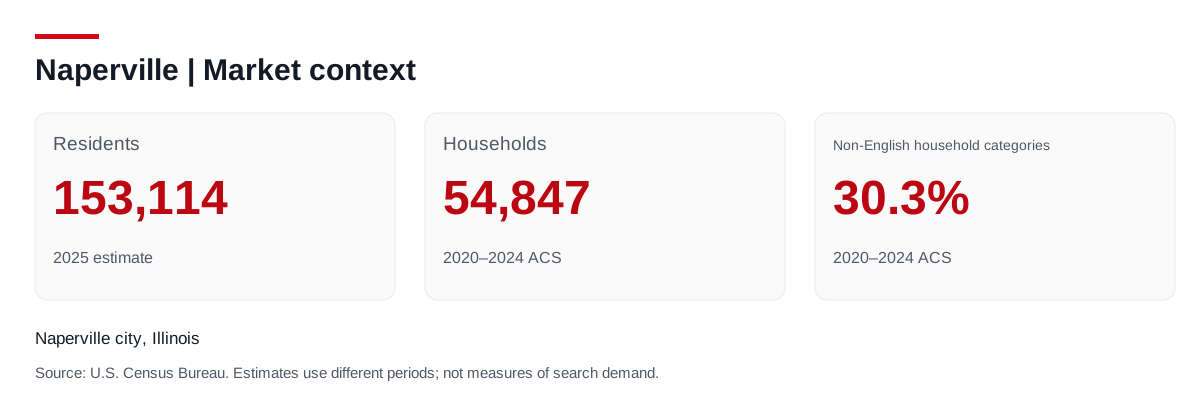
Resident population
153,114July 1, 2025; Census Population Estimates Program, Vintage 2025
Change from July 2024
+566 (+0.37%)2024–2025; same Census vintage
Households
54,8472020–2024 ACS five-year estimate
Spanish household-language category
5.3%2020–2024 ACS five-year estimate
An estimated 30.3% of households in Naperville city, Illinois are in Census language categories other than English only. The largest non-English category is Other Indo-European languages. Fuel uses this as a reason to test language-specific query and inquiry patterns before recommending professionally localized content and matching sales support. Household categories do not measure individual fluency or preferred search language.
The +2.39% change from the 2020 estimates base to July 2025 describes the defined place, not the whole metro. For an established business, the first decision is whether existing locations and service capacity still match the areas producing qualified customers. For a new market entry, validate the offer and conversion path before scaling coverage.
Sources, geography and estimate uncertainty
Population estimates and ACS five-year survey estimates have different reference periods. They are shown separately; no search volume, income or revenue is inferred from them.
ACS household count (1600000US1751622): 54,847; published margin of error ±833.
ACS household-language categories (1600000US1751622): English only 38,219, margin of error ±1,125; Spanish 2,886, margin of error ±390.
For combined markets, only the named component places are included. Component margins of error are retained; no combined margin or margin for the calculated percentages is claimed.
Your market, your decisions
How Fuel builds the Naperville growth plan
Naperville’s State of the City address discusses the I-88 innovation corridor and telecommunications development. That context can guide technical buyer research without assuming every local business is a technology customer.
Explain integration rather than just innovation
For a technology service, publish the systems supported, implementation stages and ownership of ongoing maintenance. Buyers should understand the operational change before booking a discovery call.
Distinguish vendor selection from technology education
Separate paid terms for an implementable business solution from general research or consumer support queries. Judge leads by application fit and decision readiness.
Make technical comparisons attributable
Give named specialists responsibility for method and compatibility answers, with dated supporting evidence. Regional innovation history should not be presented as the company’s own invention or intellectual property.
Market sources: Naperville State of the City address
The work you receive
Naperville: a defined digital marketing implementation plan
Digital marketing strategy: prioritize the right channels
Assess your acquisition mix, customer journey and commercial constraints before assigning budget to channels.
What you can review: A prioritized strategy that identifies the audience, offer, channel role and measurement approach.
Integrated execution: SEO, AI search, paid media and content
Coordinate SEO, AI search, paid media, content and conversion work so each discipline supports the same customer journey.
What you can review: A practical roadmap with owners, dependencies and agreed deliverables.
Conversion strategy: make your business easier to choose
Improve service explanations, proof, landing experiences and next steps at the points where buyers compare providers.
What you can review: Conversion-focused pages and campaigns with relevant evidence and clear calls to action.
Marketing measurement: invest using commercial evidence
Review lead quality, pipeline and revenue where measurement supports them, then use those findings to adjust the plan.
What you can review: Reporting that explains what changed, what the data supports and what to test next.
Turn technical interest into a clear implementation conversation.
A useful digital marketing assignment for a Naperville business starts by identifying what the prospective customer needs to accomplish. Someone comparing implementation partners needs different information from someone learning a technical concept or trying to repair a personal device. Connect the request to a service your company actually offers, a page that explains its boundaries and a team member who can respond. That connection gives SEO, paid media and content work a specific commercial purpose.
Distinguish the task before choosing the destination.
Technical vocabulary can conceal very different intentions. A phrase about connecting two systems may describe a business evaluating a project, an employee researching an internal assignment or a consumer looking for a quick fix. The wording alone does not establish a buying opportunity. Review the actual question, the page reached and the request received before deciding whether the campaign needs a new service page, a clearer explanation or a separate support route.
Build the distinction from your own service catalog and receiving process. If your business does not provide consumer support, do not design an advertisement that implies it does. If it does provide support, give that customer a useful destination rather than forcing every request into a new-project form. A service buyer should be able to understand the work being offered without reading through material intended for a different audience.
| Observed customer task | Useful page material | Receiving responsibility |
|---|---|---|
| A business is comparing providers for an implementation. | Explain the offered service, project boundaries, information needed for initial scoping and the next discussion. | An assigned commercial or project contact receives the request and brings in the appropriate specialist. |
| A reader wants to understand a method before considering a project. | Provide a maintained explanation that connects the method to the relevant offering without implying every reader is ready to buy. | A content owner maintains the explanation and a clear route lets the reader move to a service discussion when appropriate. |
| An existing customer needs help with a delivered service. | Show the actual support or account route your business maintains, separate from the new-business proposal path. | The established support or account owner receives the request under the existing customer process. |
| A person is troubleshooting something outside the business’s service scope. | Make the offering’s boundaries clear so the page or advertisement does not suggest an unavailable service. | The marketing owner reviews why the visitor arrived and whether targeting or the destination needs clarification. |
Give the specialist a defined publishing responsibility.
Ask the person responsible for delivery to confirm the service description before expanding its visibility. That review should identify which systems or situations the business currently supports, what the initial discussion can establish and which details require a later project assessment. Marketing can organize the explanation, but it should not infer compatibility from an old presentation, a vendor badge or a broad statement about innovation.
Keep a record of the approved explanation and its owner. When an offering changes, the reviewer should be able to identify the affected service page, comparison resource, advertisement and inquiry prompt. This is more useful than a general instruction to keep the website current: it links a particular business decision to the public material that depends on it. The review date indicates when the material was checked, rather than guaranteeing that every possible implementation will fit.
A worked example: an implementation page attracts support requests.
Consider a fictional business technology provider that offers implementation planning and ongoing maintenance. Its marketing page describes connecting workplace systems, but the page does not distinguish new projects from help with an existing installation. The receiving team reports that several contacts are asking for immediate troubleshooting. That observation does not establish that the channel is useless. It identifies a question about whether the message, destination and receiving route describe the same service.
The first release could clarify the offered implementation work and place the provider’s actual existing-customer route beside the new-project route. A maintained explanation could answer the recurring research question without presenting it as a purchase request. The specialist would check the service boundaries; the marketing team would connect the relevant resources; the receiving team would confirm where each kind of contact belongs. These are hypothetical responsibilities, not claims about a Fuel client or a particular software product.
Review the next set of contacts by their stated tasks. If implementation buyers now reach a person who can arrange the right discussion, the repaired route is doing its intended job. Whether the campaign generates more such buyers, at a sensible cost, requires separate observation. If most contacts still seek a service the business does not offer, revisit the advertisement or search intent before commissioning more content about the same broad technical phrase.
Make paid testing conditional on a usable receiving process.
A paid campaign needs more than a relevant keyword and an available budget. The destination must explain the real offering, the request must reach the right person and that person must have a way to continue the conversation. If any of those pieces is missing, a bounded page or receiving-process repair can be the more useful initial assignment. Increasing advertising expenditure would otherwise make the same ambiguity more expensive to observe.
Where the offering and route are ready, define a limited test around a particular business task. Agree which destination is being tested, which requests count as implementation discussions and who will review the received records. Set the spending boundary and review point with the business before launch. The purpose is to learn about that specific task and route; a test is not a promise of a particular number of inquiries, sales or profitable customers.
Organic work can serve a different role. If buyers repeatedly need a substantial explanation before they can compare providers, a maintained resource may be useful alongside the service page. Its success should not be judged solely by immediate form submissions. Review whether the resource answers the question, points to the correct offering and contributes useful context when a business discussion occurs. Avoid turning every educational topic into another interchangeable service landing page.
Compare proposals using three separate commitments.
Separate the agency’s delivery scope, the client’s participation and the advertising allocation. A proposal may include page research and implementation while relying on a client specialist to approve technical statements. Media expenditure may be separate from those fees. Make those boundaries visible before comparing quotations, because two apparently similar budgets can purchase different work and require different amounts of client time.
For the fictional provider, an initial scope might include revising one implementation page, connecting an existing explanation, clarifying two inquiry routes and reviewing the resulting contact records. Ask who will make each change, where it will be inspected and what is excluded. A proposal that leaves the support route to the client should say so. A proposal that includes implementation should identify the access and approvals needed to complete it.
Use investment questions to make the work comparable rather than asking for a universal marketing price. Which change is essential before advertising? What would be maintained after the first release? Which service change would require another review? What can the receiving team reasonably handle? Those answers help establish the scope and pace of an engagement without inventing a price, a local demand estimate or an expected return from public market figures.
Keep the request, the discussion and the project separate.
A received form is evidence that a message arrived, not that a commercial project exists. A continuing discussion needs its own record, and a scoped proposal or agreed project requires further evidence. Keep these stages separate when evaluating channel work. The distinction helps explain why a page can become clearer even when the total count of contacts falls: fewer unrelated requests may be consistent with a better-defined offering, but the actual records must support that interpretation.
In a fictional review, two messages from the same organization ask about one implementation. A third message asks for help with a personal device, and a fourth is an existing customer’s maintenance request. The review contains four messages, one prospective implementation discussion, one unrelated task and one existing-customer request. Do not report four new business opportunities or discard the maintenance request as worthless. Give each record the appropriate role in the business’s receiving process.
The next useful review asks what information was missing from the implementation discussion. If the prospect could identify the offering but the receiving team needed project context, improve the inquiry prompt or handoff. If the prospect misunderstood the offering, improve the explanation. This turns contact review into a specific implementation decision instead of an instruction to produce more traffic or publish more pages.
Resolve conflicting source material before publishing a comparison.
A specialist’s older presentation, a current service page and a draft proposal can describe different scopes without any of them being deliberately misleading. Before marketing combines them, identify the role of each document. A presentation may illustrate an earlier project; a service page describes the public offering; a proposal addresses a particular customer’s requirements. The comparison should not turn an example from the first document into a general promise in the second.
For the fictional provider, suppose an archived project summary includes maintenance work, while the current offering describes implementation planning only. Ask the service owner which work is available now and where the customer should ask about ongoing support. Keep the project summary’s historical context intact. Update the current explanation and receiving route only with the approved scope. That resolves a practical buyer question without rewriting the old project as evidence of an offer that no longer exists.
The same review helps when the customer supplies a requirements document. Separate the questions your public page can answer from those requiring project assessment. Give the receiving person the relevant source and the unresolved question, rather than asking marketing to publish a compatibility conclusion. The next step can then be a focused scoping discussion with the appropriate specialist, not an unsupported assurance or a generic invitation to request more information.
Maintain the relationship when the offering changes.
Suppose the fictional provider changes who handles maintenance while keeping implementation planning available. Review the dependent public resources together: the service page, technical explanation, campaign destination and contact choices. An accurate service description can still produce a poor experience if it sends a returning customer to the previous receiving route. Assign the change to someone who can confirm the new process rather than relying on a routine content refresh date.
For your Naperville engagement, bring the current offering, an example of a buyer question and the route your team can actually support. Use them to choose a concrete first assignment and the evidence that will show it was completed. That starting point gives Fuel and your specialists a shared implementation problem to solve, while leaving later channel expansion tied to what the business learns.
Scope and accountability
What digital marketing should change for your Naperville business
Fuel brings senior strategy and specialist execution into one plan. The scope follows your starting point, competition and commercial priorities. It should make the next action—and the reason for it—clear to your team.
| Decision | What we examine | What you receive |
|---|---|---|
| Starting point | Existing pages, technical issues, search performance and sales goals | An agreed baseline and prioritized work |
| Implementation | Named pages, campaigns, owners and dependencies | Completed work you can inspect |
| Customer quality | Accepted inquiries, qualified meetings, transactions or revenue | A definition of a valuable conversion |
| AI discovery | Repeated buyer questions, engine, date, cited source and recommendation | Mentions separated from citations and referrals |
Before engagement, agree on the deliverables, review cadence, implementation responsibilities and measurement access. Search engines and AI systems choose their own results; our commitment is to the work, its quality and transparent accountability.
See how we think
A practical lesson for your Naperville campaign
Watch Fuel explain the decisions behind useful search marketing. This is agency-wide education; the local campaign applies the principles to your actual market and business.
Local SEO Reporting: Track Qualified Leads, Not Just Rankings | Fuel Online
Use the lesson to ask a sharper question in your strategy review: what will change on our pages or campaigns, what evidence supports it, and how will we know whether it brought the right customer?
Service coverage
Markets and Service Coverage Across Naperville, Illinois
Build the campaign around customers you can actually serve. These connections support a wider market plan; confirm each location, offer and conversion path separately. The diagram represents service planning, not office locations or geographic boundaries.
Sources and method
The evidence behind this market brief
Fuel combines official demographic context with an editorial planning framework. Public population and household figures describe the stated geography; campaign decisions use your own query, inquiry and sales evidence. They are not estimates of SEO search volume or return on investment.
- Census population estimates, Vintage 2025
- ACS household composition, 2020–2024 (B11001)
- ACS household language, 2020–2024 (B16002)
Dates and geographic scope appear beside the figures. ACS measures are five-year estimates, with component margins of error shown above. Strategic recommendations are Fuel analysis, not conclusions published by the Census Bureau.
Direct answers
Naperville digital marketing: scope, investment and expectations
How does the Naperville market shape our digital marketing plan?
Naperville’s State of the City address discusses the I-88 innovation corridor and telecommunications development. That context can guide technical buyer research without assuming every local business is a technology customer. For a technology service, publish the systems supported, implementation stages and ownership of ongoing maintenance. Buyers should understand the operational change before booking a discovery call.
Should a Naperville business start with SEO or paid advertising?
The answer depends on current visibility, urgency, available budget, conversion performance and the value of a customer. Paid search can test existing demand while SEO develops useful organic coverage. Fuel evaluates the role of each channel rather than assuming every business needs the same allocation.
How does Fuel work with businesses in Naperville?
Fuel serves clients in Naperville with a coordinated team and a strategy tailored to the engagement. The scope, responsibilities, communication cadence and reporting are agreed around the business’s needs. Service coverage does not imply a physical Fuel office in every city.
READY TO OUTPERFORM?

Fill out the form below for rocket fast response
GET YOUR CUSTOM DIGITAL STRATEGY BUILT BY STRATEGISTS, NOT SALESPEOPLE.
No cookie-cutter templates. No recycled audits. We engineer custom digital strategies built by our top digital strategists and leadership for your unique market, goals and opportunities.
Decades of Experience.Senior strategists apply decades of digital growth experience to every recommendation, priority and proposal.
Built Around You.We engineer every strategy around your market, goals, competition, resources and strongest opportunities.
Several Smart Paths.We formulate multiple high-impact options so you can choose the right path, pace and investment.
Partners for Years.Our goal is to make every new client a long-term partner and valued member of the Fuel Online family.
YOUR NEXT STEP
STRATEGY SESSION WITH A MANAGING DIGITAL STRATEGIST
A focused call. A custom strategy. Real options.
- We dive into your business, market and growth goals
- We build a custom digital strategy tailored to you
- We deliver several high-impact options to choose from
- You decide the path forward
No sales pitch. No pressure.Just senior strategists engineering your best path forward, fast.