
FUEL ONLINE / Physical Therapy Practices / Industry growth plan
Physical Therapy Marketing

Physical therapy practices need bookable patients by service, clinic, payer, and capacity, not general exercise research or unsupported care requests. Fuel builds a physical therapy marketing program around condition, service line, referral status, payer fit, clinic, and availability. We connect decision pages, approved proof, channel priorities, and the inquiry path, then use scheduling team feedback to improve fit. The goal is appropriate booked evaluations, with work prioritized against evidence and operating capacity rather than traffic alone.
Clinic location and appointment availability; Services genuinely offered; Referral and payment processes confirmed by the practice; New-patient inquiry versus existing-patient support
Build physical therapy marketing around the appointment pattern you can support
Physical therapy marketing should begin with the kind of new appointment each clinic needs and the capacity available to receive it. Fuel Online can connect local discovery, service content and acquisition campaigns to that operational brief. This gives an agency assignment a practical goal: help the right prospective patient find the right location and understand how to begin.
Map each clinic’s services, appointment options and scheduling process before choosing a channel budget. A busy flagship and a newer location may need different priorities even when they share a brand. The website should make those differences understandable. Avoid treating every location as interchangeable when availability, facilities or service scope differ.
| Clinic situation | Best initial focus | Useful observation |
|---|---|---|
| New location building awareness | Accurate local presence and a clear first-appointment page | New inquiries that select the intended clinic |
| Established clinic with a service priority | Approved service explanation and a relevant scheduling route | Appointments requested for that service |
| Strong referrals but confusing handoff | Referral instructions and named routing responsibility | Referrals successfully received and contacted |
The first-appointment journey is useful commercial content. Explain how a person requests an appointment, what the administrative team can answer and where practical instructions will arrive. Publish only the payment or coverage information the organization can maintain accurately. Visitors should not have to make an unnecessary call merely to learn which office a page describes.
Separate clinical education from scheduling information. An approved explanation of a service can establish relevance, while a nearby practical section shows how to contact the appropriate clinic. Marketing should not turn a symptom search into a diagnosis. It can, however, remove avoidable ambiguity about the provider, location and appointment process.
Evaluate agency proposals against location reality
Ask for a sample plan showing one clinic, one demand theme and one appointment route. The proposal should identify the destination page, the receiving team and the information needed to judge inquiry quality. This is more useful than a package that promises an equal volume of content for every office regardless of local needs.
Where several clinics serve overlapping areas, distinguish them through real location information and service availability. A central directory can help visitors compare legitimate options. Duplicate neighborhood pages that add no practical differences create maintenance work without helping someone choose. Better location content explains access, contact routes and the actual experience of arranging a visit.
Referral development and consumer acquisition also deserve separate treatment. A referring office needs a reliable process and a way to resolve missing information. A prospective patient needs a straightforward introduction to the clinic. An agency should show how it will support both audiences without forcing them through one vague contact form.
Measure new demand without losing the service context
Track initial inquiries, successful scheduling contacts, booked first visits and attended first visits by location. Review the broad reason an inquiry did not progress. A clinic may receive demand outside its service scope, or a campaign may attract people seeking a different office. Those findings should change the page or targeting brief before additional spend is committed.
Do not assume that every subsequent visit belongs to the original marketing change. Keep acquisition reporting tied to observable events and let the practice evaluate care delivery through its own systems. Aggregate reporting can answer the commercial question without exposing individual clinical details to ad platforms or routine marketing dashboards.
For an initial improvement, select one clinic with a clear appointment need, fix its page and handoff, and document the launch. Review results alongside capacity changes so a staffing adjustment is not mistaken for a marketing failure. The best expansion candidate is the next clinic with the same proven operational need, not automatically every office in the group.
See medical practice marketing for the wider acquisition structure and orthopedic practice marketing for a related specialty audience. Fuel’s brief should make the location, service and next appointment decision explicit.
Turn the clinic brief into a delivery agreement
A useful agency proposal should show exactly what the clinic receives before the team discusses a wider rollout. Give finalists the same approved service description, location record, and example appointment journey. Ask them to return a proposed page map, a list of information requiring internal confirmation, and the implementation responsibilities. The exercise should reveal how the agency works with the practice's real constraints. It is not a request for a clinical assessment or a guarantee of appointment demand.
Separate the proposed work into decisions, implementation, and acceptance evidence. A recommendation to clarify a clinic page is a decision; writing and publishing approved copy is implementation; inspecting the resulting page and intended contact action is acceptance. Those activities can belong to different people. The contract should identify which the agency supplies and which require the practice or a platform owner. Otherwise, a buyer can mistake a delivered strategy document for a completed customer-facing improvement.
Ask the team to choose a bounded first release using the supplied facts. One clinic may need its existing service explanation connected more clearly to the appropriate location, while another may already have clear content and need a corrected handoff. The proposal should explain why its chosen task comes first. It should also identify work that is deliberately deferred, with a reason, rather than hide an unresolved dependency inside a broad commitment to ongoing optimization.
Use a location change to test maintainability
Give the finalist an illustrative update: one clinic changes its supported appointment-request route while another clinic remains unchanged. Ask which pages, managed profiles, campaign destinations, and confirmation messages within scope require review. The response should distinguish a local fact from shared brand information. A convenient global edit should not replace the second clinic's accurate route merely because both offices use the same template.
The team should produce a small correction record containing the original statement, approved replacement, affected destinations, implementation owner, and verification result. Assets controlled by another party should remain identified as dependencies. A request sent to a platform owner is not evidence that the route has changed. This record gives the practice a way to assess completion without having to infer it from the number of tasks marked finished in a project board.
Keep the reason for a meaningful change. A future writer or account manager should be able to distinguish a factual correction from a presentation experiment. That distinction helps prevent an outdated appointment promise from returning through a reused page or campaign asset. Ask a staff member outside the launch team to find the current source and owner for one clinic statement. If they cannot, improve the handoff documentation before expanding the pattern across additional locations.
Design the review around the practice's working capacity
The practice should name a factual approver and an operational owner for the initial release. The same person may fill both roles, but the decisions remain different. A clinician or service lead may approve the description while scheduling staff confirm how requests are handled. Ask the agency to prepare questions in a form each owner can answer, rather than sending an entire site for undirected approval. A narrow, well-framed question is easier to resolve accurately.
Record unanswered questions with the affected page and next decision. Work supported by confirmed facts can continue while a dependency remains open, but the agency should not silently treat uncertainty as approval. At the release review, distinguish completed changes, factual questions awaiting confirmation, and implementation held by another team. This gives leadership an honest view of readiness and avoids the appearance that an impressive presentation has removed an operational constraint it has only described.
If the organization changes staffing or appointment capacity during the project, record the change alongside the release evidence. It may alter which clinic should receive acquisition attention or how the later observations should be interpreted. The agency does not need confidential workforce details to understand that the operating brief changed. It needs an authorized update to the priority and the public facts that depend on it.
Specify an acceptance pack for the first release
Request a compact handoff containing the approved source reference, final page, relevant destination map, test scenarios, results, and unresolved dependencies. The evidence should demonstrate the intended reader task, not merely that a file was uploaded. Use agreed fictional scenarios and label test records. Include the incomplete or wrong-clinic path where it is relevant to the assignment. The practice should know what the visitor sees and which workflow receives the action.
The acceptance pack should also state what the team could not inspect. An external booking system may require its owner to confirm a step. A page correction may be visible before a separate system update is complete. Those limits should have owners and next actions. A precise account of the evidence is more useful than an assertion that the whole journey is seamless when the agency has only checked the public page.
Make the next investment a documented decision
At the first review, compare the delivered work with the original task and the available operational feedback. If the page still leaves a recurring factual question unanswered, clarify it before assuming the clinic needs another campaign. If the route is accurate but staff cannot act on appropriate requests, identify that handoff constraint. If the initial work is complete and the receiving team can support it, explain which additional clinic or service has a similar verified need.
The decision record should distinguish implementation success from later demand. A corrected location relationship can be verified promptly, while appointment patterns need observation and may change for other reasons. Ask the agency to state what the evidence supports and what remains provisional. This keeps the engagement accountable to useful work and gives the practice a repeatable way to choose the next task, rather than treating a monthly publishing quota as the measure of progress.
AGGRESSIVE FROM THE START
One month. The work many agencies stretch across three.
Our mandate: move faster, go deeper and put experienced specialists to work immediately.
Fuel attacks the work in parallel: site audits, technical errors, new content, internal links, backlink outreach and conversion improvements. Your agreed scope determines the channels; urgent fixes do not wait behind a drawn-out planning phase.
The physical therapy marketing brief identifies visibility and lead barriers. Actionable fixes move into production while deeper analysis continues.
Your physical therapy marketing agency work runs alongside industry-specific content, relevant links and earned-authority outreach, based on your agreed scope.
The marketing for physical therapy practices review shows completed work, lead quality and the next opportunities. You see who owns each action.
Fast execution is the operating standard. Access, approvals and scope shape delivery; search and revenue results have their own timelines.
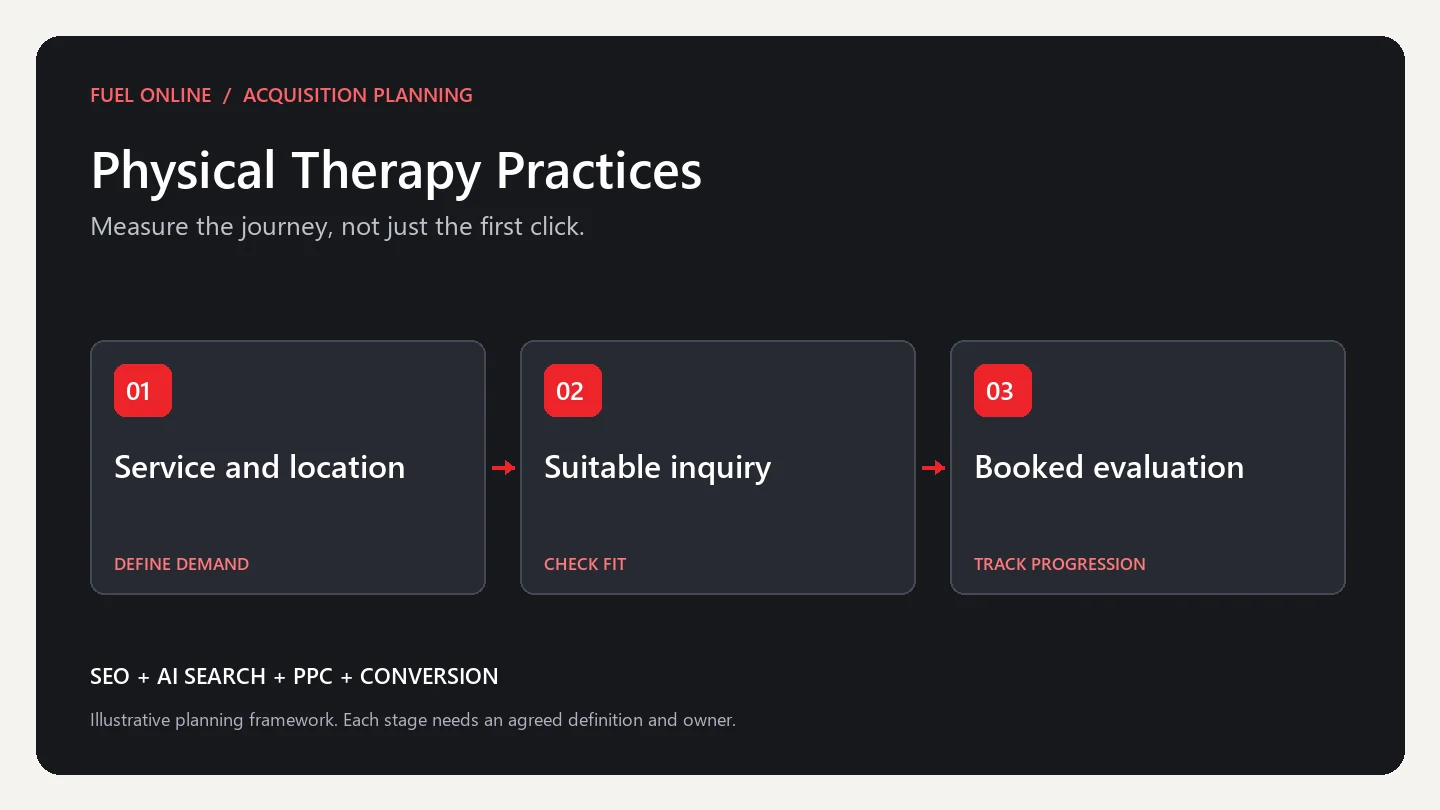
What physical therapy marketing changes for physical therapy demand
A useful physical therapy marketing plan starts with the commercial constraint. Fuel identifies which buyers the organization wants more of, what they need to believe before contact, and which requests consume time without a realistic next step. For physical therapy, the fit decision turns on condition or service line, referral status, payer fit, clinic, age fit, scheduling need, and availability.
Fuel turns that definition into condition, treatment, clinician, insurance, location, and appointment-preparation pages, channel priorities, proof requirements, and a handoff that retains reason for visit, preferred clinic, payer path, referral status when relevant, and scheduling need. Work that cannot be supported by clinician-reviewed service descriptions, current credentials, accurate payer details, and permissioned patient evidence stays out of the public claim set.
A practical physical therapy hub diagnostic
Use this diagnostic when channel activity improves but the receiving team does not see a comparable change in appropriate booked evaluations. The diagnostic for physical therapy marketing starts with the observable symptom, checks the page, source, campaign, or handoff responsible for it, and ends with one reviewed action, owner, and validation method.
Observable symptom
Marketing activity rises, but the team still cannot tell why 'vestibular physical therapy in Cambridge' inquiries are mixed with demand closer to 'physical therapy exercises PDF'.
What to inspect in physical therapy marketing agency
Review source, page, offer, contact path, and the final acceptance or rejection reason together.
Decision criteria for marketing for physical therapy practices
Prioritize the page, message, exclusion, or handoff with the clearest connection to unsuitable demand.
Inspectable output
A one-page physical therapy marketing decision record naming the symptom, evidence, owner, release, and measure tied to appropriate booked evaluations.
Marketing for physical therapy practices deliverables you can inspect
The team receives a demand map, evidence register, prioritized channel backlog, conversion specification, and commercial decision cadence it can inspect and own.
- Buyer and offer map, used to define the physical therapy marketing scope.
- Evidence and approval register, used to govern the physical therapy marketing agency release.
- Prioritized page and campaign backlog, used to evaluate the marketing for physical therapy practices decision.
- Conversion and routing specification
- Commercial scorecard and decision cadence
Illustrative physical therapy example
Illustrative example, not a client result: Fuel would compare the path taken by a prospective patient seeking an offered service at a clinic with a workable payer or referral path with the activity created by existing-patient support, unavailable services, and out-of-area scheduling requests. The decision is whether to fix the decision page, proof, contact path, or channel sequence before adding spend.
The physical therapy marketing agency work would produce a one-page demand map showing fit, friction, evidence, owner, and the next controlled release. The example becomes useful only when the team can trace the change to appropriate booked evaluations.
Within marketing for physical therapy practices, the buyer team can inspect the artifact, approval, and next investment decision.
How commercial progress is judged
Fuel connects page, query, campaign, or source context with acceptance, rejection reasons, response, capacity, and qualified appointment requests, booked evaluations, attendance, and location-level acquisition. Diagnostic measures explain where the journey breaks; they do not replace the business outcome.
The decision record for physical therapy marketing states what changed, why it changed, who approved it, and whether the next action is to expand, revise, consolidate, or stop.
Reporting for marketing for physical therapy practices must connect the service-specific diagnostic to appropriate booked evaluations, explain data limits, and name the next decision rather than treating activity as proof of value.
Questions to ask a physical therapy agency
Ask for the first demand map and channel decision, then confirm who owns pages, campaigns, tracking, approvals, and the handoff to the receiving team. A useful proposal explains which channel waits and why.
When reviewing physical therapy marketing, require a named practitioner, implementation owner, approval path, and sample artifact. Reject unsupported promises of rankings, citations, lead volume, cost, or revenue.
How we measure physical therapy marketing agency
- qualified appointment requests
- booked evaluations
- attendance
- location-level acquisition
Separate inquiry volume from usable demand
Qualified-inquiry rate = inquiries meeting your agreed criteria ÷ total inquiries reviewed.
Illustrative arithmetic: 20 suitable inquiries out of 50 reviewed inquiries is a 40% qualified-inquiry rate. Record why the other 30 did not fit before increasing investment.
Agree on the baseline, data source and qualification criteria before comparing results. Separate visibility from inquiries and accepted business opportunities.
CONNECTED SERVICES
Choose the right next step for your business
Explore Fuel’s Industry growth plan capabilities, published campaign work and team to evaluate how we would support your organization.
BEFORE YOU CHOOSE AN AGENCY
Questions about physical therapy marketing agency
What will Fuel deliver in the first 30 days?
During the first month, the physical therapy marketing scope produces a demand map, evidence register, prioritized journey decision, and the owner of the first controlled release. Fuel also records the client inputs and approval needed for the first release.
What does Fuel need from our physical therapy team?
Effective physical therapy marketing agency work requires a commercial owner, account and page access, approved proof, acceptance criteria, capacity limits, and feedback from the receiving team. Fuel identifies missing access or ownership before work is scheduled around it.
How will we know the work is commercially useful?
Under marketing for physical therapy practices, commercial usefulness depends on whether the diagnostic connects to appropriate booked evaluations, the data limits are stated, and the evidence supports a clear keep, revise, or stop decision.
Should we invest in SEO or paid acquisition first?
Choose the channel that addresses the closest constraint to appropriate booked evaluations. In physical therapy marketing, paid acquisition can test active demand quickly, while SEO is better for durable decision pages; both wait if the offer, proof, contact path, or receiving capacity is the real problem.
What does a credible physical therapy marketing agency scope include?
A credible physical therapy marketing agency scope includes buyer-fit criteria, evidence governance, journey priorities, channel sequencing, conversion ownership, and a commercial decision cadence. It also names the client dependencies, practitioner, deliverable, and approval path.
How should marketing for physical therapy practices report commercial progress?
Reporting under marketing for physical therapy practices should connect the service-specific diagnostic to appropriate booked evaluations, show what changed and why, state data limits, and name the next decision.
Make your next agency conversation specific.
Show us where physical therapy demand becomes unclear between 'vestibular physical therapy in Cambridge' and 'physical therapy exercises PDF'. The first working session on physical therapy marketing agency will identify the priority artifact, evidence, owner, and approval decision for appropriate booked evaluations.
Talk with a Fuel strategist →