
FUEL ONLINE / Physical Therapy Practices / SEO
Physical Therapy SEO Agency

Physical therapy practices need bookable patients by service, clinic, payer, and capacity, not general exercise research or unsupported care requests. Fuel maps searches such as 'vestibular physical therapy in Cambridge' to focused service, location, process, proof, and comparison pages, while treating 'physical therapy exercises PDF' as different intent. The physical therapy SEO work also fixes indexation and internal-link gaps and produces evidence-backed briefs. Reporting connects search visibility with appropriate booked evaluations, not traffic or rankings in isolation.
Clinic location and appointment availability; Services genuinely offered; Referral and payment processes confirmed by the practice; New-patient inquiry versus existing-patient support
Give physical therapy SEO distinct service, education and office resources
Choose a physical therapy SEO agency by comparing the distinct reader questions its resource plan will answer. Educational activity material, offered-service descriptions, clinician biographies, office information and appointment-process resources have different jobs. A useful organic-search plan connects those roles without merging their meanings. The buyer should understand what each new or revised destination contributes and where its facts are maintained, rather than assume that publishing more pages necessarily creates a more useful route from discovery to administrative contact.
Give education and practice information separate resource roles
Start with the actual website. Ask the agency to map each principal resource to its question, supporting practice information and next useful destination. Different query phrases may express the same need already answered clearly on one page. Similar words can also lead to genuinely different tasks. The map should explain that distinction before production volume is selected. Both strengthening an existing resource and creating a new one can be useful when the contribution and source requirements are specific.
An educational resource retains the scope of the professional material the practice selects for publication. A service page describes the offering supplied by the practice. Ask how a reader moves between them and what the link promises. A general activity topic should not silently establish an individual treatment recommendation or every related service. The agency can improve orientation and connections without adding exercise instructions to make the destination seem more comprehensive or commercially focused.
A separate program or service resource should earn its role through a distinct supported answer. Ask which facts make it useful beside the existing practice description and what material the practice needs to supply. A changed heading or query variation does not create a new reader decision by itself. If the information already has a clear home, stronger orientation may be sufficient. If a genuine gap exists, record the question and next destination before drafting another independently maintained page.
| Resource role | Contribution to establish | Useful acceptance evidence |
|---|---|---|
| Educational explanation | The practice-selected professional material retains its original context and links to relevant information. | The destination does not convert an activity topic into an individual care recommendation. |
| Program or service page | A distinct practice-supplied answer adds information beyond the existing offered-service introduction. | A new URL earns its ongoing maintenance responsibility through a real reader task. |
| Office and professional context | Maintained sources express actual geographic and clinician relationships supplied by the practice. | A changed fact can be traced to the specific dependent descriptions needing review. |
| Appointment-process resource | The public explanation preserves the difference between a new inquiry and continuing administration. | Readers find the supported route without invented eligibility or booking promises. |
Earn distinct program and office destinations
Professional biographies provide current identity context where it helps the task. Ask which source establishes the published role and which service introductions depend on it. A name appearing beside an educational topic does not establish every possible service relationship. The practice confirms what it wishes to publish. The agency's map should be specific enough that another editor can find the affected descriptions when a role changes, rather than rewrite all resources mentioning the person.
Office resources need actual geographic and administrative meaning. An address, clinician association and service-location statement may establish different things. Ask the practice to supply the relationships and the agency to explain how a separate resource helps the reader. A place name alone should not create an additional office, schedule or universal availability promise. Where the same useful answer already exists, a clearer shared destination may be more manageable than another local page repeating the introduction.
Appointment-process resources deserve their own role. A new evaluation inquiry and continuing appointment administration can need different public instructions where the practice supports them. Ask how the resource structure helps each person identify the appropriate destination. The agency should use actual practice arrangements rather than invent referral, coverage or eligibility rules. The useful task is a readable and maintained administrative path, with individual professional decisions remaining in the process the practice owns.
Review internal links through the next reader question. A service page can connect with relevant professional context, an educational resource with the maintained offering explanation and an office resource with the administrative destination. Ask why the surrounding sentence makes the link useful. A large collection of related links can leave the visitor guessing. The goal is an understandable relationship rather than the highest link count or a repeated contact invitation beneath every educational topic.
Test navigation and source dependencies
Accept navigation through two reader exercises. Begin with an educational question and find the source explanation, related practice context and appropriate administrative route. Then start with a clinician or office question. Ask an unfamiliar reviewer what each resource establishes and where they need to infer a connection. Record the specific uncertainty. A clearer transition or label may solve the task more directly than another long page duplicating an explanation already available on the site.
Images should support their actual information role. A portrait can supply professional identity, an office image can orient a reader and an activity image can illustrate a topic within the approved description. Ask what the image, caption and surrounding text establish together. Appearance alone should not become evidence of a treatment result or an individual recommendation. The agency may preserve a useful asset and improve its context rather than assume every content revision needs a new image.
Technical scope should connect findings with the resources affected. Ask for an observed issue, exact destination, responsible implementer and completed check. A generic audit list does not by itself establish priority. The practice should understand which access or navigation task improves and what evidence confirms the change, separately from later visibility or appointment records. This makes technical and editorial responsibilities comparable without implying that a single adjustment guarantees a search position or clinical outcome.
A future-change exercise tests the source map. Revise an office relationship, professional role or administrative destination in the review materials and ask which statements and links depend on it. The agency should distinguish passages needing new wording, resources requiring a link check and accurate unrelated material. Retain the explanation with the completed changes. This gives another contributor a practical maintenance baseline rather than a directory of page addresses with no account of how their meanings relate.
Make the information map useful to future contributors
Reporting should use the resource roles behind the roadmap. Identify which destination changed, which reader question became clearer and what observation helped select the next task. Keep completed editorial work separate from discovery behavior and later administrative stages. A visit to an educational resource, an inquiry action and a booked evaluation establish different things. The practice can then understand progress without treating every research visit as an unrealized appointment or every ranking change as validation of a factual statement.
At handover, retain the page-role register, source references, image context and reader tests. Another editor should explain why each principal resource exists and what would change its meaning. Give them a proposed topic before drafting and ask where it belongs. If it duplicates an existing answer, compare a revision or clearer connection first. If it is genuinely distinct, record the source needs and next destination. This makes the register a working editorial tool rather than a presentation left unused after launch.
The next SEO investment should resolve a named information or discovery gap. It may concern a confusing service relationship, an unclear office path or a missing supported explanation. Ask the agency to prioritize those needs using actual source evidence and practice input. Preserve accurate material and expand where a new resource has a distinct job. This leaves physical therapy SEO as a maintainable set of useful explanations while keeping clinical guidance, appointment decisions and invented practice facts outside the marketing production process.
For a concrete resource comparison, ask each agency to map one offered-service question and one general educational question through the current site. The exercise should identify the principal answer, source material and next useful destination. If both tasks use the same resource, ask how their distinct meanings remain clear. If separate pages are proposed, ask what information earns each one. This exposes the editorial reasoning behind the architecture without assuming that expansion or consolidation is automatically right for every part of the practice website.
Then compare a new program-resource brief with a stronger introduction to an existing explanation. The practice supplies the professional material it wishes to publish. Ask what a reader gains from each option and which facts are already maintained elsewhere. A new search phrase does not by itself establish a new information need. The useful proposal identifies the actual gap before committing the practice to another page, making the reader contribution comparable with the future maintenance responsibility that every independent resource creates.
Use a source revision to test the page map. Change a professional role or office association in the review copy and ask which introductions, captions and links depend on it. Another contributor should be able to follow particular relationships. The agency should distinguish a statement requiring revised wording from a resource needing a link check and accurate unrelated material. This provides more useful guidance than marking every page equally affected, and it demonstrates that the retained register is a working editorial tool rather than only a directory of URLs.
A local-page exercise should begin with actual practice information. Ask which question a proposed destination answers beyond repeating an office or place label. The resource may need a real geographic relationship and a clear connection with maintained service and administrative information. If the answer already exists, a better orientation may be the stronger initial task. If distinct supported context exists, record its source and purpose. The buyer can then compare the alternatives through useful information rather than an unqualified promise to produce a larger group of local pages.
At handover, give a new contributor a proposed educational topic and ask where it belongs before writing begins. They should identify the supported question, required source material and next destination. If the role repeats an existing answer, compare a useful revision or connection first. If it is distinct, retain the reason with the brief. This makes future production deliberate and helps the practice build connected explanations without accumulating pages whose roles and factual dependencies need to be reconstructed every time the marketing team changes.
For the related practice-wide scope, explore physical therapy marketing.
AGGRESSIVE FROM THE START
One month. The work many agencies stretch across three.
Our mandate: move faster, go deeper and put experienced specialists to work immediately.
Fuel attacks the work in parallel: site audits, technical errors, new content, internal links, backlink outreach and conversion improvements. Your agreed scope determines the channels; urgent fixes do not wait behind a drawn-out planning phase.
The physical therapy SEO brief identifies visibility and lead barriers. Actionable fixes move into production while deeper analysis continues.
Your physical therapy search engine optimization work runs alongside industry-specific content, relevant links and earned-authority outreach, based on your agreed scope.
The SEO services for physical therapy practices review shows completed work, lead quality and the next opportunities. You see who owns each action.
Fast execution is the operating standard. Access, approvals and scope shape delivery; search and revenue results have their own timelines.
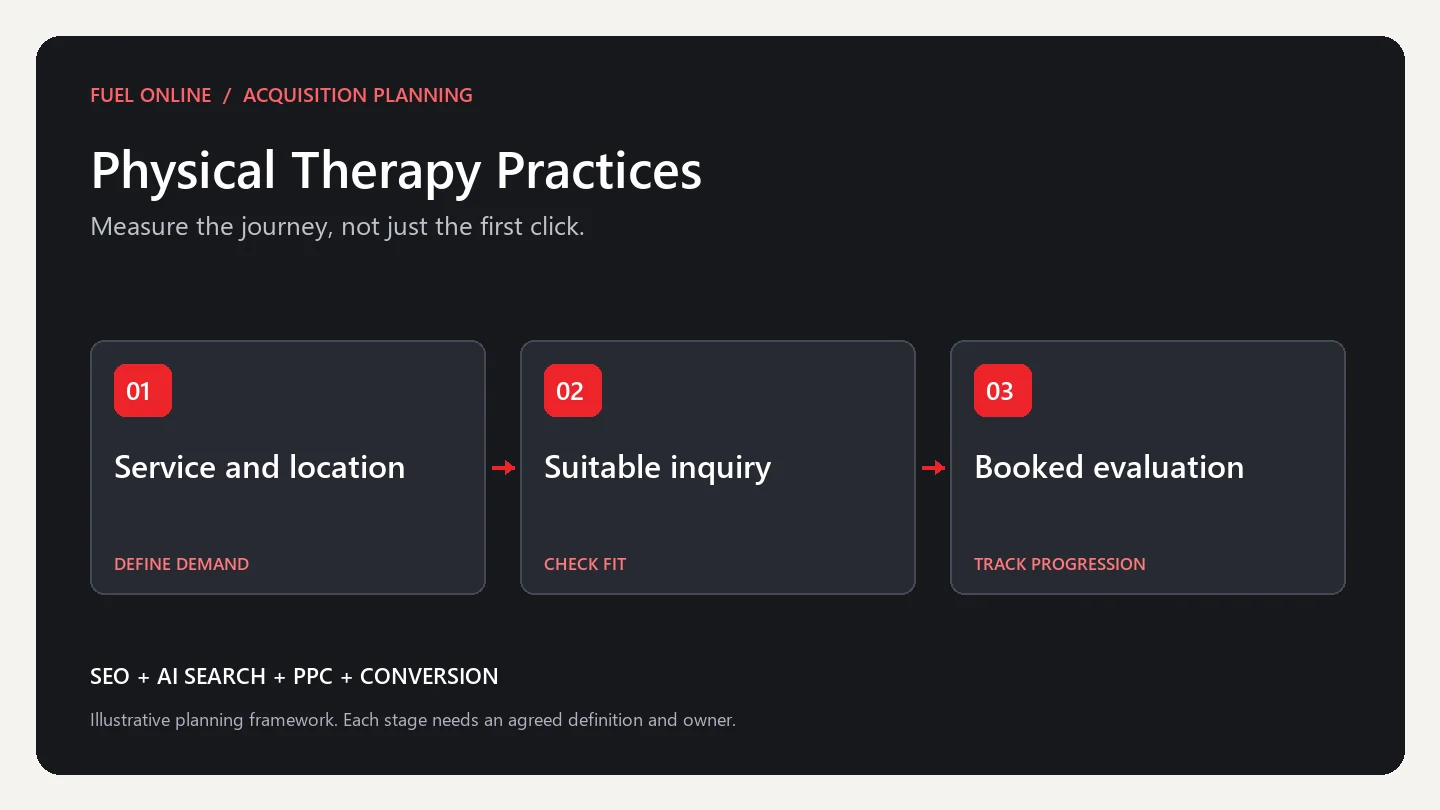
What physical therapy SEO changes for physical therapy demand
Search strategy begins with the buying decision, not a list of high-volume phrases. Fuel separates research, comparison, local, and action intent for physical therapy practices growing specific service lines across one or more clinics. One primary page owns each meaningful decision so several thin pages do not compete with one another.
The technical review covers crawl access, indexation, canonicals, redirects, rendering, and internal links. Content briefs then turn clinician-reviewed service descriptions, current credentials, accurate payer details, and permissioned patient evidence into useful condition, treatment, clinician, insurance, location, and appointment-preparation pages with a clear audience, limits, and next step.
A practical physical therapy SEO diagnostic
Use this diagnostic when search visibility improves but the receiving team does not see a comparable change in appropriate booked evaluations. The diagnostic for physical therapy SEO starts with the observable symptom, checks the page, source, campaign, or handoff responsible for it, and ends with one reviewed action, owner, and validation method.
Observable symptom
Search visibility grows around 'physical therapy exercises PDF' while the business needs discovery closer to 'vestibular physical therapy in Cambridge'.
What to inspect in physical therapy search engine optimization
Review query-to-page fit, indexation, competing pages, internal links, proof, and the next step shown on the landing page.
Decision criteria for SEO services for physical therapy practices
Consolidate, repair, expand, or retire the page before adding another URL for the same decision.
Inspectable output
A query-to-page decision and validated release ticket tied to inquiry fit and appropriate booked evaluations, not rankings alone.
SEO services for physical therapy practices deliverables you can inspect
The team receives query-to-page decisions, a technical priority register, briefs, internal-link actions, and release validation tied to inquiry fit.
- Query-to-page map and overlap decisions, used to define the physical therapy SEO scope.
- Technical priority register and validation method, used to govern the physical therapy search engine optimization release.
- Internal-link plan, used to evaluate the SEO services for physical therapy practices decision.
- Evidence-backed page briefs
- Release log tied to accepted inquiry quality
Illustrative physical therapy example
Illustrative example, not a client result: Fuel would map the search need represented by a prospective patient seeking an offered service at a clinic with a workable payer or referral path to one authoritative decision page and keep existing-patient support, unavailable services, and out-of-area scheduling requests out of that conversion path. The review would resolve competing URLs, missing proof, internal links, and indexation before another page is commissioned.
The physical therapy search engine optimization review would end with a query-to-page decision, an implementation ticket, and a validation check. Search visibility is diagnostic; continued work depends on whether the released page contributes to appropriate booked evaluations.
Within SEO services for physical therapy practices, the buyer team can inspect the artifact, approval, and next investment decision.
How commercial progress is judged
Fuel connects page, query, campaign, or source context with acceptance, rejection reasons, response, capacity, and qualified appointment requests, booked evaluations, attendance, and location-level acquisition. Diagnostic measures explain where the journey breaks; they do not replace the business outcome.
The decision record for physical therapy SEO states what changed, why it changed, who approved it, and whether the next action is to expand, revise, consolidate, or stop.
Reporting for SEO services for physical therapy practices must connect the service-specific diagnostic to appropriate booked evaluations, explain data limits, and name the next decision rather than treating activity as proof of value.
Questions to ask a physical therapy agency
Ask for a sample query-to-page map, technical ticket, content brief, and release validation. Confirm who can implement site changes and how accepted inquiries affect the search roadmap.
When reviewing physical therapy SEO, require a named practitioner, implementation owner, approval path, and sample artifact. Reject unsupported promises of rankings, citations, lead volume, cost, or revenue.
How we measure physical therapy search engine optimization
- qualified appointment requests
- booked evaluations
- attendance
- location-level acquisition
Connect organic discovery to inquiry quality
Organic inquiry qualification rate = suitable organic inquiries ÷ organic inquiries reviewed.
Illustrative arithmetic: 12 suitable inquiries out of 20 reviewed organic inquiries is a 60% qualification rate. This measures inquiry fit, not search market share, and requires a recorded source and an agreed definition of suitable.
Agree on the baseline, data source and qualification criteria before comparing results. Separate visibility from inquiries and accepted business opportunities.
CONNECTED SERVICES
Choose the right next step for your business
Explore Fuel’s SEO capabilities, published campaign work and team to evaluate how we would support your organization.
BEFORE YOU CHOOSE AN AGENCY
Questions about physical therapy search engine optimization
What does the first SEO month produce?
During the first month, the physical therapy SEO scope produces a query-to-page map, technical priorities, overlap decisions, and the first brief or consolidation ticket. Fuel also records the client inputs and approval needed for the first release.
What does Fuel need from our physical therapy team?
Effective physical therapy search engine optimization work requires site and search-data access, an implementation owner, subject-matter reviewers, approved proof, and accepted or rejected inquiry feedback. Fuel identifies missing access or ownership before work is scheduled around it.
How will we know the work is commercially useful?
Under SEO services for physical therapy practices, commercial usefulness depends on whether the diagnostic connects to appropriate booked evaluations, the data limits are stated, and the evidence supports a clear keep, revise, or stop decision.
Should SEO and paid search work together?
Yes, when they share query evidence, landing-page learning, and qualification feedback while retaining separate attribution and budget decisions. In physical therapy SEO, paid search can test active demand as SEO develops durable decision pages.
What does a credible physical therapy search engine optimization scope include?
A credible physical therapy search engine optimization scope includes query ownership, technical priorities, evidence-backed briefs, implementation responsibilities, release validation, and inquiry-quality review. It also names the client dependencies, practitioner, deliverable, and approval path.
How should SEO services for physical therapy practices report commercial progress?
Reporting under SEO services for physical therapy practices should connect the service-specific diagnostic to appropriate booked evaluations, show what changed and why, state data limits, and name the next decision.
Make your next agency conversation specific.
Bring one important search such as 'vestibular physical therapy in Cambridge', the page meant to answer it, and examples of unsuitable inquiries. The first working session on physical therapy search engine optimization will identify the priority artifact, evidence, owner, and approval decision for appropriate booked evaluations.
Talk with a Fuel strategist →