
FUEL ONLINE / Optometry Practices / Digital marketing
Optometry marketing agency: Digital Strategy

Optometry practices need appointment requests matched to service, insurance, clinic, and provider capacity, with urgent eye problems routed safely elsewhere. As your optometry marketing agency, Fuel Online gives search, paid media, decision content, landing pages, and follow-up one commercial job. We build around visit reason, clinical fit, payment path, clinic, provider availability, and timing, exclude low-fit demand, and connect channel decisions to scheduling team feedback. You receive a 30/60/90 plan aimed at appropriate booked optometry appointments, not a generic package of activity.
Location and appointment availability; Eye exams versus specialty services; Age groups and services actually served; New-patient versus existing-patient request
Choose an optometry marketing release with a clear reader and receiving purpose
Fuel Online connects optometry discovery, decision content and contact journeys around the practice's actual service, office and administrative arrangements. When comparing an optometry marketing agency, choose one initial journey before accepting a broad channel package. Exam discovery, optical research and returning-contact navigation can share sources while needing different invitations. A useful proposal shows the message, maintained explanation, public action and receiving context together, so practice leaders can inspect the release as a working relationship.
Choose the first journey before assigning channels
Begin with an offered service the practice wants to explain more clearly. Ask the agency what a new reader needs to understand before making administrative contact. The answer may involve a service explanation, professional context and the office information relevant to that offering. The agency should show the proposed path using resources the practice can supply. It should not fill an unclear relationship with a stronger claim merely because a short campaign introduction would be easier to write.
Now compare an optical-research journey. Ask which product or offering facts belong in the introduction and which maintained destination provides fuller context. That task may have a different next step from an exam inquiry. The practice decides what its process supports. A useful marketing plan makes the distinction visible rather than sending every visitor through the same invitation and interpreting every interaction as equivalent new appointment demand. This also makes the proposed production work easier to compare.
A returning person creates a third orientation task. They may be looking for an established administrative route rather than discovering the practice for the first time. Ask how the proposed release helps them recognize that route where the practice supports it. The agency does not need to infer the person's clinical circumstances. It needs to preserve the meaning of the public action and avoid making a continuing conversation appear to be a newly acquired relationship solely because a campaign label was present.
| Journey | Release artifact | Acceptance evidence |
|---|---|---|
| Exam discovery | Source-linked introduction and relevant service destination. | A reader finds the explanation and understands the administrative action. |
| Optical research | Offering context linked with maintained product information. | The introduction preserves the actual practice relationship. |
| Returning contact | Recognizable supported administrative route. | The receiver distinguishes the continuing purpose where records allow. |
| Shared-source change | Specific asset dependency map. | Another contributor identifies affected campaign destinations. |
Connect production choices with maintained practice information
Give finalists the same service explanation and office facts. Ask for a discovery introduction and the destination it would use. Which statements are shared, which need fuller context and what should the receiver recognize after contact? Compare the proposed change with the useful material already available. A focused introduction or clearer transition may be the first release. A new campaign page should have an explained role and named information dependencies rather than becoming another independently maintained summary.
Professional and office relationships can change at different times. Ask which public resource supplies a current association and which active assets use it. If the practice revises the relationship in the review materials, the agency should find the dependent introductions. An accurate general explanation may remain useful. The delivery plan should distinguish those edits from unrelated material so that maintenance remains proportionate and another employee can understand why a particular campaign resource needs attention.
Visual adaptation belongs in the same release map. A portrait, office image and optical image serve different explanatory roles. Ask what the supplied caption and surrounding material establish before the asset is shortened or cropped. The agency can preserve an effective image when its context remains clear. A new image is not automatically required for every channel. The comparison should identify the reader contribution of the adaptation and the statement it must continue to support.
Rehearse the complete contact transition
Use a fictional person following the initial message. They should reach the intended resource, understand the available action and create the agreed administrative test record. Ask the receiving role to describe the request in ordinary language. Compare that interpretation with the invitation and confirmation. A mismatch may call for a field-label repair, a clearer source introduction or a corrected connection. It does not by itself establish that the entire channel mix needs replacement.
Implementation responsibilities can determine whether that test is possible. Another supplier may manage the website, appointment-request connection or receiving record. Ask what the agency builds directly and what it supplies for another implementer. A copy draft, configured destination and completed record test are different delivery states. A useful proposal names the dependency and the acceptance evidence for the finished connection, allowing the practice to compare the work remaining after a creative presentation is approved.
Administrative feedback should point to a particular transition. Where the records support it, distinguish an unsupported offering question, a returning-contact message and a new inquiry missing useful context. Those observations suggest different improvements. Ask the agency which artifact it would change and why. A combined low-fit total does not explain whether the source description, invitation or receiving representation needs attention. The marketing plan becomes more useful when a next task follows from the inspected problem.
Make channel expansion a decision rather than a default
Compare proposals through the work needed to complete the chosen journey. Strategy, source editing, creative adaptation, destination production, record testing and ongoing review can be separate components. Ask what remains usable after each one. A bounded initial assignment and a continuing service can both contribute when their responsibilities are clear. This is a fairer commercial comparison than assuming similar monthly marketing labels include the same amount of implementation or maintenance.
For a review exercise, place the completed release beside a proposed expansion. If people cannot understand the existing contact action, broader discovery may increase the same confusion. If the path is clear but a different supported offering lacks a useful introduction, a distinct release may be justified. Ask for the evidence behind the recommendation and the resource that will change. This gives the practice a concrete choice without requiring a fabricated forecast of appointment volume or revenue.
A changed contact destination tests the ongoing arrangement. Ask which current campaign resources, saved public pages and recurring introductions depend on the older route. Pausing an advertisement does not explain what a person sees when revisiting a saved destination. The agency should identify the maintained public resource and the specific changes it will make. Retain the old and new relationship in the release record so that an incoming contributor understands the maintenance decision.
At handover, give an employee unfamiliar with the project the source map, two journey briefs and accepted record test. They should explain why the exam introduction differs from the optical introduction and where the returning person is directed. If the meaning depends on an unexplained campaign nickname, clarify it in the materials. This creates a usable baseline for future production, allowing the practice to retain the coherent parts of the release while improving the particular transition that evidence shows needs attention.
Compare a focused release with a genuinely different second journey
To make a proposal comparison concrete, prepare two fictional release cards from current practice information. The first introduces an offered exam or service to a new reader. The second introduces an optical resource without assuming it has the same contact purpose. For each card, ask the agency to identify the source passage, public invitation, destination and receiving interpretation. The practice can then see whether the same creative system can serve both tasks or whether a separate explanation is necessary. Similar production formats do not settle that question.
Compare the resource effort as well as the creative concept. One agency may propose adapting a maintained service page; another may recommend a new campaign destination. Ask what the new destination contributes and which facts it must continue to share with the main site. A separate page can be useful when it gives the selected task a clear path, but it also needs an update relationship. The buyer should receive the reason for the choice and the maintenance work it creates, rather than an unqualified preference for either reuse or expansion.
Give the team a fictional delay in one implementation component. For example, another supplier may need to complete the receiving representation after the public copy is ready. Ask what can progress, what remains incomplete and which evidence will establish the finished connection. The agency can produce source-linked creative and a test specification while the dependency is resolved. That is different from declaring the whole journey operational. A useful release plan makes the remaining task visible without preventing unrelated accurate work from moving forward.
Review the launch through a returning-person scenario as well. Someone revisits a saved destination after the practice changes a supported administrative route. Ask which public explanation they encounter and where the maintained route is now described. The relevant task may involve an older page or a reusable introduction, not only a currently running campaign. Comparing this scenario helps the practice distinguish a production-only service from an arrangement that includes the continuity of its released public resources.
For the investment discussion, place observations beside the two release cards. A clear exam introduction with weak discovery has a different problem from an optical introduction that attracts interest but leaves the next action ambiguous. Ask which resource or transition the proposed next assignment changes. The evidence may be incomplete; the agency should name what additional observation would help. This is still a useful commercial recommendation because it explains why a bounded task belongs before a larger expansion across every channel.
Retain the accepted cards with their source and implementation relationships. Ask a future contributor to propose a shorter format using the same facts. They should preserve the difference between the journeys and identify the destination each format supports. If the adaptation changes the public action, it needs a deliberate explanation rather than an unnoticed creative variation. The first release then becomes a practical reference for later work, allowing the practice to compare additional production through clear reader purpose instead of activity counts alone.
When the release reveals lost context at contact, optometry request design can inspect the public action and receiving record.
AGGRESSIVE FROM THE START
One month. The work many agencies stretch across three.
Our mandate: move faster, go deeper and put experienced specialists to work immediately.
Fuel attacks the work in parallel: site audits, technical errors, new content, internal links, backlink outreach and conversion improvements. Your agreed scope determines the channels; urgent fixes do not wait behind a drawn-out planning phase.
The optometry marketing agency brief identifies visibility and lead barriers. Actionable fixes move into production while deeper analysis continues.
Your optometry digital marketing work runs alongside industry-specific content, relevant links and earned-authority outreach, based on your agreed scope.
The digital marketing for optometry practices review shows completed work, lead quality and the next opportunities. You see who owns each action.
Fast execution is the operating standard. Access, approvals and scope shape delivery; search and revenue results have their own timelines.
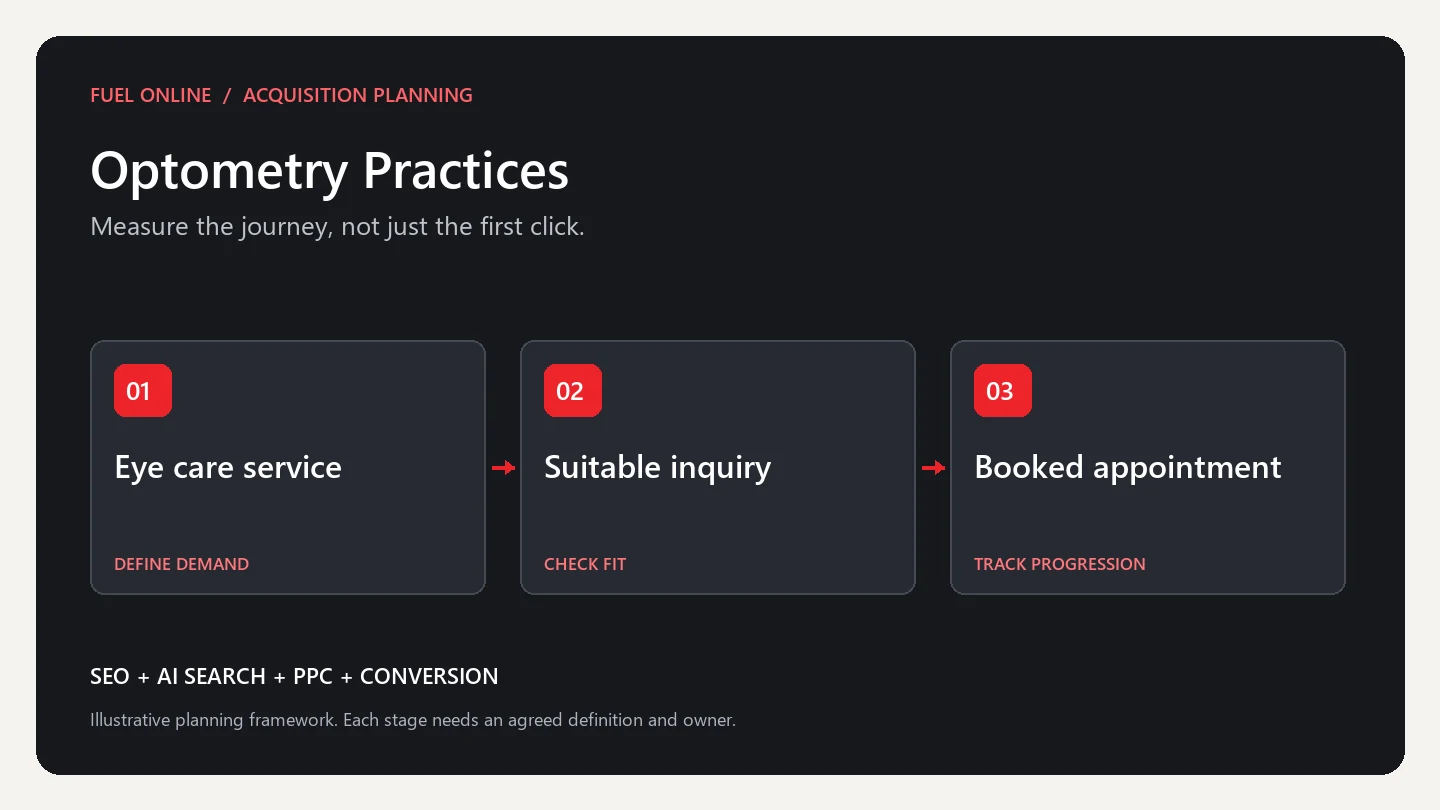
What optometry marketing agency changes for optometry demand
The problem is rarely a missing channel. It is a broken link between audience, promise, evidence, page, and follow-up. Fuel gives each channel a job in winning appropriate booked appointments within insurance, location, and provider-capacity limits and uses visit reason, age and clinical fit, insurance or self-pay path, clinic, provider availability, and timing to keep the message consistent.
Organic search handles durable discovery, paid media tests controllable demand, and decision content supports evaluation. Every path uses optometrist-reviewed service information, current credentials, accurate payer details, approved product information, and permissioned patient evidence and carries visit reason, preferred clinic or provider, payment path, scheduling constraints, and safe contact details into the receiving workflow.
A practical optometry digital diagnostic
Use this diagnostic when digital activity improves but the receiving team does not see a comparable change in appropriate booked eye-care appointments. The diagnostic for optometry marketing agency starts with the observable symptom, checks the page, source, campaign, or handoff responsible for it, and ends with one reviewed action, owner, and validation method.
Observable symptom
Channel reports improve while appropriate booked optometry appointments stay flat and requests closer to 'eye emergency treatment at home' keep consuming follow-up time.
What to inspect in optometry digital marketing
Compare the channel promise with the landing page, form or call path, follow-up owner, and final business outcome.
Decision criteria for digital marketing for optometry practices
Reassign the channel, revise the page, repair the route, or stop the activity based on the broken stage.
Inspectable output
A channel decision with a named page or handoff change, owner, release date, and measure tied to appropriate booked optometry appointments.
Digital marketing for optometry practices deliverables you can inspect
The team receives a journey map, page and campaign backlog, measurement specification, release log, and ownership record for every digital change.
- Channel role and budget map, used to define the optometry marketing agency scope.
- Priority plan for service, provider, insurance, eyewear, specialty-care, and location pages, used to govern the optometry digital marketing release.
- Campaign exclusions and landing-page requirements, used to evaluate the digital marketing for optometry practices decision.
- Conversion, routing, and tracking specification
- Weekly operating and monthly commercial review
Illustrative optometry example
Illustrative example, not a client result: A patient reaches an eye-care page but cannot confirm exam type, specialty service, age group, location, payment path, or scheduling action. Fuel would trace the entry page, proof viewed, next action, fields, routing, and final disposition, then repair the first break rather than redesigning the whole site without evidence.
The optometry digital marketing release would include the revised page or path, measurement event, receiving owner, and validation record. The test stays only if it improves the journey toward appropriate booked eye-care appointments.
Within digital marketing for optometry practices, the buyer team can inspect the artifact, approval, and next investment decision.
How commercial progress is judged
Fuel connects page, query, campaign, or source context with acceptance, rejection reasons, response, capacity, and qualified new-patient requests, booked exams, attendance, and service-location fit. Diagnostic measures explain where the journey breaks; they do not replace the business outcome.
The decision record for optometry marketing agency states what changed, why it changed, who approved it, and whether the next action is to expand, revise, consolidate, or stop.
Reporting for digital marketing for optometry practices must connect the service-specific diagnostic to appropriate booked eye-care appointments, explain data limits, and name the next decision rather than treating activity as proof of value.
Questions to ask an optometry agency
Ask to see a journey map, release ticket, and measurement specification. Confirm who changes the site, campaigns, analytics, forms, CRM connection, and quality feedback loop.
When reviewing optometry marketing agency, require a named practitioner, implementation owner, approval path, and sample artifact. Reject unsupported promises of rankings, citations, lead volume, cost, or revenue.
How we measure optometry digital marketing
- qualified new-patient requests
- booked exams
- attendance
- service-location fit
Compare channels using the same qualification rules
Cost per qualified inquiry = attributable channel spend ÷ inquiries meeting the agreed criteria.
Keep the reporting window and included costs consistent. A cheaper contact is not necessarily a cheaper customer; compare later progression where the data supports it.
Agree on the baseline, data source and qualification criteria before comparing results. Separate visibility from inquiries and accepted business opportunities.
CONNECTED SERVICES
Choose the right next step for your business
Explore Fuel’s Digital marketing capabilities, published campaign work and team to evaluate how we would support your organization.
BEFORE YOU CHOOSE AN AGENCY
Questions about optometry digital marketing
What changes first in a digital marketing engagement?
During the first month, the optometry marketing agency scope produces a journey map, page and campaign backlog, measurement specification, and the first release ticket. Fuel also records the client inputs and approval needed for the first release.
What does Fuel need from our optometry team?
Effective optometry digital marketing work requires site, campaign, analytics, form, and CRM access plus reviewers, approved proof, capacity limits, and accepted or rejected inquiry feedback. Fuel identifies missing access or ownership before work is scheduled around it.
How will we know the work is commercially useful?
Under digital marketing for optometry practices, commercial usefulness depends on whether the diagnostic connects to appropriate booked eye-care appointments, the data limits are stated, and the evidence supports a clear keep, revise, or stop decision.
Do we need every digital channel at once?
Start with the break closest to appropriate booked eye-care appointments, not a predetermined channel. The diagnostic for optometry marketing agency may prioritize the page promise, proof, form, measurement, route, or response owner before recommending more acquisition.
What does a credible optometry digital marketing scope include?
A credible optometry digital marketing scope includes journey mapping, page and campaign priorities, measurement, implementation ownership, release validation, and inquiry-quality feedback. It also names the client dependencies, practitioner, deliverable, and approval path.
How should digital marketing for optometry practices report commercial progress?
Reporting under digital marketing for optometry practices should connect the service-specific diagnostic to appropriate booked eye-care appointments, show what changed and why, state data limits, and name the next decision.
Make your next agency conversation specific.
Bring the channel, page, or follow-up problem preventing more appropriate booked optometry appointments. The first working session on optometry digital marketing will identify the priority artifact, evidence, owner, and approval decision for appropriate booked eye-care appointments.
Talk with a Fuel strategist →