
FUEL ONLINE / Window and Door Companies / Industry growth plan
Window and Door Marketing
A window and door company can fill its pipeline with glass repair, parts and out-of-area requests while estimators wait for viable installation projects. As a window and door marketing, Fuel Online connects buyer education, discovery and conversion around the work the business wants. Pages, campaigns and handoffs use product, installation ZIP code and opening count to separate fit, and reporting follows accepted installation estimates and estimate-to-sale rate.
installation ZIP code, product type, opening count, project timing and ownership
Make the estimate request specific enough to route
A window-and-door marketing proposal should distinguish the job the customer describes from the service your company can actually quote. Ask the agency to use your approved product and installation categories when designing the inquiry route. Replacement windows, a new exterior door and a repair request may require different receiving teams. The website should explain the available next step without implying that every product or repair is offered.
Test the proposed route with a hypothetical request spanning two product categories. Ask the agency to show which page the requester reaches, which facts establish service-area fit and who decides whether the request can progress. The useful output is a receiving decision record, not a promise that form submissions will become completed installations.
Check the handoff when an appointment cannot immediately be scheduled. Identify who communicates the next step, where the request remains visible and which campaign information accompanies it. Keep advertising labels understandable to the receiving team so it can recognize the service that was promoted without asking the requester to repeat the entire journey.
Review a small pilot before expanding location coverage. Classify unsuitable requests by unavailable service, unsupported area, unclear product category or contact failure. Each category suggests a different page or campaign correction. Retain the approved product description and the change record so future marketing work does not recreate the same mismatch. Judge the agency on whether it improves the route using those observed facts, while installation recommendations and product suitability remain with your qualified team.
Build a replacement-project journey before buying more traffic
Window and door marketing should help buyers understand the company’s actual products and installation scope, then begin a useful estimate conversation. Fuel Online can connect that journey with search visibility and campaigns. The commercial starting point is the kind of project the business wants, the area it serves and the process its sales team can support.
Replacement projects, new construction and repair inquiries are not interchangeable. Define which categories the company accepts and show the relevant route. A page dominated by a single promotion may attract contacts while leaving people unsure whether the company handles their project. Clear scope information helps both the visitor and the estimator.
| Decision | Useful public content | Sales handoff |
|---|---|---|
| Identify a suitable project provider | Actual replacement or construction scope and coverage | Relevant project inquiry |
| Explore available options | Verified products and genuine installation examples | Consultation about applicable choices |
| Understand the estimate process | Site discussion, proposal steps and contact ownership | Qualified estimate appointment |
Product content should explain the selection the company actually offers. Use verified manufacturer information for technical claims. Do not invent energy savings, product performance or payback figures to make a page sound more persuasive. The agency can make genuine differences easier to compare without converting a broad product claim into a promise for every home.
Installation proof adds value when it shows the company’s role and project context. With permission, explain the type of work performed and the choices the customer considered. Preserve useful photographs and existing proof. A gallery with a short explanation can help a prospect describe their interest more effectively than a collection of unattributed product images.
Make the offer and estimate process consistent
If the business uses a published promotion, explain the actual terms and keep them synchronized with the sales team. A page should not imply a complete project price when the company’s estimate depends on site conditions and configuration. Buyers should know whether they are requesting a callback, an appointment or a proposal discussion.
Ask an agency to demonstrate one complete replacement journey. The plan should connect the audience question, destination page, inquiry form and estimator follow-up. Include ownership for keeping products, service coverage and current offers accurate. This is a more useful buying test than comparing content quantities alone.
Location pages should support genuine operations. Describe real coverage and available services rather than inventing offices across every target market. If installation teams or product availability differ by area, explain those differences accurately. The visitor needs help choosing a provider, not a repeated geographic slogan.
Measure the project pipeline beyond the inquiry
Track relevant inquiries, estimate appointments, completed consultations, proposals and accepted projects separately. Break results out by project category when labels are reliable. A campaign attracting repair requests will not solve a replacement-project growth goal even if its contact cost is low.
Review broad reasons opportunities stop, including outside coverage, unsuitable scope, timing and proposal outcome. The agency can improve targeting and page clarity from those findings. The business decides which offers and sales commitments are commercially sustainable. Reporting should keep those responsibilities visible.
A focused pilot selects one project category and genuine service area, then improves its page and estimate handoff. Document the launch and changes in sales capacity. Review opportunities far enough through the proposal process to understand their fit before expanding. This yields a clearer budget decision than judging a longer project purchase by first-week form volume.
Explore home services marketing and construction marketing for the broader project acquisition framework. Fuel’s window and door brief should connect verified products, real installation evidence and the estimate conversation.
Separate product evidence from installation evidence
A buyer comparing windows or doors may need to understand both the product and the company installing it. Those are related but different decisions. Product information should use verified manufacturer or supplier facts for the actual offering. Installation evidence should describe the contractor’s own work and process. A page becomes more useful when it makes that distinction visible instead of treating every product image as proof of local project experience.
Label galleries with meaningful context. Identify the work category and the company’s role using approved information. If an image is illustrative, do not present it as a completed customer installation. Preserve genuine project photographs and credits. A visitor can then use the gallery to explain an interest during an estimate conversation without assuming every shown configuration is available or appropriate for the property.
Help buyers compare the actual project scope
A project page can encourage useful questions about what the company’s estimate covers, how the site is reviewed and how product choices are discussed. Keep those explanations tied to the contractor’s actual process. Do not turn general marketing content into a technical conclusion about an individual opening, property condition or required work. The qualified project team assesses those details.
Explain how the initial conversation develops into a proposal. If the company needs a site visit or additional review, make that step clear before the visitor submits. A contact request should not appear to establish a final project price or installation slot. Consistent language across the page and acknowledgment helps the buyer understand what has and has not been arranged.
Make relationship responsibilities clear without universal promises
Buyers may ask which team handles product questions, installation coordination and later service. The company should approve a plain explanation of its real process and the appropriate contact routes. Marketing should not invent a blanket warranty interpretation or imply that one team assumes every responsibility. Accurate relationship information can reduce uncertainty without replacing the terms and project-specific discussion the business actually provides.
If several offices or teams share the brand, keep the receiving route consistent with the location and project. A central directory can help visitors identify a real office, while the relevant page explains the actual offering there. Do not imply that every location carries identical products or provides the same service when operations has not confirmed that fact.
Design commercial project content for a different buying unit
A commercial property team may need to coordinate scope, multiple openings and an organizational decision process. When the contractor supports that work, describe the real commercial remit and responsible contact. The destination should not rely entirely on a household promotion. It should help a business buyer understand how to begin the appropriate scope conversation.
Use genuine relevant examples and identify gaps honestly. If the company lacks approved public proof for a particular category, ask for the information needed rather than fabricate a customer story. The agency can still create a clear process explanation and inquiry route. Unsupported experience should not be invented merely to justify a new industry page.
Compare agencies through a complete project journey
Request a sample brief for a real product and project audience. It should connect the buyer question, maintained product facts, existing installation proof, contact action and receiving estimator. Ask which current pages and media remain. This gives the contractor a concrete way to compare scope instead of judging proposals by content volume or a general promise to produce more leads.
The channel recommendation should name the actual bottleneck. A product-selection gap may call for better information. Weak relevant discovery may call for stronger service architecture or a focused campaign. Relevant requests that do not reach an estimator call for a handoff repair. The proposal should explain why its first assignment addresses the observed condition and what dependency must be resolved before expansion.
Use proposal feedback to choose the next investment
Keep broad inquiry and project categories stable enough to compare. Installation demand, repair questions, parts requests and work outside coverage should not disappear into one total. Each can reveal a different issue with targeting, page boundaries or navigation. The business can retain detailed project economics internally while sharing enough category feedback to guide acquisition.
For an illustrative pilot, choose a real replacement offering and service area. Review the product facts, installation evidence and estimate explanation together, then confirm the receiving route. Record the launch and review opportunities through the normal proposal process. Account for changes in product availability and sales capacity. The comparison should guide a specific next decision rather than imply that one page guarantees sales or a particular property outcome.
AGGRESSIVE FROM THE START
One month. The work many agencies stretch across three.
Our mandate: move faster, go deeper and put experienced specialists to work immediately.
Fuel attacks the work in parallel: site audits, technical errors, new content, internal links, backlink outreach and conversion improvements. Your agreed scope determines the channels; urgent fixes do not wait behind a drawn-out planning phase.
The window and door marketing brief identifies visibility and lead barriers. Actionable fixes move into production while deeper analysis continues.
Your window and door marketing agency work runs alongside industry-specific content, relevant links and earned-authority outreach, based on your agreed scope.
The window and door lead generation review shows completed work, lead quality and the next opportunities. You see who owns each action.
Fast execution is the operating standard. Access, approvals and scope shape delivery; search and revenue results have their own timelines.
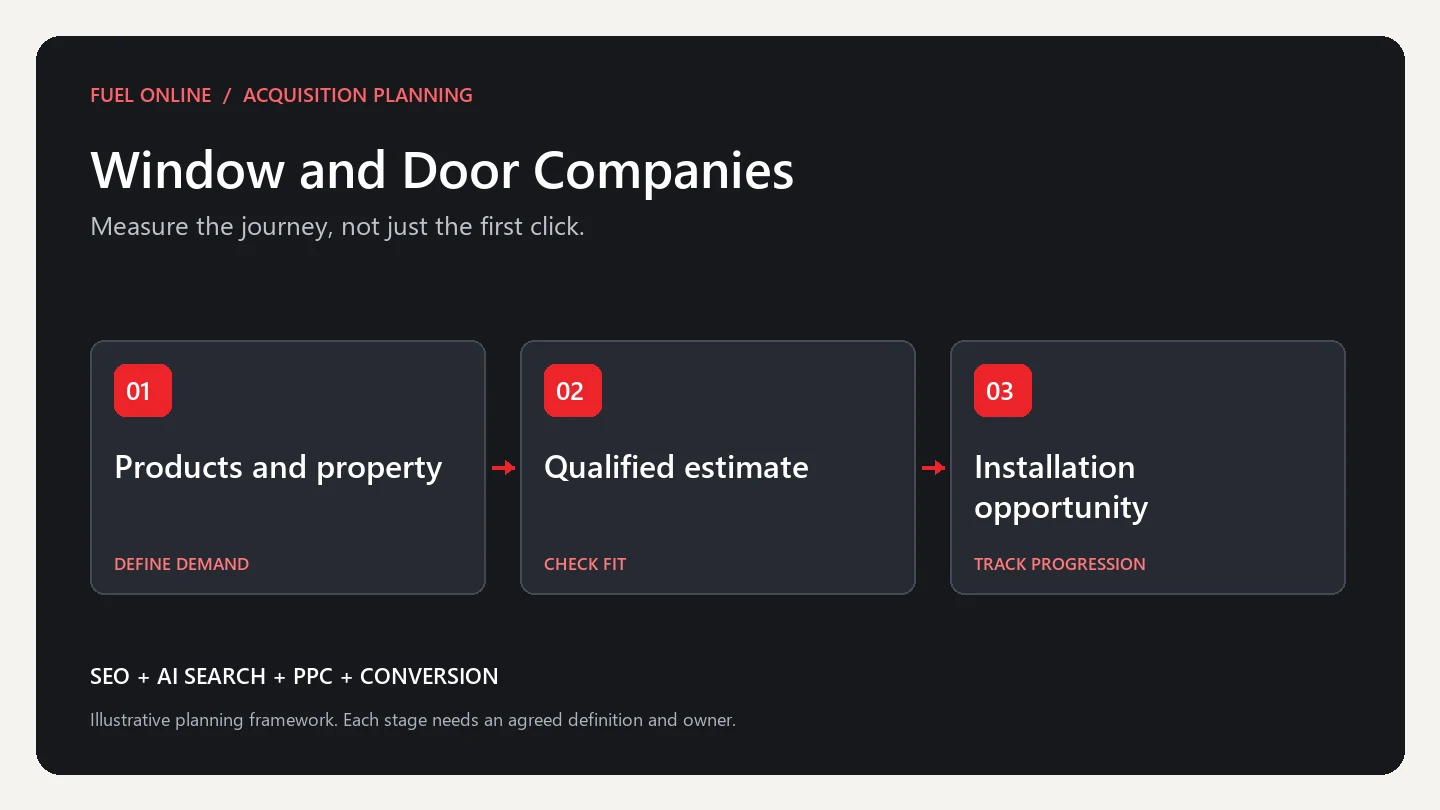
What the window and door marketing scope needs to solve
The useful audience is homeowners replacing windows, entry-door buyers and commercial property teams. They are deciding whether the installer serves the property, carries the requested product, can document the installation process and can prepare a useful estimate.
Fuel Online begins by interviewing the people who sell, schedule or deliver the work. That reveals the language buyers use, the requests the business rejects and the questions that delay a next step. The resulting plan prioritizes decision clarity over channel volume.
The first decision in a window and door marketing engagement is whether the buyer, request and next step fit the business.
Decision map for window and door marketing agency
The core site architecture covers replacement windows, entry doors, patio doors, commercial openings, materials, installation process and genuine service-area pages.
Each path states who it is for, what is available, what information matters and what happens after contact. Qualification addresses route by product and installation ZIP code, then give the estimator opening count, ownership, timing and the requested project type. It also discourages glass-only repair, parts, do-it-yourself research, unsupported brands and addresses outside the installation area before those requests consume staff time.
The page and handoff map makes window and door marketing agency inspectable before production expands.
Operational requirements for window and door lead generation
SEO earns visibility for durable service and evaluation questions. Paid search tests urgent demand and controlled offers. AI-search work improves the clarity and retrievability of approved answers. Conversion work protects the handoff.
A channel earns more investment only when the business can see progress in accepted installation estimates, estimate-to-sale rate, cost per accepted estimate and revenue by product line. Traffic, impressions and form totals remain diagnostic measures, not the commercial scorecard.
The operating standard for window and door lead generation names the approved source, reviewer and next buyer action.
Illustrative planning example
This is an illustrative marketing decision, not a client result. The window and door marketing agency choice is shown so a buyer can inspect the logic before approving similar work.
The marketing decision
A homeowner searching for three replacement windows needs product and installation guidance, while a property manager pricing twenty commercial openings needs a scoped estimator handoff. They should not share one generic quote path. For window and door marketing agency, the team should choose which buyer path has enough value and operating capacity before adding more channels. The window and door marketing plan should state why this is the first priority.
What the buyer can inspect
The practical lesson is to design the journey around the decision and handoff, rather than forcing every buyer through the same page. The decision record ties the window and door marketing agency change to a window and door lead generation deliverable, owner and release check.
How to audit a window and door marketing plan
Use this framework when activity looks healthy but the commercial result is unclear. It turns a visible symptom into an evidence check, a bounded change and a deliverable the business can verify. The diagnostic for the window and door marketing plan keeps the symptom, evidence check, action and output in one decision record.
1. Observable symptom
The sales team receives repair, glass-only, parts or out-of-area requests while viable installation estimates are hard to trace.
2. What to inspect
Compare inquiry dispositions by buyer path, service and location. Inspect whether the website states installation ZIP code, product type, opening count, project timing and ownership, whether proof is available, and where a visitor loses the next step. This evidence check shows whether window and door marketing agency reflects the real offer and handoff.
3. Decision and action
Repair the buyer path with the largest verified commercial loss. That may mean a clearer service page, a proof gap, a channel exclusion or a routing change.
4. Inspectable output
A prioritized decision log naming the affected buyer path, owner, evidence dependency, release date and expected change in accepted installation estimates and estimate-to-sale rate.
Deliverables and reporting for window and door lead generation
The initial deliverables are a demand and exclusion map, page and campaign priorities, proof inventory, conversion specification, measurement dictionary and opening execution sprint test plan. Each item has an owner and decision date.
Monthly reviews connect changes to accepted installation estimates, estimate-to-sale rate, cost per accepted estimate and revenue by product line and identify the next constraint. Buyers comparing agencies should ask who performs the work, who owns the accounts and data, how corrections are handled and what evidence is required before scope expands.
For Window and Door Companies, the marketing plan documents how installation ZIP code, product type, opening count, project timing and ownership affect page, campaign or routing decisions. Before release, the assigned business reviewer checks approved project photos, product authorizations, genuine reviews and documented installation process against every visible claim and records any dependency that remains unresolved.
The monthly review for window and door lead generation compares completed work with accepted demand and identifies the next commercial decision.
- Demand map covering homeowners replacing windows, entry-door buyers and commercial property teams
- Page plan for replacement windows, entry doors, patio doors, commercial openings, materials, installation process and genuine service-area pages
- Evidence and constraint register built from approved project photography, product authorizations, warranty responsibilities, reviews and a documented measuring and installation process
- Handoff design that can route by product and installation ZIP code, then give the estimator opening count, ownership, timing and the requested project type
- Measurement dictionary for accepted installation estimates, estimate-to-sale rate, cost per accepted estimate and revenue by product line
How we measure window and door marketing agency
- accepted installation estimates
- estimate-to-sale rate
- cost per accepted estimate
- revenue by product line
Separate inquiry volume from usable demand
Qualified-inquiry rate = inquiries meeting your agreed criteria ÷ total inquiries reviewed.
Illustrative arithmetic: 20 suitable inquiries out of 50 reviewed inquiries is a 40% qualified-inquiry rate. Record why the other 30 did not fit before increasing investment.
Agree on the baseline, data source and qualification criteria before comparing results. Separate visibility from inquiries and accepted business opportunities.
CONNECTED SERVICES
Choose the right next step for your business
Explore Fuel’s Industry growth plan capabilities, published campaign work and team to evaluate how we would support your organization.
BEFORE YOU CHOOSE AN AGENCY
Questions about window and door marketing agency
Where should a window and door marketing plan start?
Start where the business can see a costly mismatch: the sales team receives repair, glass-only, parts or out-of-area requests while viable installation estimates are hard to trace. A window and door marketing review should trace one real example from its source through the page or campaign and into the receiving team's disposition. Compare inquiry dispositions by buyer path, service and location. Inspect whether the website states installation ZIP code, product type, opening count, project timing and ownership, whether proof is available, and where a visitor loses the next step. The first window and door marketing action should produce a named owner, a bounded correction and a release check rather than a broad activity list.
What does window and door marketing agency include?
A decision-ready growth plan: priority audiences, exclusions, page and channel map, proof gaps, conversion handoff, measurement definitions and a opening execution sprint sequence. It gives the business a way to judge work before committing to broad production or media spend. A window and door marketing agency scope should name the owner, deliverable, dependency and review gate.
How do we measure window and door lead generation?
Agree on definitions and data sources for accepted installation estimates, estimate-to-sale rate, cost per accepted estimate and revenue by product line before launch. Channel metrics explain what happened upstream, while staff disposition and downstream stages show whether the work created demand the business could accept. Measure window and door lead generation through the accepted commercial stages the receiving team can verify. Reporting for window and door lead generation should show the source, stage definition, owner and limitation behind each decision metric.
What should a window and door company ask before hiring an agency?
Ask who will perform the work, who owns the accounts and data, what is delivered in the opening execution sprint, how facts are reviewed, how rejected inquiries change the plan and which decision would cause the agency to pause or expand investment. Compare a window and door marketing engagement with other proposals by inspecting the proposed work, account ownership and response to rejected demand.
Where should the first marketing investment go?
Start with the biggest verified decision gap. That may be an unclear service page, missing proof, poor routing, unqualified paid traffic or tracking that cannot distinguish accepted demand. Fuel Online scopes the first release after reviewing the current journey and operational constraints. For window and door marketing agency, document access, approvals and handoffs across internal and agency roles.
What should we bring to an initial strategy conversation?
Bring the website, priority services and locations, capacity constraints, current agency concerns and any breakdown of accepted and rejected inquiries. Useful evidence includes approved project photography, product authorizations, warranty responsibilities, reviews and a documented measuring and installation process. That context makes the first scope more concrete. A useful window and door lead generation scope starts with current offers, capacity, evidence and examples of accepted and rejected inquiries.
Make your next agency conversation specific.
Tell us which services or markets matter to your window and door business, which inquiries your team accepts, and where the current growth plan breaks down. Bring one accepted and one rejected example. Fuel Online will help identify the first page, campaign, answer or handoff worth changing. Use the working session to define one window and door lead generation action with a source, owner, release check and downstream measure.
Talk with a Fuel strategist →