
FUEL ONLINE / Dumpster Rental Companies / SEO
Dumpster Rental SEO Agency

A dumpster rental company wastes dispatch time when inquiries omit the address, material, container need or placement constraint that determines serviceability. As a dumpster rental SEO agency, Fuel Online maps valuable queries to accurate service, location and proof pages. Pages, campaigns and handoffs use address, material, size, placement and delivery date to separate fit, and reporting follows qualified booking requests and completed bookings.
delivery address, material type, container size needs, delivery date and placement constraints
Build dumpster rental SEO around container, project, material and coverage decisions
Fuel Online’s dumpster rental SEO service connects organic discovery with useful information about the operator’s actual containers, project contexts, material rules and delivery relationships. The first scope decision is which resource should answer each customer question. A size page, project explanation and coverage destination can have different jobs. A useful plan earns those roles through the decisions they support and connects them to a request the operator can evaluate.
Assign distinct jobs to the existing resources
A container resource establishes the operator’s description of an option. A project explanation can help someone understand the relevant information to review for a particular job. A material resource carries the operator’s maintained rules. A coverage resource explains the geographic relationship. Mapping these roles before expanding the site makes it easier to find a missing explanation or connection without creating another broad introduction that repeats the same rental message.
Ask the agency to state the reader decision beside each proposed page. A different search phrase does not automatically establish a different information need. Where two pages have the same purpose, compare a clearer shared resource or a better division of roles. Where a distinct question has supported information and a useful next step, explain why a separate destination would help. This lets the operator compare immediate editorial value with ongoing maintenance work.
| Resource role | Customer decision | Acceptance evidence |
|---|---|---|
| Container information | Understand the stated option and relevant specifications. | The resource identifies the operator’s actual offering without a universal job-fit claim. |
| Project explanation | Find the context and questions relevant to a proposed load. | The reader can reach the related container, material and inquiry information. |
| Material guidance | Locate the operator’s maintained distinctions. | The page preserves the actual rule and routes unresolved questions appropriately. |
| Coverage resource | Understand the relevant delivery relationship. | The page distinguishes general area information from a particular delivery confirmation. |
Compare a project guide with the source information it uses
A project guide earns its role when it helps a customer navigate a meaningful question using actual operator information. It should not infer that every load from a named project is accepted or that one option suits every situation. Ask which source supports each material or container relationship and what remains a question for the operator. This gives the writer a concrete brief rather than an invitation to fill the page with generic project advice.
For an illustrative renovation resource, identify what the reader needs to prepare before an inquiry and which maintained explanations answer related questions. A clear connection may be more useful than repeating full material rules in several guides. If a repeated statement is necessary for understanding, identify its source and maintenance owner. This keeps useful project content from becoming another independent version of a changing operating rule.
Make coverage pages useful without inventing a local presence
A coverage destination should explain the operator’s actual relationship to an area and the next step for a relevant request. A place name does not establish a branch, identical offering or confirmed delivery arrangement. The agency can organize local information supplied by the operator and connect it to the maintained service resources. The useful contribution is the clarity of that relationship, rather than a location name inserted into otherwise interchangeable copy.
Use an unfamiliar reviewer to begin on the coverage page, find the applicable container information and locate the request step. Ask what the page confirms and what still needs operator review. Record any point where the reader has to guess. This gives local editorial work an acceptance standard that can be checked directly, alongside later search observations.
Choose a source repair before another publication
Inspect whether the recurring question is unanswered or merely difficult to navigate. If the maintained material resource already answers it clearly, improve the contextual connection from the project or container page. If a genuinely distinct question lacks a supported explanation, identify the factual inputs needed. A new resource should follow that gap rather than become the automatic response to every query variation.
Compare the complete before-and-after destination when an existing page is revised. Preserve useful container descriptions, imagery and working contact routes. New sections should help the reader make a distinct decision or understand a meaningful qualification. A long addition can make the task harder if it repeats the same invitation before the person reaches practical information they already came to find.
Keep material and container relationships maintainable
Record which resources depend on each maintained operator fact. A change to a container description, material explanation or delivery instruction may affect several guides and campaign references. The agency’s maintenance plan should identify those relationships and the owner of each implementation. This makes ongoing SEO a manageable information task rather than a recurring publication target detached from the operator’s actual offering.
Use a hypothetical source revision to test the map. The operator supplies the changed fact; the agency identifies affected paragraphs and links while retaining unrelated accurate material. The acceptance record should distinguish a drafted revision from a completed and checked resource. This gives the buyer a concrete way to compare a planning-only engagement with one that includes implementation.
Measure the portfolio by the questions its pages serve
Container research, project exploration and local provider discovery may begin at different stages. Review available search and inquiry evidence beside those roles before combining totals. A useful guide can answer an information question without producing an immediate rental request. The agency should inspect the relationship between task and destination before treating every visit as an unrealized booking.
Where receiving feedback identifies a recurring misunderstanding, connect it to the relevant explanation if the records allow. A coverage question may need a local resource repair; a material ambiguity may need a better source distinction. Keep unknown attribution visible. The review should explain why the next editorial task addresses the observed question instead of assign every request outcome to a single page.
At handover, retain the page-role inventory, source dependencies, implemented examples and reader tasks. Another editor should understand why each destination exists and what would trigger review. This makes future expansion more deliberate: strengthen an existing answer, repair a connection or create a genuinely distinct resource when the customer needs one.
Compare dumpster rental SEO agencies by asking each to explain one current page and one proposed improvement. Look for an earned resource role, a supported operator fact and an acceptance exercise that follows the customer’s task. These details make the scope commercially useful while preserving the original site information and the routes the operator already relies on.
Use one operator fact to test the organic page map
Choose a maintained material statement and ask the agency to identify the project, container and coverage resources that refer to it. The operator supplies the current wording. The useful map shows the particular dependency rather than mark every page as equally affected. This gives the buyer a practical view of how a growing organic portfolio will be kept coherent after a routine source revision.
Now compare a resource that repeats the statement with one that links to the maintained explanation. Both approaches can have a role when the reader needs enough context to continue. Ask why the agency chose each treatment and how it will check the relationship after an update. This makes the maintenance tradeoff visible before the operator commits to another cluster of independently written project guides.
Use a reader task to accept the changed relationship. Start on the affected project resource, identify the relevant container information and locate the maintained material explanation. Ask the reviewer to describe what is established and where an unresolved question goes. Record the precise point of uncertainty if the path remains unclear. The result supports a focused editorial or connection repair rather than a general instruction to make the site more authoritative.
Keep the source dependency and reader result with the page-purpose record. A future editor should be able to understand why the resource exists and which fact would trigger its review. This makes organic expansion more manageable and helps the operator invest in useful explanations that remain connected, instead of accumulating similar pages whose relationships are difficult to reconstruct.
Give retained imagery an explicit information role
Review the operator’s existing images with the container or project explanation they accompany. An asset may illustrate the business context without establishing every specification or accepted load. Ask what the surrounding text helps the reader understand and which maintained source supports any attached statement. This makes image selection part of the page’s information task rather than another opportunity to add a promotional claim.
If the agency proposes a different asset, compare its contribution with the useful original. A better caption or clearer placement may be enough when the existing image already supports orientation. The operator should see the reason for the change and the context to retain. This keeps visual editing focused on reader understanding while preserving the site’s established media and source meaning.
For outside answers that blur container, material or coverage distinctions, dumpster rental AI-search review can document the observation and inspect its sources.
AGGRESSIVE FROM THE START
One month. The work many agencies stretch across three.
Our mandate: move faster, go deeper and put experienced specialists to work immediately.
Fuel attacks the work in parallel: site audits, technical errors, new content, internal links, backlink outreach and conversion improvements. Your agreed scope determines the channels; urgent fixes do not wait behind a drawn-out planning phase.
The dumpster rental SEO agency brief identifies visibility and lead barriers. Actionable fixes move into production while deeper analysis continues.
Your dumpster rental SEO work runs alongside industry-specific content, relevant links and earned-authority outreach, based on your agreed scope.
The dumpster rental SEO services review shows completed work, lead quality and the next opportunities. You see who owns each action.
Fast execution is the operating standard. Access, approvals and scope shape delivery; search and revenue results have their own timelines.
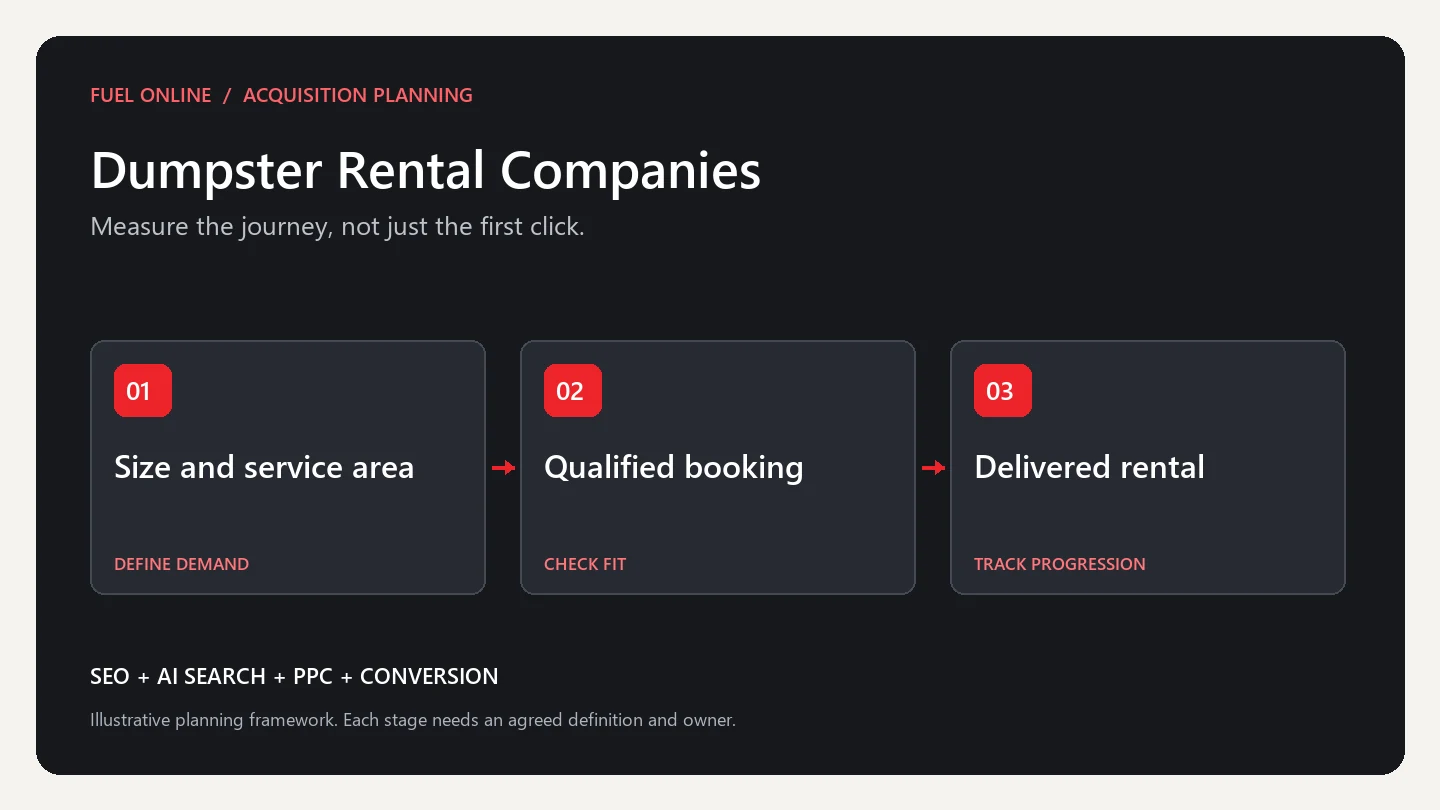
What the dumpster rental SEO agency scope needs to solve
The target is a buyer among homeowners, renovation contractors and commercial project managers who is trying to decide whether the provider can deliver the right container to the address, accept the material and meet the delivery and pickup window.
Keyword research therefore separates viable service and evaluation intent from prohibited materials, addresses outside delivery coverage, requests for unavailable sizes and price shoppers whose scope omits weight or placement constraints. Qualification follows the real sales handoff, not a traffic threshold. Fuel Online maps each priority query group to one page and one honest next step, reducing cannibalization and preventing a blog from competing with a transactional service page.
The first decision in a dumpster rental SEO agency engagement is whether the buyer, request and next step fit the business.
Decision map for dumpster rental SEO
The recommended architecture includes container sizes, cleanouts, renovation debris, roofing or construction uses, accepted materials, prohibited materials, delivery coverage and booking guidance.
A page is created only when the offer, audience, evidence or next step is meaningfully different. Briefs specify the buyer question, sources, reviewer, internal links and how the page supports this handoff: collect delivery address, material, estimated volume, placement conditions, delivery date and rental period before confirming the appropriate next step.
The page and handoff map makes dumpster rental SEO inspectable before production expands.
Operational requirements for dumpster rental SEO services
The technical backlog covers crawl paths, indexation, canonicals, redirects, templates, internal links, page speed and structured data that matches visible content. Local work aligns location facts and avoids doorway pages.
Fuel Online pairs those checks with actual container specifications, documented material rules, verified delivery coverage, placement guidance and authorized project images. Technical fixes receive a priority based on affected buyer paths and business value, not the size of an automated audit export.
The operating standard for dumpster rental SEO services names the approved source, reviewer and next buyer action.
Illustrative search example
This is an illustrative SEO decision, not a client result. The dumpster rental SEO choice is shown so a buyer can inspect the logic before approving similar work.
The SEO decision
A homeowner clearing household contents may need a smaller container and simple driveway placement. A roofer needs material and weight guidance, jobsite timing and repeat delivery coordination. For dumpster rental SEO, the team should assign each query group to a useful page, support the decision with approved evidence and connect the page to the right next step. The dumpster rental SEO agency plan should state why this is the first priority.
What the buyer can inspect
That distinction supports separate query groups, pages and calls to action without creating thin variations of the same copy. The decision record ties the dumpster rental SEO change to a dumpster rental SEO services deliverable, owner and release check.
How to audit a dumpster rental SEO agency plan
Use this framework when activity looks healthy but the commercial result is unclear. It turns a visible symptom into an evidence check, a bounded change and a deliverable the business can verify. The diagnostic for the dumpster rental SEO agency plan keeps the symptom, evidence check, action and output in one decision record.
1. Observable symptom
Dispatch reviews requests with prohibited material, an unserviceable address or no usable size and placement details.
2. What to inspect
Review the query, ranking page, internal links and resulting inquiry. Check whether the page answers the buyer's questions about delivery address, material type, container size needs, delivery date and placement constraints and supports its claims with actual container specifications, material restrictions, delivery coverage and authorized project images. This evidence check shows whether dumpster rental SEO reflects the real offer and handoff.
3. Decision and action
Improve or consolidate the page that owns the query. Add the missing decision information and approved evidence, correct technical access or internal links, and verify the published result.
4. Inspectable output
A verified query-to-page decision with the technical or editorial change, source owner, internal links, release check and reporting connection to qualified booking requests and completed bookings.
Deliverables and reporting for dumpster rental SEO services
Rankings, impressions, clicks and landing-page behavior explain discoverability. The commercial view follows qualified booking requests, completed bookings, cost per completed booking and revenue by container size and the rejection reasons recorded by the receiving team.
The monthly deliverable links each finding to a technical, editorial, internal-link or conversion action. When comparing SEO agencies, ask to see the proposed page map, review workflow, ownership model and method for connecting queries to accepted opportunities without pretending attribution is perfect.
For Dumpster Rental Companies, the SEO scope documents how delivery address, material type, container size needs, delivery date and placement constraints affect page, campaign or routing decisions. Before release, the assigned business reviewer checks actual container specifications, material restrictions, delivery coverage and authorized project images against every visible claim and records any dependency that remains unresolved.
The monthly review for dumpster rental SEO services compares completed work with accepted demand and identifies the next commercial decision.
- Query-to-page map for container sizes, cleanouts, renovation debris, roofing or construction uses, accepted materials, prohibited materials, delivery coverage and booking guidance
- Prioritized technical and indexation backlog
- Content briefs with evidence and reviewer requirements
- Internal-link plan connecting service, proof and next-step pages
- Monthly decision report tied to qualified booking requests, completed bookings, cost per completed booking and revenue by container size
How we measure dumpster rental SEO services
- qualified booking requests
- completed bookings
- cost per completed booking
- revenue by container size
Connect organic discovery to inquiry quality
Organic inquiry qualification rate = suitable organic inquiries ÷ organic inquiries reviewed.
Illustrative arithmetic: 12 suitable inquiries out of 20 reviewed organic inquiries is a 60% qualification rate. This measures inquiry fit, not search market share, and requires a recorded source and an agreed definition of suitable.
Agree on the baseline, data source and qualification criteria before comparing results. Separate visibility from inquiries and accepted business opportunities.
CONNECTED SERVICES
Choose the right next step for your business
Explore Fuel’s SEO capabilities, published campaign work and team to evaluate how we would support your organization.
BEFORE YOU CHOOSE AN AGENCY
Questions about dumpster rental SEO services
Where should a dumpster rental SEO agency plan start?
Start where the business can see a costly mismatch: dispatch reviews requests with prohibited material, an unserviceable address or no usable size and placement details. A dumpster rental SEO agency review should trace one real example from its source through the page or campaign and into the receiving team's disposition. Review the query, ranking page, internal links and resulting inquiry. Check whether the page answers the buyer's questions about delivery address, material type, container size needs, delivery date and placement constraints and supports its claims with actual container specifications, material restrictions, delivery coverage and authorized project images. The first dumpster rental SEO agency action should produce a named owner, a bounded correction and a release check rather than a broad activity list.
What does dumpster rental SEO include?
Dumpster rental SEO includes a query-to-page map, technical and indexation backlog, evidence-backed content briefs, internal-link decisions, release verification and downstream measurement. New pages are justified by a distinct offer, location or buyer decision; repeated place-name pages without unique facts are excluded.
How do we measure dumpster rental SEO services?
Agree on definitions and data sources for qualified booking requests, completed bookings, cost per completed booking and revenue by container size before launch. Channel metrics explain what happened upstream, while staff disposition and downstream stages show whether the work created demand the business could accept. Measure dumpster rental SEO services through the accepted commercial stages the receiving team can verify. Reporting for dumpster rental SEO services should show the source, stage definition, owner and limitation behind each decision metric.
What should a dumpster rental company ask before hiring an agency?
Ask who will perform the work, who owns the accounts and data, what is delivered in the opening execution sprint, how facts are reviewed, how rejected inquiries change the plan and which decision would cause the agency to pause or expand investment. Compare a dumpster rental SEO agency engagement with other proposals by inspecting the proposed work, account ownership and response to rejected demand.
Should we prioritize SEO or paid search first?
Choose based on the gap. Paid search can test controlled queries while budget is active. SEO develops useful pages and discovery over time. If the current site cannot explain fit or route an inquiry, repair that path before sending substantially more traffic from either source. For dumpster rental SEO, document access, approvals and handoffs across internal and agency roles.
What should we bring to an SEO review?
Bring access to search and analytics data, priority services and locations, examples of suitable and unsuitable inquiries, and available proof such as actual container specifications, documented material rules, verified delivery coverage, placement guidance and authorized project images. We can then discuss the page map, technical access, reviewers and a practical first release. A useful dumpster rental SEO services scope starts with current offers, capacity, evidence and examples of accepted and rejected inquiries.
Make your next agency conversation specific.
Tell us which services or markets matter to your dumpster rental business, which inquiries your team accepts, and where the current SEO program breaks down. Bring one accepted and one rejected example. Fuel Online will help identify the first page, campaign, answer or handoff worth changing. Use the working session to define one dumpster rental SEO services action with a source, owner, release check and downstream measure.
Talk with a Fuel strategist →